
Ask a lab team which part of a glove box installation was specified last, and the vacuum pump is usually the answer. It sits below the bench or behind a panel, runs for a few minutes at a time, and rarely features in conversations dominated by analyser ranges, purification columns and glove port dimensions. That habit is understandable, and it is also where a good deal of avoidable frustration begins, because the pump governs the pace of every operation that moves material across the boundary of the box.
An inert-atmosphere glove box is not airtight in the way a sealed ampoule is airtight. It is a working enclosure with doors, gloves, feedthroughs and ports that are opened regularly, and every opening represents an opportunity for room air to enter. The vacuum side of the system exists to reduce the consequences of that traffic, cycle after cycle.
Why the Vacuum Pump Deserves Its Own Specification
A vacuum pump is one of the few glove box accessories with a genuine gas-compatibility question attached. A unit that performs comfortably on nitrogen may behave differently on argon, and differently again on a stream carrying solvent vapour from a coated sample or fine powder from a milled material. Those differences affect service life, oil condition and, in the worst case, whether contamination travels upstream into the chamber.
There is also a specification problem. Pump catalogues are organised around pumping speed, ultimate pressure and inlet size, while glove box users think in terms of transfer time, atmosphere stability and maintenance intervals. The two vocabularies describe the same equipment from opposite ends, and the mismatch is why pumps are frequently oversized in one respect and undersized in another.
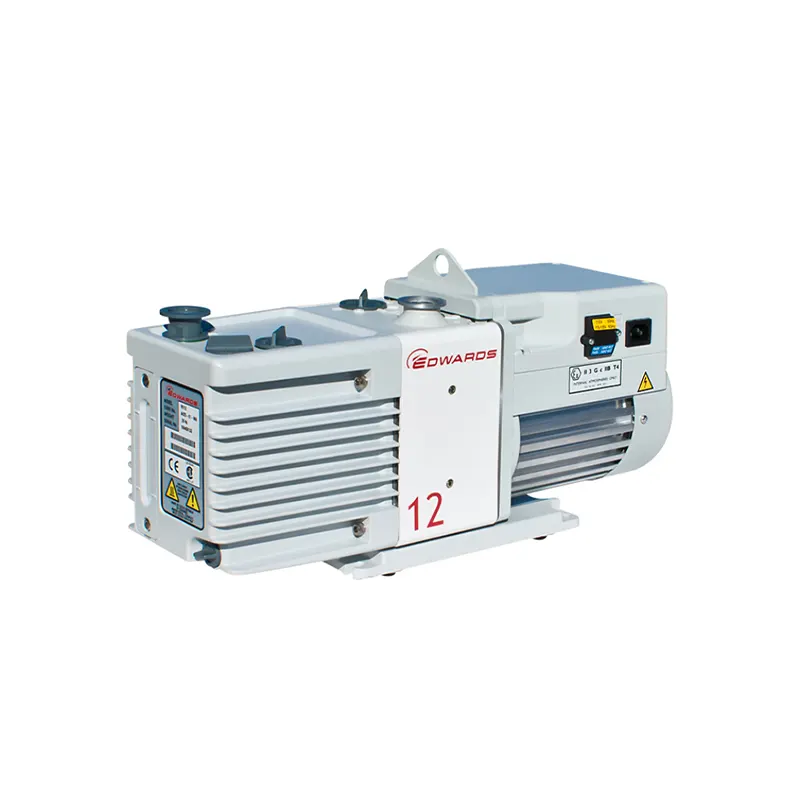
The Glove Box Vacuum Pump is an example of the category this discussion addresses: an accessory whose specification should be derived from the chamber it serves rather than selected from a general list of vacuum hardware. Everything that follows applies to that category, not to one model alone.
What a Glove Box Vacuum Pump Actually Does
It helps to separate three jobs that a single pump may perform on the same installation, because they have different duty profiles and different failure modes, and confusing them leads to the wrong diagnosis when something changes.
Antechamber evacuation before a transfer
The antechamber, also called the transfer chamber or airlock, is a small volume with an outer door facing the room and an inner door facing the inert atmosphere. Its operation is coordinated through a vacuum pump, a controlled vent and pressure sensing. The usual sequence is this: material is placed inside, the outer door is sealed, the chamber is evacuated, working gas is admitted to bring the pressure close to that of the main box, and the cycle may repeat. Only then does the inner door open.
The purpose is dilution. Each evacuation and refill replaces part of the residual air with working gas, and repeating the cycle reduces what is carried into the main chamber further, at the cost of time and gas. A pump that evacuates quickly but cannot be isolated cleanly, or whose inlet line is long and narrow, stretches that cycle and encourages operators to skip repetitions, which is often the moment atmosphere quality starts to drift.
Refill, purge and the three gas streams
The three gas streams in an inert-atmosphere installation should not be confused. Working gas is the atmosphere the sample lives in, typically nitrogen or argon depending on the material and the process. Control gas drives pneumatic valves, regulators and sometimes the analyser circuit at the pressure those instruments expect. Regeneration gas is consumed periodically to restore purifying material, a process involving heat and a defined flow that is entirely separate from routine evacuation. The vacuum pump belongs to the first category in the sense that it empties space that working gas later fills. It does not purge, and it does not regenerate anything.
Vacuum pump versus gas purification
The most common conceptual error in glove box discussions is to treat the vacuum pump as part of the atmosphere conditioning chain. It is not. A purification system circulates the working atmosphere in a closed loop through material that removes moisture and oxygen continuously, with monitoring and regeneration as part of its own cycle. A vacuum pump removes bulk air from a sealed chamber before that air reaches the main working volume.
Both functions are necessary, and neither substitutes for the other. A powerful pump will not lower the moisture level of the main chamber, and a well-maintained purification loop will not compensate for a transfer routine that dumps fresh air into the box several times an hour. This boundary is the foundation for every selection decision that follows.
How Pump Duty and Antechamber Design Interact
Because the pump's task is defined by the chamber, the specification conversation should start there rather than with a pump catalogue.
Volume, cycle frequency and throughput
A small antechamber cycled a few times a day asks very little of a pump. A large transfer chamber, a load-lock that accommodates tooling, or a multi-port configuration shared by several users asks much more: each cycle has more gas to remove, and cycles may overlap. The relevant question is not only how long one evacuation takes, but how many evacuations per hour occur at peak and whether the pump runs continuously or intermittently.
Pumping speed matters, and so does the conductance of the path between chamber and pump. Short, wide, well-routed lines with few bends let rated performance reach the chamber. A pump that looks generous on paper but is throttled by a narrow hose behaves like a smaller pump, and the operator experiences it as a machine that takes forever, with no obvious fault to report.
Working pressure, ultimate vacuum and leakage
Several vacuum-related numbers circulate in glove box conversations, and they describe different things. Treating them as interchangeable produces specifications that cannot be met and performance judgements that are simply wrong.
| Quantity | What it describes | Where it originates |
|---|---|---|
| Box working pressure | The slight positive pressure maintained in the main chamber during operation | Main chamber and its pressure control |
| Antechamber vacuum | The pressure reached in the transfer chamber during an evacuation step | Antechamber volume, seals and the pump |
| Pump ultimate vacuum | The lowest pressure the pump itself can approach under defined, no-load conditions | Pump specification |
| Leak rate | How quickly pressure rises in a sealed, isolated volume | Seals, doors, gloves and feedthroughs |
| Oxygen and moisture content | Residual reactive species in the working atmosphere | Purification loop, analyser and operating discipline |
Only one row of that table belongs to the pump alone. A high leak rate defeats a good pump, and a mediocre pump is rarely rescued by excellent seals. Diagnosis therefore starts by isolating which quantity is actually off target, rather than by replacing the component that is easiest to blame.
Where the numbers are implemented matters as much as their values. A system that keeps the inner door locked until the antechamber has returned to working pressure, and that counts evacuation cycles rather than relying on operator memory, delivers more consistent results than one that leaves the sequence to habit. Interlocks and cycle counting are configuration choices, and they belong in the specification alongside the pump itself.
Gas Compatibility, Contamination and Service Life
Argon, nitrogen and pumping behaviour
Working gas choice is driven by the material, not by the pump, but the pump feels the difference. Gases vary in molar mass and in how they behave through compression and exhaust, and some designs handle one gas more comfortably than another. After a conversion from nitrogen to argon, or during leak testing with helium, achievable pressure and pump behaviour may change. These are questions for the pump supplier, answered against the specific gas and duty, not inferred from a general vacuum rating.
Solvent vapour, condensables and the case for adsorption
Samples coated with solvent, or processes that release volatile species inside the antechamber, put condensable vapour into the evacuated stream. Many pump designs handle condensables poorly: lubricant can be diluted or degraded, the exhaust path can accumulate deposits, and vapour can migrate back toward the chamber when the pump stops. That is one reason solvent adsorption is often discussed alongside the vacuum side of a glove box.
Precision is useful here. Solvent adsorption targets organic vapour; it does not remove oxygen or moisture from the working atmosphere, and it does not replace a purification loop. Its role is protecting the vacuum path and limiting condensable contamination rather than conditioning the atmosphere.
Oil-lubricated and dry vacuum technologies
Broadly, pumps used in this role divide into lubricated rotary-vane designs and dry, oil-free designs. Lubricated pumps have a long record in laboratory service and usually offer strong performance per unit cost, but they demand attention to oil condition, exhaust filtration and the risk of backstreaming if a cycle is interrupted or the pump is used outside its intended regime. Dry pumps keep oil out of the swept volume and simplify several contamination questions, with a different cost and service profile.
Neither technology is universally better. The deciding factors are the gas stream, the presence of condensables, the maintenance interval the site can realistically sustain, and whether the pump sits in an area where oil mist is unacceptable.
Particles, powders and upstream protection
Powder handling is why many users first think about filtration. If an antechamber is used to move fine powders, some fraction can be carried toward the pump on the exhaust stroke. A particle filter on the vacuum side protects the pump. It does not protect the working atmosphere, because particle filtration and moisture removal are different functions, and the distinction matters whenever contamination is reported and the evidence points to dust rather than humidity.
Where a Purification System Fits, and Where It Does Not
The vacuum pump rarely works alone in a contemporary installation. Continuous atmosphere control is handled by a purification system, and it is worth describing that role accurately without assuming that any given pump and any given purification unit belong together.
Closed-loop purification cabinets
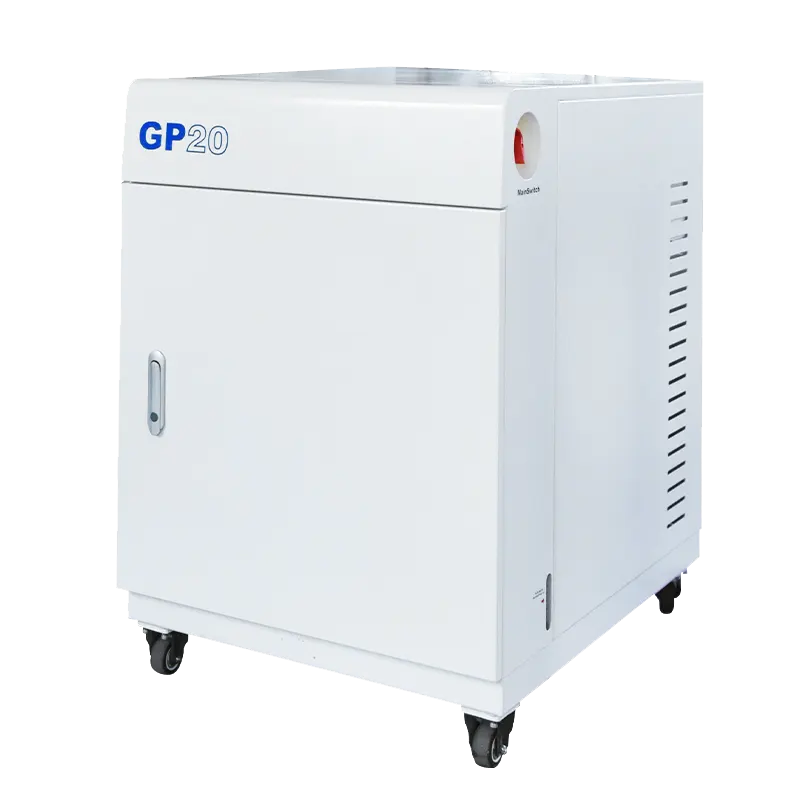
A purification cabinet such as the GP20 Gas Purification System Cabinet is a standalone unit that circulates gas through purifying material in a closed loop with compatible sealed enclosures or process equipment. Its functions are circulation, removal of moisture and oxygen, monitoring and periodic regeneration of the purifying material. It is not a glove box: it contains no working space for an operator and does not by itself provide an inert environment for a sample.
Why the vacuum pump is not a purification device
Because both pieces of equipment sit on the same bench and both are described with vacuum and pressure language, they are sometimes confused. The confusion produces two characteristic mistakes. The first is expecting the pump to lower moisture and oxygen content in the main chamber: it cannot, because those species are removed by contact with purifying material in a circulating loop rather than by evacuation. The second is expecting the purification cabinet to absorb the consequences of careless transfer practice. It can, but only at the cost of faster saturation and more frequent regeneration.
Compatibility is a question, not an assumption
Nothing in that arrangement implies that a particular pump is the right match for a particular cabinet or chamber. Compatibility has to be checked on several levels: the pressure ranges each unit is designed for, the gas type, where the pump exhausts, whether control signals and interlocks exist, and how the pump is isolated when it is not running. A pump that suits one enclosure may be unsuitable for another because of volume, gas or control architecture. Where the answer is not documented, the right move is to obtain confirmation from the supplier rather than to infer compatibility from product names or from the fact that two items are sold by the same company.
Slow Recovery and Other Symptoms: Reading the Evidence
Most vacuum-related complaints arrive as symptoms rather than as failed components. Separating the indicators listed earlier is useful precisely because each symptom narrows the field of possible causes without requiring a guess about a specific machine.
The antechamber takes longer than it used to
If an evacuation step that once completed quickly now drags, the most likely explanations sit on the vacuum side rather than in the pump's fundamental capability. A door seal that has hardened, a glove that has begun to permeate, or an O-ring contaminated with powder will admit gas nearly as fast as the pump removes it. Long evacuation times often come with a pressure that stalls at a plateau instead of continuing to fall, which points to a leak or to a vapour load rather than to pump wear. If the pump has run for months with condensable vapour, degraded lubricant or a fouled exhaust filter can also reduce performance, and a service inspection is the appropriate response.
Water and oxygen readings climb after a transfer and recover slowly
This symptom has two possible home territories. If readings rise sharply on every transfer and take a long time to return, transfer practice is the first suspect: too few evacuation and refill cycles, an inner door opened before the chamber has returned to working pressure, or a vent valve that admits gas so quickly that residual air is stirred into the main volume. If readings rise without any transfer taking place, the vacuum side is unlikely to be responsible, and analyser calibration, purification loop status and overall leak rate deserve attention first.
Recovery time is a useful diagnostic because it reflects the balance between how much contamination entered and how much capacity the purification loop has available. Short cycles with a high residual air load gradually consume that capacity, so each recovery looks slower. Operators often describe this as the box getting worse, when what changed was the transfer routine.
Readings that never settle despite continuous circulation
When circulation runs properly and the analyser is healthy but moisture or oxygen will not fall to the expected level, the search shifts to sources that bypass the purification loop: a leaking feedthrough, a damaged glove, an unsealed port, a sample that is outgassing, or a solvent source the loop is not designed to handle. In this situation the vacuum pump is generally a bystander, and its only relevance is whether the antechamber path adds a fresh air load on every transfer.
What an analyser does and does not tell you
An oxygen or moisture analyser measures the atmosphere; it does not purify it, and it says nothing directly about the vacuum side. Its range, resolution and calibration determine how confidently small changes can be interpreted, and resolution is not accuracy. Two analysers with the same resolution can disagree on absolute values, which matters whenever readings are used as evidence about pump performance.
A Specification Checklist for the Vacuum Side
Before requesting a quotation for the glove box vacuum pump, it helps to assemble the information that actually determines the answer. The same list works as a pre-installation review for a system that is already running.
Information to provide to a supplier
- Chamber volumes to be evacuated: antechamber, load-lock and any additional sealed volume served by the same pump.
- Required evacuation time per cycle and the number of cycles per hour at peak use.
- Working gas, plus any gas used for leak testing or special processes.
- Whether the evacuated stream can carry solvent vapour, moisture or fine powder.
- Pressure range over which the pump will operate, and whether it will be valved off or run continuously.
- Exhaust destination and any facility constraints on noise, heat or oil mist.
- Whether the pump must be interlocked with doors, valves or the control system of the enclosure.
- Maintenance access and the service interval that is realistic for the site.
Points to confirm rather than assume
- Ultimate vacuum figures are pump-level values under defined conditions; they are not a promise about the pressure your antechamber will reach.
- Pumping speed at the pump inlet is not the same as effective speed at the chamber; line length, routing and diameter matter.
- Antechamber pressure, box working pressure and leak rate are separate quantities with separate causes.
- Solvent adsorption protects the vacuum path; it does not remove oxygen or moisture from the working atmosphere.
- Particle filtration is not atmosphere purification.
- A purification cabinet and a vacuum pump perform separate functions and are not interchangeable or automatically compatible.
Matching the pump to the way the box is actually used
The final judgement is operational. A research group transferring a few sealed samples a day needs a different duty profile from a facility running production-adjacent work with frequent load-lock cycles and solvent-bearing parts. The accessory that suits the second case may be oversized and inconvenient for the first, while the accessory that suits the first will frustrate the second through slow cycles and shortened service intervals.
Where documentation does not settle a question, whether that is gas compatibility, achievable pressure under real load or control integration, the correct step is to ask the equipment supplier with the full set of application details in hand. A specification that begins with the chamber, the gas and the duty cycle holds up far better than one that begins with a catalogue page.
