
Start With the Sample and the Duty Cycle, Not the Chamber
Most glove box requests arrive as a single sentence: we need an inert atmosphere. The engineering problem underneath is narrower and more specific. Two samples that both oxidize in air can require completely different hardware, because what separates them is not whether they are air-sensitive but how much contamination they tolerate and for how long. A freshly exposed lithium metal surface, a perovskite precursor, or a reduced catalyst can change within minutes at parts-per-million oxygen and moisture levels. A dried powder, a sealed component, or a specimen that is only briefly handled during mounting may tolerate considerably more exposure than the researcher assumes when writing the specification.
That distinction decides the atmosphere strategy. One strategy keeps a sealed enclosure under continuous treatment: gas circulates in a closed loop through purifying material, and oxygen and moisture are removed as they appear. The other strategy removes contamination by dilution. The chamber is evacuated and refilled with inert gas, repeatedly, so the residual air fraction falls with each cycle. The GBV-2 Stainless Steel Vacuum Glove Box belongs to the second family, and its published listing describes it as a vacuum glove box rather than a continuously purifying system. That difference is not administrative. It determines what the enclosure can promise, what the operator has to do between experiments, and which auxiliary items are worth buying.
Before comparing port counts, antechamber sizes, or accessory lists, write down three answers: the acceptable oxygen and moisture window for your most sensitive step, the number of transfers you expect per day, and whether the box must hold its atmosphere overnight or across a weekend without an operator present. Those three answers eliminate most unsuitable configurations before any quotation is requested, and they also tell you whether a purge-based enclosure is the right architecture at all.
A useful first comparison
The table below contrasts the two architecture families in general terms. It describes principles, not guaranteed performance for any specific model, because the achievable result depends on the individual chamber, seals, pump, and operating discipline.
| Requirement | Vacuum / evacuation-and-backfill enclosure | Closed-loop purifying enclosure |
|---|---|---|
| Atmosphere mechanism | Repeated pump-and-refill cycles dilute residual air | Continuous circulation through purifying material |
| Typical best fit | Intermittent handling, solvent or chemical work, samples tolerant of cycle-level contamination | Frequent daily access, long unattended holds, continuously low readings |
| Operator burden | Running and documenting cycles, maintaining transfer discipline | Monitoring readings, regenerating or replacing purifier material |
| Common weak points | Seals and elastomer permeation, surface outgassing, antechamber practice | Purifier saturation, loop leaks, analyzer drift |
| What to verify | Chamber vacuum capability, seal materials, pump matching, leak rate | Purifier capacity, regeneration gas supply, monitoring range and calibration |
How Evacuation and Backfill Build a Working Atmosphere
The physics is dilution, and it is worth understanding because it explains why two boxes with similar dimensions can behave very differently. If a chamber filled with air is pumped down to a fraction of atmospheric pressure and then refilled with argon or nitrogen to slightly above atmospheric, the remaining air is diluted in roughly the same ratio as the residual pressure to the refill pressure. Two real-world effects make the outcome worse than the ideal calculation: gas desorbing from interior surfaces, and air entering through leaks, door seals, and elastomer permeation during the pumpdown and refill sequence.
Water is the more stubborn of the two contaminants. It adsorbs onto stainless steel and glass surfaces and diffuses into elastomer seals, then desorbs slowly over hours. This is why a box that reads acceptably immediately after a cycle can drift upward when it sits closed overnight: the interior surfaces are returning what they previously adsorbed. Aluminum and polymer interior furniture, cardboard, paper labels, and unsealed powders all add to that reservoir, so material discipline inside the chamber matters as much as the vacuum pump.
Why cycles reduce concentration geometrically
Each pump-and-refill step multiplies the impurity fraction by a factor related to the pressure ratio achieved. As an idealized illustration, if a chamber is evacuated to one tenth of atmospheric pressure and refilled, the oxygen concentration is reduced by roughly one order of magnitude per cycle, starting from the oxygen content of air. Two or three such cycles therefore move the calculation by factors of hundreds to thousands, which is why purge-based boxes can be perfectly usable for many air-sensitive tasks. The illustration deliberately ignores desorption and leakage; in practice the measured result approaches a floor set by those effects rather than reaching the idealized value.
The practical consequence is that the final concentration is not the only number that matters. What matters is the contamination present during the first minutes of manipulation, after a transfer has occurred, and how quickly the level returns afterward. A box whose readings recover slowly after every transfer will feel unreliable to the operator even if its best-case reading looks acceptable on paper.
Where purge-based control reaches its limit
Because there is no circulating purifying loop, an evacuation-and-backfill enclosure does not continuously remove contaminants that appear between cycles, and it does not hold a low residual level while held closed for extended periods. If the application demands a continuously maintained low-parts-per-million environment during hours of uninterrupted manipulation, a closed-loop purification architecture is the honest answer. That can take the form of a box with an integrated purifier or a separate purifying unit connected to a compatible sealed enclosure.
Whether a specific enclosure can be connected to an external purifying unit is a configuration question, not a category question. The connection point, the circulation path, the pressure regime, and the monitoring arrangement all have to be compatible, and that compatibility should be confirmed against the actual configuration rather than inferred from a product family name. If solvent vapors are part of your process, keep in mind that solvent adsorption addresses vapors only; it does not substitute for moisture and oxygen control, and a particulate HEPA filter removes particles rather than water or oxygen. Those functions are separate and should be specified separately.
The GBV-2 Platform: What to Verify Before You Specify
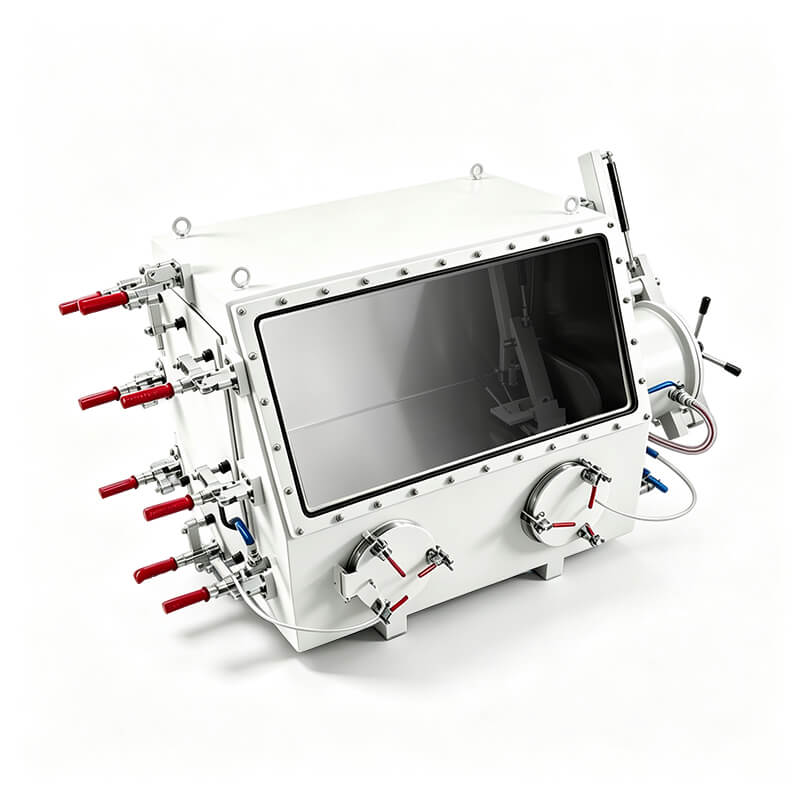
The GBV-2 Stainless Steel Vacuum Glove Box is a stainless steel enclosure in the vacuum family. Stainless steel construction matters for vacuum duty in ways that go beyond ruggedness: it tolerates repeated evacuation without the flexing that plastic walls experience, it resists many solvents and cleaning agents, and it does not scratch into a permanently hazy surface. The trade-off is transparency. The operator's view comes through a window or viewport, so interior lighting and sightlines have to be designed rather than assumed, and that affects how comfortable long manipulations will be.
Acrylic enclosures, by contrast, offer better all-round visibility and lighter construction, but the grades used for clean-looking boxes generally do not support the same vacuum duty, and their chemical compatibility with aggressive solvents has to be checked case by case. Vacuum capability, the presence of an antechamber, and the presence of any purification equipment vary by model and wall construction, so those capabilities must be read from the specific specification sheet rather than assumed from the word glove box on a catalog page.
Port arrangement and working reach
Port count and port placement follow the workflow, not the other way around. A single-operator bench setup usually needs one comfortable working position with a glove reach that covers the entire useful floor of the chamber. A double-sided enclosure lets two people work from opposite faces, which is valuable when a procedure needs four hands, when a supervisor must watch a delicate transfer, or when two instruments sit at different ends of the chamber. Multi-station layouts trade interior volume and gas load against the number of people who can work simultaneously.
Whatever the layout, ask for the interior dimensions, the port diameter, the glove length and thickness, and the cuff size, and check them against the actual reach of your shortest and tallest operators. A box that is perfectly adequate on a drawing can be tiring to use if the gloves are too short for the far corners, and a glove that is difficult to work in encourages shortcuts that cost you atmosphere quality later.
The antechamber decides your cycle economics
The antechamber, or transfer chamber, is the component that most directly determines how much contamination enters the box during normal use. Every transfer introduces a slug of air proportional to the antechamber volume and to the pressure remaining after pumpdown. A small antechamber pumps down quickly and introduces less air per event, but it accepts fewer or smaller items at a time. A larger antechamber reduces the number of transfer events for bulky equipment but costs more time per cycle and more gas per cycle.
The pump that serves the antechamber also has to be matched to it. The relevant pump properties are the ultimate vacuum it can reach, its pumping speed at the pressures where most of the air is removed, and its tolerance for the gas load involved. Oil-sealed rotary vane pumps reach good vacuum economically, but backstreaming of oil vapor into the chamber is a real risk if the pump is poorly managed. Dry pumps avoid that risk but generally cost more and may have different ultimate pressure characteristics. Ask how the pump is isolated when the antechamber is backfilled, and how the exhaust is routed.
Interior equipment, ports, and feedthroughs
Most labs eventually want something inside the box that was not in the original specification: a hot plate, a spin coater, a balance, a microscope, a light source, or a small furnace. Each of those adds outgassing, cabling, and often a dedicated feedthrough. Electrical and signal feedthroughs, KF vacuum interfaces, gas inlet and vent lines, and analyzer ports are configuration items, so the port schedule should be documented in writing before the order is placed. This is also the point at which it becomes clear whether the enclosure has enough spare ports for future work, because adding a feedthrough after delivery is far more disruptive than including it at the start.
Questions the product page cannot answer for you
A catalog listing identifies a model and its class; it does not tell you how that model will behave with your samples, your chemicals, and your transfer frequency. Before committing, obtain written answers to these: What vacuum level is achievable in the main chamber under normal operating conditions, and how is it measured? What leak rate is considered acceptable, and with which test method? Which elastomer is used for door seals and glove port seals? Which internal surfaces and furniture materials are exposed to the atmosphere? Which accessories are supported on this enclosure, and which are not recommended? Without those answers, any comparison between models is guesswork.
Glove Port Sealing Rings and the Real Leak Budget
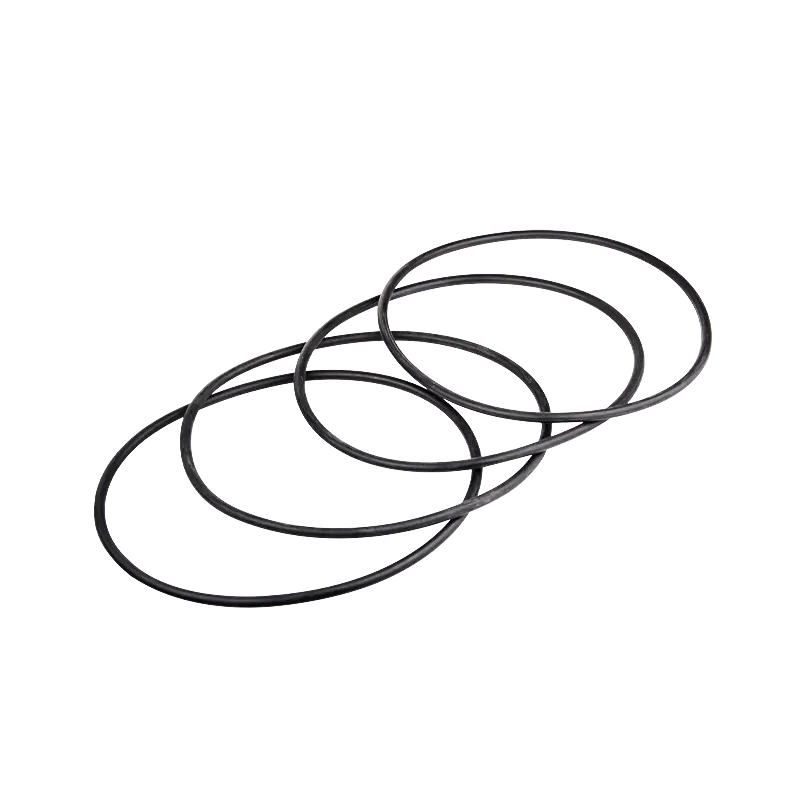
The glove port sealing ring is one of the least expensive items on a glove box and one of the most consequential. In a vacuum enclosure the seal experiences the full pressure differential during every pumpdown and every cycle, not merely the small differential of a continuously purged box held near ambient. That repeated mechanical and pressure cycling is what makes seal material and fit worth attention rather than a footnote on the order.
The ring does two jobs at once. Mechanically, it retains the glove bead against the port flange so the glove cannot be pulled free during a manipulation. As a barrier, it closes the gap between glove and flange so air cannot migrate into the chamber along the interface. If it fails mechanically, the glove releases mid-task, the box loses atmosphere immediately, and the operator has to re-seat everything before work can continue. If it fails as a barrier, the loss is slower and easier to miss: air enters continuously at a rate that depends on the differential and the geometry of the leak path, and the readings drift in a way that is easy to blame on the pump or the purifier.
Selection factors that actually change performance
Elastomer families differ in gas permeation, solvent resistance, temperature range, and compression set, and those four properties drive most of the relevant decisions. For vacuum service, low compression set and low permeation of oxygen and water vapor are the priorities, because a material that takes a permanent set stops applying sealing force after a number of cycles. For laboratories working with aggressive solvents or vapors, chemical compatibility dominates instead, because a swollen or degraded ring loses both its sealing force and its shape. Where gloves are changed frequently, hardness and groove geometry matter more, since the ring has to hold a glove bead securely without distorting it.
Confirm which material is supplied as standard for the port you are ordering, then compare it against your chemical inventory. If the standard material is not compatible with the solvents you plan to use, ask for an alternative rather than accepting the default and replacing rings on a short interval. Chemical compatibility tables from the elastomer supplier are the appropriate reference here, and the glove material itself deserves the same scrutiny, since a glove and a seal made of differently compatible materials will not fail at the same rate.
Fit, cleanliness, and installation
Fit is as important as material. A ring that is undersized for the port and glove bead cannot generate enough compression to seal reliably. A ring that is too thick or too stiff can distort the glove bead, prevent the assembly from seating fully, or make the glove uncomfortable and difficult to insert. The sealing surfaces themselves should be clean and undamaged before installation; a single particle trapped on the flange creates a leak path that no amount of tightening will close, and a scored metal flange will leak even with a new ring.
Install gloves without twisting them. A twisted bead concentrates stress at one point on the ring, ages that area faster, and often creates a small leak that only appears under vacuum. When the assembly is complete, a brief isolated pressure-rise check on the antechamber or chamber is a quick way to confirm that the glove and seal are seated before the box is put back into service.
When to replace a sealing ring
Treat the ring as a scheduled consumable rather than a part that fails only when something goes obviously wrong. Warning signs include gloves that slide or twist in the port, visible cracking, whitening, or swelling of the elastomer, a chamber that takes noticeably longer to reach its usual vacuum, and moisture readings that climb faster than they used to after a normal cycle. Keeping spare rings on the shelf is inexpensive insurance, because a lab that has to wait for a replacement ring will usually keep working with a degraded seal, and the resulting readings will be blamed on something else. The glove port sealing ring is a small line item, but its condition sets the floor on everything the vacuum system can achieve.
Transfer Discipline: Where Contamination Actually Enters
In a vacuum glove box, the transfer sequence is the main route by which contamination enters the working volume. The standard sequence is: place the item in the antechamber, close and seal the outer door, pump the antechamber to the target pressure, backfill with working gas, repeat if the sample is very sensitive, then open the inner door. The number of pump-and-backfill cycles trades time against cleanliness, and that trade should be decided per sample class rather than applied uniformly out of habit.
Porous items deserve special thought. Powders, fabrics, filter papers, and porous ceramics hold air inside their structure, and that air is released into the chamber over the minutes and hours after the transfer, long after the antechamber cycle appears complete. Pre-drying, vacuum degassing inside the antechamber, or transferring such items in sealed containers reduces the effect. Sealed containers also help when a sample must travel between sites, provided the container itself is opened under the atmosphere you intend to protect.
Pressure steps and mechanical disturbance
Pressure changes move things. Gloves behave like flexible membranes: when the chamber pressure changes relative to the room, they balloon inward or outward, and that motion can knock over a sample holder or disturb a freshly prepared film. Opening an inner door against a large differential produces a rapid airflow that can loft powders and shift light objects. Ramping pressures gradually, and equalizing before an inner door is opened, avoids most of these events. The same reasoning applies to valve sequencing: opening the vent before the pump line is closed, or the reverse, produces unnecessary pressure spikes and pulls particles into lines where they later cause leaks.
Why readings can recover slowly after a transfer
A slow return to the previous reading after a transfer has several possible causes, and it is worth distinguishing between them before concluding that hardware has failed. Surface desorption is the most common benign explanation: water released from walls and furniture during the transfer has to be removed again, and the process takes time. Glove permeation and door seal condition are the next candidates, particularly in older installations or after a solvent exposure. A saturated or exhausted purifier explains the behavior only where a purifier is present, and it should not be assumed on an enclosure that does not have one.
Instrumentation and sampling paths also contribute. A moisture analyzer fed by a long polymer sampling line can report values influenced by the line itself rather than by the chamber, and a sensor that is due for calibration can drift in one direction over weeks. The reasonable diagnostic order is: isolate the box and observe the rate of change with nothing else happening, compare the reading against a second measurement method or a second location, inspect seals and door gaskets, then review the instrument's calibration status. Without that evidence, attributing the behavior to a specific component is guesswork.
Instruments and Units: Reading the Numbers Honestly
Glove box specifications mix several quantities that are not interchangeable, and comparing them carelessly leads to bad purchasing decisions. Chamber working pressure describes the enclosure during operation. Antechamber vacuum describes what the transfer chamber reaches during a cycle. Pump ultimate vacuum describes what the pump can reach on a closed, clean, empty system, and is never the same as what a loaded chamber achieves. Leak rate describes how fast pressure rises in an isolated volume, usually expressed per unit time. Oxygen and moisture concentrations describe the composition of the gas in the working volume, usually in parts per million.
Units compound the problem. Pressure may appear in pascals, millibars, torr, or inches of mercury; leak rate may appear in millibar liters per second or pascal cubic meters per second; water content may appear as a dew point, as parts per million by volume, or as a percentage. A number without its unit and its measurement conditions cannot be compared with a number from another datasheet. Where a specification seems internally inconsistent, or where the configuration behind a value is unclear, the useful move is to ask for the measurement conditions rather than to accept the figure into a comparison table.
Resolution is not accuracy
An analyzer that displays values to two decimal places is not necessarily accurate to that resolution. Resolution describes the smallest change the instrument can display; accuracy describes how close the displayed value is to the true value, and it depends on calibration, sensor age, temperature stability, and the sampling arrangement. Ask for the calibration interval, the reference standard used, and the recommended verification procedure. For moisture measurement especially, the sampling point, line material, and line length influence what the instrument sees, so two analyzers reading the same chamber through different plumbing can legitimately disagree.
Leak rate testing in practice
A simple pressure-rise test is a practical way to monitor enclosure condition over time. Evacuate the chamber or antechamber, isolate it from the pump, record the pressure at the start, wait a defined interval, and record it again. The change over that interval, multiplied by the volume and divided by the time, gives a leak rate. Because the result depends on volume and temperature, comparisons are only meaningful when the same volume, the same starting pressure, and similar temperatures are used, which is why documenting the procedure matters more than the headline number. A rising leak rate over months usually points to seals, gloves, or fittings rather than to the pump.
Configuration Checklist Before You Order
Use the following list as the working document you send to the supplier. It is designed for a vacuum-type enclosure of the GBV-2 class, and it also serves as a comparison framework if you are still deciding between a purge-based and a purification-based architecture.
- Sample classes and their acceptable oxygen and moisture windows, stated per process step rather than as a single blanket figure.
- Required internal dimensions, working positions, and the number of operators who must work simultaneously, from one or both sides.
- Port count, port diameter, glove length and thickness, cuff size, and the glove material's chemical compatibility with your process.
- Expected transfers per day and the largest item that must pass through the antechamber, since that determines antechamber volume and pumpdown time.
- Chamber vacuum capability, antechamber vacuum capability, and leak rate, each with its test method and measurement conditions.
- Pump type, pumping speed, ultimate vacuum, oil backstreaming protection, and exhaust routing.
- Seal materials for doors and glove ports, their chemical compatibility with your solvent list, and recommended replacement intervals.
- Interior equipment list with power, signal, and gas requirements, plus the feedthrough and port schedule needed to support them.
- Monitoring instruments, their ranges, resolutions, accuracy statements, calibration intervals, and sampling locations.
- Whether any continuous purification is present, and if not, what a future connection to an external purifying unit would require.
- Particle filtration, solvent vapor adsorption, and cooling needs stated as separate functions, with recognition that each addresses a different contamination problem.
Answering those points takes an afternoon of work, and it prevents the more expensive mistake of buying an enclosure whose architecture cannot deliver the atmosphere your samples need. If the answers point toward a purge-based design, the discussion can move directly to chamber geometry, seals, and transfer practice, because those are the variables that will set your working limits every day. If they point toward continuous purification, the conversation shifts to purifier capacity, regeneration, and monitoring, and the enclosure becomes one part of a larger gas-handling system. Deciding which conversation you are having, before any model number is chosen, is the single most useful step in the specification process.
