
Air-sensitive powders rarely fail in a dramatic way at the start. They fail quietly: a sample picks up moisture during weighing, a transfer introduces oxygen, or fine dust migrates to a surface where it changes the next experiment. For sulfide solid electrolyte powders used in solid-state battery research, the weighing and transfer stage is therefore a genuine equipment-selection problem, not a routine bench step. The objective is to keep the powder representative of its stored state while giving the operator controlled access, cleanable surfaces, and a documented transfer path.
This guide examines that stage as an application analysis rather than a customer case study. It starts with the material and process requirements, then applies them to documented TENCAN equipment: the GBV-3 Stainless Steel Vacuum Glove Box and the Small Glove Box Antechamber. The same framework can be used to evaluate an international alternative, provided the comparison uses verifiable product data rather than brand reputation.
A glove box is an umbrella term, not a performance specification. A sealed acrylic box, a stainless steel vacuum glove box, a glove box connected to an independent gas purification system, and a simple transfer chamber are not interchangeable. Each addresses a different part of the problem. The selection question is which combination gives the required atmosphere, transfer control, operator access, and documentation for the actual powder and workflow.
The material challenge: sulfide electrolyte powder at the weighing stage
Sulfide-based solid electrolytes are attractive because of their ionic conductivity and mechanical processability, but those advantages also make them sensitive to handling. Many sulfide electrolytes react with moisture, and some can release hydrogen sulfide when exposed to water or humid air. The first selection input is therefore not a glove box catalogue; it is the material safety data sheet, the laboratory exposure-control assessment, and the site's requirements for gas detection and ventilation. A glove box can support a controlled atmosphere, but it should not be treated as a substitute for a proper safety review.
The powder itself creates several practical issues. Fine particles have a high surface area, so they can pick up moisture quickly. They may become electrostatically charged, adhere to gloves and windows, and agglomerate during weighing. Fine dust can migrate into corners and contaminate the next sample. At the same time, the sample quantity may be small, which makes losses and inconsistent weighing significant. The equipment has to support careful, repeatable handling rather than simply enclose the powder.
The process usually includes receiving and opening the container, sampling, weighing, possible sieving or subdivision, and loading into a measurement or cell-assembly step. Every time an item enters or leaves the main chamber, the atmosphere is disturbed. Every open container is an exchange opportunity. The most effective configuration is often the one that reduces the number of transfers and makes each transfer more controlled, not the one with the largest chamber or the most accessories.
It is also important to separate three functions that are sometimes conflated in procurement discussions. Inert gas filling displaces air, but it does not by itself provide continuous moisture and oxygen control. Vacuum in an antechamber helps remove air before entry, but the achievable vacuum and leak rate depend on the actual build. A gas purification system can maintain a low-moisture, low-oxygen atmosphere, but it is a separate subsystem with its own capacity, regeneration, and monitoring requirements. The word “inert” on a quotation is not evidence of a particular atmosphere performance.
Selection criteria that matter more than the label “glove box”
A useful selection process begins with the target atmosphere and the measurement method. If the laboratory needs a specific moisture or oxygen level, that target, the instrument used to verify it, and the recovery time after a transfer should all be stated in the inquiry. Without those details, two suppliers can quote the same box with very different assumptions. The target should be based on the material's sensitivity and the experimental requirement, not on a generic number copied from another project.
The second criterion is the transfer path. Small, frequent entries are different from occasional large equipment entries. A small antechamber can be convenient for vials, tools, sample boats, and small fixtures, while a larger chamber may be needed for a balance, a press, or a bulky cell fixture. The right choice depends on the item list and the acceptable cycle time. A dedicated small antechamber is not a continuous purifier and does not replace the main chamber's atmosphere control.
The third criterion is material compatibility and cleanability. Stainless steel is common in dry powder glove boxes because it is mechanically durable and can be cleaned, but no material is universally compatible with every powder, solvent, or cleaning agent. The interior finish, corners, window seals, glove material, and cleaning procedure all affect cross-contamination. For sulfide powders, the cleaning method should be agreed with the supplier and with the site's safety team. A smooth, accessible interior is more useful than a list of nominal features if powder can hide in difficult corners.
Ergonomics is the fourth criterion, and it is often underweighted. Weighing inside a glove box requires the operator to see the balance display, reach the sample container, and manipulate a spatula without excessive glove movement. The chamber height, window angle, glove-port position, and balance footprint all matter. A box that meets an atmosphere target but makes weighing awkward may produce more variability than a simpler box with better access. The balance should be selected for the chamber environment, and its dimensions should be checked before the glove box is ordered.
Pressure control, gas supply, safety monitoring, and documentation complete the list. Rapid pressure changes can disturb a light powder or affect a balance. The gas supply must be compatible with the intended atmosphere and available at the required purity. Gas monitoring ports, exhaust connections, and alarm integration should be planned with the site's environment, health, and safety team. Finally, the quotation package should include general-arrangement drawings, leak-test information, utility requirements, material certificates where relevant, and the scope of commissioning and training.
| Selection factor | Why it matters | Suitable documented feature |
|---|---|---|
| Inert atmosphere and moisture control | Sulfide powder can react with moisture; achievable performance depends on seals, purifier, and protocol | GBV-3 is documented as a stainless steel vacuum glove box; request the target atmosphere, measurement method, and purifier scope from TENCAN |
| Transfer airlock | Each entry can carry air and moisture into the main chamber | Small Glove Box Antechamber is documented as a glove box accessory; confirm its volume, vacuum or purge rating, and compatibility with the specific GBV-3 port |
| Material and cleanability | Fine powder adheres to surfaces and can contaminate the next batch | Stainless steel chamber construction supports cleaning and durability; confirm interior finish, corners, and approved cleaning agents |
| Vacuum and pressure control | Rapid pressure change can disturb powder, balance readings, or sample boats | GBV-3 is a vacuum glove box; confirm the vacuum level, leak rate, and controlled venting procedure |
| Weighing ergonomics | Poor reach or visibility increases handling time and sample loss | Confirm chamber dimensions, window, glove-port placement, and balance footprint before ordering |
| Gas purification scope | Inert gas filling is not the same as continuous purification | Clarify whether an independent purification system is included, how it is regenerated, and how moisture and oxygen are monitored |
| Safety monitoring | Some sulfide powders require hydrogen sulfide detection and site-specific controls | Confirm sensor ports, exhaust connections, and alarm integration; the glove box is not a substitute for the EHS assessment |
| Documentation and service | Procurement and qualification need verifiable information | Request drawings, leak-test records, utility list, installation scope, and training content |
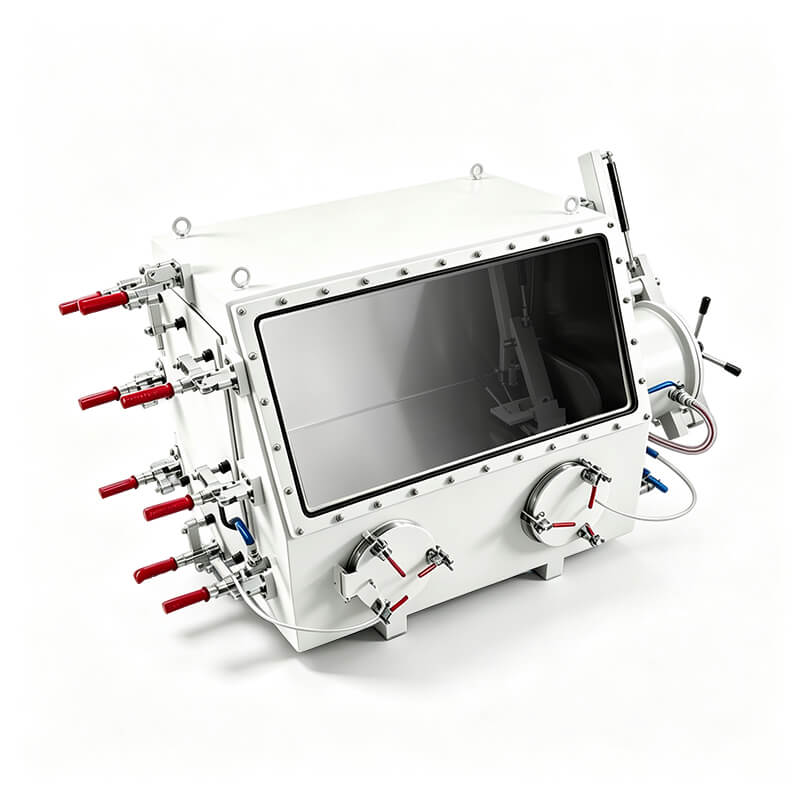
TENCAN GBV-3: a documented stainless steel vacuum glove box for air-sensitive powder work
The TENCAN GBV-3 Stainless Steel Vacuum Glove Box is the first configuration to evaluate for this application because it is documented as a stainless steel vacuum glove box. That description is a starting point, not a complete performance specification. The quotation should confirm the chamber dimensions, achievable vacuum, leak rate, port layout, window configuration, glove material, and whether a gas purification system is included.
Stainless steel construction is relevant to sulfide powder handling because the chamber can be made cleanable and mechanically robust. It is suitable for many dry powder operations, but it is not automatically compatible with every chemical or cleaning agent. The powder's safety data sheet and the site's cleaning procedure should be reviewed before the material is introduced. The interior finish and the ability to reach corners should be checked during the technical review, because fine powder can remain on surfaces even when the chamber looks clean.
The vacuum designation matters for the transfer path. An antechamber that can be evacuated before the inner door is opened can reduce the air carried into the main chamber compared with a simple pass-through. The actual benefit depends on the vacuum level, the pump, the leak rate, and the operating procedure. TENCAN should state these values for the quoted configuration, and the laboratory should verify them during commissioning. Vacuum is a transfer aid, not a guarantee of a low-moisture or low-oxygen atmosphere.
For weighing, the GBV-3 should be evaluated with the real balance, sample container, and target sample mass. The question is not only whether the balance fits, but whether the operator can place the container, open it, use a spatula, read the display, and clean the area without excessive glove movement. A balance that is too large for the chamber or poorly positioned can make a good glove box unusable for routine work. If the balance generates heat or vibration, that should also be discussed with TENCAN and the balance supplier.
The product page should be used as the reference for the standard configuration, while the quotation should define the actual build. Do not assume that a purification system, a particular glove material, or a specific monitoring package is included unless it is listed. Do not assume that the small antechamber is compatible with every GBV-3 port arrangement; ask TENCAN to confirm the interface and the transfer procedure for the items the laboratory will use.
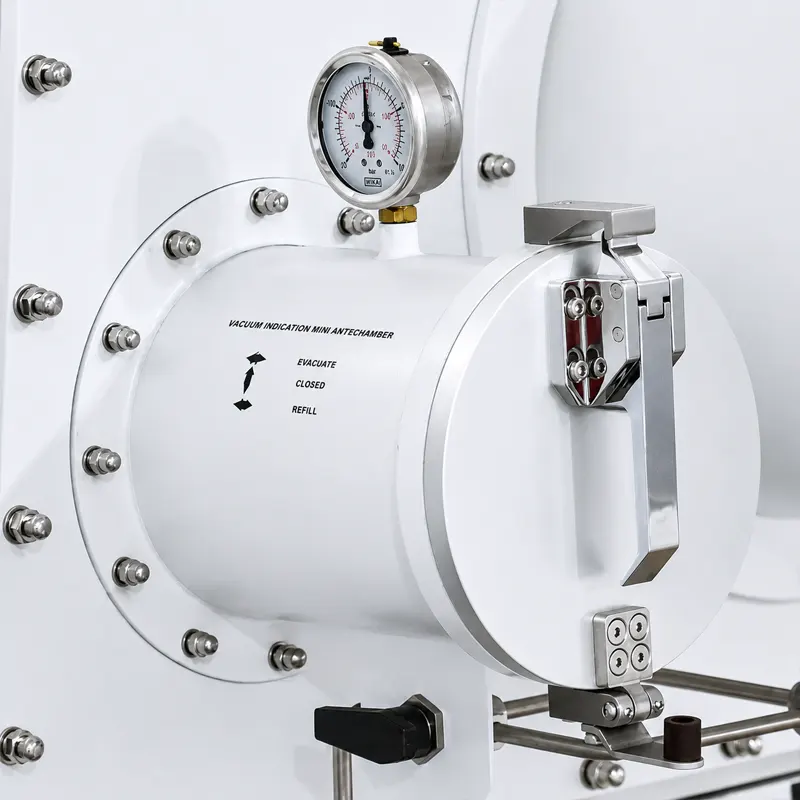
Small Glove Box Antechamber: right-sizing the transfer path
In a busy powder laboratory, the main atmosphere is disturbed most often by small items: sample vials, spatulas, weighing boats, tools, and small fixtures. A large antechamber can handle these items, but it may require a longer purge or evacuation cycle and may create a larger exchange volume. A smaller antechamber can be a sensible accessory when the majority of transfers are small and frequent, provided the cycle is validated and the chamber is correctly integrated with the main box.
The TENCAN Small Glove Box Antechamber is documented as a glove box accessory. It should be evaluated as part of the transfer path, not as a stand-alone glove box or as a replacement for a continuous purification system. The relevant questions are the internal volume, the vacuum or purge rating, the port and flange arrangement, the door seal, and the procedure for moving items into the main chamber without disturbing the powder or the balance.
For sulfide electrolyte work, a small antechamber is most useful when it is dedicated to clean, dry items and when the operator follows a consistent entry routine. The chamber should be compatible with the cleaning method and with the materials that will pass through it. If the laboratory also needs to transfer a large balance, a press, or a bulky fixture, a separate larger entry path or a different chamber configuration may be required. The right answer is based on the item list, not on the assumption that smaller is always better.
Matching the configuration to the weighing and transfer workflow
Receipt and container opening
The receiving step should minimize the time the powder container is open outside a controlled atmosphere. If the container can be transferred into the glove box without opening it in the laboratory, the exposure risk is reduced. The antechamber size should match the container, and the transfer procedure should be written down. A small antechamber may be suitable for sample vials and small containers; larger shipping containers may need a different entry path.
Sampling and weighing
Sampling and weighing are the highest-value steps because they determine the representativeness of the result. The balance should be placed where the operator can see and reach it comfortably. A dedicated weighing area inside the chamber, with a cleanable tray and a fixed spatula position, can reduce powder dispersion. Anti-static measures may be relevant if the powder adheres to surfaces, but they should be selected with the powder supplier and the balance manufacturer. The small antechamber can be used for weighing boats, tools, and sample vials if its cycle and compatibility are confirmed.
Sieving, mixing, and subdivision
If sieving or mixing is performed inside the glove box, the chamber must have enough space for the equipment and enough access for cleaning. Fine powder can escape from the top of a sieve or settle on the window, so the workflow should include a cleaning step and a defined waste path. A small antechamber is useful for removing small tools and sample containers, but larger sieving equipment may require a different transfer arrangement. The equipment list should be shared with TENCAN before the chamber layout is finalized.
Loading and cell assembly
Cell assembly may involve additional tools, dies, separators, and current collectors. These items should be transferred in a way that does not compromise the main atmosphere. If cross-contamination is a concern, a dedicated tool set and a documented cleaning routine are more effective than adding more access points. The glove box should support the required item flow without forcing the operator to make unnecessary openings.
Evaluating international alternatives without double standards
International glove box suppliers can be appropriate alternatives when a laboratory needs a modular platform, an integrated purification train, a particular service network, or compatibility with an existing site standard. Those are positive reasons to include an international option in a shortlist. A well-documented modular system can also make later expansion easier if the laboratory's workflow changes. The value of these advantages depends on the specific project, not on the country of origin.
To compare fairly, use the same evidence for every candidate. Ask for the same chamber volume class, the same transfer requirement, the same atmosphere target and measurement method, the same leak-test documentation, and the same scope of commissioning. A supplier that can provide clear drawings and test records is easier to qualify than one that relies on general statements. A brand name is not evidence of performance, and a lower price is not evidence of suitability.
TENCAN should be assessed on the same sheet. Its documented starting points for this application are the GBV-3 stainless steel vacuum glove box and the small glove box antechamber. The first is a main chamber option; the second is an accessory for the transfer path. They should not be presented as equivalent products or combined without confirming compatibility. The same rule applies to any international alternative: compare the main chamber to the main chamber, the airlock to the airlock, and the purifier to the purifier.
A sample validation plan for sulfide electrolyte powder
Before purchase, the laboratory should send TENCAN a representative powder sample, the intended sample quantity, the item list for the antechamber, and the target moisture and oxygen levels with the measurement method. The supplier can then recommend a configuration and identify the tests that need to be performed. A validation plan should test the actual powder and the actual transfer items, not only an empty chamber.
| Validation item | What to observe | Why it matters |
|---|---|---|
| Material compatibility | Powder contact with stainless steel, window, gloves, and cleaning agents | Confirms that the proposed materials are suitable for the specific powder and procedure |
| Atmosphere baseline | Starting moisture and oxygen readings and the instrument used | Establishes whether the configuration can meet the stated target |
| Transfer recovery | Time and procedure needed to recover the atmosphere after antechamber use | Shows whether the transfer path is practical for the expected entry frequency |
| Weighing trial | Balance stability, visibility, reach, static behavior, and powder loss | Connects equipment layout to sample representativeness and operator technique |
| Dust and cleaning | Powder retention on surfaces, gloves, and corners after a simulated run | Reduces cross-contamination and supports a realistic cleaning routine |
| Pressure control | Powder disturbance during vacuum or venting | Protects the sample and the balance from unnecessary movement |
| Alarm integration | Placement of gas sensors and connection to the site alarm system | Links the glove box to the laboratory's exposure-control plan |
| Documentation | Drawings, leak test, utility requirements, and training scope | Supports installation, qualification, and safe routine operation |
Procurement checklist
- Define the target moisture and oxygen levels and state how they will be measured.
- List every item that will enter the glove box, including its size, material, and frequency.
- Confirm the GBV-3 chamber dimensions, window, glove ports, and balance footprint.
- Confirm the vacuum level, leak rate, and venting procedure for the main chamber and antechamber.
- Clarify whether a gas purification system is included, and how it is monitored and regenerated.
- Review stainless steel grade, interior finish, and approved cleaning agents with TENCAN.
- Confirm glove material and thickness for the powder and the required dexterity.
- Plan gas-monitoring and exhaust connections with the site's EHS team.
- Request general-arrangement drawings, utility requirements, and leak-test records.
- Agree on commissioning, operator training, and spare-parts support before placing the order.
For a sulfide electrolyte powder project, the next step is a focused technical review rather than a general brochure request. Share the powder's safety data sheet, the target atmosphere, the sample quantity, the item list for the antechamber, and the available laboratory space with TENCAN. That information allows the GBV-3 and the small antechamber to be checked against the actual workflow, and it gives any international alternative the same basis for comparison.
