
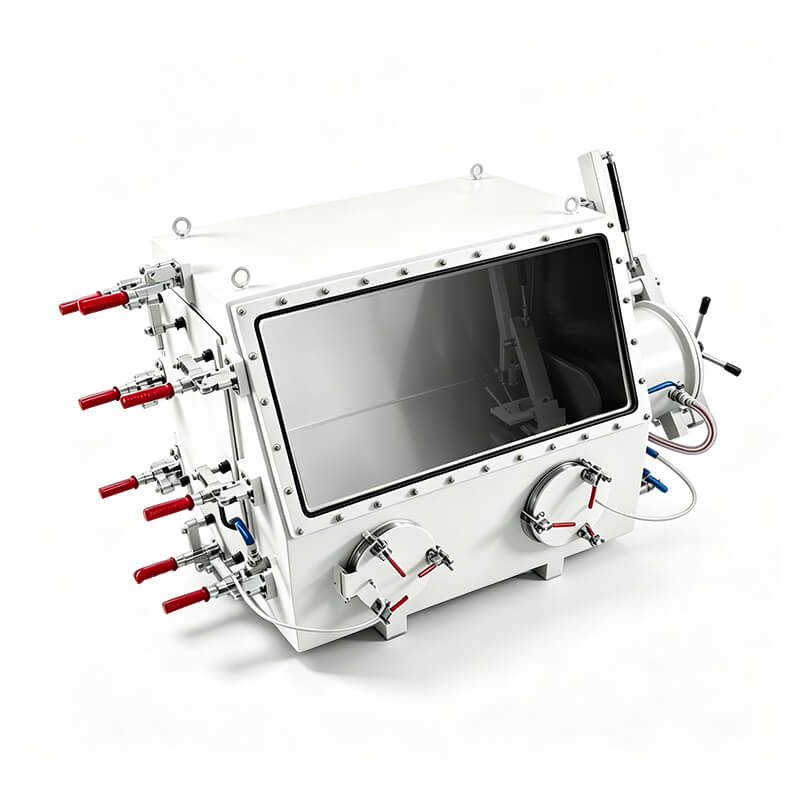
A stainless steel vacuum glove box solves a specific problem: it lets you handle air-sensitive material inside a sealed chamber whose atmosphere you rebuild on demand, without depending on a continuously regenerated purification loop. The GBV-1 is built around that principle, and understanding the principle is what tells you whether it fits your samples or whether you need a different class of system.
Two Ways to Hold an Atmosphere, and Where the GBV-1 Sits
Laboratory atmosphere control splits into two families that are often discussed as if they were interchangeable. One rebuilds the atmosphere by dilution: seal the box, pump the air out, fill it with nitrogen or argon, and repeat until the residual oxygen and moisture are low enough for the work at hand. The other maintains the atmosphere continuously: a closed loop circulates the box gas through a purifier column that strips oxygen and water, and the column is regenerated periodically. Both can produce a workable environment. They differ in how the low-oxygen state is reached, how it is held, and what happens the moment a sample, a tool, or a pair of gloves introduces a fresh load of air and solvent.
The purge-and-hold approach
The GBV-1 stainless steel vacuum glove box belongs to the first family. Its chamber is designed to be evacuated and refilled, and the controlled atmosphere is the product of that cycle rather than of a continuously operating purifier. Evacuation removes a large share of the original atmosphere in one pass; the inert gas refill replaces it; repeating the sequence reduces the residual air by a further fraction each time. Because the chamber is isolated between cycles, the atmosphere is held rather than polished — the box does not keep scrubbing itself while you work.
The continuous-purification approach
A purifying glove box adds a blower, a purifier column with regenerable media, oxygen and moisture analyzers in the loop, and the controls that switch between purification and regeneration. Its advantage is steady state: every minute the loop runs, oxygen and water that leak in or outgas from surfaces are removed. Its cost is complexity — more fittings, more instruments, more maintenance procedures, and a regeneration step that takes the box out of service unless a second column is fitted.
The distinction matters at the procurement stage because it changes what you should ask for. A purification system is specified by circulation rate, achievable oxygen and moisture levels under stated conditions, column capacity, and regeneration requirements. A vacuum-purge box is specified by chamber volume, the vacuum the chamber and any transfer chamber can reach, the number of purge cycles and the purity of the gas you can supply, and the leak tightness of the assembly. Mixing the two sets of numbers is one of the most common reasons a purchase disappoints.
Inside a GBV-1 Evacuation and Refill Cycle
It helps to walk through the sequence in the order a user experiences it, because each step has a different failure mode.
Step One: Removing the Starting Atmosphere
With the box closed and the gloves mounted, a vacuum pump draws on the chamber. The goal is not to reach the pump's ultimate vacuum inside a box that will later hold gloves, ports, and a window; it is to remove as much of the original air as the chamber construction and the pump allow in a reasonable time. Large volumes take longer, and the last part of the pump-down is slow because the remaining gas is mostly what interior surfaces are releasing. Stainless steel is helpful here: it can be cleaned, it does not absorb water the way acrylic does, and its outgassing behaviour is more predictable under vacuum. Chamber geometry matters too — deep corners and dead legs pump down more slowly than a simple rectangular volume, and anything left inside the box during evacuation becomes a source of vapour.
Step Two: Refilling and Holding Slight Positive Pressure
The chamber is then refilled with nitrogen or argon from a regulated supply. Operators typically bring the box to a small positive pressure relative to the room so that leakage, if any, moves outward rather than inward, and the box is monitored with a gauge or manometer while gas is admitted. For a box without a circulation loop, the refill is also a mixing step: gas enters at one point and displaces the residual atmosphere, so inlet position, flow rate, and the time allowed for mixing all affect how uniform the result is. Sampling oxygen at a single port immediately after a refill can easily read lower or higher than the chamber average, especially in a large or irregularly shaped box.
What Limits the Achievable Atmosphere
Four factors set the practical floor. The first is the number of evacuation and refill cycles and the pressure ratio reached in each. The second is the purity of the supply gas; a nitrogen line carrying a few hundred parts per million of oxygen sets a ceiling that no amount of cycling will beat. The third is outgassing and leakage: elastomer seals, gloves, cable insulation, and the samples themselves release water and solvent vapour into the chamber, and every sealed joint is a potential path for room air. The fourth is time. A vacuum-purge box that sat overnight with a sample inside will not be at the same condition as one purged an hour ago, because nothing is circulating to remove the accumulated load except another cycle.
Designing the Transfer Path: Antechamber, Gloves, and Leak Paths
Most atmosphere contamination in daily use does not come from a faulty chamber; it comes from how material gets in and out and from the elastomer surfaces that separate the operator from the inside.
If the configuration includes a transfer chamber, its role is to be the disposable volume. The antechamber is evacuated and refilled while the main chamber stays sealed; the inner door is then opened, and only the antechamber's residual atmosphere enters the working space. Antechamber volume is a genuine trade-off. A small chamber costs less gas and less time per transfer but limits what can be passed in; a large one accepts bulky parts and fixtures but extends each cycle. Confirm the antechamber volume, the vacuum it is rated to reach, and whether the inner door has any interlock that prevents it from being opened before the outer cycle is complete. If those details are not stated for the configuration you are considering, ask rather than assume.
Gloves are the largest elastomer surface in the system and the one place where the atmosphere is separated from the operator by a fraction of a millimetre of material. Glove material, thickness, and permeation behaviour against the specific gas determine how much room air and moisture migrate inward during a long session. Correct glove size matters more than it looks: an oversized glove folds and abrades, an undersized one strains the port O-ring and the cuff. Port diameter and O-ring material should be confirmed against the gloves you intend to use, and gloves should be inspected for pinholes as routine practice rather than only after a reading looks wrong.
Pressure retention is the simplest test of a vacuum box's integrity. A chamber that cannot hold a small positive pressure for a defined period, or cannot reach its stated vacuum, has a leak, a worn seal, or a valve that is not seating. Vacuum grease condition, O-ring compression, glove cuffs, and feedthrough seals are the usual suspects. Leak rate is worth recording at acceptance and at each service interval, because slow degradation is far easier to diagnose from a trend than from a sudden failure in the middle of an experiment.
The purge gas plumbing deserves the same attention as the chamber. Regulator quality, line material, and the presence of any elastomer hose between the supply and the box all influence the moisture and oxygen content of the gas that actually arrives. A long, permeable hose left pressurised overnight can deliver a noticeably wetter gas than the cylinder label suggests. Where the gas is supplied through a house line, a point-of-use filter or dryer and a periodic check of the supply are worth the small effort.
What a Vacuum Box Cannot Do for You
Buyers sometimes assume that a vacuum glove box is a purification glove box with one module removed — the same product, minus the purifier. That assumption leads to trouble. The GBV-1 is deliberately distinct from continuously purifying systems, and the absence of a circulation loop has consequences that are better understood before the order than after it.
- It does not remove contamination continuously. Every transfer, every opened inner door, and every outgassing sample adds to the load, and only another evacuation–refill cycle reduces it.
- It does not guarantee a particular ppm figure. Any oxygen or moisture result depends on gas purity, cycle count, dwell time, and sample load. A number is meaningful only when those conditions are stated alongside it.
- Filtration is not atmosphere control. If particle filtration is fitted, it removes particulates; it does not remove water vapour or oxygen, and it does not substitute for purging.
- Solvent adsorption is not purification. Adsorption media capture solvent vapour and have finite capacity. They do not replace oxygen and water removal, and saturated media can release what they captured.
- Inert is not sterile or cleanroom grade. An inert atmosphere is not a validated cleanliness classification, a sterile environment, or biological containment. Those require separate qualification.
Instrumentation is another place where expectations run ahead of the hardware. An analyzer measures the atmosphere; it does not change it. A probe mounted near the gas inlet may read very differently from the far corner of the chamber, and electrochemical or zirconia sensors each have their own range, response time, and cross-sensitivity. Resolution is not accuracy, and neither is a statement about the whole box. When readings and expectations disagree, the first questions are where the sample is drawn, when it was last calibrated, and what the sample load was at the time.
| Measurement | What it describes | Common misreading |
|---|---|---|
| Chamber working pressure | The small positive pressure held during operation | Taken as evidence of gas purity |
| Transfer chamber vacuum | How completely the antechamber was evacuated before the inner door opened | Confused with the condition of the main chamber |
| Pump ultimate vacuum | The best a clean, empty pump and system can reach | Assumed to be reached inside a loaded, gloved box |
| Leak rate | How quickly the sealed assembly gains pressure or loses vacuum | Ignored once the box is in service |
| Oxygen and moisture readings | The atmosphere at one sampling point at one moment | Treated as a chamber-wide, all-session guarantee |
Matching the GBV-1 to Real Sample Work
The useful question is not whether purge-and-hold is better than purification in general, but which of them matches the shape of your working day.
Where Purge-and-Hold Works Well
Batch-oriented work with clear start and end points suits this design: weighing and loading air-sensitive powders, preparing lithium metal or solid-state battery samples for transfer to another instrument, mounting perovskite or OLED substrates for a short deposition step, sealing a finished device, or handling oxygen-sensitive catalysts in small quantities. It also suits work where the object is large or awkward and the priority is a spacious, sealed, stainless workspace rather than continuous ppm control, and teaching or demonstration settings where the sequence of evacuate, refill, and verify is itself part of the exercise. In each case the atmosphere is established before the critical step, the work is completed, and the box is either re-purged for the next session or left sealed.
Where Continuous Purification Earns Its Cost
Long daily sessions with many transfers, multi-user laboratories where the box is never really idle, procedures with solvents that keep entering as vapour, targets in the low-ppm range that must hold for hours, and processes where an unattended overnight atmosphere matters all point toward a purifying system. In those settings, steady removal of incoming oxygen and water does work that a purge-only box can only do between sessions, and the loop's analyzers give a continuous record rather than a spot check.
Procedural Measures That Change the Outcome
Some needs sit between the two families. Reducing transfer frequency, consolidating operations into fewer and longer sessions, adding a small antechamber for tools and consumables, storing samples in a sealed secondary container inside the box, keeping solvent-heavy procedures out of the chamber, and scheduling a purge cycle immediately before each critical step all lower the load. These are procedural compensations, not substitutes for a purifier, but they materially change what a given box can deliver in practice.
Physical configuration matters as much as atmosphere strategy. Chamber size, the number of glove ports, single- or double-sided access, window size and lighting, and the height at which the gloves sit all determine whether a task is comfortable or exhausting. A box that is too deep forces operators to work at full reach, which strains gloves and seals and discourages the careful technique that atmosphere control depends on. Floor loading, door swing, and the path for bringing heavy items to the antechamber are worth checking against the room before delivery, not after.
Bringing Electrical Signals Through the Wall
Much of the work that needs an inert atmosphere also needs a wire. Resistance measurements on a pellet, a thermocouple reading during a heating step, a sensor being calibrated, a device being probed — each requires an electrical path from inside the sealed chamber to the instrument outside, without turning the chamber wall into a leak.
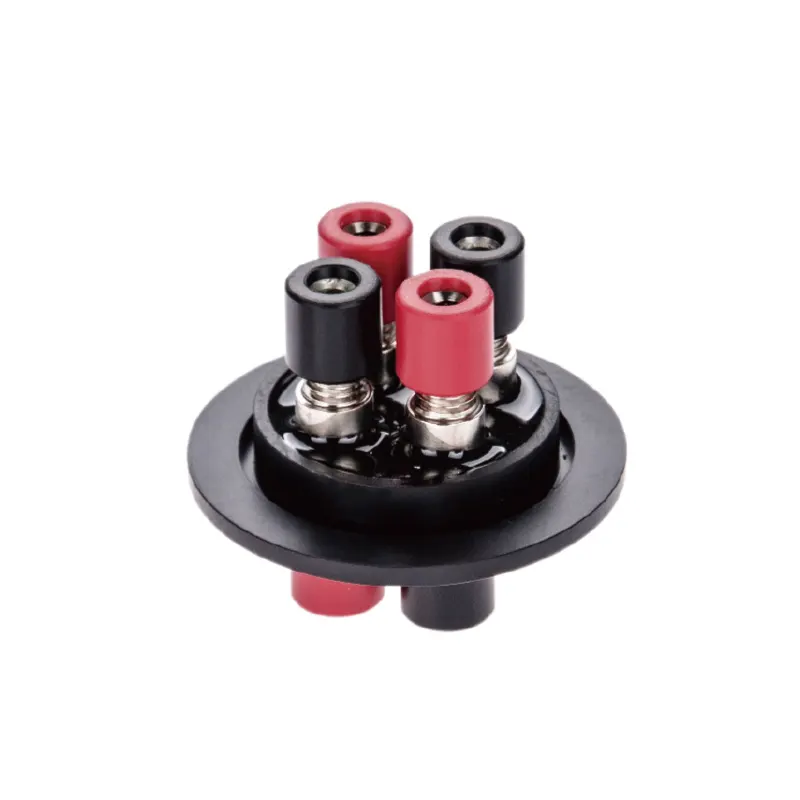
A feedthrough does that job. Conductors pass through a flange on a ceramic or epoxy seal, and the flange standard — KF, CF, or ISO — defines the mechanical interface that must match a port on the box. The conductor count, wire gauge, voltage and current rating, and insulation material determine what signals can be carried; the seal construction and the flange surface determine how well vacuum is held. A feedthrough that is electrically adequate but sealed with the wrong elastomer, or mounted on a flange that does not match the port, creates a leak that no amount of purging will compensate for.
The KF40 Electrical Test Lead Feedthrough is an accessory of this type: a KF40-flanged fitting that carries test leads through a chamber wall. Because KF is a quick-release vacuum interface, the practical questions are straightforward but easy to skip. Does the box have a spare KF40 port, or is the flange currently blanked or occupied? Are the conductors rated for the voltages and currents the experiment needs? Is there enough lead length inside the chamber to reach the sample without pulling on the seal, and enough outside to reach the instrument without strain? Whether a given feedthrough suits a given box is a question about the port list and the electrical requirement together, so confirm both rather than assuming a standard fit.
Installation practice decides whether the fitting stays leak-tight. Route signal cables so they do not rest on glove cuffs or cross the door seal, provide strain relief on both sides, and label each conductor before the chamber is closed, since identifying leads through a window is unreliable. After fitting, verify the seal with a pressure-rise or vacuum check before loading sensitive material; a leak found with an empty box costs minutes, while the same leak found with a partially prepared sample can cost the experiment. Where several signals are needed, grouping them onto one multi-conductor feedthrough usually reduces the number of seals that must be maintained.
Numbers and Details to Confirm Before Ordering
Specification documents reward careful reading, because the same word — vacuum, purge, oxygen — can describe rather different things from one datasheet to the next. The list below is the information a supplier needs in order to match a configuration to the work rather than to a template.
- Sample description: composition, sensitivity, quantity, and physical form — powders, foils, liquids, or finished devices — including anything likely to outgas.
- Required atmosphere: gas type and supply purity, the oxygen and moisture condition needed at the start of a session and after two hours of work, and how it will be verified.
- Duty cycle: sessions per day, transfers per session, typical dwell time, and whether the box sits idle overnight with samples inside.
- Vacuum requirement: what the chamber and the transfer chamber must reach, and whether the pump is sized for the volume and the acceptable pump-down time.
- Leak acceptance: the test method and acceptance criterion agreed at factory test, and how it will be repeated on site.
- Ports: number, type, and size of spare ports, including KF flanges for feedthroughs and any optical or fluid ports.
- Glove specification: port diameter, glove material and thickness, cuff style, and the spares to be held on site.
- Solvent and particle control: whether solvent adsorption or particle filtration is required, with the understanding that neither replaces oxygen and water removal.
- Instrumentation: analyzer type, range, calibration approach, and where the sample point sits relative to the working area.
- Footprint and handling: floor loading, working height, door swing, lighting, and access for loading heavy items.
- Utilities: inert gas supply capacity and dew point, pump exhaust routing, and electrical service.
- Documentation: the operating sequence, the number of purge cycles recommended for your samples, maintenance intervals for seals and gloves, and a spare parts list.
A supplier can only size a box well when the request describes the work rather than only the box. The most useful first message lists the material, the number of transfers, the dwell time, the gas supply, and the measurements that must be made inside the chamber. From that, the choice between a purge-and-hold vacuum box such as the GBV-1 and a continuously purifying system, together with the port list that goes with it, usually follows without much argument.
