
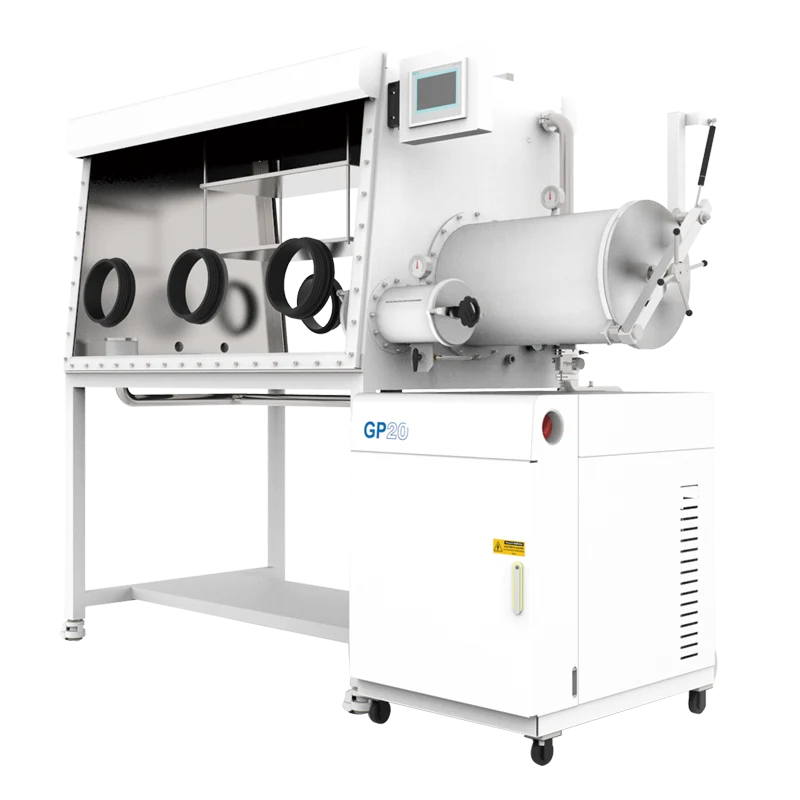
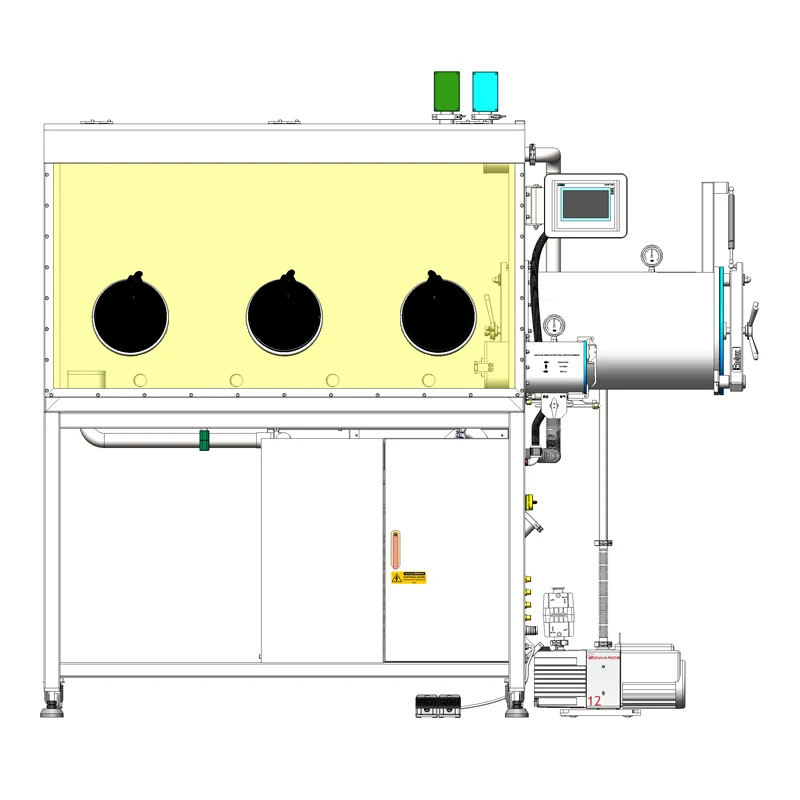
A six-glove double-sided glove box is often specified when several researchers need to work in a shared inert atmosphere without turning every operation into a queue. More glove positions, access from two faces, and a larger working envelope can improve throughput, but they also increase the number of seals, gloves, and transfer events that influence atmosphere stability. The decisive question is not how many gloves the cabinet has. It is whether the purification loop, transfer strategy, and monitoring arrangement match the way the box will actually be used. The six-glove double-sided glove box with gas purification system is a useful reference because it combines a multi-position work zone with closed-loop purification, yet the final configuration still has to be matched to the application.
Why a Six-Glove Double-Sided Box Changes the Atmosphere Problem
Adding glove positions and a second working face changes more than ergonomics. A larger cabinet has more internal surface area, more seals, more gloves, and usually more equipment inside. Each of those features can hold or release moisture and oxygen, and each adds a potential leak path. A double-sided layout can improve throughput because preparation, assembly, and inspection can be split between operators on opposite faces. That benefit is real, but it is a workflow benefit first. It becomes an atmosphere benefit only when the purification loop and transfer discipline are designed for the resulting demand pattern.
Shared access is not the same as independent atmospheres
Unless the cabinet is explicitly divided into separate chambers, operators on both sides share one atmosphere. Six glove positions do not create six independent zones, and a low reading at one sensor does not prove that every corner is equivalent. A double-sided box therefore needs deliberate zoning: high-outgassing operations kept away from clean assembly, tools stored so they do not block circulation, and transfer routes that avoid carrying wet or solvent-laden items across the working area. Reach and sightlines also matter. A cabinet that is difficult to work in encourages rushed movements, open ports, and unnecessary air exchange.
The demand profile matters more than nominal volume
Purification sizing is often discussed as if box volume were the only variable. In practice, the demand profile matters: how often the airlock is cycled, how much material is introduced, whether solvents are used, how long ports are open, and how many operators work at once. A large box used gently may be easier to control than a small box used intensively. This is why a six-glove double-sided enclosure should be selected against a realistic schedule, not only a footprint drawing.
What the Purification System Does and What It Does Not Do
With a gas purification system, the box atmosphere is circulated through a closed loop. The loop typically includes a blower, one or more purifying columns, and control elements that manage circulation and regeneration. Depending on design, separate beds may target moisture and oxygen, or a combined arrangement may be used. The purpose is to remove contaminants that enter through transfer, leaks, gloves, or materials, and to return the atmosphere to the working condition defined for the process. The exact column arrangement, sensor set, and control architecture should be confirmed on the product page and datasheet.
Working gas, control gas, and regeneration gas are different streams
Inert atmosphere, control gas for valves and instruments, and regeneration gas for the purifying media do not serve the same function. Regeneration is a maintenance or cycle step that restores the capacity of the purifying material; it is not the same as purging the box, and it is not a guarantee that the working atmosphere has returned to its baseline. If the system uses an automatic regeneration cycle, the operating schedule should make clear when purification is unavailable, what happens to the loop during that period, and which alarms or interlocks apply. Do not infer regeneration conditions from a generic article; use the manufacturer's instructions.
Purification is not particle filtration or solvent removal
A purification loop that removes water and oxygen does not automatically remove particles, acidic gases, or solvent vapor. HEPA filtration addresses particles. Solvent adsorption addresses organic vapor and is not a substitute for water and oxygen removal. An oxygen analyzer measures the atmosphere; it does not purify it. These distinctions matter when a process uses photoresist, solvents, reactive powders, or high-surface-area materials. Each additional contaminant may require a separate control strategy, and the compatibility of the box materials, gloves, and seals must be checked.
| Subsystem | Primary job | Not a substitute for |
|---|---|---|
| Purification loop | Circulates and removes water and oxygen | Leak correction, airlock purge, or solvent control |
| Airlock | Moves items in and out with limited exchange | Continuous purification or good operator technique |
| HEPA filter | Traps particles | Water or oxygen removal |
| Solvent adsorber | Captures organic vapor | Oxygen or moisture purification |
| Oxygen analyzer | Measures oxygen | Purification or calibration |
These functions are complementary. A box can have a good purification loop and still show unstable readings if the airlock is used poorly, a glove is damaged, or a wet sample is introduced. Conversely, an analyzer can be accurate and still provide little protection if it is placed where it cannot see the working zone.
Reading Oxygen Correctly: Analyzer, Sensor, and Control Logic
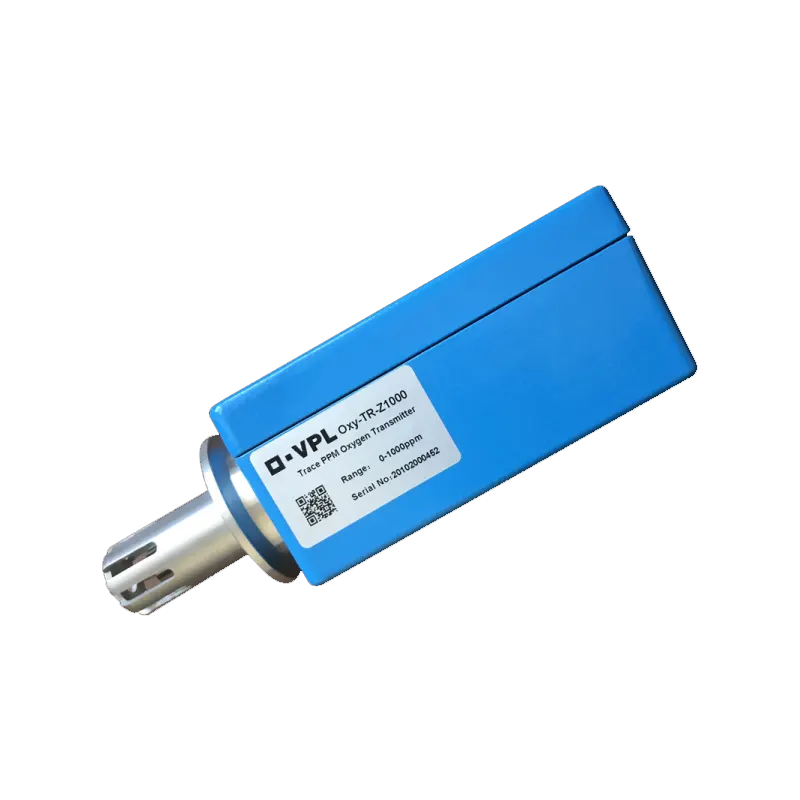
Oxygen monitoring is often treated as a single number, but the number has a context: where the sample is drawn, how it is conditioned, when the sensor was calibrated, and what the display resolution actually means. A zirconia oxygen analyzer is a measuring instrument. It can be useful for trend monitoring, alarm logic, and confirming that a transfer or purification step has had the expected effect. It cannot compensate for a leak, and it does not define the purity of every part of the box.
Measurement location and sample handling
An analyzer connected to a sample line sees the gas that reaches its sensor, not necessarily the gas at the far corner of the work zone. Sample flow, line length, dead volume, and the point of extraction all affect response time. If the sample is taken downstream of the purification loop, the reading may look better than the general working atmosphere; if it is taken near an airlock, it may show a local disturbance. The useful question is not only what the reading is, but what the reading represents and how quickly it would respond to a real change.
Resolution, accuracy, and calibration
A display with fine resolution can look more precise than the underlying measurement. Resolution is the smallest displayed increment; accuracy is how close the reading is to the true value. Calibration gas, sensor condition, temperature, and sample pressure can all affect the result. Calibration intervals should follow the manufacturer's guidance and the process risk, not an arbitrary schedule. The glove box zirconia oxygen analyzer page is the right place to confirm the instrument's intended role, range, and installation requirements rather than assuming that any analyzer is interchangeable.
Use trends, not isolated readings
A single reading is a snapshot. A trend before transfer, during transfer, after purging, and after stabilization shows whether the system is responding as expected. A slow recovery may point to a large air exchange, a wet load, a glove issue, or a purification loop that is not circulating effectively. It may also reflect sample-line lag or a calibration problem. Without a diagnostic sequence, it is better to describe the observation than to declare a fault. The same principle applies to moisture: water and oxygen are related but not identical, and one can recover more slowly than the other.
Transfer, Glove Ports, and the Daily Disturbances That Matter
Most atmosphere upsets enter through ordinary actions: opening an airlock, loading a container, changing a glove, or bringing in a sample that was not fully dried. A six-glove box has more glove positions and more opportunities for handling, so the quality of routine practice has a large influence on stability. The design should make good practice easy. If the airlock is awkward, operators will improvise; if storage blocks circulation, the purification loop will be less effective than its capacity suggests.
Airlock trade-offs
An airlock reduces exchange with the room, but it does not eliminate it. Larger airlocks can accept more equipment and reduce the number of cycles; smaller airlocks may require more cycles but use less gas per cycle. Vacuum-assisted transfer and gas-purge transfer are different approaches, and their effectiveness depends on the item, the packaging, and the procedure. A box working pressure, an airlock vacuum level, a pump's ultimate vacuum, and a leak rate are separate specifications. They should not be collapsed into one sealing claim.
Gloves and seals are part of the atmosphere boundary
Glove material, thickness, cuff design, and condition affect both feel and permeation. A pinhole or a poorly seated glove can be more consequential than a small change in purification capacity. Six glove positions mean more seals to inspect and more chances for a glove to be damaged during assembly work. Inspection should include the gloves, ports, O-rings, windows, door seals, and feedthroughs. Any accessory added to the boundary, such as an extra port, a sensor, or a power feedthrough, should be checked for compatibility and sealing.
Loads and scheduling
High-surface-area powders, porous parts, solvents, and materials that release volatiles can extend recovery time. That does not mean such materials cannot be used; it means the transfer and purification schedule should be planned around them. Staggering high-load operations, using a dedicated airlock, and allowing the loop to stabilize before critical work are practical measures. The right set of measures depends on the process, and the supplier should see the actual load profile rather than only the box dimensions.
Configuration Decisions for a Double-Sided Six-Glove Installation
A double-sided six-glove box is a configuration, not a single fixed layout. The number and spacing of glove ports, working height, window geometry, internal shelving, airlock location, and service access all influence how the system is used. The purification system adds further choices: where the loop connects, where sensors are placed, how regeneration is managed, and whether the control panel is accessible from both sides. These details should be settled before the cabinet is built, because later changes to ports and penetrations can create new sealing risks.
Layout and workflow
Two working faces can support a useful division of labor: one side for sample preparation and transfer, the other for assembly, inspection, or testing. That division works best when the internal layout keeps clean and dirty operations apart and when operators can see each other without reaching across the entire box. A very deep cabinet may offer more volume but poorer reach and sightlines. A wider, shallower arrangement may be easier to use but requires more floor space. The right compromise depends on the parts being handled, not on volume alone.
Airlock, feedthrough, and service choices
The airlock should match the largest routine item and the acceptable transfer frequency. Electrical and signal feedthroughs should be selected for the connections actually needed, with spare capacity treated as a deliberate choice rather than an afterthought. Vacuum pump selection should consider the gas being handled, the required duty, and the airlock or process load; pump ultimate vacuum is not the same as box working pressure. An analyzer port should be placed where it can sample a representative stream and where the instrument can be maintained.
Materials, solvents, and accessories
If the process uses solvents, the question is not only whether a solvent adsorber is available, but whether the gloves, seals, windows, and internal materials are compatible with the exposure. A HEPA filter may be appropriate for particle control, but it does not replace moisture and oxygen purification. Additional accessories should be introduced because they serve a defined function, not because a longer option list looks more complete. Compatibility should be confirmed with the supplier for the specific combination.
Because the purification loop, cabinet, and accessories interact, a six-glove double-sided system should be reviewed as one atmosphere system. The six-glove double-sided glove box with gas purification system is the reference product for this configuration; the final specification should still be matched to the application.
Commissioning and Verification Without Overclaiming Performance
Commissioning is the point where design assumptions meet the real installation. A useful sequence is to verify the enclosure and connections, confirm the purge and circulation behavior, check sensor calibration, test alarms and interlocks, and then run representative transfers with typical loads. The last step is often skipped. An empty box can look stable while a realistic load exposes slow recovery, poor circulation, or a transfer procedure that needs adjustment.
Separate the specifications
Leak rate, pressure decay, working pressure, airlock vacuum, pump ultimate vacuum, oxygen concentration, and moisture concentration are different measurements with different test conditions. A statement that a system can reach a certain value under one set of conditions should not be read as a continuous guarantee for every process load. If a value is presented without units, test conditions, or the point of measurement, ask for clarification. It is better to omit an uncertain number than to build a process around it.
Verification should include normal use
Record baseline readings, then observe the response to a planned airlock cycle, a glove change, and a representative material transfer. Note how long the system takes to return to its starting trend and whether the recovery is consistent. This is more informative than a single pass or fail reading. The records also help distinguish a gradual change, such as a slow leak or an aging sensor, from an event-related disturbance. The manufacturer's acceptance procedure and manual take precedence over generic guidance.
Operator practice is part of the system
Training should cover glove inspection, airlock sequencing, material preparation, storage, and what to do when a reading changes. Operators should know which alarms are informational and which require stopping work. They should also know the limits of the monitoring arrangement: an analyzer at one point is not a complete map of the atmosphere. Good practice is not a substitute for correct equipment, but correct equipment cannot compensate for consistently poor transfer habits.
Specification Checklist for a Six-Glove Purified Glove Box
Before requesting a quotation, provide the information that determines atmosphere demand, not just the cabinet outline:
- Process and materials: chemistry, oxygen and moisture sensitivity, solvents, particles, outgassing, and temperature.
- Atmosphere target: required oxygen and moisture range with units and test conditions, not simply inert.
- Access: number of operators, glove positions, single or double-sided working, reach, and sightlines.
- Transfer: largest routine item, transfer frequency, airlock type, vacuum or gas purge, and pump duty.
- Internal equipment: weight, heat, electrical and signal needs, feedthroughs, and shelving.
- Purification: working, control, and regeneration gas; cycle strategy; sensor locations; analyzer calibration.
- Contaminant control: HEPA, solvent adsorption, acid gas, humidity, and cleaning requirements.
- Installation: footprint, floor loading, services, maintenance access, noise, and heat rejection.
- Verification: leak check, pressure test, alarm test, baseline logs, and acceptance with a representative load.
- Documentation: manuals, loop diagrams, sensor calibration records, spare parts, and training.
The most useful supplier conversation is specific about the work, not just the cabinet. Describe the samples, the transfer pattern, the solvents, the required atmosphere, and the measurements you will use to accept the system. A six-glove double-sided glove box can be an efficient shared platform, but its value comes from matching the purification loop, monitoring, and daily practice to the same demand profile. Confirm every performance value against the actual test conditions and the final configuration.
