
Material and process stage: lithium metal foil plus sulfide solid electrolyte
This guide addresses a specific pre-test handling problem: lithium metal foil and a sulfide solid electrolyte are brought together for research or pilot cell work, and both materials pass through weighing, temporary storage, transfer, and loading into a controlled atmosphere. The electrolyte may arrive as powder, granule, or tape; the lithium may arrive as foil on a backing or as a small coupon. The equipment brief begins when the package is opened and ends when the sample is inside the working zone, because that is where atmosphere quality, operator technique, and transfer hardware meet.
The material pair is demanding for two different reasons. Lithium metal is reactive with moisture, and its surface state changes with handling. Sulfide solid electrolytes are also moisture-sensitive; many can release hydrogen sulfide when hydrolyzed. Those are material hazards to confirm from the supplier safety data sheet, not assumptions to bury in a generic inert claim. A glove box therefore has to support chemical containment and good housekeeping as well as a low-oxygen, low-moisture working atmosphere. TENCAN's four-station single-sided split-type glove box with gas purification is a relevant first platform to evaluate because its documented description matches a shared, purification-supported workflow; the rest of this article explains what that description does and does not prove.
Why inert atmosphere is not a complete purchasing specification
Inert atmosphere is a condition, not a guaranteed number. For this application the specification should separate at least five variables: oxygen concentration, moisture concentration, working pressure or slight positive pressure, antechamber vacuum performance, and leak integrity. It should also define recovery time after a transfer, because a box can show a good steady-state reading and still be slow to recover after a door opens. Those variables interact, but they are not interchangeable. A HEPA filter removes particles; it does not remove water or oxygen. An antechamber vacuum gauge does not describe the working zone moisture level. A nitrogen purge can reduce oxygen without providing the same purification duty as a closed-loop purification system.
Hydrogen sulfide risk belongs in the risk assessment
If the sulfide electrolyte is handled as a powder, the risk assessment should include dust control, electrostatic discharge, and the possibility of hydrolysis products. The glove box specification should state which gas is used, how exhaust or scrubbing is handled if required, and how sensors are selected. This is not a reason to avoid the material; it is a reason to avoid vague procurement language. Ask for the material SDS, confirm compatibility of contacted materials, and check whether the facility requires gas detection or scrubber provision. Inert atmosphere is not a biological safety cabinet and is not an explosion-proof enclosure by default.
The transfer step often determines real atmosphere quality
Many atmosphere problems are introduced at the door. A foil or powder container that is too large for the antechamber, a bag that traps air, or a port left open longer than necessary can impose a load that the purification system must remove. The equipment brief should therefore include the containers, tools, and sample carriers that will pass through the box, not only the box itself. Port covers, antechamber sizing, and a defined loading routine matter because they shape the frequency and duration of atmosphere disturbance. None of these accessories replaces purification or leak-tight construction; they support a disciplined transfer routine.
What the equipment must achieve before a supplier is chosen
A useful requirement statement for this application has six parts. It should define the working atmosphere and the test method used to demonstrate it; define the transfer path and the largest item that must pass through; define how many people will work at the same time and from which side; define the internal layout for weighing and sample staging; define material compatibility and cleaning needs; and define the records, alarms, and service access the laboratory needs. A low headline moisture figure is not sufficient if the box cannot recover after a transfer or if the layout forces operators to crowd the same port.
- Atmosphere target: State oxygen and moisture targets separately, with test conditions and acceptable recovery time after a defined transfer.
- Containment: Confirm leak-test method, port sealing, gasket materials, and response to a pressure excursion.
- Transfer: Size the antechamber for real containers and define the vacuum/purge routine without treating vacuum as a working-pressure specification.
- Ergonomics: Match station count and handedness to the number of operators and the weighing or assembly tasks.
- Cleanability: Provide surfaces and corners that can be cleaned without creating traps for sulfide powder.
- Services: Confirm power, gas supply, exhaust, floor loading, and access for the purification module or other service items.
Selection factor table for lithium metal and sulfide electrolyte handling
| Selection factor | Why it matters | Suitable documented feature or confirmation point |
|---|---|---|
| Oxygen and moisture control | Both materials are sensitive to the working atmosphere; steady-state and recovery performance are relevant. | The TENCAN product is documented as a glove box with a gas purification system. Request target values, test method, sensor type, and recovery data for the actual transfer duty. |
| Transfer path | Containers and tools can carry air and moisture into the working zone. | Confirm antechamber size and vacuum/purge procedure. Keep working pressure and antechamber vacuum as separate specifications. |
| Operator stations | Shared research work often needs more than one operator without crowding the same gloves. | Four-station, single-sided configuration is named in the TENCAN product title. Confirm station spacing and task allocation against your workflow. |
| Layout and service access | Purification hardware, controls, and service clearances affect installation and uptime. | Split-type layout is documented in the product name. Request a dimensioned drawing and service-access plan. |
| Port discipline | Unused ports and open transfers disturb the atmosphere. | The TENCAN Glove Box Port Cover is a documented accessory. Use it as part of a controlled port routine, not as a substitute for purification. |
| Material compatibility | Powder, foil backing, solvents, and cleaning agents contact gloves, windows, and internal surfaces. | Confirm glove material, window material, seal compatibility, and cleaning-agent approval with the supplier and your safety assessment. |
| Particle and chemical control | Sulfide powder can be dispersed during weighing; particle filtration and moisture/oxygen control are different functions. | Do not equate HEPA filtration with water or oxygen removal. Ask how particle containment and cleaning are addressed in the layout. |
| Instrumentation and records | Research teams need to know whether an excursion occurred during a run. | Specify sensor locations, alarm logic, calibration interval, and data export required by your quality system. |
| Safety and facility interface | Inert gas, pressure, exhaust, and material hazards must be managed together. | Confirm gas choice, exhaust or scrubber needs, pressure-relief provisions, and local safety requirements. Inert atmosphere is not a certification by itself. |
| Validation | A purchase decision should reflect the real materials, containers, and operator routine. | Ask for a factory acceptance test and an on-site validation plan using agreed test conditions rather than a generic certificate alone. |
The TENCAN option for a shared lithium-metal and sulfide-electrolyte workflow
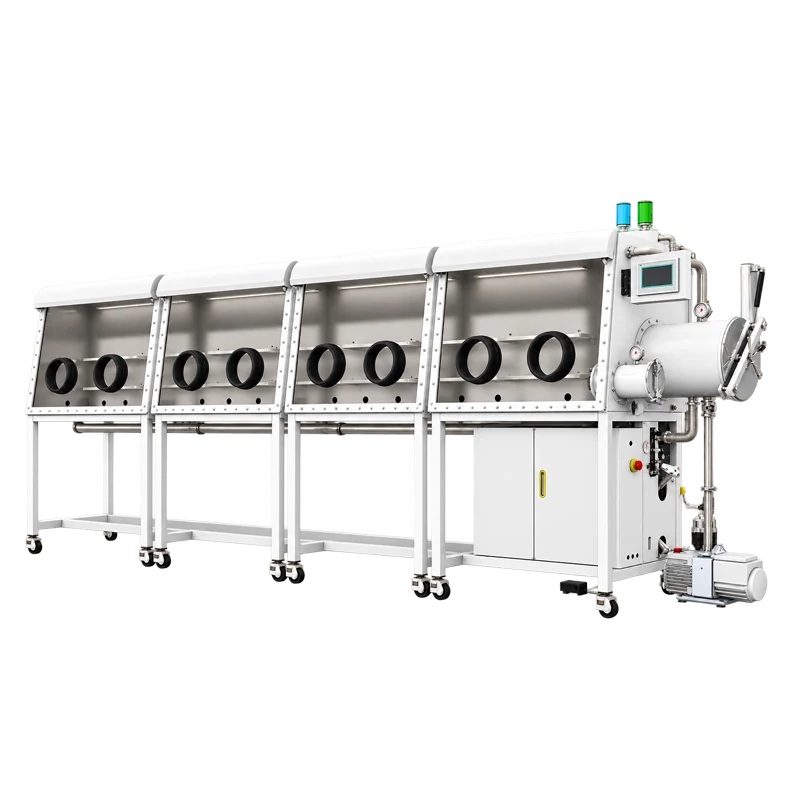
The documented TENCAN product for this brief is the Four-Station Single-Sided Split-Type Glove Box with Gas Purification System. Its value in the application is architectural rather than slogan-based: it is described as a four-station, single-sided, split-type glove box with gas purification, which makes it a plausible platform for a shared laboratory workflow in which several operators handle moisture- and oxygen-sensitive materials. The description supports a discussion about station count, access side, layout, and purification integration. It does not, by itself, establish a specific oxygen or moisture level, a recovery time, a leak rate, or a maximum transfer load. Those are configuration and validation questions.
Four stations and single-sided access in practice
Four stations are useful when the work is shared but not identical: one position may be used for weighing, another for temporary staging, another for sealing or packing a sample, and another for observation or a second operator. Single-sided access keeps the operator face on one side, which can simplify room layout and supervision. It also means the working rhythm depends on how tasks are distributed along that side. Before choosing this configuration, map the real sequence: who receives the sample, where the balance sits, where waste and tools are staged, and how a second operator reaches the box without crossing the first operator's work zone.
What split-type should be clarified in the quotation
Split-type construction can be advantageous where the installation route, room height, or service access makes a single monolithic enclosure difficult. It can also separate the working enclosure from part of the support hardware, depending on the design. Because the available product description does not provide a dimensioned drawing or a utility schedule, the quotation should show exactly what is split, how the sections join, how leak integrity is maintained at the joint, and how the purification module is serviced. Ask for plan and elevation drawings, floor loading, and the clearance needed to replace filters or service the purification loop.
Gas purification is a system, not a single number
The phrase with gas purification system tells the buyer that the product includes a purification function, but it does not define the achievable atmosphere at the working zone. The request for quotation should therefore ask for the target oxygen and moisture values, the measurement points, the sensor technology, the calibration method, and the recovery test after a defined transfer. It should also ask how the purification unit behaves during idle periods and how the system is regenerated or serviced. For lithium metal and sulfide electrolyte work, the relevant question is not only how low it can go, but how quickly and repeatably it returns to the working target after real containers pass through the antechamber.
Port covers and the small parts that protect a transfer routine
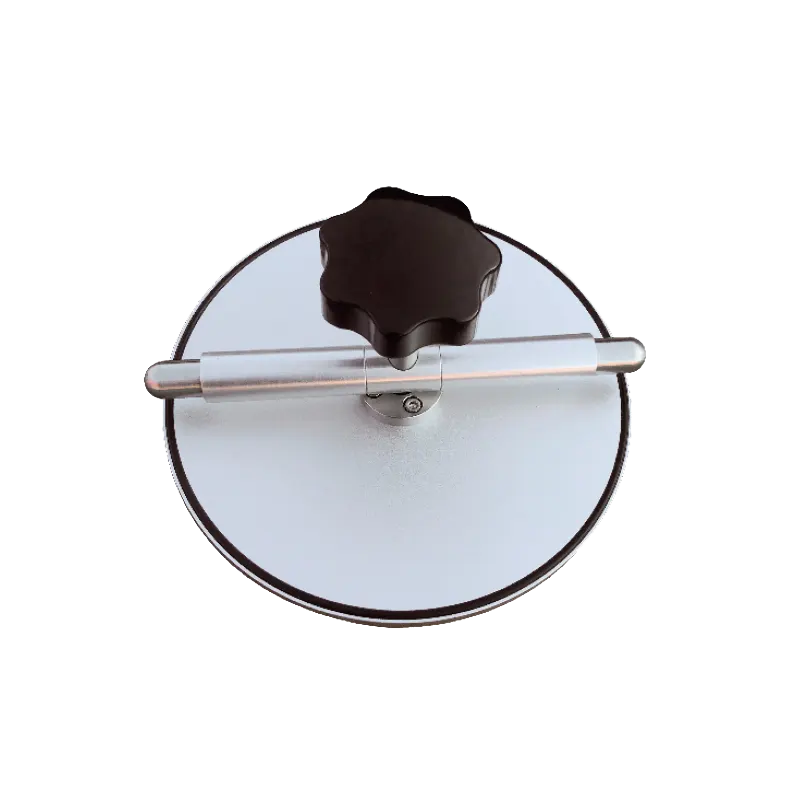
The second documented TENCAN item in this brief is the Glove Box Port Cover. It is an accessory, not a glove box and not a purification device. Its place in the workflow is straightforward: when a port is not in active use, a cover helps close off that opening as part of housekeeping and contamination control. In a shared four-station box, good port discipline matters because every unnecessary opening is a disturbance. A cover can support a routine in which operators open only the ports needed for the current task and restore the others afterward. It should be specified with the correct port size and material compatibility, and it should be inspected as part of the maintenance schedule.
Why small accessories deserve a place in the selection table
Accessories are often bought after the box is installed, when the process has already exposed the weak points. It is better to include them in the initial configuration review. Ask which ports are expected to remain unused, whether the cover interferes with gloves or fixtures, how it is cleaned, and whether it is compatible with the materials handled. The point is not to add parts for their own sake. The point is to make the operator routine explicit: which port is for transfer, which is for weighing, which is closed during a sensitive step, and who checks the state before a run begins. A well-chosen cover supports that discipline; it cannot compensate for a leaking port, a damaged gasket, or an undersized purification system.
International benchmarking without invented rankings
Verified model-level specifications for named international glove-box suppliers were not available for this guide, so no brand ranking is presented. It would be easy to list familiar company names, but that would not be a defensible comparison. This guide therefore does not invent a brand score, award, or test result. Instead, it sets out how to benchmark an international proposal on the same technical basis as the TENCAN proposal. That is more useful to a procurement engineer than a ranked list built from unverified claims.
Positive capabilities to look for in an international proposal
A strong international proposal can add value in several legitimate ways, and these should be documented rather than assumed:
- Defined atmosphere performance: a test method, measurement location, steady-state target, and recovery data for a stated transfer load.
- Modular layout: a clear drawing showing how the enclosure, antechamber, purification hardware, and service access fit the room.
- Transfer engineering: antechamber sizing, container compatibility, and a purge/vacuum routine that matches the materials and throughput.
- Documentation and training: a validation protocol, calibration plan, operating manual, and operator training that support repeatable use.
- Service and spares: a realistic plan for gaskets, gloves, sensors, filters, and purification consumables over the equipment life.
These are comparison dimensions, not endorsements of a particular company. A supplier that can answer them clearly is easier to compare with TENCAN and with any other qualified source.
Like-for-like questions for every candidate
Give each supplier the same material list, the same container sizes, the same operator count, and the same acceptance-test outline. Ask them to state what is included in the base scope and what is an option. Confirm whether the quoted atmosphere performance applies to the working zone or only to a purification loop, and whether the test is performed empty or with a representative transfer. Ask how working pressure is controlled and how antechamber vacuum is measured. Ask whether alarm history can be exported and whether sensor calibration is performed on site.
Sample validation plan before purchase
A sample validation plan turns the selection discussion into evidence. The plan should use the real material form where possible, or a representative surrogate approved by the safety review. It should not require unsafe handling of lithium metal or sulfide powder in an open laboratory. The supplier and the user should agree on the test conditions in advance.
- Atmosphere baseline: record oxygen and moisture at defined points after the agreed stabilization period, with sensor status and calibration date.
- Transfer challenge: pass a representative container through the antechamber using the proposed routine and record the atmosphere response and recovery time.
- Pressure behavior: verify working pressure control and confirm that antechamber vacuum is reported separately from box pressure.
- Port and cover fit: check that the port cover, gloves, and fixtures do not interfere with planned tasks and can be cleaned.
- Material compatibility: review glove, window, seal, and surface contact with the material SDS and cleaning agents.
- Operator task trial: carry out a simulated weighing and staging sequence with the intended number of operators.
- Alarm and record review: confirm that an excursion is visible, time-stamped, and exportable in the format the laboratory needs.
- Service access: verify that the purification module, controls, and replaceable parts can be reached without dismantling the working enclosure.
Acceptance should be based on the agreed test record, not on a single spot reading taken during a demonstration. Where a target cannot be verified on site, ask for the factory test record and the conditions under which it was obtained.
Procurement checklist for this application
- Material list: lithium metal form, sulfide electrolyte form, backing, solvent, and cleaning agents.
- Atmosphere specification: oxygen and moisture targets, test points, recovery criterion, and alarm thresholds.
- Transfer specification: largest container, antechamber size, vacuum/purge routine, and port-cover needs.
- Layout: four-station arrangement, single-sided access, split-type joint details, and service clearances.
- Safety: gas choice, exhaust or scrubber requirement, pressure relief, SDS review, and local rules.
- Compatibility: gloves, windows, seals, internal surfaces, and spare parts.
- Instrumentation: sensor type, calibration interval, data export, and alarm history.
- Documentation: drawings, utility schedule, operating manual, training, and validation protocol.
- Lifecycle: consumables list, spares lead time, service response, and warranty terms.
- Acceptance: factory test record, site validation plan, and sign-off criteria.
Application notes by process step
Receipt and protected storage
Receipt is the first atmosphere decision. Confirm how the supplier packs the lithium and the sulfide electrolyte, whether the package can be opened inside the glove box, and whether an outer bag should be pumped or purged before transfer. Keep the package size within the antechamber envelope. Labels should identify the material, date, and opening status so that a second operator does not introduce an unplanned load. The glove box is not a substitute for proper storage; it is the controlled working environment in which the material is opened and used.
Weighing and sub-sampling
Weighing generates powder movement and static charge. The layout should give the balance a stable position, keep the powder away from the purification return or sensor area if the design requires it, and provide a clean tray or secondary containment. Ask whether the balance can be operated comfortably through the gloves and whether draft in the box affects readings. For sulfide powder, cleaning between samples matters; a shared box needs a defined wipe-down routine and a way to manage wipes and disposable tools.
Transfer into the working atmosphere
The transfer routine should be written, trained, and audited. It should name the container, the antechamber cycle, the port used, and the person responsible for checking the atmosphere before and after the transfer. Port covers can be part of the routine, but they are not a measurement device. The operator should know what to do if the atmosphere reading moves outside the agreed band: stop, close, investigate, and record. The TENCAN four-station layout is useful here because roles can be separated, but only if the laboratory defines those roles.
Cleaning and maintenance
Cleaning is a materials-compatibility issue as much as a housekeeping issue. Confirm which cleaning agents are approved for the gloves, window, and internal surfaces, and whether the residue is acceptable for the next experiment. Keep a log of glove changes, seal inspections, sensor calibration, and port-cover condition. If the purification system requires periodic service, plan the downtime so that sensitive material is not left in a box that will be opened or taken offline. A maintenance plan is part of the atmosphere specification because an unserviced box does not keep the performance that was validated at installation.
Conclusion: build the brief around the material and the transfer
The right glove box for lithium metal and sulfide solid electrolyte handling is not chosen by a single atmosphere number. It is chosen by matching the material hazards, the transfer containers, the operator count, the layout, and the validation method. The TENCAN four-station single-sided split-type glove box with gas purification is a relevant documented platform to evaluate for a shared workflow, and the glove box port cover is a sensible accessory to include in the port-discipline discussion. The next step is deliberately narrow: provide TENCAN with the material forms, target oxygen and moisture limits, largest transfer container, number of operators, and acceptance-test outline, then ask for a configuration review and a test plan.
Sources and Further Reading
- TENCAN: Four-Station Single-Sided Split-Type Glove Box with Gas Purification System
- TENCAN: Glove Box Port Cover, product page linked in the accessory section above.
