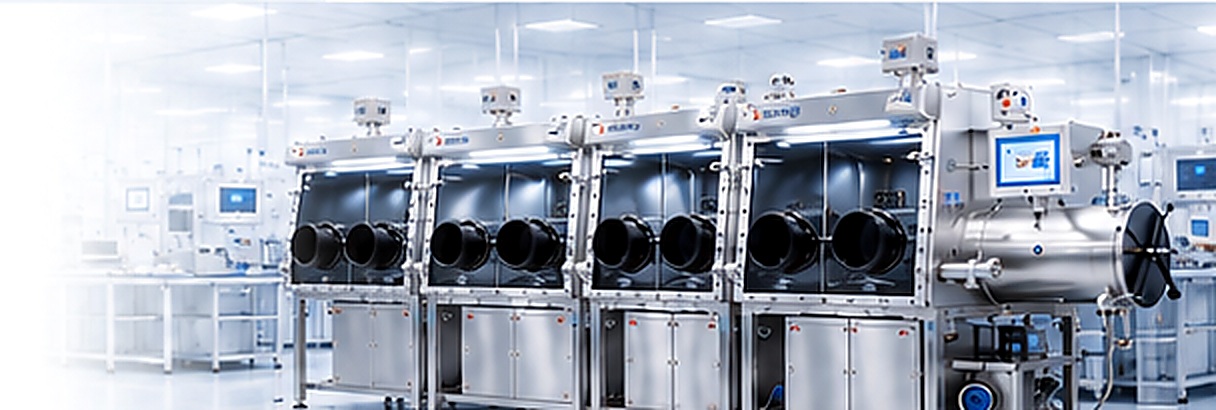
Air-sensitive powders punish a good process plan in quiet ways. A hygroscopic solid electrolyte can pick up moisture during weighing. A catalyst precursor can oxidize during transfer. A perovskite powder can change surface chemistry before the experiment begins. The glovebox is therefore not a peripheral cabinet. It is part of the analytical chain, and its layout, atmosphere control, transfer path, and cleaning routine all affect whether a sample reaches the experiment in the intended state.
TENCAN's eight-station double-sided split-type glove box with gas purification system is a relevant reference point for multi-user powder work. This guide compares it with MBRAUN, an established German supplier of inert-atmosphere gloveboxes, at the supplier and portfolio level. It does not assign model-level values to MBRAUN that were not supplied, and it does not rank brands. The aim is narrower: to show how a documented TENCAN configuration maps to air-sensitive powder handling, which questions separate a suitable box from an unsuitable one, and what to verify before purchase.
One boundary matters from the start. An inert atmosphere is not a biosafety certification, an explosion-protection rating, or a guarantee that every powder remains unchanged. HEPA filtration captures particles; it does not remove oxygen or water. A purge or displacement box is not the same as a continuously purified system. Working pressure, antechamber vacuum, and oxygen and water performance are separate specifications. Each must be stated with its test condition.
Start with the powder, not the box
The first specification is not chamber size. It is the powder's sensitivity profile. Does the material react with oxygen, water, or both? Is the risk a slow surface change, a rapid exotherm, or a physical change such as caking? What is the allowable exposure during weighing and transfer? Is the powder toxic, flammable, pyrophoric, or simply moisture-sensitive? These answers determine whether a purification glovebox, a vacuum glovebox, or a simpler dry environment is appropriate.
For battery materials, the relevant powders may include lithium metal, sulfide or oxide solid electrolytes, silicon-based anode materials, and hygroscopic salts. For perovskite research, precursor salts and finished powders can be moisture-sensitive. Catalyst and organometallic chemistry adds sensitivity to trace oxygen and, in some cases, reactivity that requires a process hazard review. Advanced materials such as hydrides, metal powders, and MOFs may combine air sensitivity with flammability or toxicity. The glovebox cannot be selected from a material name alone; it must be selected from a written handling brief.
That brief should state the target oxygen and water level at the working position, not only at the sensor. It should state batch size, weighing accuracy, the largest and smallest item that must pass through an antechamber, the number of operators, peak transfer frequency, cleaning agents, and any solvent vapor. It should also state how the atmosphere will be verified: by the built-in sensor, by an independent analyzer, or by a sample exposed under a defined protocol. Without those details, a comparison becomes a conversation about cabinet size rather than sample integrity.
What TENCAN documents in the eight-station system
TENCAN lists the product as an Eight-Station Double-Sided Split-Type Glove Box with Gas Purification System. The name documents three architectural choices: eight work stations, access from two sides, and a split-type construction. Those choices are useful for a laboratory that needs several operators or several parallel sample-preparation points without placing every task in one compact chamber. They also create procurement questions: how many operator positions are usable at once, where the antechambers sit, how clean and dirty transfers are separated, and whether the split construction suits the available door width and floor loading.
Because the product includes a gas purification system, it should be evaluated as an atmosphere-management platform, not just a sealed box. A purification system recirculates the working gas through purification media and is supported by sensors, controls, and a regeneration procedure. The important purchasing data are the achievable oxygen and water levels at stated conditions, the sensor technology and calibration interval, the regeneration load, the permitted solvent vapor load, and the alarm behavior. TENCAN's product page identifies the purification configuration; the exact performance envelope should be confirmed for the selected model and installation.
The eight-station layout also changes human factors. More glove ports mean more potential leak paths, more clutter, and a greater need for a disciplined transfer protocol. The advantage is throughput with a common atmosphere. The requirement is layout discipline: a place for clean glassware, a place for powders, a place for waste, and a clear rule about what never enters the box. For a multi-user lab, that discipline is as important as the purification hardware.
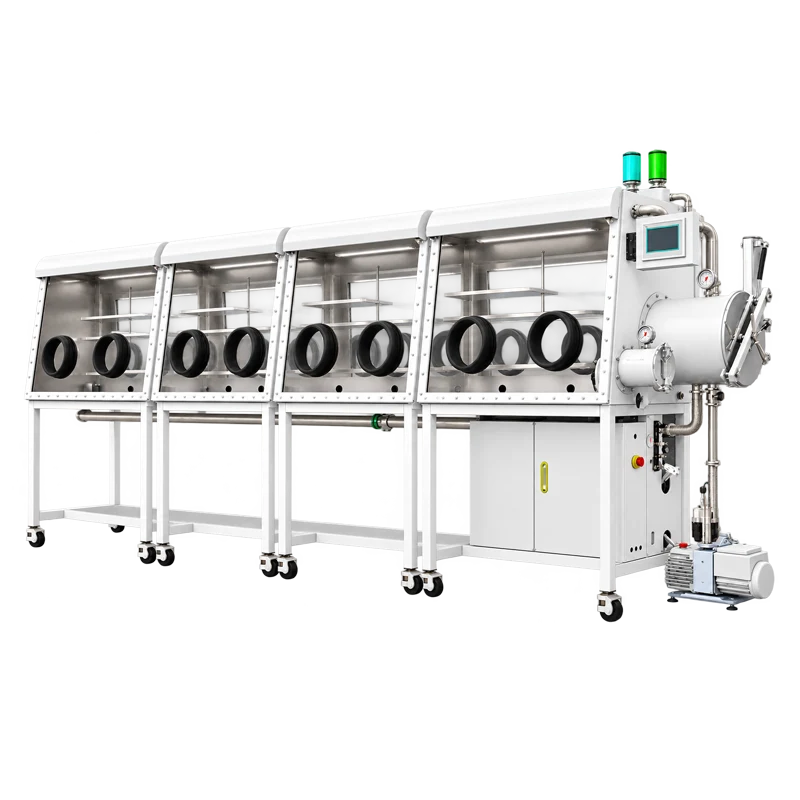
For a closer view of the configuration, the product page is the appropriate starting point: TENCAN eight-station double-sided split-type purification glove box. Use the published layout to test a realistic workflow rather than assuming that eight stations automatically means eight comfortable work positions.
The vacuum pump is an accessory, not an atmosphere specification
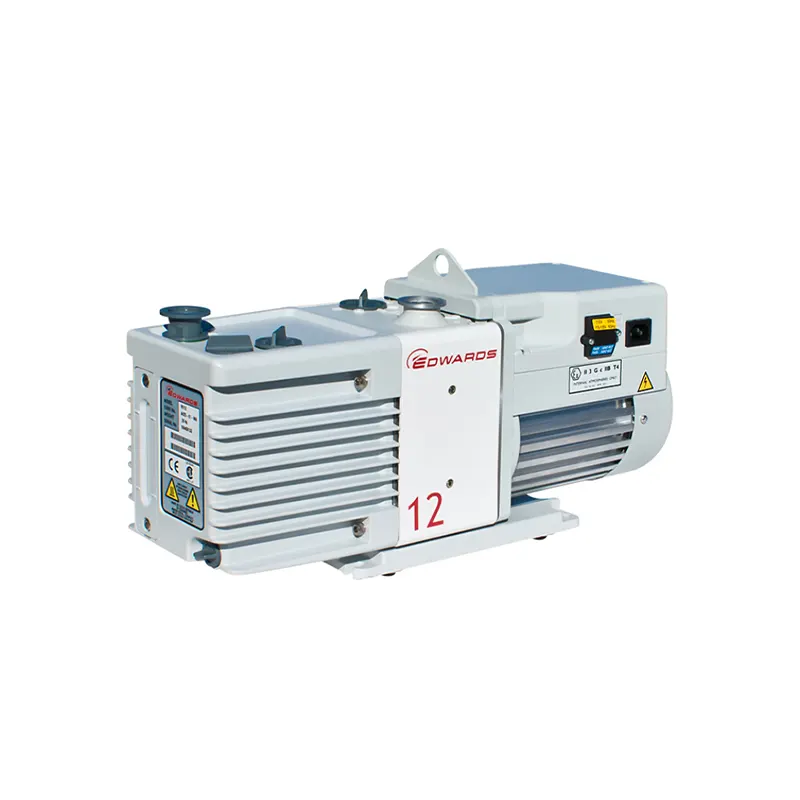
TENCAN lists a Glove Box Vacuum Pump as an accessory. The product name is specific but not a complete specification. In a powder workflow the pump is usually associated with antechamber evacuation, but the correct match depends on chamber volume, required vacuum, cycle frequency, solvent vapor, and the tolerance of the sample to pressure changes. The pump should not be treated as a substitute for purification, and it should not be assumed to be included with every glovebox. Confirm the connection, control interface, ultimate pressure, and chemical compatibility with TENCAN.
Transfer is where many otherwise good gloveboxes fail. A small antechamber that is repeatedly opened, a vacuum path that is slow, or a transfer bag that sheds particles can dominate the working day. Ask for the number and size of antechambers, the vacuum and purge sequence, and the available storage inside the box. If the powder is very fine or highly insulating, ask how the transfer will limit turbulence and static generation. The accessory list is part of the process design, not a shopping list to complete after the cabinet is chosen.
MBRAUN as the international portfolio comparator
MBRAUN is a German supplier with an established inert-atmosphere glovebox and gas-purification portfolio. Its relevance here is as an international reference: a buyer who needs a European supply chain, a broad platform range, or a local service discussion can evaluate MBRAUN with the same criteria used for TENCAN. The positive case for MBRAUN at portfolio level is breadth and application engineering. The appropriate evidence is its current official model documentation, not a generic assumption about what a glovebox can do.
This article does not attribute specific oxygen and water levels, leak rates, regeneration intervals, or cycle times to MBRAUN. Those values are model- and configuration-dependent. A fair comparison asks both suppliers for the same documents: datasheet, utility matrix, acceptance test, sensor calibration certificate, spare-parts list, and service response definitions. That keeps the comparison at the same evidence level and gives the procurement team something it can actually audit.
For TENCAN, the documented starting point is the eight-station purification system and its associated vacuum pump. For MBRAUN, the documented starting point is the supplier's current portfolio and the model selected for the application. Both suppliers should be asked to state what is standard, what is optional, and what is project-specific. The distinction matters because a comparison table that mixes a standard configuration with an optional upgrade is not a comparison at all.
Six criteria that keep the comparison fair
1. Atmosphere target and duty cycle
Define the allowable oxygen and water concentration at the sample, the expected open and close frequency, the number of operators, and the longest unattended period. A box that holds a low level overnight is not automatically suitable for frequent transfers. Ask how the level is measured, where the sensor sits, and how the system recovers after a transfer. Do not accept a single headline number without the test condition. This is also where the distinction between a purge box and a purification system matters. A purge box displaces atmosphere with inert gas; a purification system manages recirculation and regeneration. They solve different problems.
2. Layout and multi-user flow
Eight stations are an advantage only if the work flows. Map the path from material entry to storage, weighing, processing, and exit. Keep powder handling away from turbulence and traffic. Confirm whether the double-sided layout allows a clean and dirty separation, whether the split sections can be isolated, and whether the viewing panels and glove ports are at a comfortable height. For a multi-user lab, label storage zones and assign a transfer owner. A well-designed glovebox with a poor protocol will still produce variable samples.
3. Purification and regeneration
A purification system is a process unit. Ask about the purification media, regeneration trigger, regeneration gas, heat load, and what happens during regeneration. If the lab uses solvents, confirm the permitted vapor load and the compatible trap strategy. If the powder is sensitive to trace impurities, ask whether the measured species is oxygen, water, or both. Confirm alarm and fail-safe behavior. These questions are not brand-specific; they are how a purification claim becomes an operating procedure. The same questions should be sent to TENCAN and to MBRAUN.
4. Antechamber, vacuum, and transfer
Specify the largest item that must pass through, the smallest container that must not tip, and the frequency of transfer. For powders, avoid unnecessary turbulence and static generation. Ask whether the antechamber can be purged and evacuated independently, what the pump duty is, and how the vacuum is vented. The TENCAN vacuum pump accessory should be matched to the selected box, not ordered by name alone. The same discipline applies to MBRAUN or any other platform. A vacuum rating without a chamber volume and cycle definition is not enough to compare.
5. Powder behavior and cleanability
Air sensitivity is only one property. Particle size, surface area, flowability, triboelectric charging, and agglomeration change how a powder behaves in a glovebox. A fine insulating powder can cling to gloves, windows, and weighing boats; a cohesive powder can bridge in a transfer funnel. Ask for antistatic provisions, grounded weighing arrangements, smooth interior surfaces, and a cleaning method that does not introduce water or reactive residues. Confirm material compatibility of gloves, seals, and windows with the powder and any solvent used. Cleanability is a performance feature, not a housekeeping detail.
6. Materials, utilities, and documentation
Ask for the chamber material, window material, seal material, and the cleaning agents that are permitted. For stainless-steel systems, confirm the surface finish and weld treatment. For acrylic or other polymer windows, confirm solvent compatibility and scratch sensitivity. The split-type construction should be reviewed for floor loading, door access, and seismic restraint. Documentation should include utility requirements, leak-test method, sensor calibration, alarm list, spare-parts list, and training scope. A glovebox is a long-lived asset; the manual is part of the product.
Table 1. Supplier-level comparison for air-sensitive powder work
| Selection dimension | TENCAN eight-station purification glovebox | MBRAUN inert-atmosphere portfolio |
|---|---|---|
| Documented configuration | Eight-station, double-sided, split-type chamber with gas purification system; vacuum pump listed as an accessory. | Established German supplier of inert-atmosphere gloveboxes and gas-purification equipment; exact model to be selected from current portfolio. |
| Atmosphere control | Integrated gas purification system; confirm oxygen and water range, sensor type, calibration, regeneration, and alarm logic for the selected model. | Request the same atmosphere data and test method from current official documentation; do not infer from brand name. |
| Scale and throughput | Eight work stations support multi-user or parallel preparation; confirm usable positions, passbox locations, and internal storage. | Select the model and chamber size against the same operator count and transfer frequency. |
| Powder workflow | Suited to weighing, transfer, and material preparation where an inert atmosphere is required; confirm antistatic measures and cleaning access. | Confirm powder-handling options, static control, and cleanability for the proposed model. |
| Vacuum and transfer | TENCAN vacuum pump accessory available; match to antechamber volume, required vacuum, and cycle frequency. | Confirm whether vacuum is integrated or separate, and request antechamber dimensions and cycle definition. |
| Documentation package | Request leak test, sensor calibration, utility matrix, FAT and SAT scope, spare-parts list, and training. | Request the same package and compare like for like. |
The table deliberately separates documented TENCAN configuration from model-specific MBRAUN questions. That is the only fair way to compare when one side has a published product page and the other is being evaluated at portfolio level. It also prevents a common procurement error: treating an optional feature on one side as standard on the other.
Application fit: where an eight-station purification box makes sense
Battery and solid-electrolyte powders
Battery research often involves lithium metal, sulfide or oxide solid electrolytes, silicon-based anode powders, and hygroscopic salts. The powder may need weighing, mixing, pressing, and transfer to a cell-assembly step. An eight-station purification box can support parallel sample preparation if the layout keeps weighing and pressing separate from dirty transfers. The procurement question is not only oxygen and water at the sensor; it is recovery after a transfer and static control around the balance. Confirm that the box can accommodate the balance, press, and tooling, and that the floor and utilities support the installation. TENCAN's product page documents the eight-station purification configuration; specific battery-material compatibility should be confirmed with sample testing.
Perovskite and catalyst research
Perovskite precursors and catalyst powders are sensitive to moisture and oxygen to different degrees. Some are handled under dry air rather than high-purity inert gas; others require a low-oxygen environment. Do not assume that one atmosphere is correct for every material. Define the allowable exposure, the maximum transfer time, and the analytical method used to check the sample. A double-sided box can separate weighing from a reaction or coating step, but only if the airflow and traffic patterns are designed. For catalysts, trace oxygen can change surface speciation; for perovskites, moisture can alter phase behavior. The box should be selected against the analytical question, not against a generic inert label.
Advanced materials and scale-up
Metal powders, hydrides, MOFs, and organometallic precursors may add flammability, toxicity, or pyrophoric behavior. An inert glovebox is not automatically explosion-proof, and it does not replace a process hazard review. If the powder is reactive in air, define the hazard with a safety officer and then ask the supplier which configuration, interlocks, and monitoring are appropriate. TENCAN's purification box may be part of the solution, but the safety case must be built separately. The same applies to MBRAUN or any other supplier. For scale-up, ask how the split-type layout can be expanded, how additional storage can be added, and whether the purification system has capacity for the future load.
Procurement checklist for an air-sensitive powder glovebox
- Material identity or class, with safety data and a written handling brief.
- Target oxygen and water level at the working position, including test method.
- Batch size, weighing accuracy, and the largest and smallest item through the antechamber.
- Number of operators, peak transfer frequency, and the longest unattended period.
- Balance and instrument dimensions, load, vibration, power, and data connections.
- Solvent, acid, base, and cleaning-agent exposure, with material compatibility.
- Powder properties: particle size, static behavior, cohesion, toxicity, and flammability.
- Working pressure and antechamber vacuum stated separately from atmosphere performance.
- Purification concept, sensors, regeneration, alarm logic, and spare media.
- Leak test, factory acceptance test, site acceptance test, and calibration certificates.
- Utility matrix: power, compressed gas, exhaust, heat load, and floor loading.
- Service scope, spare parts, response definitions, warranty, and training.
- Footprint, door access, future expansion, and a realistic installation plan.
Use the same checklist for TENCAN and for MBRAUN. A response that leaves a line blank is not necessarily a weakness, but it is a question to close before purchase. The goal is a written configuration that matches the powder, the people, and the room.
A sensible next step
Prepare a one-page sample brief for TENCAN: powder identity or class, sensitivity, target atmosphere, batch size, weighing method, solvent, transfer frequency, available utilities, and acceptance test. Ask TENCAN to confirm the eight-station layout, purification performance at the stated condition, vacuum pump match, and documentation package. A sample evaluation under the intended handling sequence is more informative than a brochure comparison. If MBRAUN is also on the shortlist, send the same brief and compare the written responses side by side. The right configuration is the one that can be explained, tested, and repeated.
Sources and Further Reading
TENCAN, Eight-Station Double-Sided Split-Type Glove Box with Gas Purification System: product page.
TENCAN, Glove Box Vacuum Pump: product page.
MBRAUN model-level specifications are not cited in this article. Consult MBRAUN's current official documentation for any model under consideration and compare it with the same checklist used above.