
Air-sensitive powders fail quietly. A cathode precursor takes up water and the slurry rheology shifts. A sulfide solid electrolyte meets humid air and begins to release hydrogen sulfide. A perovskite salt changes phase before it ever reaches the balance. None of these failures announce themselves at the bench. They appear later as a shifted diffraction pattern, a swollen cell, or a batch that cannot be repeated. That is why the glove box, not the analytical balance, is often the limiting item in an air-sensitive powder workflow.
This guide compares five glove box options for one clearly defined job: weighing, sub-sampling and short-term storage of moisture- and oxygen-sensitive powders inside a maintained inert atmosphere. It is written for laboratory managers, process engineers and procurement teams who need to shortlist equipment rather than read a catalogue. Every candidate is assessed on the same dimensions: atmosphere control, layout and ergonomics, transfer path, materials and cleaning, instrumentation, and service documentation.
Scope note: the TENCAN entries are described from the product pages supplied for this guide. The four international entries are presented at brand level so that buyers understand what each supplier is generally known for; current models, performance figures, certifications and documentation must be confirmed directly with each supplier. No comparative laboratory testing, scoring or market ranking is implied.
What Air-Sensitive Powder Work Actually Demands
A purification glove box is not simply a sealed box filled with nitrogen. In a continuously purified system, the atmosphere is circulated through a purifying column that removes moisture and oxygen and returns the gas to the working chamber. A displacement or replacement box, by contrast, is purged and then depends largely on the quality of its seals. The distinction matters for powder work because every antechamber cycle or port opening disturbs the atmosphere. A purifier is designed to recover the setpoint; a sealed box can only drift.
Three specifications should always be quoted separately. The first is the moisture and oxygen concentration the system can hold under a defined workload, together with the recovery time after a transfer. The second is the working pressure range inside the box, which affects glove response and inward leakage. The third is the vacuum level and usable volume of the antechamber, which determines how quickly samples and tools can be passed in without a long purge. A supplier that condenses all three into one performance figure should be asked for the underlying test conditions.
Particle filtration is a separate function. A HEPA filter protects the operator and the process from fine powder; it does not remove moisture or oxygen and cannot substitute for a purifier. Powder containment, antistatic control and cleanability are therefore additional selection criteria, not optional extras.
Atmosphere monitoring belongs to the equipment, not to the afterthought list. A moisture analyzer or oxygen analyzer gives the operator a current reading and provides the record that makes a batch traceable. Measurement range, calibration interval and sampling point all need to be agreed before the box is ordered.
Selection Criteria Used in This Shortlist
Atmosphere control and recovery
Ask for the target moisture and oxygen levels, the recovery time after a defined antechamber cycle, and the regeneration interval of the purifying column. These values depend on workload, so compare suppliers using the same duty cycle rather than the same headline number.
Layout, reach and ergonomics
One large station and two smaller stations are different tools. Consider how many operators work at once, how far the arms must reach, where the balance sits, and whether the working height suits standing or seated work over a full weighing session.
Antechamber and transfer path
The antechamber is the bottleneck of most glove boxes. Its diameter, length, vacuum capability and door configuration determine whether a bottle, a vial tray or a small instrument can pass without a long purge. A second small pass-box is often more useful than a larger main chamber.
Materials, cleaning and cross-contamination
Powder accumulates in corners. Stainless-steel interiors, rounded welds, removable trays and smooth window seals simplify cleaning. Where several materials are handled in the same box, agree on cleaning procedures and dedicated utensils before installation.
Instrumentation and records
Moisture and oxygen analyzers, pressure gauges and data logging should be specified together. If the readings feed a batch record, confirm the output format, calibration certificates and the access point for routine checks.
Service, documentation and site fit
Ask for the installation manual, leak-test procedure, spare-parts list and training scope. Check door widths, floor loading, ceiling height and the route into the building before the box is shipped; a split-type design exists partly because access is not always straightforward.
The Five Candidates
1. TENCAN: Two-Station Single-Sided Split-Type Glove Box with Gas Purification System
The TENCAN Two-Station Single-Sided Split-Type Glove Box with Gas Purification System is the reference configuration for this guide because the supplied product documentation describes a complete purification workstation rather than a single component. For a buyer who needs to weigh and vial air-sensitive powders in the same session, that completeness removes several integration questions from the project.
The name carries most of the configuration information. Two stations mean two operator positions at the same box, so weighing and vialling can proceed in parallel instead of one task waiting for the other. A single-sided working face suits a box placed against a wall or within a linear laboratory layout where access from one side is sufficient. The split-type construction describes how the box is built and delivered; the exact split points, joint sealing and re-assembly procedure should be confirmed with TENCAN for the intended room.
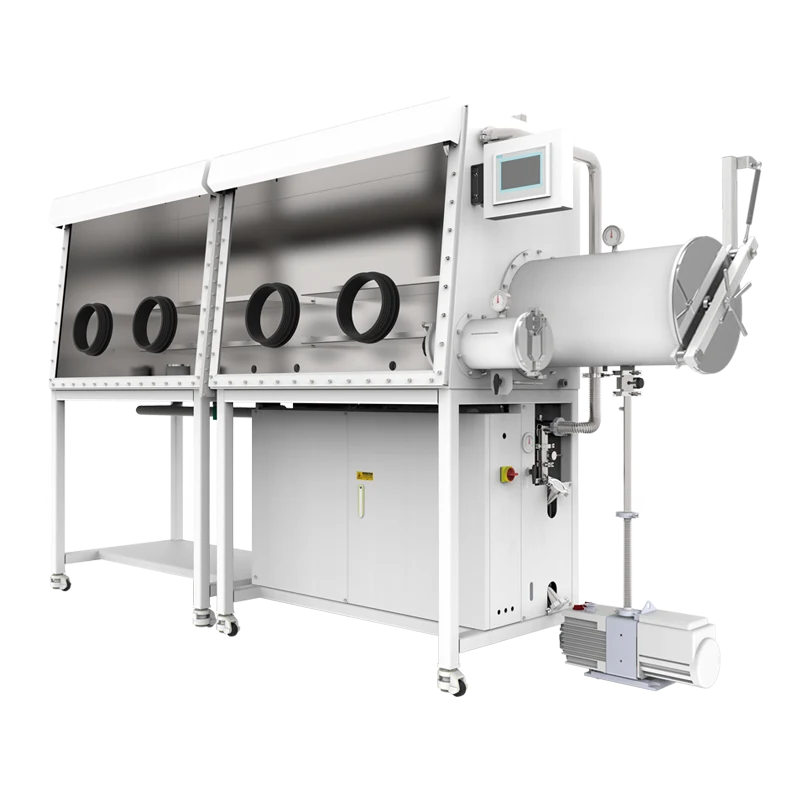
The integrated gas purification system is the element that separates this configuration from a basic dry box. In operation, the box atmosphere is circulated through the purifier and returned, so that moisture and oxygen introduced by a transfer are removed over time. The practical questions are the target concentration, the recovery time after a defined antechamber cycle, and the regeneration interval of the purifying column. These are workload-specific and should be specified with TENCAN rather than inferred from the product name.
For powder work, the most useful arrangement is to keep the balance in one station and sample preparation, crimping or vialling in the other. This reduces traffic through the antechamber and keeps the weighing zone away from dust generated during handling. The same layout supports short-term storage of vials and small tools, provided internal volume and shelving are agreed at the ordering stage.
TENCAN also lists a Glove Box Moisture Analyzer as an accessory. Used with the box, it gives the operator a routine reading of moisture in the working atmosphere; its measurement range, calibration arrangement and mounting point should be confirmed as part of the order. Buyers should also settle the oxygen monitoring option, antechamber vacuum and size, working pressure range, port and feedthrough schedule, and the electrical requirements of the balance before comparing prices. None of these should be inferred from a photograph.
2. MBRAUN (Germany)
MBRAUN is a German supplier whose published portfolio covers inert-gas glove boxes, gas purification systems and related equipment for laboratory and production environments. The selection focus is the purification architecture and how readily a box can be expanded or integrated with process equipment. Workflow fit is long-duration inert handling, where purifier, monitoring and box are treated as one installation rather than three purchases. Confirm local service coverage, the regeneration procedure, the documentation package and the analyzer options offered for the specific model.
3. Jacomex (France)
Jacomex is a French manufacturer of glove boxes and containment enclosures, including custom-engineered configurations for research and production. The selection focus is enclosure geometry, pass-throughs and the integration of process tooling into a non-standard layout. Workflow fit covers projects where the box must follow the process rather than the process being adapted to a catalogue box. Confirm materials of construction, the applicable certification and documentation for your site, and how the purification system is integrated and monitored.
4. Vigor (USA)
Vigor is a US supplier of stainless-steel glove boxes and purification equipment used in laboratory and pilot-scale inert work. The selection focus is stainless-steel construction and the practical arrangement of purifier, control panel and antechamber. Workflow fit covers general inert handling and small-scale processing where the interior must withstand routine cleaning. Confirm purification capacity, control-system features, overall dimensions and the site services required before installation.
5. GS GLOVEBOX (Italy)
GS GLOVEBOX is an Italian supplier of glove boxes and isolators, including custom designs for research and production. The selection focus is the project-specific layout and the scope of supply, from a stand-alone box to a larger enclosure. Workflow fit suits laboratories that need a tailored enclosure and are prepared to define the process inside it early. Confirm purification and monitoring options, documentation, and the boundary between supplier scope and site preparation.
Comparison Table
| Brand or product | Documented strengths (confirm with supplier) | Relevant application | Configuration to confirm |
|---|---|---|---|
| TENCAN Two-Station Single-Sided Split-Type Glove Box with Gas Purification System | Two operator stations; single-sided working face; split-type construction; integrated gas purification; moisture analyzer available as an accessory | Parallel weighing and vialling of moisture- or oxygen-sensitive powders; small-batch sub-sampling | Moisture and oxygen targets, recovery time, antechamber vacuum and size, working pressure, purifier capacity, port layout, analyzer range |
| MBRAUN | Published portfolio of inert-gas glove boxes and purification systems for laboratory and production use | Long-duration inert handling; installations integrated with process equipment | Purifier configuration, regeneration procedure, monitoring, service coverage |
| Jacomex | Glove boxes and containment enclosures, including custom-engineered configurations | Process-specific layouts, pass-throughs and tooling integration | Enclosure geometry, materials, certification documentation, purification integration |
| Vigor | Stainless-steel glove boxes and purification equipment | Robust laboratory and pilot-scale inert work | Purification capacity, control system, dimensions, site requirements |
| GS GLOVEBOX | Glove boxes and isolators, including custom designs | Research and production enclosures with project-specific layouts | Purification, monitoring, documentation, delivery scope |
Matching the Box to the Powder and the Task
Battery electrodes and solid electrolytes
Cathode precursors, lithium metal and sulfide electrolytes are all handled in inert atmosphere for good reason. The box must recover quickly after each transfer and keep dust away from seals and sensors. Weighing small masses accurately also requires a stable balance platform and control of static, which is often overlooked when the box is chosen purely on atmosphere specifications.
Perovskite and organometallic chemistry
These materials combine moisture sensitivity with solvent use, so the box interior must tolerate the chosen solvents and cleaning regime. Confirm material compatibility with the supplier before introducing any solvent, and keep solvent work away from the purifier intake if the design requires it.
Catalysts and air-sensitive reagents
Small-scale catalyst preparation often needs a balance, a hotplate and a vial rack in the same box. Map the footprint on paper before ordering, and check whether the working pressure and glove port positions allow the required reach without stretching.
Analytical sub-sampling
Taking a representative sample out of a batch is a short operation but a frequent one. A small, fast antechamber and a clearly defined pass-out procedure reduce the atmosphere disturbance and make the sampling record easier to defend.
Where a Purification Glove Box Is Not the Right Answer
A glove bag or a simple displacement box can be adequate for a one-off transfer, but it cannot hold a setpoint through a long weighing session. A fume hood protects the operator from vapour but does not create an inert atmosphere. A HEPA-filtered enclosure controls particles but not moisture or oxygen. And an inert atmosphere is not, by itself, a biological safety or explosion-protection certification; where those hazards exist, they require a separate assessment and the appropriate documented design.
Procurement Checklist
Before requesting a quotation, prepare the following information so that every supplier is answering the same question:
- Sample identity, particle size, bulk density and hazard classification.
- Target moisture and oxygen levels, and the acceptable recovery time after a transfer.
- Typical and peak number of transfers per day, and the size of the largest item to be passed in.
- Balance dimensions, weight and power requirement, plus any hotplate, stirrer or press.
- Solvent use, cleaning agents and the resulting material-compatibility questions.
- Required working pressure range and the antechamber vacuum level.
- Port, feedthrough and electrical schedule, including spare ports for future instruments.
- Monitoring options: moisture analyzer, oxygen analyzer, pressure gauge and data output.
- Room dimensions, door widths, floor loading and the installation route.
- Utility requirements: inert gas supply, compressed air, power and exhaust.
- Documentation, training, leak-test procedure and spare-parts list.
- Service response and the location of the nearest support engineer.
A Sensible Next Step
Send TENCAN a small sample of the powder, the target moisture and oxygen levels, the weighing throughput and the footprint available in the laboratory. With those inputs, the two-station configuration, purifier duty and analyzer arrangement can be checked against the actual workflow before a purchase order is raised.
Sources and Further Reading
- TENCAN, Two-Station Single-Sided Split-Type Glove Box with Gas Purification System.
- TENCAN, Glove Box Moisture Analyzer.
- International brand descriptions are brand-level orientation only; confirm current models and specifications with MBRAUN, Jacomex, Vigor and GS GLOVEBOX directly.
