
For laboratories handling air- or moisture-sensitive materials, the glove box decision is rarely settled by asking for the largest enclosure or the lowest advertised number. The useful question is whether the chosen format supports the actual work sequence: how many people or tasks must share the atmosphere, how samples enter and leave, which tools remain inside, and how quickly the environment must return to its operating condition after a disturbance. TENCAN's Two-Station Single-Sided Glove Box with Gas Purification System is a useful case because its name already reveals three design choices: two work positions, access from one side, and an integrated purification loop. Those choices solve different problems, and each has a cost in footprint, gas management, or operating discipline.
The relevant framing is therefore not “what is a purified glove box?” but “when does this arrangement justify itself, and what must be confirmed before it is ordered?” A purification system can provide continuous removal of oxygen and moisture, yet it cannot compensate for a poor transfer routine, an incompatible solvent, or an enclosure layout that forces operators to work at the edge of their reach. Likewise, a two-station format can improve throughput while adding internal volume and more glove-sleeve interfaces to manage. The product name is a starting point for engineering questions, not a performance specification.
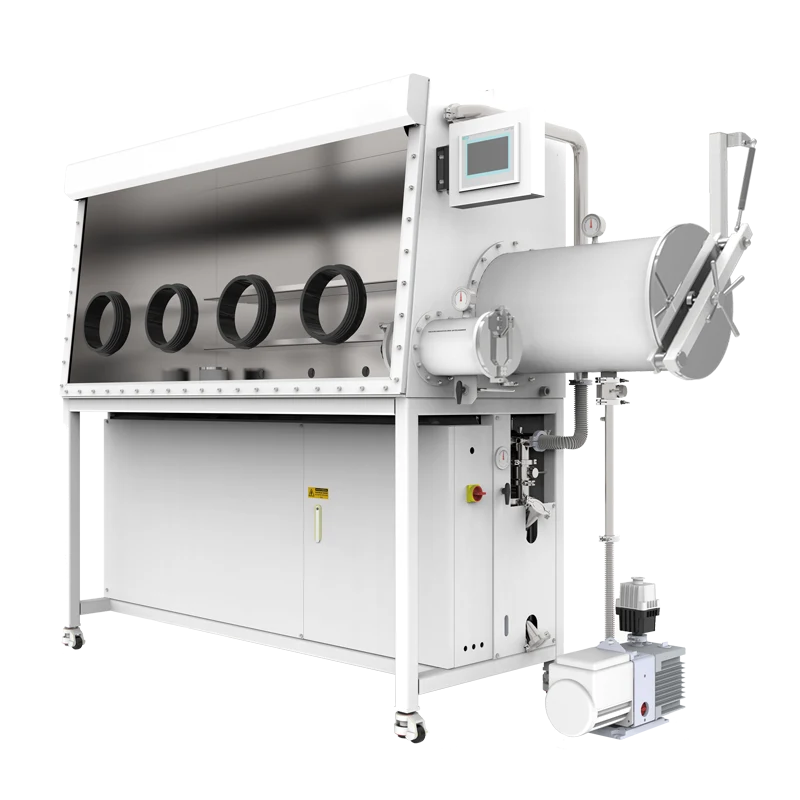
What the Two-Station, Single-Sided Format Changes
The first part of the product name describes working geometry. “Two-station” indicates two work positions, while “single-sided” indicates that operator access is arranged from one face of the enclosure. The two stations share one atmosphere; they are not two independent mini-boxes joined together. That distinction matters because a task performed at one station can affect the atmosphere, tools, and available space at the other. The arrangement can be efficient when two operators need to collaborate, when one person runs a long preparation while another handles analysis, or when a process has two natural hand positions. It asks more of layout planning than a single-station box because both positions must have clear sightlines, adequate reach, and a sensible route for samples and tools.
Single-sided access usually supports a compact bench or floor-standing footprint and keeps the service side of the box distinct from the operator side. It can simplify placement against a wall or within a line of equipment, but the installer still needs room for doors, antechambers, gas panels, and maintenance access. A drawing is more trustworthy than an assumption here. The current TENCAN product page should be used to confirm the external dimensions, window arrangement, glove-port positions, antechamber size, and the available space for the purification unit. None of those details should be inferred from the words “two-station” alone.
Two stations do not automatically double throughput. If one operator must move between positions, the second station can become storage space unless the workflow is designed around it. In a well-planned installation, the second station earns its place through parallel handling: one side receives a sample while the other prepares a substrate, or one operator performs a delicate assembly while a colleague records data. In a poorly planned one, it increases the volume that must be cleaned, purged, and monitored. The question is not whether two stations sound more capable, but whether the laboratory has a repeatable two-position task.
Purification Is a Closed-Loop Function, Not a Synonym for Purging
A gas-purification glove box manages its internal atmosphere by circulating it through a purification unit. The basic elements are familiar: a blower or circulator, one or more purifier columns, valves and piping, sensors for oxygen and moisture, and a controller that decides when the loop should run. The purifier removes contaminants from the circulating gas, while the enclosure limits exchange with the room. The loop is closed in the sense that the working gas is reused rather than continuously dumped. That architecture is different from simply filling the box with inert gas and venting the mixture to the exhaust.
Purging and vacuum exchange are useful tools, but they are not interchangeable with continuous purification. A purge dilutes oxygen, moisture, or solvent vapor by supplying clean gas and releasing the contaminated mixture. It can bring a box into service or clear a temporary upset, but it consumes gas and may not hold a demanding condition under a continuous load. Vacuum exchange removes part of the atmosphere by pumping and refilling; the result depends on the number of cycles, the achievable vacuum, and the gas used. Neither method provides the same continuous contaminant removal as a circulating purifier, and neither should be described as if it does.
Water and oxygen removal are also distinct from particle filtration and solvent control. A HEPA filter captures particles; it does not remove moisture or oxygen, and it is not a substitute for a purifier column. A solvent adsorber can reduce organic vapor, but it does not replace the water/oxygen purification function. An oxygen analyzer measures the atmosphere; it does not clean it. These separations matter during troubleshooting because a rising reading may point to a transfer event, an outgassing sample, or an analyzer issue rather than to the purifier alone.
The TENCAN product is identified as a glove box with a gas purification system, which tells you the architecture, not a guaranteed residual level. Purifier capacity, circulation flow, sensor type, regeneration strategy, and allowable working gas all depend on the configuration. A responsible quotation should state which conditions are guaranteed, how they are measured, and what load or operating state applies. It should also distinguish working gas from control gas and regeneration gas, and explain what happens during regeneration. Regeneration is an operating state with its own sequencing; it is not the same as normal circulation.
Matching the Box to the Material and Work Sequence
Sensitive-material work covers a wide range of demands. Lithium metal and solid-state battery precursors may react with moisture; perovskites and OLED materials may be sensitive to oxygen, water, or both; air-sensitive catalysts and organometallics may require a specific inert gas; metal powders and additive-manufacturing feedstock may need controlled handling for reasons that include oxidation and dust. The box is not automatically suitable for all of them. “Inert” is gas-specific and material-specific: argon and nitrogen are not interchangeable for every sample, and a low oxygen reading does not prove that a solvent, vapor, or biological hazard is controlled.
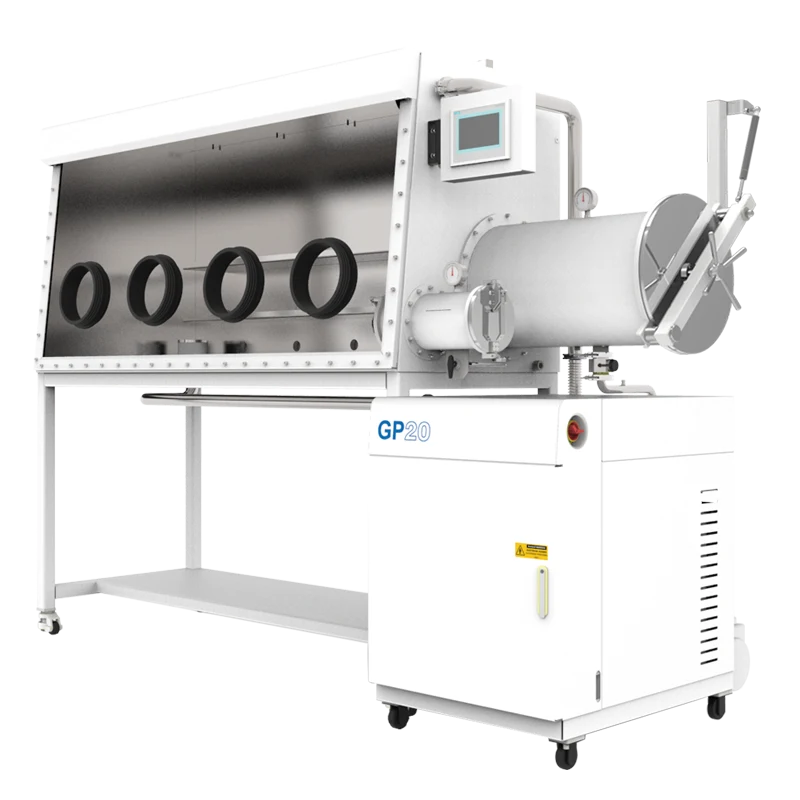
The work sequence determines the useful configuration. If a single operator performs short preparations and analysis in one session, a single station may provide better economy of internal volume and cleaning effort. If two operators must work at once, or if a long assembly and a separate weighing step must proceed in parallel, the two-station format can prevent queuing. The trade-off is that the larger working volume and additional glove interfaces must be managed. More internal surface, more stored tools, and more hand movements can all add to the contamination load.
Material compatibility deserves the same attention as atmosphere. Gloves, seals, viewing panels, tubing, and internal fixtures must tolerate the solvents and reagents used. A box that is effective for dry inorganic powders may be a poor place for a solvent-heavy process unless the solvent vapor is managed and the wetted materials are compatible. Heat-generating tools, hot plates, and curing lamps add another load; they should be discussed with the supplier rather than treated as ordinary benchtop equipment. The same applies to sharp tools, abrasive powders, and anything that can damage a glove or a seal.
Visibility and ergonomics are not cosmetic issues. A single-sided box is viewed from one side, so the operator's line of sight, the height of the work surface, and the position of the antechamber affect how often the gloves are strained or the sample is moved unnecessarily. Two stations with poor sightlines can be worse than one well-placed station. Ask for the internal layout and confirm that the intended tools fit without blocking the purification return or the sensor location.
The target atmosphere should be written as an operating window, not a slogan. It should state which gas is used, what oxygen and moisture ranges are acceptable for the samples, whether those values must hold continuously or only during critical steps, and how long recovery may take after a transfer. This is also where the two-station layout meets the purification design: a larger working volume with more access points may tolerate the same purifier only if the transfer discipline is tighter. If the process generates solvent vapor or particles, those loads need their own controls. A single “low oxygen” claim cannot answer these questions, and a supplier cannot size a system responsibly without the load description.
Transfer, Pressure, and the Recovery Behavior Users Notice
Most atmosphere disturbances begin at a boundary: a door, a glove, a feedthrough, or an antechamber. The antechamber is the small airlock used to move samples and tools in or out. Its useful selection questions are capacity, door size, shelf or rail arrangement, whether it has vacuum capability, and how it is purged. A generous antechamber reduces the need to break large items into pieces, but it also increases the gas and pump time per cycle. A small antechamber is quicker but may force awkward handling, which can lead to a partially sealed door or a rushed transfer.
Pressure and vacuum readings need to be kept with their objects. The box working pressure, the antechamber vacuum, the pump's ultimate vacuum, the leak rate, and the oxygen or moisture reading are different quantities. A pump may reach a very low ultimate vacuum in a closed test, yet the antechamber may still have a slow leak; a display may show a fine resolution, yet its measurement accuracy and calibration may be worse. Do not convert one value into another or treat a model's best-case number as a continuous guarantee for every installation. Keep the original units and the stated test conditions.
After a transfer, it is normal to see the oxygen or moisture reading move. The interesting question is how quickly and completely it returns under a defined load. Possible causes include air carried in on the item or trapped in the antechamber, outgassing from the sample or its container, residual solvent, a glove or seal that is not seated, a purifier that is due for regeneration or replacement, or a sensor that is responding to a local pocket rather than the bulk atmosphere. Without diagnostic evidence, it is not responsible to call any of these a confirmed equipment fault.
A practical recovery check separates the load from the system. Observe the reading with the box empty and stable, then repeat a controlled transfer with a known clean tool. Compare the direction and duration of the change. Check the antechamber cycle, door seals, glove cuffs, and feedthrough fittings. Confirm the analyzer's last calibration and the purifier status. If a new material is the only change, isolate it and discuss its vapor pressure and outgassing behavior with the supplier. If the recovery slows only after a particular operation, the operation may be the dominant load. This kind of sequence is more informative than increasing purge time without knowing what is being removed.
The most useful instrument is a trend, not a single display value. A logged recovery curve after a repeatable transfer shows whether the system returns to its baseline in a consistent time. It also separates a slow sensor from a real contamination load. If the reading drifts while the box is closed and unused, look for a leak, an outgassing source, or a calibration issue; if it moves only when a specific item enters, review the transfer and the item. Record the gas supply, purifier state, and antechamber cycle alongside the reading so that later comparisons mean something.
Data Feedthroughs, KF40 Ethernet, and Instrumentation
Modern sensitive-material work often brings a computer, balance, potentiostat, camera, or sensor cable into the box. Passing a cable through an open door or pinching it in a glove port is not a controlled solution. A feedthrough provides a defined path through the enclosure boundary, with a fitting and a cable or connector arrangement that can be sealed and tested. It is a small component, but it affects atmosphere integrity, cable routing, electromagnetic behavior, and the way the box is serviced.
The KF40 Ethernet Feedthrough listed in TENCAN's accessories is identified by its flange style and data type. KF40 is a flange size, while Ethernet describes the signal. Those two facts are not enough to establish the cable category, connector gender, shielding, vacuum rating, leak performance, or whether the feedthrough is appropriate for a particular box. If the enclosure has a compatible KF40 port and the electrical requirements match, the feedthrough can support a data connection without opening the main chamber. If no port exists, adding one is an engineering change that should be reviewed and leak-tested; a KF40 fitting should not be assumed to be present on every glove box.
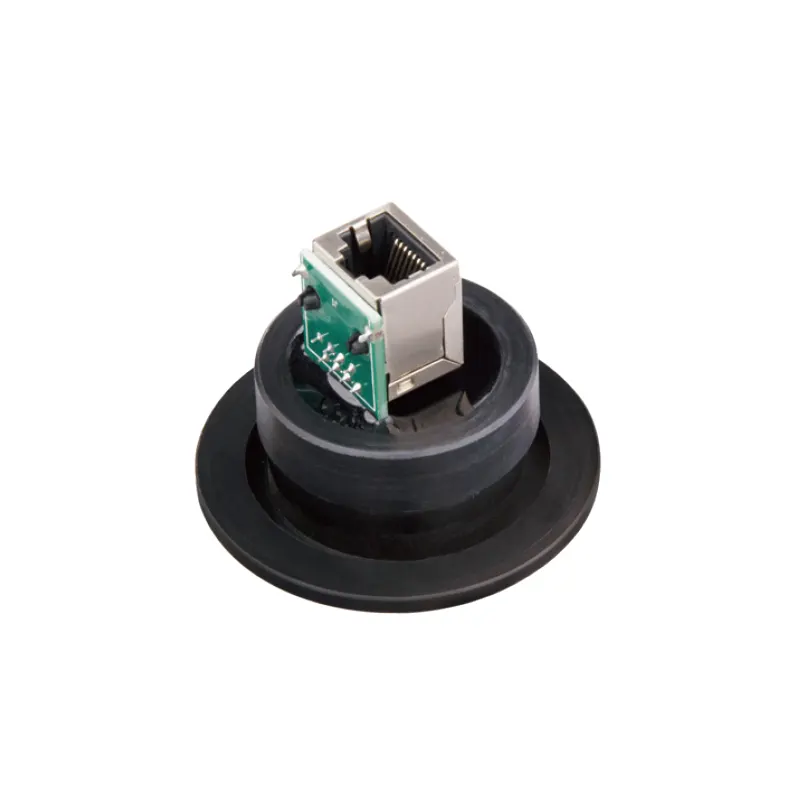
Ethernet is a data connection, not a general power supply. Devices that require power need a separately rated electrical feedthrough, and Power over Ethernet should be confirmed rather than assumed. Cable length, service loops, strain relief, grounding, and shielding all matter when a cable crosses a sealed boundary. A feedthrough that is mechanically convenient but poorly supported can load the fitting or abrade the cable. During commissioning, check the fitting, the mating connector, and the data link while the box is at its normal working condition. Add the new penetration to the leak-check and maintenance records.
The accessory image below shows the KF40 Ethernet feedthrough as a separate interface component. It is not a substitute for a purification system or a transfer chamber; it simply lets a data line cross the boundary in a controlled way. Its role in a two-station box is easiest to justify when the work requires continuous logging or communication between an internal instrument and an external computer. If the instrument can remain outside the box, that may be simpler; if it must be inside, the feedthrough should be part of the initial layout discussion rather than a later improvisation.
Configuration Review Before Quotation
The most useful request for quotation is a short process description, not only a model name. State what the box must protect, how often it is opened, what enters and leaves, which solvents and particles are present, whether heat or vacuum is involved, and what data connections are needed. Ask for a current drawing and a clear list of included items. Then compare the proposed two-station single-sided configuration against the actual work sequence rather than against a generic checklist.
| Configuration question | Why it matters | What to provide |
|---|---|---|
| Task and operators | Determines whether two stations are used in parallel or become storage | Describe a typical run and peak run |
| Internal equipment | Tools consume space and create outgassing/heat | Dimensions, power, heat, materials |
| Transfer routine | Antechamber size and cycle define disturbance | Item sizes, frequency, packaging |
| Solvents and particles | Compatibility, adsorption, filtration needs | Solvent list, quantity, particle type |
| Target atmosphere | Defines monitoring and acceptance test | Gas, target range, recovery expectation |
| Data and power | Feedthroughs add boundary penetrations | Cable types, connectors, power needs |
| Gas supply and regeneration | Purification depends on gas and service infrastructure | Available gas, purity, pressure, exhaust |
| Service and validation | Access, spares, calibration, training affect uptime | Site constraints, maintenance plan |
During review, ask specifically whether the gas purification system is integrated or supplied as a separate unit, which gases are acceptable, how the atmosphere is monitored, and what the supplier includes for commissioning. Do not accept a single peak number as a substitute for an operating specification. Ask how the guaranteed condition is measured: at what location, after what stabilization time, with what load, and with which gas. These questions are not adversarial; they define the boundary between a demonstration and a working method.
Finally, plan the human side. A two-station single-sided box works best when the transfer point, tools, and data connections support a repeatable choreography. If samples are heavy, if gloves are frequently changed, or if two operators must reach across each other, the layout will show it. The right configuration is the one that keeps the atmosphere stable through the real workday, not the one with the longest feature list. Use the TENCAN product page as the starting point for a configuration discussion, and require the final proposal to match the drawings, the materials, and the measurements you will actually use.
