
Stainless steel glove boxes are often treated as a single category. Two units can share the same box, gloves, and viewing window while operating on entirely different atmosphere strategies. One may recirculate gas through purifying columns; another may depend on vacuum and inert-gas refill to establish a working atmosphere. That difference changes sample throughput, operating cost, achievable conditions, and the kind of work that can be repeated reliably.
The GBV-3 stainless steel vacuum glove box belongs to the vacuum-replacement family. TENCAN identifies it as a stainless steel vacuum glove box, which makes the pump-and-refill cycle, not continuous purification, the first design question to examine. For a laboratory comparing enclosure types, the practical task is not to decide which label sounds more advanced. It is to establish whether vacuum replacement matches the materials, the duration of exposure, and the frequency of transfer.
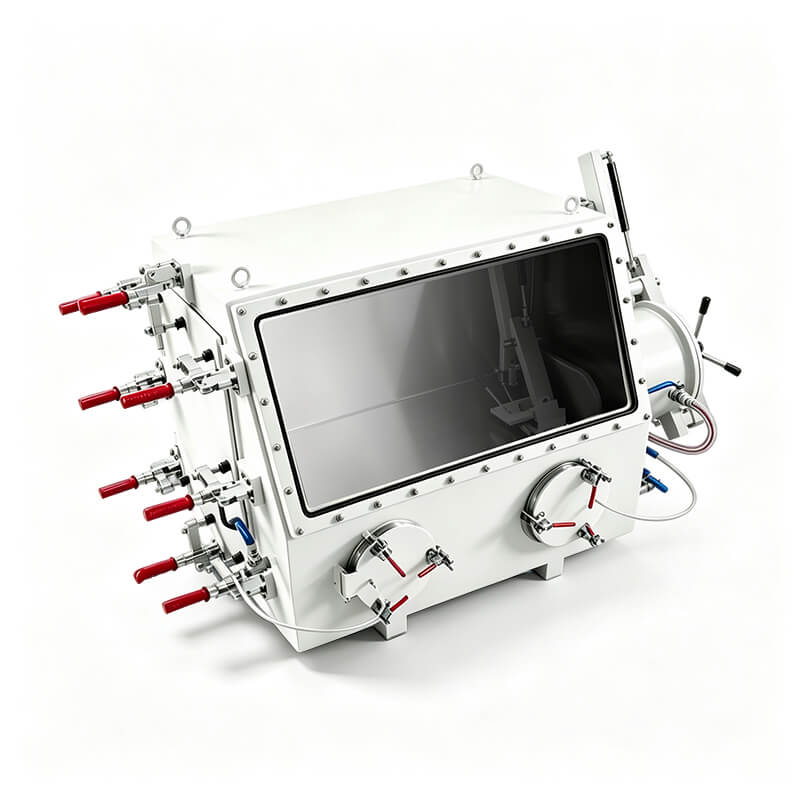
The design intent behind a stainless steel vacuum glove box
Most vacuum glove boxes share a recognizable architecture: a rigid chamber with glove ports, a viewing panel, a transfer path, and gas and vacuum connections. The operator works through gloves while the chamber separates the sample from room air. In a stainless steel vacuum glove box, the chamber is intended to be evacuated and refilled with an inert gas. One or more exchange cycles reduce the original air inventory, and the refill gas sets the new atmosphere. The result can be a controlled environment, but it is not automatically a continuously conditioned one.
Continuous purification is a different mechanism. A purifier circulates gas through material that adsorbs or reacts with water and oxygen, and the loop can continue while the box is in use. A vacuum-replacement box does not automatically have that loop. If gas is not being purified, impurities that enter through gloves, seals, transfer operations, or outgassing remain in the gas phase and can accumulate. The distinction matters because the phrase glove box says nothing about whether purification is present.
The choice of stainless steel is more than a finish. Stainless steel gives the enclosure mechanical robustness and a cleanable interior, and it is often selected where vacuum or solvent exposure would be a concern for other materials. It does not, by itself, guarantee compatibility with every acid, solvent, or reactive gas. Welds, window seals, glove material, O-rings, and valves are part of the exposed system. A process that attacks one of those components is not made safe by the chamber's stainless-steel shell.
Vacuum introduces structural and operational trade-offs. The chamber, window, and seals must be designed for the intended pressure difference. Gloves can be displaced during evacuation and must be managed according to the manufacturer's procedure. Working pressure, the vacuum level used for exchange, and the pump's ultimate vacuum are separate quantities. None of them should be inferred from a model name. The TENCAN GBV-3 page is the controlling source for available dimensions, port layout, and options; where a value is not stated, confirm it rather than assume it.
Vacuum replacement versus continuous purification
Vacuum replacement and continuous purification solve related but not identical problems. The table below compares them at the level of operating logic. It is not a specification for a particular model, and it cannot replace the current product data for the GBV-3 or any other enclosure.
| Selection point | Vacuum-replacement glove box | Continuously purified glove box |
|---|---|---|
| Primary atmosphere control | Evacuate and refill with inert gas; repeat as needed | Circulate gas through purification material while the box is closed |
| Typical duty cycle | Batch work, intermittent access, processes that also need vacuum | Long or frequent work where a steadier atmosphere matters |
| Recovery after transfer | Re-established by exchange cycles; depends on chamber, gas, and procedure | Purifier and circulation work to remove incoming water and oxygen |
| Infrastructure and consumables | Inert gas, pump maintenance, seals, and gloves | Purification media, circulation power, gas, and maintenance |
| Key verification | Leak-tightness, exchange procedure, gas purity, vacuum compatibility | Purifier capacity, flow, sensor calibration, regeneration, leak-tightness |
| Limits | No continuous removal loop unless one is fitted | Not a vacuum chamber unless designed for it; purification does not replace containment |
Neither method overrides physics. The refill gas has its own purity. Residual air remains in dead volumes. Walls, gloves, and samples can release water or solvent vapor after the chamber has been closed. A few exchange cycles do not create an absolute barrier, and a purifier cannot compensate for a leaking glove or a bad seal. This is why atmosphere claims need test conditions: starting state, chamber volume, gas quality, number of cycles, sensor type, and stabilization time.
Selection should follow duty cycle. If the work needs a vacuum step, runs in batches, and can tolerate re-establishing the atmosphere between operations, a vacuum-replacement box is a coherent choice. If samples are added frequently, the box stays closed for long experiments, and the process needs continuous removal of incoming water and oxygen, a purifier is usually the more logical starting point. A hybrid system is possible, but it must be explicit in the configuration. Do not assume a vacuum glove box has a purification loop simply because the enclosure looks similar to a purified unit.
Where the GBV-3 fits, and where it does not
Because the GBV-3 is a stainless steel vacuum glove box, its natural role is work in which evacuation and inert refill are acceptable or useful. That includes batch handling of air-sensitive samples in closed containers, short assemblies or inspections, sealing operations, and processes that already require a vacuum step. It is also relevant where an operator wants a rigid stainless enclosure for mechanical protection and cleaning, and where the atmosphere can be re-established between campaigns rather than held continuously for days.
Vacuum-capable does not mean every sample can be pumped on. Powders can be disturbed, lightweight foils can move, solvents can evaporate, and some materials trap gas or release it slowly. The evacuation step must be compatible with the sample and container; no generic article can prescribe a cycle for an unknown material. If the work involves loose powder, the first question is whether the powder will remain contained during pump-down and refill. A closed vial or secondary container may be more important than the box's atmosphere alone.
The enclosure is a poor fit when the process demands continuous low-level water and oxygen control while the gloves are in frequent use. A vacuum-only box can be excellent for a sealed batch, but every transfer and every pump-and-refill event is a disturbance. If the experiment needs stable conditions for hours while samples are added and removed, a purifier or a suitably integrated system is usually the more coherent starting point. That is not a criticism of vacuum boxes; it is a statement about duty cycle. Buying a vacuum box for a continuous-purification job creates a daily workaround, and buying a purifier for a job that really needs evacuation adds cost without solving the vacuum requirement.
Stainless steel construction can support cleaning and resistance, but solvent vapors still contact gloves, window seals, and O-rings. Confirm compatibility of the whole exposed bill of materials. Visibility through the viewing panel is valuable, but visibility is not the same as atmosphere performance. A clear panel with poor sealing or an incompatible glove is still a leak path. Finally, the model name should not be used as a performance guarantee. GBV-3 identifies the product family and broad configuration; it does not tell you the chamber volume, leak rate, or achievable moisture level. Those must come from current product data or a written quotation.
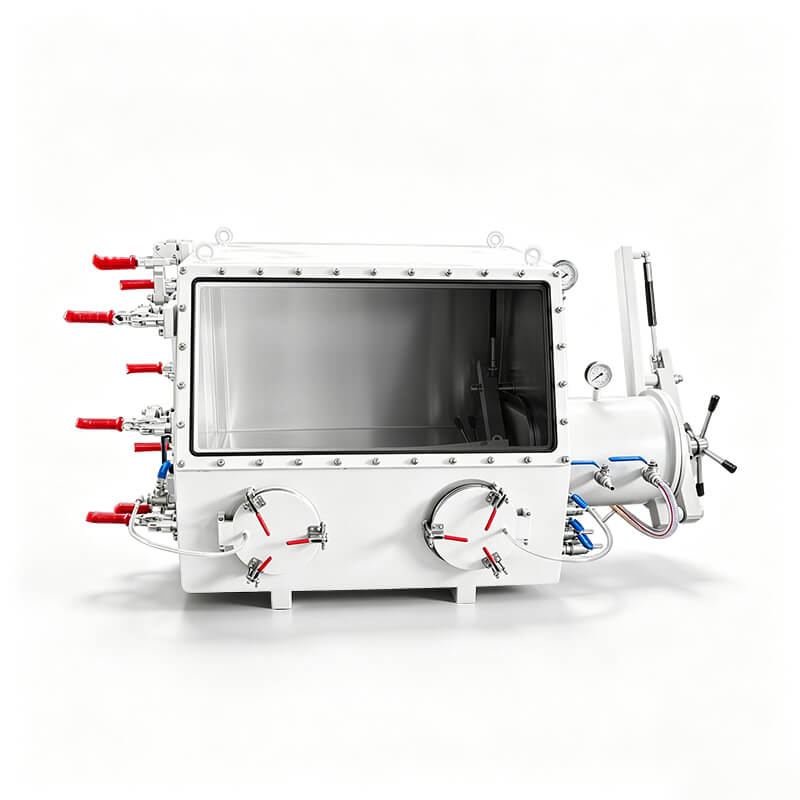
Reading pressure, vacuum, oxygen, and moisture correctly
Operators often compare numbers that measure different things. A working-pressure gauge, a vacuum gauge on the transfer chamber, the pump's ultimate pressure, a leak-rate test, and an oxygen or moisture analyzer answer different questions. A box can hold a modest vacuum and still have a poor leak rate under another test. A pump can reach a low ultimate pressure and still be poorly matched to the gas load. None of these values is interchangeable.
What each reading actually describes
- Working pressure: the slight positive or negative pressure maintained during operation. It affects glove behavior, seal loading, and the way the enclosure is used.
- Vacuum level: how far the chamber or transfer volume has been evacuated. It is not a statement of gas purity.
- Pump ultimate vacuum: a pump capability under defined conditions. It is not the system leak rate and not the oxygen concentration in the box.
- Leak rate: ingress under a specified pressure difference. It needs a stated test method and acceptance criterion.
- Oxygen and moisture concentration: gas composition at a particular sample point. It depends on the analyzer, calibration, location, and stabilization time.
- Analyzer resolution: the smallest displayed change, which is not the same as measurement accuracy. Accuracy depends on calibration and the full measurement chain.
An analyzer measures atmosphere; it does not purify it. HEPA filtration removes particles; it does not remove water or oxygen. Solvent adsorption protects the process or a purifier from solvent vapor, but it does not replace a water and oxygen removal step. These are separate functions, and treating them as one is a common source of disappointing performance.
Why a reading can recover slowly
A slow return to a stable oxygen or moisture reading has several plausible causes. There may be real ingress through a glove, seal, valve, or fitting. The transfer may have introduced more air than expected. Materials inside the chamber may be outgassing. The exchange procedure may be too short for the chamber volume. The supply gas may not meet the assumed purity. If a purifier is present, its media may be exhausted or its flow may be inadequate. The analyzer itself may be misplaced, uncalibrated, or slow to respond.
This list is diagnostic, not a verdict. If the issue persists, use a leak test and a documented exchange cycle before adding more purge gas. More purging can hide a leak while consuming gas and time. For the GBV-3, ask what sensor and sampling point any reading represents. A value taken in a quiet corner may not describe the sample zone, especially after a transfer or during glove movement.
Sample transfer, pumping cycles, and atmosphere recovery
Sample transfer dominates atmosphere quality in any glove box, and it is especially visible in a vacuum-replacement system because there is no continuous purifier working in the background. If the GBV-3 configuration includes an antecamber, its volume and pump-and-refill procedure determine how much air enters the main chamber. Do not assume an antecamber is present; verify the configuration. If transfer must pass through the main chamber, the disturbance is larger and the recovery procedure needs to be planned.
Transfer principles to evaluate
- Keep sample containers closed and clean, and avoid dust on sealing surfaces.
- Use the smallest practical transfer load and avoid unnecessary open time.
- Confirm that the inert gas supply meets the purity assumed by the process.
- Allow time for mixing and stabilization before treating an analyzer reading as steady state.
- Use HEPA filtration for particles, not as a substitute for water or oxygen control.
- Use solvent-compatible traps and materials where solvents are present; confirm the entire exposed material set.
Powders deserve specific attention. Fine particles can migrate, adhere to seals, and create cleanup problems. A stainless chamber is easier to wipe than some alternatives, but cleaning is not the same as removing adsorbed water. If a process generates dust, plan containment at the sample level and confirm that the transfer path can be cleaned without damaging gloves or sealing surfaces.
Throughput also belongs in the calculation. Twenty transfers per day through a small antecamber is a different problem from one sealed batch per week. In the first case, vacuum cycles can dominate the schedule and a purifier may be worth considering. In the second, a purifier may sit underused while the vacuum-replacement approach does the necessary job. The GBV-3 should be evaluated against the real schedule, not against an idealized experiment that never opens the box.
Data access through a sealed enclosure
Sealed enclosures often need data, not just gas. A camera, a sensor, a datalogger, or an instrument may need an Ethernet connection to the outside. Drilling a hole through a glove box panel is not an acceptable solution; it defeats the enclosure. A feedthrough provides a controlled path through a defined flange, with sealing and mechanical support treated as part of the design.
TENCAN lists a KF40 Ethernet feedthrough in its glove-box accessory range. In general terms, a KF40 Ethernet feedthrough is a flange-mounted connector assembly that carries an Ethernet signal through a KF40 port while maintaining the sealing boundary. The important word is defined: the flange, feedthrough body, connector, cable, and sealing method must be compatible with the enclosure and with the vacuum or pressure regime.
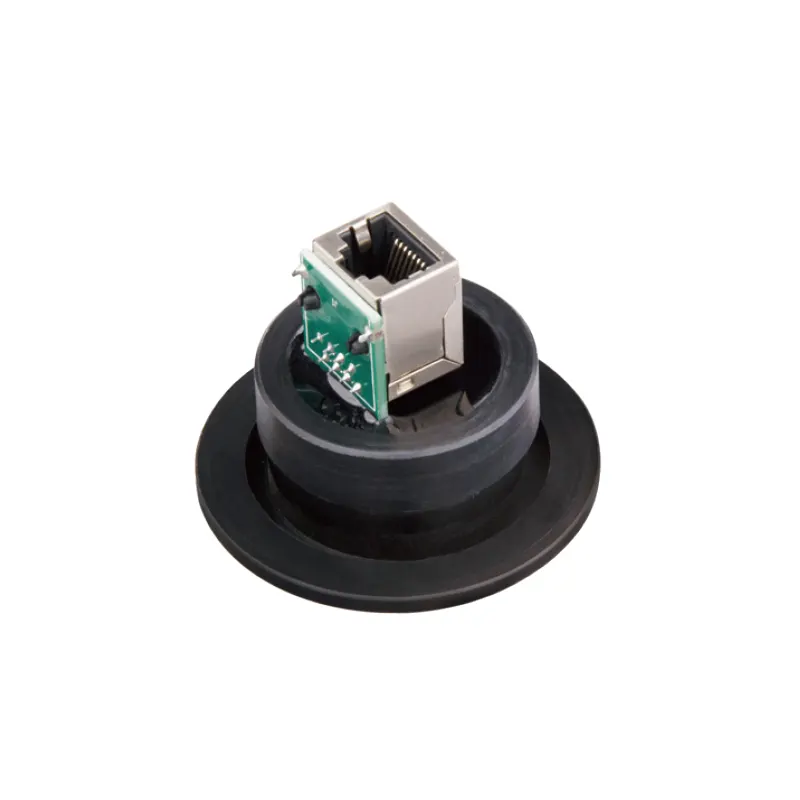
Will it fit the GBV-3?
A KF40 feedthrough is not universal. It requires a KF40 port or a compatible engineered adapter on the chamber; the sealing surfaces must be correct; the vacuum-side materials must suit the process; and the cable must not interfere with gloves or sample handling. If the GBV-3 configuration does not include a KF40 port, do not assume the part can simply be clamped anywhere. Ask TENCAN to confirm port location, flange standard, seal material, and leak-test procedure.
An Ethernet feedthrough is not a power feedthrough. It does not supply mains or DC power to an instrument, and it does not condition the atmosphere. If an instrument needs power and data, plan both paths and keep power and signal routing separated according to the equipment supplier's requirements. For sensitive data, shielding and cable length matter; those details should be specified, not guessed.
The accessory is relevant only when the experiment actually needs a wired network connection through the enclosure. A box used only for sealed vials may not need it at all. A box used for in-situ sensors, cameras, or continuous data logging may need the connection planned before the chamber is built, because port location and internal cable routing are difficult to improve later.
Configuration checklist before specifying a system
Before specifying the GBV-3 or any vacuum glove box, write down the process rather than the product category. The following checklist separates the decisions that change the mechanism from those that only change the fittings.
- Process and materials: samples, byproducts, solvents, dust, outgassing, temperature, and whether evacuation is acceptable for the sample form.
- Atmosphere target: the required oxygen and moisture level, the duration for which it must hold, and whether a vacuum-replacement cycle can meet it.
- Duty cycle: transfers per shift, open-glove time, batch versus continuous work, and acceptable recovery time.
- Enclosure: chamber size, glove-port count and position, viewing requirements, stainless grade, window material, and transfer chamber. Verify which options are actually available for the GBV-3.
- Vacuum: pump compatibility, ultimate vacuum, working pressure, gauges, leak test, and exhaust routing.
- Connectivity: Ethernet, power, sensor feedthroughs, and KF ports. Confirm KF40 Ethernet feedthrough compatibility with the selected chamber.
- Safety and compatibility: solvent compatibility, pressure and vacuum limits, personal protective equipment, and the manufacturer's operating procedure. Do not claim sterile, cleanroom, or biocontainment performance without documented evidence.
Information to provide to a supplier includes the process description, sample and solvent list, required atmosphere and duration, transfer frequency, instrument connections, facility gas and power, floor space, and the acceptance test that will be used after installation. These details let the supplier recommend a mechanism and configuration instead of matching a model number to a vague application.
TENCAN's GBV-3 is a sensible starting point when a stainless steel vacuum chamber, batch atmosphere exchange, and a rigid enclosure match the work. It is not a universal replacement for a continuously purified glove box, and the model name alone is not evidence of a particular oxygen or moisture level. The useful purchase decision is made by matching mechanism to duty cycle, then confirming dimensions, ports, vacuum performance, and accessory compatibility in writing.
Start with the sample, the acceptable exposure, and the number of transfers per day. Those three facts usually separate a vacuum-replacement requirement from a continuous-purification requirement faster than a catalog comparison. Once the mechanism is right, the remaining choices, including chamber layout, pump, transfer chamber, analyzer, and feedthroughs, can be specified with fewer surprises.
