
Every glove box specification is argued over in terms of the large components: the antechamber, the circulation blower, the purification column, the oxygen and moisture analyzers. The glove box port cover rarely enters that conversation. Yet it is one of the few accessories that sits directly on the boundary between a controlled atmosphere and the room, and the way it fits, seals and is used affects how much work the purification system has to do.
This article treats the port cover as a functional part of an atmosphere-controlled system rather than a cosmetic cap: what it does, where it sits among the enclosure's seals, which interfaces decide whether it fits, how it behaves on multi-port and double-sided cabinets, and what to check after installation. Values such as port diameter, gasket hardness or compression force have to come from the current datasheet for the exact part, so they are not assumed here.
What a Port Cover Does in a Glove Box System
A port cover is a closure that closes off a glove port — the round opening in the front window or wall of a glove box through which the glove is mounted. On most enclosures the port is a machined or moulded ring with a flange, sometimes with a groove for an O-ring, and the glove is held in place by a retaining ring, an O-ring band or a clamp. A cover sits against that same ring geometry. Its functions split into three groups, and confusing them is the most common reason people are disappointed by a part that looked trivial.
Blanking a port that is not in use
Multi-port enclosures are rarely operated with every port occupied. A double-sided cabinet may have ports on both faces; a four-station cabinet multiplies that again. Operators tend to work from one or two positions and leave the rest idle. An idle port is still an open design feature: the glove hangs in the opening, its elastomer is exposed to room light, dust, sharp objects on the bench and accidental contact, and the glove bead is the only barrier between the process atmosphere and the room.
A cover closes that opening on the room side. It adds a rigid mechanical barrier in front of the glove, protects the elastomer from abrasion, cuts, spills and unnecessary handling, and discourages operators from reaching in through a port they are not using. In day-to-day practice the protection function is the one that pays back most quickly, because glove damage is one of the most frequent causes of an unplanned atmosphere excursion.
Isolating a port during glove change and maintenance
When a glove is replaced, its port has to be opened, and the enclosure is exposed to the room for as long as the work takes. A cover can be used to close or shield a port during that window, and to blank the port afterwards while hardware is checked. The exact sequence — whether the box is left under slight positive pressure, whether tools go through the antechamber, how long a port may stay open, and what purge is required before normal operation resumes — depends on the enclosure design and the manufacturer's procedure. A cover does not change those rules; it gives you a defined part to close the opening with.
Several covers are also useful for a box that is idle, being moved between rooms, or stored. They keep dust and workshop debris out of the gloves and stop a loose glove from being snagged during handling. What a cover should not be assumed to do is turn an enclosure into a sealed shipping container: unless the part is explicitly specified as a pressure-retaining closure, treat it as a barrier against contamination and mechanical damage, not as a gas-tight blanking plate for transport or for vacuum service.
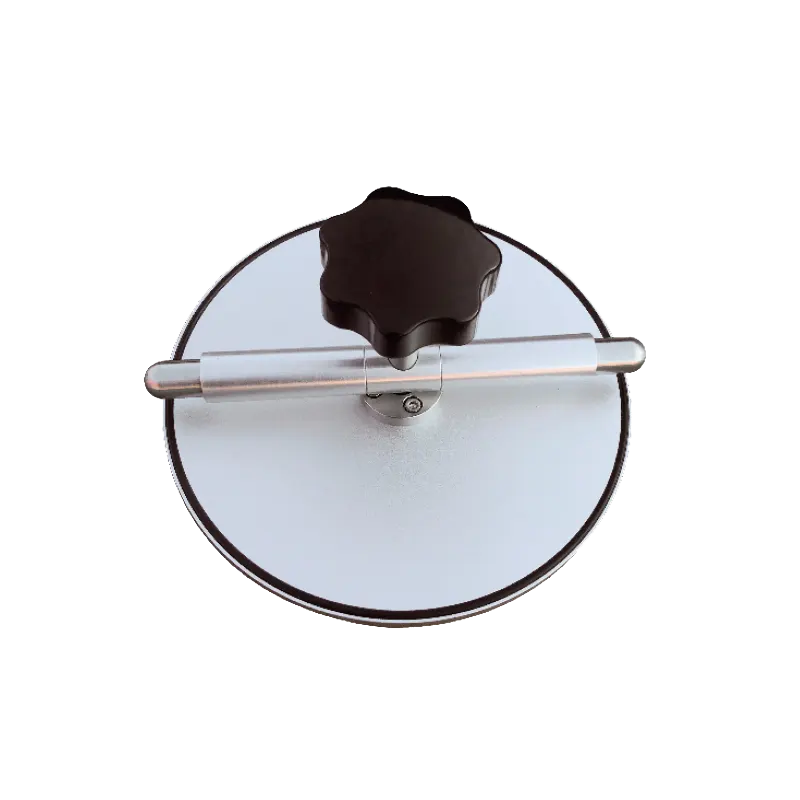
Good covers share a few practical traits regardless of style. They seat flat against the port without rocking, they clear the glove retention ring instead of pressing on the glove bead, they can be fitted and removed by one person without tools, and they are visible from a distance so that a covered port is obviously out of service. A cover that needs force to fit is telling you the geometry is wrong.
Why an Unused Port Is a Continuous Atmosphere Load
Inside a purified glove box, the water and oxygen content is the result of a balance: the purification system removes contaminants at some rate, and every leak, permeation path and open operation adds them. Blanking unused ports is an attempt to reduce the second term. It is worth being precise about how that load enters, because it explains both what a cover can achieve and where its limits are.
Permeation is not the same as a leak
The glove itself is a thin elastomer membrane. Even a perfectly intact glove allows water vapour and oxygen to permeate through the material at a rate that depends on the polymer, its thickness and the temperature. A glove hanging in an open port also has a large exposed area and a bead compressed against the port ring — a joint that is sensitive to how evenly it was seated. Adding a cover in front of the glove reduces vapour exchange on the room side, protects the bead from knocks and keeps the membrane from being stretched or pinched. It does not stop permeation through the glove, and it does not repair a bead that was never seated correctly.
The cost appears in regeneration
Every parasitic load — permeation, a slightly compressed seal, a port left open overnight — consumes capacity that the purification system would otherwise have available for the process. In a closed-loop system the columns eventually have to be regenerated, and how often that happens depends on total load rather than on any single source. Reducing several small loads is therefore worthwhile even though none of them is dramatic on its own. That is the honest case for port covers: a low-cost way to remove one avoidable contribution, not a substitute for the purification system, antechamber discipline or periodic leak checks.
Room conditions still reach the box
Room humidity, draughts and temperature swings act on the outside of the enclosure regardless of what is inside it. A cover does not insulate the port, but it does interrupt the direct path between a humid room and a glove surface, and it stops a loose glove from billowing into the working area when the circulation is running. Laboratories that record recovery times often notice that ports facing an open window or a door show more variability than ports on the sheltered side of the same cabinet — a reminder that the enclosure is part of a room, not an isolated object.
Fit and Interface: Three Parts Share One Opening
Port cover, glove port and glove are not independent items. They meet at one opening, and each constrains the others. Most fit problems come from specifying the cover against the panel cut-out rather than against the actual port ring and the glove retention hardware.
Port geometry comes first
Glove ports vary in internal diameter, flange profile and the way the glove is retained. Some rings are flat with an O-ring groove; others have a raised bead that the glove cuff stretches over; others use a separate clamping ring. A cover that is nominally the right size but designed for a different flange style will press on the glove bead instead of the ring, loading the seal unevenly and potentially creating a slow leak that did not exist before. Before ordering, measure the port ring itself, photograph the flange and retaining hardware, and state how the glove is fixed.
Seal material and cleaning agents
If the cover carries its own gasket or O-ring, that elastomer becomes part of the enclosure's seal inventory. It has to tolerate the solvents and cleaning agents used around the box, the process vapours that migrate out through the gloves, and the temperature of the room. An incompatible elastomer may swell, harden or craze, and a cover that sealed well in the first week can become a new leak path after months of exposure. The same caution applies to polymer covers on acrylic panels: aggressive solvents attack acrylic, and a cover tightened hard to chase a suspected leak can mark the panel permanently.
| Interface | What to confirm | What goes wrong if it is assumed |
|---|---|---|
| Port diameter and flange profile | Measure the port ring, not the window cut-out | The cover rests on the glove bead and compresses it unevenly |
| Seal element | Material, hardness, and whether the cover uses its own seal or the port's | Swelling or hardening after solvent exposure creates a new leak path |
| Glove retention hardware | Cuff ring, band or clamp type, and glove thickness | The cover fouls the ring or pinches the glove at the bead |
| Enclosure material | Acrylic, stainless steel or glass panel | Clamping loads and cleaning agents differ; acrylic is easily crazed |
| Intended function | Protective barrier or pressure-retaining closure | A protection cover is treated as a gas-tight blanking plate |
Port Covers on Multi-Station and Double-Sided Enclosures
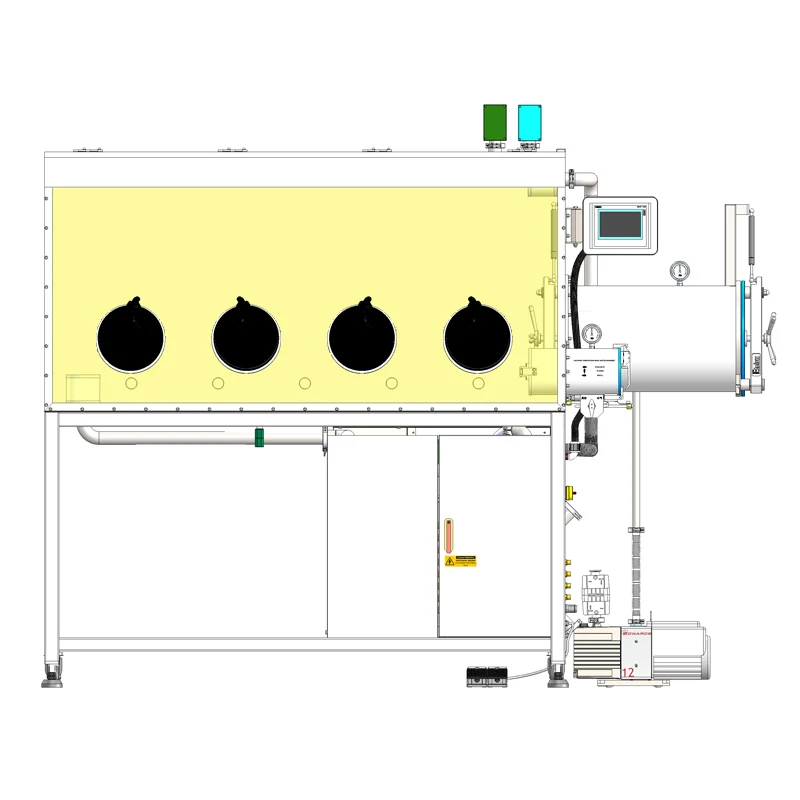
Configuration matters because the number of ports changes the arithmetic of sealing. A four-station double-sided glove box with a gas purification system is a useful reference point: the working space is arranged for several operators or several simultaneous tasks, the ports are distributed across both faces of the enclosure, and the purification loop is sized for the enclosure volume rather than for the number of ports in use.
That last point is the practical one. Purification capacity is fixed by the machine; the number of glove interfaces is fixed by the cabinet; but the number of interfaces actually in service is a decision the laboratory makes. On a double-sided box, one face is often used far less than the other. Blanking the idle face changes the balance without touching the process. On a four-station box, the same logic applies to whichever positions sit outside the current workflow.
Practical rules for multi-port cabinets
- Cover idle ports rather than removing their gloves; a port without a glove is an open hole, while a port with a glove plus a cover is a protected seal.
- Keep covers on the side of the box that is used least, so working positions stay clear for reach, lighting and photography.
- Do not carry covers between enclosures of different construction. A cover selected for a stainless steel cabinet with machined flanges is not automatically right for an acrylic cabinet with moulded ports, or for a smaller enclosure with different ring geometry.
- Label or colour-code covers when a laboratory runs more than one enclosure, so a cover is not forced onto the wrong port during maintenance.
Ergonomics deserve a mention because they decide whether covers stay in use. A cover that has to be set down on a crowded bench, or that obstructs the antechamber door when it is swung open, will be left off within a week. Check the clearance around the port, the swing of any door or hinged panel, and whether an operator wearing gloves can fit the cover with one hand.
Verification After Fitting: Reading Pressure and Analyzer Data
Fitting a cover is a mechanical change; verifying it is a measurement exercise. The trap is to read one number — usually the oxygen or moisture display — as a verdict on the cover. That display reflects the whole system, so a stable reading after fitting is encouraging but not proof, and a slow recovery is a prompt to investigate rather than a diagnosis.
Pressure decay and leak checks
Where the enclosure is designed for a pressure-decay or leak-rate test, run it with the gloves in place and the covers fitted, and compare the result with a baseline taken under the same conditions. Record the working pressure, the starting and ending values, the stabilisation time and the ambient temperature, because a decay test run in a warm room after a cold night will not compare with last month's numbers. If the enclosure has no documented leak-test procedure, do not invent one: ask the manufacturer what the design allows and what value counts as a pass for that model.
Oxygen and moisture readings
Analyzer readings respond to net contaminant concentration. After fitting covers, expect a trend rather than a step change: recovery after an antechamber cycle may be slightly shorter, or the interval between regeneration cycles slightly longer. A reading that stays high or recovers slowly may indicate a glove bead that is now pinched, a gasket that is incompatible, a port disturbed during fitting, or a load elsewhere in the system — a door seal, a feedthrough, an antechamber valve. Note also that resolution on a display is not measurement accuracy; two analyzers can agree to the last digit and both be wrong about the absolute value.
When a cover is the wrong remedy
If a port is leaking through the glove or its seating, a cover will mask the symptom for a while and then the trend will return. The correct order is to restore the glove and its seal first, then add the cover as protection. Likewise, if the goal is transport protection or vacuum service, the cover must be specified for that duty rather than adapted to it. Keep a short log — date, ports covered, glove changes, readings before and after — so that a future drift can be compared with something real instead of a memory.
Configuration Checklist Before Ordering
Port covers are simple parts, but they are only simple once the interface is known. The information below is what a supplier needs to confirm that a specific cover suits a specific enclosure; without it, any recommendation is a guess about geometry. The glove box port cover page is the starting point for the exact part, and the list is what to send alongside an enquiry.
- Port internal diameter and flange profile, ideally with a photograph of the port ring and the glove retention hardware.
- Enclosure material and panel thickness: acrylic, stainless steel or glass.
- How the glove is retained — cuff ring, O-ring band or clamp — and the glove type and thickness in use.
- Whether the cover must only protect, or must also close the port against pressure; state the design working pressure if the latter.
- Solvents, cleaning agents and process vapours the cover will see, so that gasket and body materials can be checked.
- How many ports need covering, on which faces, and whether covers stay fitted during operation or only when the box is idle.
- Any antistatic, cleanliness or documentation requirement that applies to the accessory.
The same discipline applies to the rest of the accessory list. Antechambers are chosen by transfer volume and cycle time, analyzers by range and calibration, pumps by gas and load, feedthroughs by connection and sealing, and gloves by size, permeation and material compatibility. Each item has one or two parameters that decide the choice, and for the port cover those parameters are the port geometry and the seal material.
None of this makes the port cover a performance component. It does make it a boundary component, and boundaries are where atmosphere control is won or lost. A laboratory that covers its idle ports, checks the seating after every glove change and records what it did carries a slightly smaller load to purify, has a slightly lower chance of a snagged glove, and holds one more variable it can account for when a reading drifts.
