
Start From the Atmosphere the Work Actually Needs
Most glove box enquiries begin with a sentence rather than a number: the sample is air sensitive, so the atmosphere must be inert. That sentence compresses at least three different requirements, and they do not all lead to the same equipment. The first requirement is protection during handling, where a moisture- or oxygen-sensitive sample is opened, weighed, split, mounted or packaged inside an enclosure and the exposure window is measured in minutes. The second is a working atmosphere for long sessions, where an operator sits at the box for hours, uses solvents, heats or cools samples and moves material in and out repeatedly while the oxygen and water content must stay inside a band the chemistry tolerates. The third is containment, where the enclosure exists to keep dust, vapour or reactive fines away from the operator and the room rather than to protect the sample.
Only the first two usually decide the choice between a vacuum-purge enclosure and a continuously purified one, and that choice is made by mechanism, not by size. A stainless steel vacuum glove box such as the GBV-2 works by evacuation and inert-gas refill: the air originally inside the chamber is removed and diluted step by step until the residue is small enough for the work at hand. A purifier-based box works by circulation, pushing gas already inside the enclosure through media that capture water and oxygen while people work. Neither mechanism is a superset of the other. A vacuum-purge box re-creates its atmosphere on demand; a purified box holds one continuously.
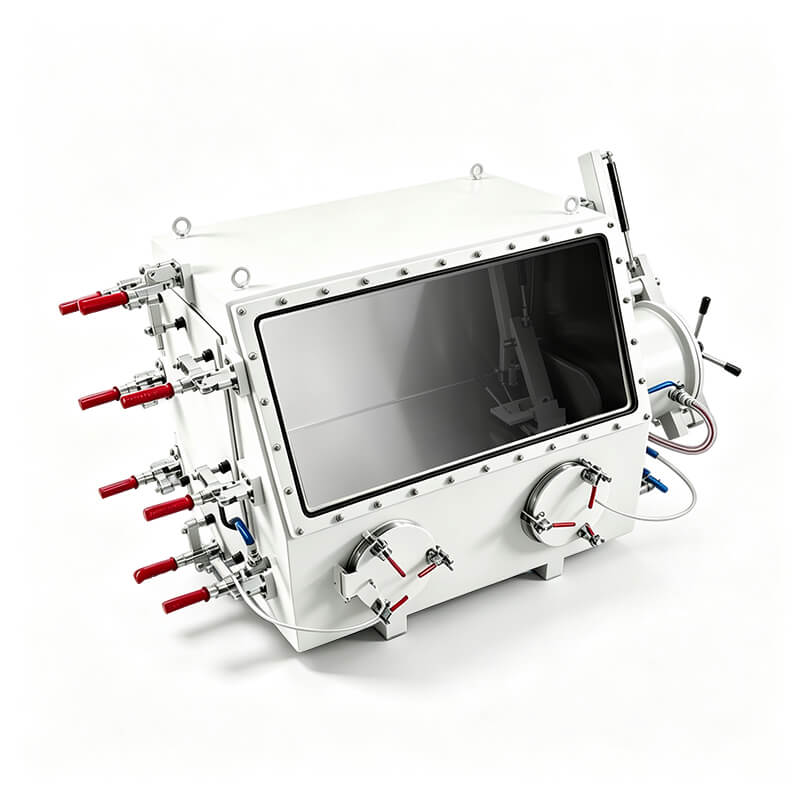
Three questions that separate the two approaches
- How long must the atmosphere hold between interventions? If the answer is "until the next transfer, and we can purge again when needed", on-demand replacement may be sufficient. If the answer is "continuously for a full working day, including while the box is open", you are describing a steady-state requirement.
- How often will the enclosure be opened? Every transfer is an atmosphere event. The number that matters is not the initial quality of the atmosphere but how quickly and reliably the system returns to it afterwards.
- Does the process tolerate pressure cycling? Evacuation loads gloves, seals, windows, feedthroughs and anything fixtured inside. A process that cannot be evacuated has to be handled differently, sometimes through an antechamber, sometimes with a different enclosure concept altogether.
Answering those three questions honestly removes much of the ambiguity before any model is discussed, and it prevents a common mismatch: buying a vacuum chamber for a job that actually needs continuous purification, or buying purifier capacity for a job that only ever needs short, protected handling windows.
How a Purge Cycle Removes Air
Evacuation and gas replacement are two operations that are often described as if they were one. Evacuation reduces the total pressure inside the chamber and is driven by the pump and by how tight the enclosure is. Gas replacement swaps the gas phase for inert gas and is driven by dilution. A useful first-order picture: if the chamber is evacuated to a fraction f of atmospheric pressure and then refilled with inert gas to atmospheric pressure, the original gas remaining is roughly the fraction f, and each additional cycle multiplies that residue by f again. Two or three well-executed cycles therefore remove far more air than one deep evacuation followed by a single refill, which is why purge procedures are usually written as a sequence rather than as a single step.
The illustration is meant to explain the mechanism, not to predict a result. Real performance depends on the lowest pressure the pump actually pulls in that specific chamber, on dead volumes such as tubing, gauges and the antechamber, on the purity and flow of the backfill gas, and on how much water is clinging to internal surfaces. Because those factors vary with configuration, purge counts, target pressures and acceptance criteria should be taken from the documentation of the specific model rather than from a general rule of thumb.
Evacuation removes gas-phase species, not adsorbed water
A pump removes molecules that are already in the gas phase very quickly. It does not remove the water that sits on stainless steel walls, elastomer seals, glove surfaces, window frames and any porous item placed inside. That adsorbed inventory is in equilibrium with the gas phase, and when the chamber is refilled the balance shifts and water begins to desorb again. This is why a box can reach an excellent pressure reading during evacuation and still show a disappointing moisture reading after refill. The water was never in the gas phase to begin with; it was on the surfaces and came back.
Four operations that must not be confused
- Evacuation — lowers total pressure. The governing factors are pump capability, chamber volume and leak tightness.
- Gas replacement or purge — replaces the gas phase with inert gas. The governing factor is dilution, repeated across cycles.
- Circulation — moves gas through purifying media in a closed loop. This belongs to purified systems, not to a purge cycle.
- Regeneration — restores the capacity of purifying media. It is a maintenance operation on purification equipment and has nothing to do with evacuating the box.
Blurring these four categories produces specifications that cannot be met by any single machine. A purge sequence will not regenerate a purifier, and a purifier will not evacuate a chamber.
Reading the GBV-2 as a Pressure Vessel
A stainless steel vacuum glove box is, first of all, a vessel that will be cycled between reduced and ambient pressure many times over its service life. Stainless steel construction gives that cycling a sound mechanical basis: the body and frame are rigid, joints and ports can be welded or clamped to a controlled geometry, and the surfaces tolerate the cleaning and solvent exposure that accompany real laboratory work. The trade-offs are equally real. Stainless steel is heavier than a polymer enclosure, it is opaque, so visibility depends on how the window and ports are laid out, and it has to be watched for corrosion if aggressive vapours are used inside without effective removal.
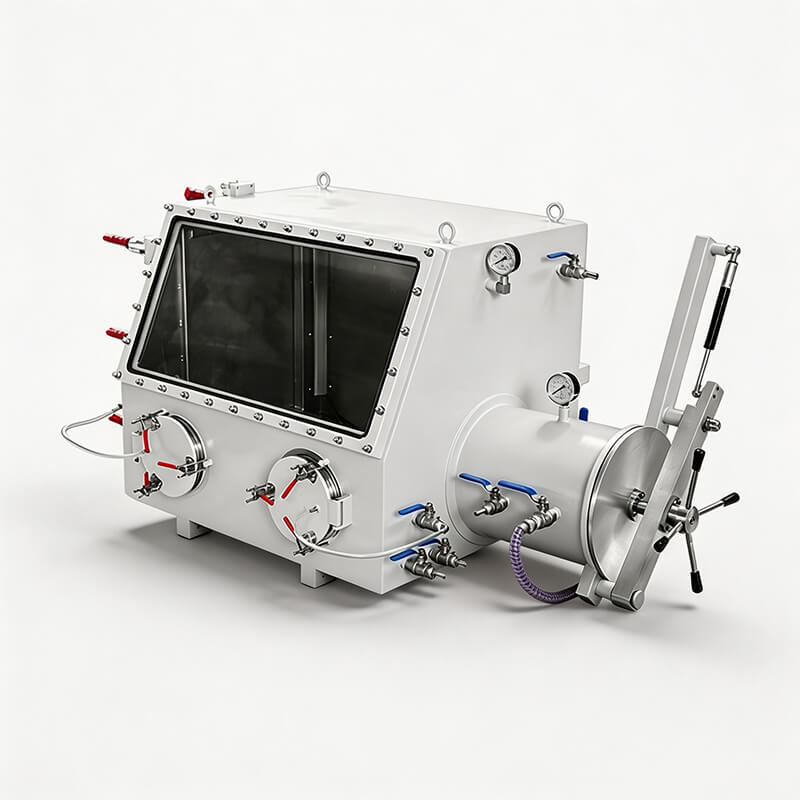
Acrylic enclosures are a different starting point
Acrylic glove boxes are usually chosen for visibility, light weight and cost, and their capabilities vary by model and wall construction: whether a given unit can be evacuated, whether it includes an antechamber and whether it can be connected to purification all depend on the specific configuration, so none of those features can be assumed across a range. Acrylic also has a different solvent compatibility profile from stainless steel, and it is more easily scratched and more sensitive to cleaning chemicals. The practical question is not which material is better in the abstract, but whether vacuum cycling is a genuine requirement of the process. If it is, the enclosure has to be engineered for it; if it is not, simple isolation plus a well-sealed glove port may be enough.
The antechamber is a second, smaller atmosphere problem
Passing samples in and out without opening the main chamber requires a small transfer chamber with its own purging routine. Its volume, geometry and door sealing determine how much air it contributes each time it is used, and its internal pressure during pump-down is a different quantity from the working pressure of the main box. A common source of confusion is to treat an antechamber's vacuum performance as evidence about the moisture level of the main chamber. Those are separate measurements of separate volumes, and only the main chamber's atmosphere matters to the sample.
Glove ports are where the boundary is softest
The rigid parts of a vacuum glove box are comparatively easy to keep tight. The gloves are the largest compliant, permeable part of the wall, and the point where each glove meets the chamber is a mechanical interface rather than a weld. In a box that is evacuated repeatedly, that interface is a pressure boundary that is loaded and unloaded on every cycle. The component that carries most of that duty is the sealing ring.
Glove Port Sealing Rings and the Atmosphere Budget
The glove port sealing ring looks like a trivial part next to a pump or an analyser, but it occupies a disproportionate share of the atmosphere budget. Under vacuum it is squeezed between the port land and the glove bead while the pressure differential pulls inward. At ambient pressure it relaxes. Repeated thousands of times, that loading history determines whether the port still seals as well in year two as it did on the first day.
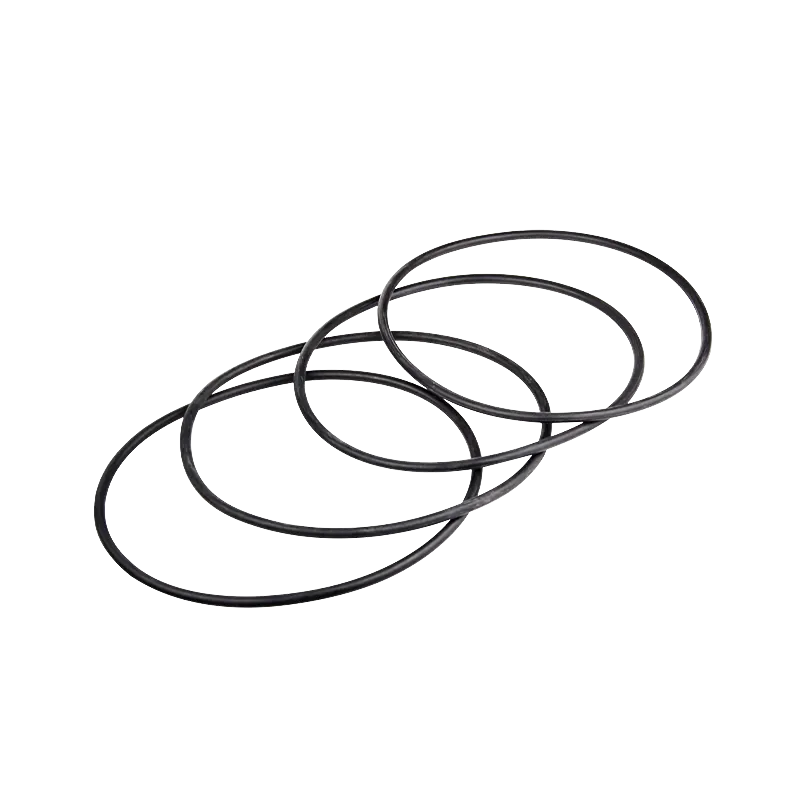
What the ring has to do
- Compress and conform to the port land and the glove bead without leaving a continuous leak path.
- Resist compression set — the tendency of an elastomer to stay flattened after being squeezed — so that sealing force does not decay cycle after cycle.
- Retain the glove bead so the glove does not rotate, creep outwards or pull free under the pressure differential.
- Tolerate the solvents, vapours and temperatures it will actually meet inside the box.
- Be replaceable in the field with the gloves, as part of normal maintenance rather than as a factory repair.
Selection factors worth confirming
Because the sealing ring is supplied as a defined part, the specification that matters is the match between the ring and the rest of the assembly. Elastomer family determines which solvents and vapours the ring survives and how much it swells; a ring that swells gains volume but loses dimensional control and may extrude into the gap. Hardness, usually expressed as durometer, sets the compromise between conforming to an imperfect surface and resisting extrusion under differential pressure: softer compounds seal rougher surfaces but deform more. Groove and land geometry, glove bead diameter and glove thickness all have to agree with the port, otherwise clamp force is spent deforming the glove rather than compressing the seal. Cleanliness and outgassing behaviour of the ring material also matter, since the ring sits inside the controlled volume and any volatile it releases becomes part of the atmosphere you are trying to control.
Symptoms of a marginal seal
A port seal that is no longer doing its job usually announces itself indirectly. The moisture or oxygen reading may rise whenever a glove is moved or a transfer is made, then settle at a level slightly worse than before. A glove may rotate or shift in the port, or the bead may appear pinched on one side. The ring may look glazed, cracked, permanently flattened or swollen. Because several other causes produce similar readings, the honest sequence is to isolate the chamber and observe how quickly pressure rises, then compare the result with the antechamber and with the rest of the system before concluding that the port ring is the culprit. Diagnosing a leak path is not the same as diagnosing a failed component, and replacing rings without that step often leaves the real problem in place.
Why Water and Oxygen Read Slowly After a Transfer
Operators commonly report that the atmosphere "goes bad" after every transfer and recovers only slowly. In many cases nothing is broken. The reading is responding to a genuine temporary inventory of water or oxygen that has to be removed by the same mechanism that removed the original air, and the speed of that removal is set by the mechanism, not by willpower.
Benign causes
- Outgassing from newly introduced items. Paper, cardboard, plastic bags, un-baked tools, porous powders and the sample itself all carry adsorbed water and, once inside, release it into the chamber.
- Glove surfaces and permeation. Gloves carry moisture on their outside faces and allow a slow transmission of atmospheric gases through the material, which is a continuous background load rather than an event.
- Adsorbed water on the chamber walls. After each refill, the wall inventory re-equilibrates with the gas phase, which is exactly what a purge cycle is trying to dilute.
- Analyzer behaviour. Response time, calibration state and the dead volume of the sampling line all shape what the display shows. An instrument measures the atmosphere; it does not purify it, and a fine resolution figure on a display is not the same thing as measurement accuracy.
- Genuine leak paths. A port ring, a door gasket, a feedthrough or a valve can admit room air steadily, in which case the reading climbs even when nothing is moving.
Distinguishing an inventory problem from a leak
The most informative experiment is the cheapest one: leave the box undisturbed, with no transfers and no new material, and watch the trend. A reading that climbs steadily while everything is static points towards a leak path or continuous outgassing. A reading that rises after a transfer and then falls back as purge cycles are repeated points towards a temporary inventory that the system is removing as designed. A reading that settles at a slightly worse level after each transfer and never fully returns suggests that the recovery procedure is too short for the load being introduced, or that the sealing performance has degraded. Separating these cases before changing hardware prevents unnecessary maintenance and prevents the opposite mistake of accepting a real leak as normal behaviour.
Vacuum-Purge or Continuously Purified: A Decision Table
The two architectures are easiest to compare when they are described by what they do rather than by what they contain. The table below keeps the comparison qualitative on purpose, because the achievable numbers depend on the specific enclosure, its sealing, its load and its instrument, and must be confirmed from the documentation of the model under consideration.
| Attribute | Vacuum-purge enclosure | Continuously purified enclosure |
|---|---|---|
| Primary mechanism | Evacuation plus inert-gas refill, repeated | Closed-loop circulation through purifying media |
| Atmosphere between interventions | Re-established on demand; drifts with leaks and outgassing | Held at a steady state while the loop runs |
| Consumables and maintenance | Inert gas, gloves and seals; no purifying media | Inert gas for make-up, purifying media subject to regeneration or replacement |
| Start-up | Depends on purge sequence, pump and chamber volume | Depends on loop performance and on how dry the enclosure is at first start |
| Best fit | Protected handling, sample preparation, process steps that tolerate pressure cycling | Long sessions, frequent transfers, processes needing a stable atmosphere throughout |
| Main limitation | No steady-state guarantee; sensitive to leak rate and to adsorbed water | Purification is not containment; media have finite capacity and need servicing |
Where a process needs both properties, the usual approach is to combine an enclosure with a separate purifying unit that circulates gas through it. That configuration has to be treated as a system: the purifier is not itself a glove box with working space, the connections and gas path must match the enclosure, and the assumption that any purifier can be attached to any chamber is not safe. Compatibility of the loop, the fittings and the control logic should be confirmed with the supplier rather than inferred from a catalogue heading.
One clarification that prevents expensive mistakes
Inert gas protection is not sterility, not a cleanroom classification, not biological containment and not hazardous-material containment. Those are separate requirements with separate standards, and a glove box that provides a good inert atmosphere may provide nothing at all in those other categories. Equally, no inert gas is inert towards every sample; reactive powders, solvents and catalysts can behave differently, and compatibility has to be checked for the specific material.
Configuration Checklist Before You Specify
The information a supplier actually needs is the application, not a preference for one architecture over another. A short, factual brief resolves most of the technical risk before a quotation is written.
- Working atmosphere: what oxygen and water content the chemistry needs, and whether that value must hold continuously or only at the moment of handling.
- Verification method: which instrument will be used to confirm the atmosphere, where it samples from, and how it is calibrated.
- Gas supply: the inert gas available, its purity, and how it reaches the box.
- Operators and layout: how many people work at the box at once, and whether single-sided or two-sided access is needed.
- Solvents and vapours: which ones are used, and how they affect glove and seal materials.
- Sample form: powder, foil, liquid, device or assembly, and how much adsorbed water each form brings in.
- Transfer load: the size, mass and frequency of items passing through, since this sets antechamber requirements.
- Process conditions inside: whether the work itself needs vacuum, heating, cooling or electrical and signal connections through the wall.
- Maintenance plan: who inspects gloves and port seals, on what schedule, and which spare parts are kept on site.
- Documentation: the purge and transfer procedure, leak-check acceptance criteria and material information for seals and gloves.
Two habits make the specification process faster and the installation more predictable. The first is to describe the atmosphere as a requirement with a duration attached, not as a single number, because a box that reaches a value quickly and a box that holds a value for eight hours are answering different questions. The second is to treat every compliant element — glove, port sealing ring, door gasket, valve, feedthrough — as a scheduled maintenance item rather than as a permanent fixture, since these are the parts whose condition decides whether a stainless steel vacuum glove box behaves the way it did on the day it was commissioned. The principles discussed here are a basis for selection and diagnosis; the operating procedure, cycle counts and acceptance values for a specific unit should always come from that model's own documentation.
