
Air-sensitive work rarely fails because the material was difficult to make. It fails because the environment around it changed while no one was watching: a few minutes of humid air during a glove change, a sample carried in on packaging that had been sitting open on a bench, a port seal that quietly stopped holding vacuum three weeks earlier. The equipment question behind most of those incidents is not which brand to buy. It is how much atmosphere control the task actually needs, and which mechanism can deliver that level reliably, day after day.
TENCAN Glove Box Systems builds both continuously purified glove boxes and vacuum-type boxes, and the two families exist for different reasons. The GBV-1 stainless steel vacuum glove box belongs to the second family: a sealed stainless steel chamber in which the working atmosphere is created by evacuation and inert gas replacement. Understanding what that mechanism does well — and what it does not attempt — prevents the most common specification mistakes.
Start With the Material and the Exposure Window, Not the Box
Two materials that are both described as air sensitive can need equipment that differs by an order of magnitude in cost. Lithium metal, sulfide solid electrolytes, perovskites, OLED emitters, organometallic catalysts, and freshly reduced metal powders all react with water or oxygen, but at very different rates and threshold concentrations. A material that degrades over hours at a few hundred parts per million is not the same customer as a material that changes within seconds at single-digit ppm.
Three practical questions narrow the field faster than any datasheet comparison:
- What does the material tolerate, and for how long? The relevant figure is not the best number a box can reach on a good day, but the level the material survives for the duration of your process.
- How often does something enter or leave? A box opened twice a week behaves very differently from one opened twenty times a day, because every transfer injects air, water vapor, and whatever the object carried on its surface.
- What else goes inside? Solvents, high-surface-area powders, paper, cardboard, foam, and wipe cloths release water and organic vapor long after they are inside. Tools and containers matter less, but not nothing.
Once those answers are known, the mechanism usually follows. There are two established ways to protect air-sensitive samples inside a glove box: continuous closed-loop purification, where chamber gas is circulated through media that remove water and oxygen, and evacuation-and-replacement, where the sealed chamber is pumped down and refilled with inert gas until the residual air has been diluted enough for the work at hand. The GBV-1 belongs to the second group. Treating the two as interchangeable — or assuming a vacuum box is simply a cheaper purifying box — is where most specification errors begin.
What a Vacuum Glove Box Actually Does
Seal, evacuate, backfill
A vacuum glove box rests on a simple physical idea. The chamber is closed by the gloves in their ports, by the door, and by sealed windows and feedthroughs; the gas inside is then removed with a vacuum pump. When inert gas is admitted again, the remaining air is diluted in proportion to the residual pressure relative to the fill pressure. Because the process is multiplicative, the first cycle is highly effective and later cycles progressively less so: reducing oxygen from the ambient twenty-one percent to a fraction of a percent is straightforward, while pushing the last traces into the low parts-per-million range depends on the vacuum level reached, the purity of the supply gas, the leak rate of the assembled box, and outgassing from every internal surface.
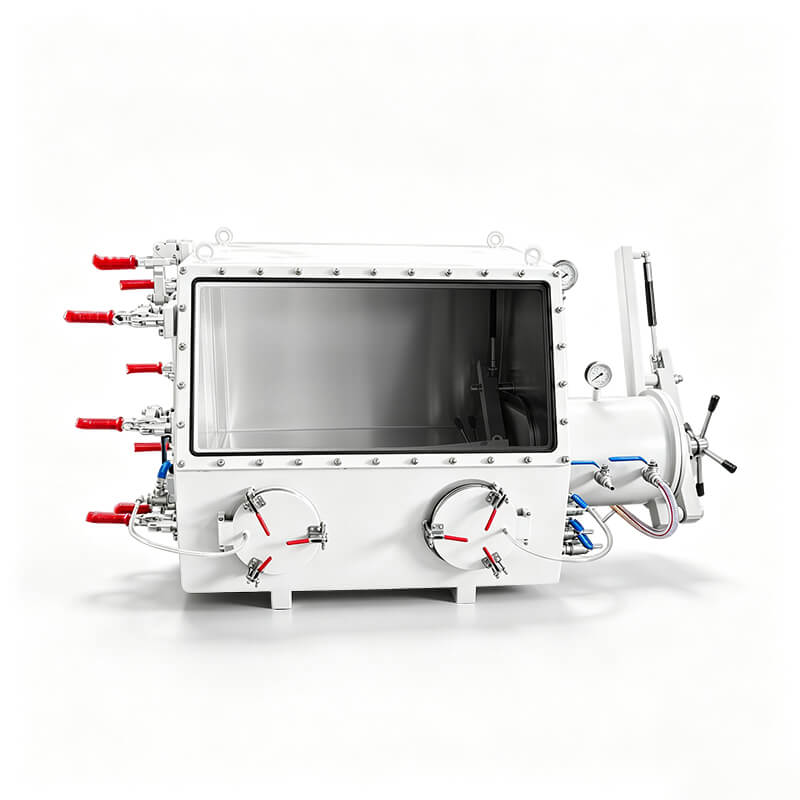
The result is a controlled working atmosphere for a session. It is not a regulated setpoint held continuously by active equipment, and that difference shapes how the box is used, what it consumes, and how it responds when someone opens a port.
What the cycle does not include
A vacuum box of this type does not circulate gas through purification media, so there is no continuous removal of water and oxygen that enter with samples or diffuse in through seals and gloves. GBV-1 product information draws this line explicitly: the model is distinguished from systems built around continuous purification. Purification columns, regeneration cycles, and the analyzer trends that accompany them belong to the purifying family, and they should not be assumed here. A project that requires a maintained low-level atmosphere over several days is pointing at a different architecture, not at a longer evacuation schedule.
What this means for daily work
Work inside a vacuum box is naturally batch-shaped. The operator prepares items before opening the box, brings in the minimum necessary, works within a defined window, and closes up again. Inert gas consumption is tied to how many cycles are run rather than to how long the box sits closed, which makes the approach economical in intermittent use and increasingly expensive in continuous, high-turnover operation. The main consumable is gas; the main maintenance item is the sealing system — door gaskets, glove port rings, and gloves. There is no media to regenerate, but also no buffer against contamination.
GBV-1 in Context: A Stainless Steel Vacuum Box for Practical Handling
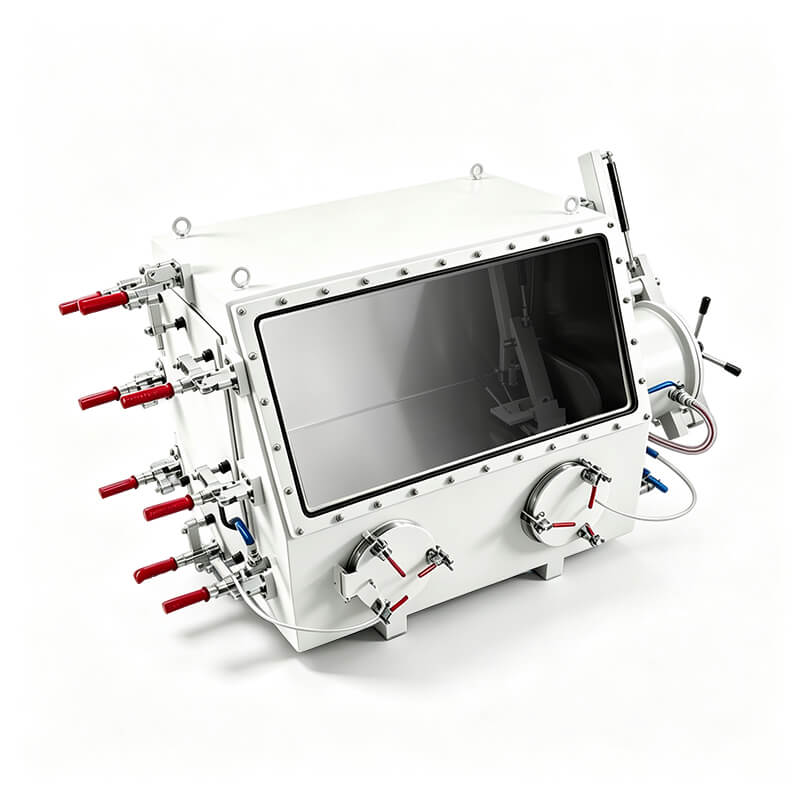
Why the chamber is stainless steel
Evacuation is a mechanical load. Every cycle pushes on the walls, the door, the window frames, and the glove ports, and a chamber that flexes under that load will eventually leak at its joints. Stainless steel provides the rigidity to take repeated cycles, resists most laboratory solvents and cleaning agents, and stays cleanable — which matters, because contamination left on internal surfaces keeps releasing vapor into the atmosphere you just built. The trade-offs are weight and visibility. A metal box does not offer the all-around transparency of a clear enclosure, so window size, interior lighting, and where an operator can observe the sample become configuration points to settle with the supplier rather than assumptions.
Tasks that match a vacuum box approach
Vacuum-and-replacement boxes fit work where protection is needed for a defined period at a level that a few cycles can reach: sample handling and portioning, assembly of moisture-sensitive components, packaging and sealing of samples for transport, storage of materials during a procedure, and any workflow where the box is used in campaigns rather than continuously. They are also a sensible step up from a bench-top operation for moderately sensitive materials, because a tightly sealed stainless steel chamber that is purged before use is far better than open air.
Tasks that point to a purifying system instead
The opposite case is equally clear. If the requirement is a maintained single-digit ppm environment, if ports are opened many times per hour, if experiments run for days and are interrupted by sample additions, or if the process releases solvent vapor that would gradually load purification media, then a closed-loop purifying glove box is the right architecture. Extra evacuation cycles do not reproduce a purification loop: each cycle helps, but the atmosphere drifts upward again as soon as work resumes.
A side-by-side view of the two mechanisms
| Aspect | Vacuum / replacement box (GBV-1 type) | Closed-loop purifying box |
|---|---|---|
| How the atmosphere is created | Evacuation followed by inert gas backfill; residual air is diluted by repeated cycles | Chamber gas is circulated continuously through media that remove water and oxygen |
| What maintains it between operations | Nothing active; the sealed chamber drifts slowly with leaks and outgassing | The purification loop, within its capacity |
| Response to a sample transfer | Usually requires another cycle to restore the working level | The loop removes the added load over a recovery period |
| Consumables and service | Inert gas; seals, gloves, and pump maintenance | Purification media at regeneration or replacement intervals; seals, gloves, analyzers |
| Typical best match | Intermittent, session-based handling and storage of moderately sensitive materials | Continuous or high-frequency work with stringent limits and long experiments |
| Values to confirm with the supplier | Vacuum level reached, leak rate, cycles needed for the target, supply gas purity | Purification capacity, achievable water and oxygen levels, recovery time |
Over-specifying is as costly as under-specifying. A purification system sized for continuous duty but used twice a week spends most of its life idling, while a vacuum box asked to hold a stringent limit through a full working day will keep consuming gas and operator time without ever settling. The purchase decision is easier once the operating pattern, not the catalogue position, is written down first.
The Glove Port Sealing Ring: A Small Part That Decides Whether the Cycle Works
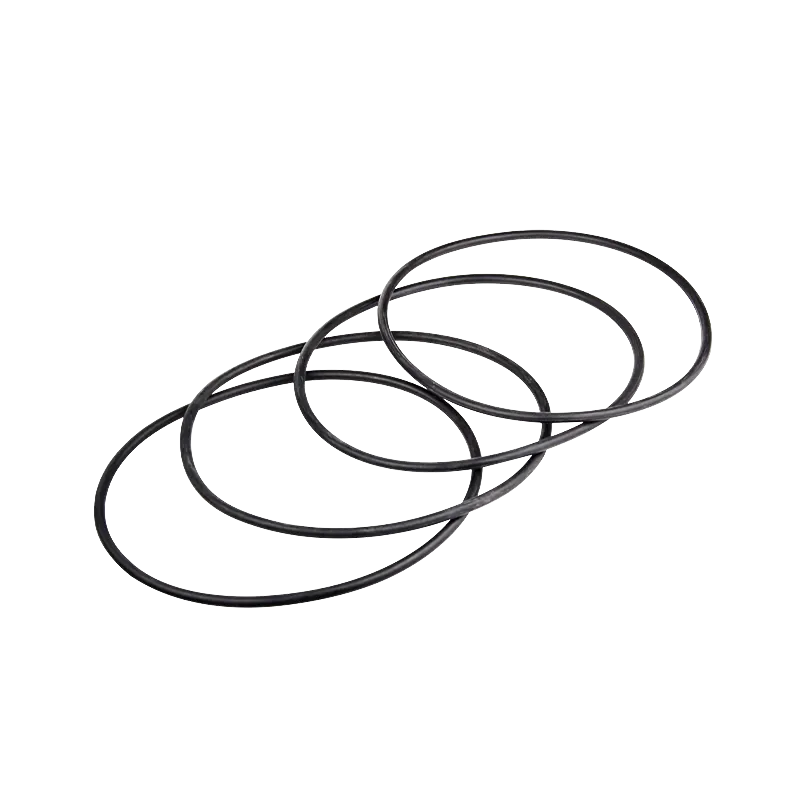
Why glove ports are the hardest-working seals in a vacuum box
A glove port does two jobs at once. It holds the glove cuff against the chamber opening so the glove cannot pull out during use, and it closes the gap between glove and flange so the chamber stays sealed. In a purifying glove box, an imperfect port seal is a slow nuisance that the loop can partly absorb. In a vacuum box, the same seal sits across the full pressure differential every time the chamber is pumped down. A ring that has taken a compression set, hardened with age, swollen after solvent contact, or been nicked during a glove change will leak — and the symptom is deceptive, because the box still pumps down "normally" and simply never reaches the level that made earlier cycles efficient. Operators then run extra cycles to compensate, burning gas without knowing why.
What to look at when selecting a sealing ring
- Dimensions matched to the port flange. Port diameter is the primary selection criterion. Tightening cannot compensate for a ring that does not seat exactly, and forcing a mismatched ring damages both the ring and the port.
- Material compatibility. Elastomer choice depends on the solvents, acids, or cleaning agents that may reach the port area, and on temperature if heated processes are used nearby. A material that swells in a solvent you use routinely will fail early and unpredictably.
- Compression set and elastic recovery. A static seal works by staying compressed. A ring that loses its recovery holds less, and the loss is gradual enough to be mistaken for a pump problem.
- Replacement policy. Treat sealing rings as consumables. Inspect them whenever a glove is changed, and replace them when deformation, cracking, hardening, or a persistent slow leak appears.
Fit depends on the specific configuration
The glove port sealing ring is a general glove box accessory rather than a part tied to one model number. Whether a particular ring suits a given build depends on the port flange dimensions and the glove retention design of that build, so the ring should be ordered against those two details rather than against a photograph. The reliable approach is to confirm port diameter, glove size, and retention arrangement with the supplier when ordering, particularly if the box and the accessories are being specified together.
Where Atmosphere Is Actually Lost During Sample Transfer
Each transfer brings more than the sample
Every object that enters the chamber arrives with a boundary layer of air and adsorbed water on its surface, and porous materials carry far more than smooth metal. Paper, cardboard, foam, wipe cloths, powders with high specific surface area, and many plastics keep releasing moisture long after they are inside. Solvent residues evaporate, re-condense on cooler surfaces, and slowly return to the gas phase. Gloves are not perfectly impermeable either: water vapor and oxygen pass through elastomer and polymer films at a low but non-zero rate, so a long session with hands in the gloves imposes a continuous load that a short one does not.
The two architectures respond differently. In a vacuum box, contamination is corrected by another evacuation and backfill cycle, so the cost of a careless transfer is gas and time. In a purifying box, the loop removes it over a recovery period, and the cost appears later as shorter media life or steadily longer recovery times.
Reducing disturbance without overcomplicating the workflow
- Pre-dry or pre-bake items where the material allows it, and let them cool before transfer.
- Minimize the number and the surface area of items entering the box.
- Seal samples in suitable containers rather than carrying open vials.
- If the configuration includes a transfer chamber or antechamber, use it as designed: close, evacuate or purge, then open the inner door. Whether a particular build has one, and how it is operated, is a detail to confirm.
- Wipe tools and containers before they go in, and keep porous packaging out of the working space.
- Match glove material and thickness to the task, since the glove is part of the atmosphere boundary.
Slow recovery is a symptom, not a diagnosis
When readings take longer than usual to return after a transfer, several causes look identical from the outside: a larger sample load, media that has aged, a leak at a seal or valve, a valve left partly open, a sensor due for calibration, or simply a sample point far from where gas returns. None of these should be assumed before the others are checked. The equivalent symptom in a vacuum box is a pump-down that no longer reaches the previous level. There, the sealing system, door gasket, pump, and gas supply are the first places to look, and leak testing should follow the procedure given in the manual rather than an improvised method.
Reading the Numbers: Pressure, Vacuum, Water and Oxygen Are Different Things
Five measurements that get called "the vacuum"
- Chamber working pressure. The pressure inside the box while work is in progress, which in some designs is a slight positive pressure and in others near ambient. It is a different quantity from anything measured during evacuation.
- Transfer chamber vacuum. The level reached in a small lock used to pass items in and out. It says nothing about the main chamber.
- Pump ultimate vacuum. A property of the pump, measured at the pump inlet under defined conditions. A pump that reaches a deep vacuum on a test stand does not guarantee a deep vacuum in a box with leaks and outgassing.
- Leak rate. A property of the assembled system over time, and the number that actually decides whether repeated backfill cycles converge on the target.
- Water and oxygen content. Gas composition in ppm, measured by analyzers. It is the figure most users care about and the least predictable from the others.
Mixing these together produces bad decisions. A tight box fed with moist supply gas will not deliver a dry atmosphere. A high-quality pump attached to a leaky box will not reach the intended level. A chamber that holds pressure well may still see oxygen rise because of glove permeation and outgassing. When a value on a specification sheet has an unclear unit, an unclear object, or an unstated configuration, the honest treatment is to mark it unconfirmed and ask.
Measurement is not purification, and filtration is not either
An analyzer reports the atmosphere; it does not change it. HEPA filtration captures particles and does nothing for water, oxygen, or solvent vapor. Solvent adsorption targets organic vapors and does not substitute for water and oxygen removal. Gas replacement, evacuation, circulation, and media regeneration are four separate operations, and a workflow that confuses them tends to add equipment that cannot solve the problem it was bought for.
Resolution is not accuracy
A sensor with a fine display resolution can still be wrong by more than that resolution if it is uncalibrated, if the sample point is poorly chosen, or if the element has drifted since its last service. Treat analyzer readings as trends to be validated rather than absolute truth, and keep calibration in the maintenance schedule.
Configuration Checklist Before You Order
The most useful thing a buyer can send a supplier is the application, not a model number. For a vacuum-type box such as the GBV-1, these points cover most of what determines the final configuration:
- Target water and oxygen levels, and how long they must hold.
- Session length, transfer frequency, and how many people work at the box at once.
- Materials handled, including solvents, powders, and any heated steps.
- Glove size, material, number of ports, and the working reach required.
- Whether a transfer chamber is needed, and the size and shape of items that must pass through it.
- Pump selection and compatibility with chamber volume, process gas, and the vacuum level required.
- Instrumentation: whether water and oxygen analyzers are needed, their ranges and calibration interval.
- Sealing consumables: door gaskets, glove port sealing rings, gloves, and their expected replacement interval.
- Leak-test method and acceptance criteria for the assembled system.
- Footprint, services, and access for maintenance.
For a sealing ring ordered on its own, the list is short: port diameter, glove size and retention style, the chemicals it will contact, and the temperature. Getting those four right is often the difference between a ring that lasts and one that quietly undermines every evacuation cycle.
Choosing between a vacuum box and a purifying system is not a matter of which is better. It is a matter of which mechanism matches the exposure window, the transfer frequency, and the sensitivity of the material — and then of treating seals, gloves, and supply gas as the working parts they are.
