
The GBV-2 is listed as a stainless steel vacuum glove box. That description points to a specific way of creating a controlled atmosphere: isolate the working chamber, remove the existing atmosphere with a vacuum pump, and refill with an inert gas. It does not, by itself, mean that the box includes a continuously operating gas purification system. For a researcher comparing options, that difference is more important than the model number.
The GBV-2 stainless steel vacuum glove box is therefore best evaluated as a vacuum-and-inert-gas enclosure, with the final configuration determined by the chamber, gloves, transfer method, pump, instrumentation, and accessories that appear on the quotation. The public product reference available for this article identifies the model and shows product images, but it does not list chamber volume, achievable vacuum, leak rate, port count, or analyzer specifications. Those values must come from the current quotation and drawings, not from assumptions based on the name.
Start with the atmosphere requirement, not the model name
A vacuum glove box is often requested because it appears to be the simplest route to an inert workspace: seal a chamber, pump it down, refill with argon or nitrogen, and work through gloves. In practice, the useful starting point is the sample. The box must keep oxygen and moisture below the level at which the material changes, and it must do so for the duration of weighing, transferring, mixing, sealing, or testing.
Four questions usually determine whether a vacuum box is appropriate:
- What maximum oxygen and moisture level can the sample tolerate, and for how long?
- How often will the chamber be opened, and how much material will enter or leave each time?
- Will the process involve vacuum, heat, solvents, fine powders, or electrical connections?
- Which inert gas will be used, and what purity and supply arrangement are available?
These questions separate a batch-operated enclosure from a system that must actively remove contaminants during continuous work. A box can show a low reading after a long purge and still recover slowly after the next transfer. That recovery behavior matters as much as the first reading, because it reflects leakage, outgassing, glove permeability, dead volumes, and the way the box is used.
The GBV-2 should be matched to those requirements rather than treated as a universal atmosphere solution. If the application is occasional handling of air-sensitive samples, a stainless steel vacuum box with the right transfer arrangement may be sufficient. If the target is a very low oxygen and moisture level maintained through frequent openings, a system with continuous purification may be the more realistic category. The distinction should be made before the purchase order, not after the first experiment.
Why a vacuum glove box is not a recirculating purifier
A continuously purified glove box uses a closed gas loop. Gas is circulated through purifier columns that remove moisture and oxygen, and analyzers monitor the atmosphere. The purifier works while the box is in use, so it can compensate for small ingress and for contaminants released by samples or materials. A vacuum glove box uses a different principle: it removes the original atmosphere by evacuation and replaces it with inert gas. Repeated exchange can produce a clean atmosphere, but the box does not continuously remove oxygen and moisture unless a purification loop is explicitly part of the configuration.
The GBV-2 product reference identifies the model as a stainless steel vacuum glove box. It should not be described as a purifying glove box, and a purifier should not be assumed simply because the chamber is made of stainless steel. If a quotation includes purification, that is a configuration fact to verify in the specification. If it does not, the operating plan must account for exchange cycles, source-gas purity, and the rate at which contamination enters during work.
What continuous purification adds
A purification loop is useful when the box must stay at a low setpoint during active handling, when the chamber is opened frequently, or when samples release moisture or oxygen over time. The purifier does not make the box hermetic; it buys time by removing contaminants that enter. Its capacity, regeneration requirements, and analyzer arrangement still need to match the workload.
For a vacuum box, the equivalent strategy is disciplined exchange: evacuate, hold, refill, and repeat as needed. That approach can be very effective for batch operations, but it is not the same as continuous removal. A user who needs a stable atmosphere during hours of open-glove work should ask for evidence of the complete system’s performance, not only the chamber’s vacuum capability.
What stainless steel changes
A stainless steel chamber is rigid, cleanable, and suitable for vacuum service when the design and seals are rated for it. It is often preferred where mechanical durability and solvent cleaning matter. However, stainless steel is only one part of the wetted system. Gloves, window seals, door gaskets, tubing, and pump materials also contact the process atmosphere. A stainless steel chamber does not make the entire box compatible with every solvent, and it does not remove the need to check glove and seal compatibility.
When exchange-only operation is a better fit
A vacuum-and-refill box is often reasonable for batch loading, sample storage, short transfers, and operations where the chamber is not held open for long periods. It can also suit workflows that need vacuum for a process step rather than a permanent low-oxygen setpoint. The decision should be based on the required atmosphere, the acceptable recovery time after each opening, and whether a purifier would be continuously loaded beyond its practical capacity.
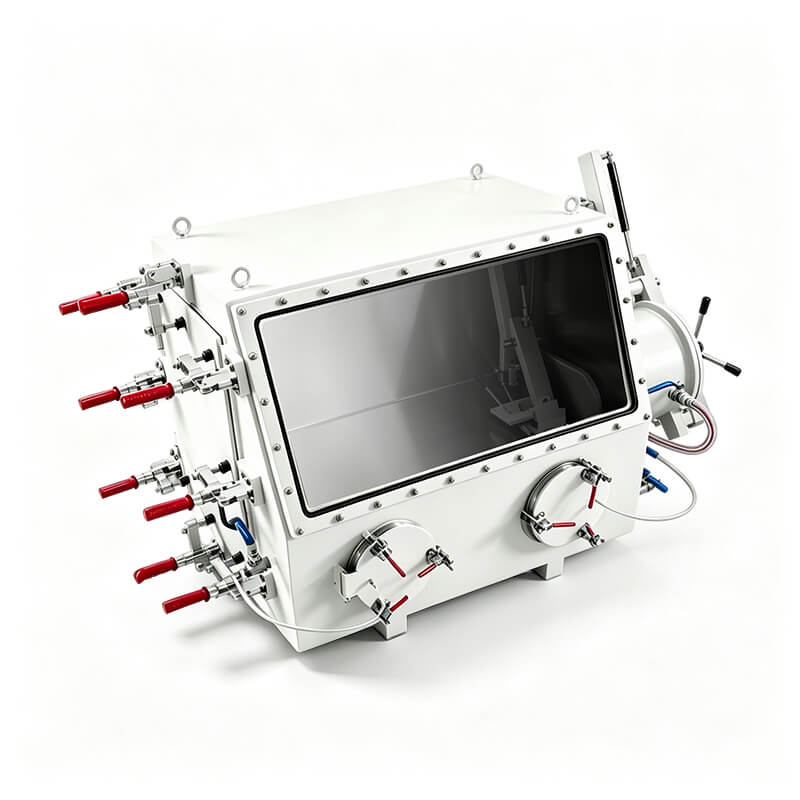
How vacuum and inert gas exchange establish a working atmosphere
The basic cycle is straightforward. The chamber is sealed, evacuated to remove the air inside, and backfilled with inert gas. Repeating the cycle reduces the original atmosphere by dilution. The result depends on the vacuum reached, the hold time before refilling, the purity of the refill gas, the volume of tubing and antechambers, and the amount of gas released by the sample and interior surfaces.
The cycle is dilution plus removal
Evacuation removes gas from the chamber, but it also lowers the pressure that opposes outgassing. Moisture adsorbed on surfaces, solvent residues, and volatile materials can be released during pumping and then mix with the refill gas. A longer evacuation or a heated purge can help in some cases, but heat and vacuum can also change the sample. The operating procedure should therefore be based on the sample and the chamber, not on a fixed number of cycles copied from another laboratory.
For a powder, the surface area is large and the material may carry adsorbed moisture into the box. For a dense solid or a sealed container, the load may be much smaller. The same box and the same number of cycles can produce different results with different loads, which is why the atmosphere should be verified after the actual transfer, not only during an empty-chamber test.
Pressure is not purity
A vacuum gauge reads total pressure. It does not report the partial pressure of oxygen or water, and it cannot prove that the atmosphere is suitable for a sensitive sample. A chamber can reach a low pressure while moisture continues to desorb from surfaces. Conversely, a moderate vacuum combined with sufficient inert-gas exchange may be adequate for a less demanding material. Chamber working pressure, antechamber vacuum, pump ultimate vacuum, leak rate, oxygen concentration, and moisture concentration are separate quantities with separate units and separate meanings.
Gas choice and material compatibility
Argon and nitrogen are common inert gases, but they are not interchangeable for every material. Density, cost, availability, and the behavior of the sample at the intended temperature all matter. Nitrogen is not automatically inert toward every metal or reactive compound under every condition. The gas should be selected with the sample chemistry in mind, and the supply should be specified with the required purity and delivery pressure. The box should not be treated as a guarantee that any gas is inert to any sample.
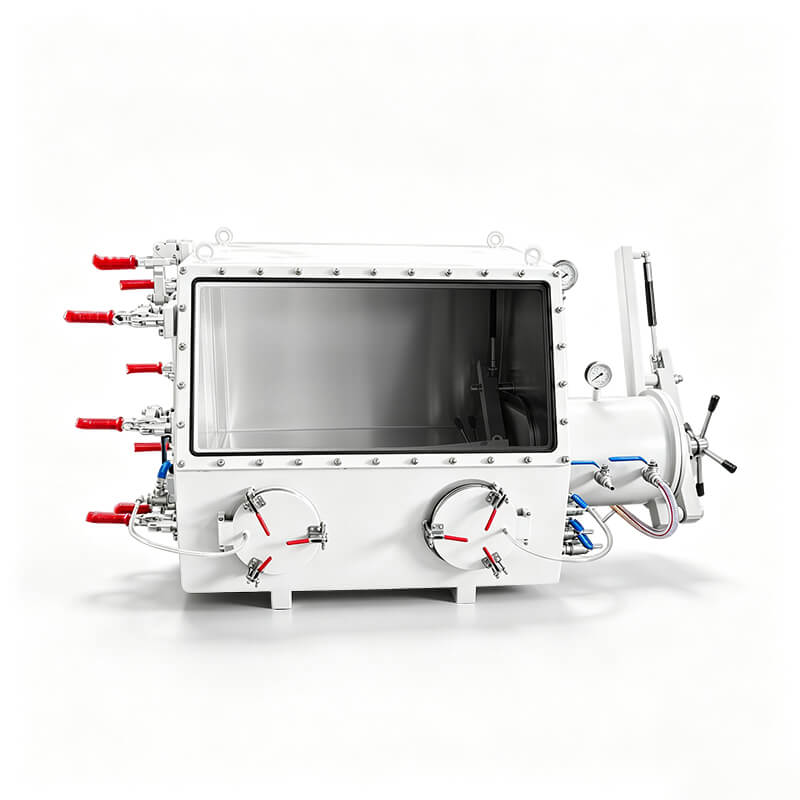
Configuring the GBV-2 around sample transfer and daily work
A vacuum glove box is a system, not a chamber alone. The working experience is shaped by how the operator reaches into the box, how samples are transferred, how the chamber is evacuated, and how instruments and utilities are connected. Because the available GBV-2 reference does not provide a full parameter table, the following points should be treated as configuration questions to confirm on the current drawing and quotation.
Chamber, gloves, and access
Chamber size and shape affect reach, visibility, and the amount of atmosphere that must be exchanged. A larger chamber may accommodate more equipment, but it also contains more gas and more surface area. Glove port count, port spacing, glove size, and window position determine whether an operator can work comfortably and whether two people can collaborate. Glove material and thickness influence dexterity and permeation, while the mounting frame and floor space affect installation. A stainless steel box can be heavy, so support and access for service should be planned early.
Antechamber and transfer
If the selected GBV-2 configuration includes an antechamber, its volume, door seals, evacuation path, and shelving determine how quickly samples can be introduced without opening the main chamber to room air. The antechamber should be large enough for the usual sample container and any tools that must pass through. Frequent transfers may justify a larger or separately pumped antechamber, but the final choice depends on the actual load and the acceptable recovery time.
An antechamber should not be assumed merely because a vacuum glove box is being quoted. If no antechamber is fitted, the transfer strategy must be designed another way, and the effect of each opening on the atmosphere must be considered. The supplier should state clearly what is included, what is optional, and how the transfer path is intended to work.
Feedthroughs, pump, and utilities
Electrical and signal feedthroughs, gas ports, KF connections, vacuum lines, and sensor ports all create penetrations that must be sealed and arranged without interfering with glove movement. The pump must match the chamber volume, the required vacuum, and the gases or vapors being handled. A pump that is suitable for clean dry gas may not be suitable for solvent vapor without a trap or a different pump technology. The same applies to gauges and analyzers: their ranges and materials must be compatible with the process atmosphere.
| Item to confirm | Why it matters | What not to assume |
|---|---|---|
| Chamber dimensions and port layout | Reach, equipment fit, and gas volume | That a model name fixes the size or number of ports |
| Antechamber volume and pumping path | Transfer speed and atmosphere disturbance | That an antechamber is included or fully vacuum-rated |
| Glove material and size | Dexterity, permeation, and seal compatibility | That one glove type suits every solvent or sample |
| Pump and vapor handling | Evacuation time and compatibility with solvents | That ultimate pump pressure equals working atmosphere quality |
| Analyzer range and calibration | Verification of oxygen or moisture | That display resolution equals measurement accuracy |
Verifying oxygen, moisture, and pressure without overreading one number
Atmosphere verification is often reduced to a single displayed value. That is convenient but incomplete. An oxygen reading, a moisture reading, a vacuum gauge, and a leak test answer different questions. The instrument location matters as well: a sensor measures the gas at its sampling point, not the average composition of the entire chamber or the atmosphere inside a closed sample container.
Analyzers measure at a point
An oxygen analyzer may use an electrochemical or other sensor, while a moisture analyzer may use a capacitive or chilled-mirror principle. In either case, calibration, response time, sample flow, and placement influence the reading. A display that resolves to a small number is not necessarily accurate to that number. The analyzer also does not purify the atmosphere; it only reports what reaches the sensor. If the sampling line is long or has dead volume, the response may lag behind the chamber.
Leak rate, vacuum, and atmosphere are different
Leak rate describes how quickly gas enters a sealed system under a defined pressure difference. Chamber working pressure describes the pressure at which the box is operated. Pump ultimate vacuum describes the pump’s capability under specified conditions. Oxygen and moisture concentrations describe the gas composition. None of these can be substituted for another. A box that holds vacuum may still have a slow air leak, and a box with a good oxygen reading after purging may still recover poorly during work.
Slow recovery is a diagnostic clue, not a verdict
If oxygen or moisture returns slowly after a transfer or purge, several explanations are possible: a door or glove seal, permeation through gloves, a wet or porous sample, insufficient exchange of dead volumes, contaminated tubing, an analyzer sampling lag, or solvent residue. If a purifier is present, its capacity and regeneration state also matter. None of these should be asserted without checking the system. The useful approach is to compare the baseline with the rate of change, inspect the obvious seal paths, verify the gas supply, and confirm the analyzer with a known calibration gas.
| Observation | What it can support | What it cannot prove |
|---|---|---|
| Low vacuum-gauge reading | The chamber or pump reached a pressure condition | That oxygen and moisture are low |
| Low oxygen display | The sensor saw low oxygen at its sampling point | That the entire chamber or sample is protected |
| Stable reading during idle | The box is stable under that condition | That it will recover quickly after opening |
| Fast pressure rise | A leak or outgassing source deserves investigation | The exact location or cause without further testing |
Heat, solvents, and accessory choices that change the enclosure
Thermal and chemical loads are often added after the box is selected, yet they can change the safe and practical configuration. A sealed chamber is not a good place to reject heat. A hot process can raise the chamber temperature and pressure, affect gloves and seals, and increase outgassing. A cold process can reduce pressure and create condensation. These effects should be discussed with the supplier before accessories are chosen.
Process heat and the recirculating chiller
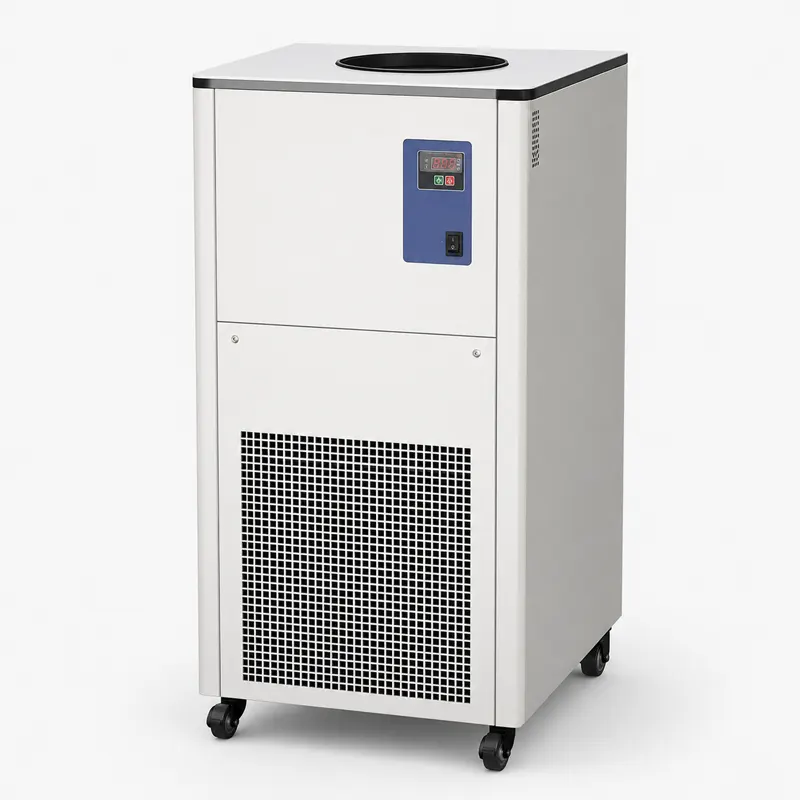
A precision recirculating water chiller can be part of a thermal-management plan for a process or device that generates heat. It circulates a cooled fluid through an external loop; it does not control oxygen or moisture and it does not replace a purifier. Compatibility must be confirmed: heat load, fluid type, tubing, connections, condensation risk, control interface, and whether the glove box configuration provides a suitable path for the loop. The accessory category alone is not proof that a particular chiller is compatible with a particular GBV-2 configuration.
Solvent vapor and particle filtration
A HEPA filter removes particles. It does not remove water vapor, oxygen, or solvent vapor. If solvents are used, the vapor may attack gloves, seals, or windows, load the vacuum pump, and contaminate a purifier if one is present. A suitable vapor trap or adsorbent may be needed, and its capacity and replacement interval must be part of the operating plan. Solvent adsorption is not a substitute for water and oxygen purification. The safest approach is to declare the solvents and quantities in the application information so that wetted materials, pump protection, and exhaust arrangements can be reviewed together.
A specification checklist for the GBV-2
The most useful request for quotation is a description of the work, not a list of model numbers. For the GBV-2, the following information allows the supplier to propose a coherent configuration and allows the buyer to compare offers on the same basis.
- Sample and process: material chemistry, typical quantity, powder or solid form, and whether the sample releases moisture, solvent, or gas.
- Atmosphere target: required oxygen and moisture limits, the duration for which they must be held, and the acceptable recovery time after opening.
- Gas supply: argon or nitrogen, specified purity, delivery pressure, and whether a backup supply is needed.
- Vacuum requirement: whether vacuum is needed in the main chamber, the antechamber, or both, and the purpose of each evacuation step.
- Transfer pattern: sample size, container type, transfer frequency, and whether a glove bag, antechamber, or another interface is intended.
- Working space: chamber dimensions, glove port count and position, window preference, and any equipment that must remain inside.
- Utilities and feedthroughs: electrical power, signal lines, gas lines, KF ports, sensors, and data connections.
- Chemical and thermal loads: solvents, acids, particles, heating or cooling devices, and the expected heat load.
- Instrumentation: oxygen and moisture analyzer ranges, calibration arrangements, alarm functions, and recording requirements.
- Pump and protection: pump type, traps, filters, pressure relief, gauges, and the intended maintenance access.
- Verification: leak test, rate-of-rise test, analyzer calibration, and the acceptance criteria that will be used at installation.
Once these items are on paper, the choice between an exchange-only vacuum box and a continuously purified system becomes clearer. The GBV-2 may be the right enclosure for batch work, vacuum-assisted handling, or isolation of sensitive materials. It should not be asked to perform as a purification system unless the quotation explicitly includes that capability. The final specification should state what is included, what is optional, and which performance values apply to the supplied configuration rather than to a generic model category.
