Product Introduction
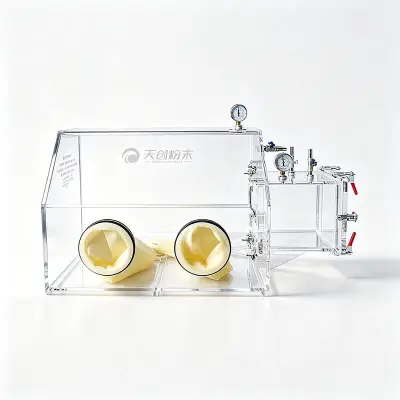
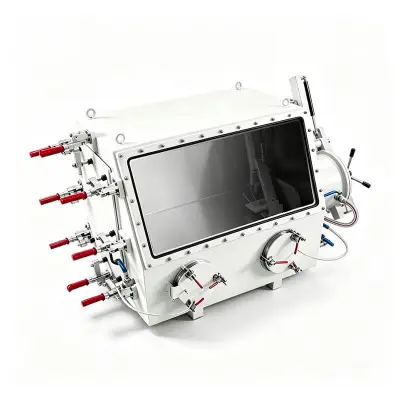
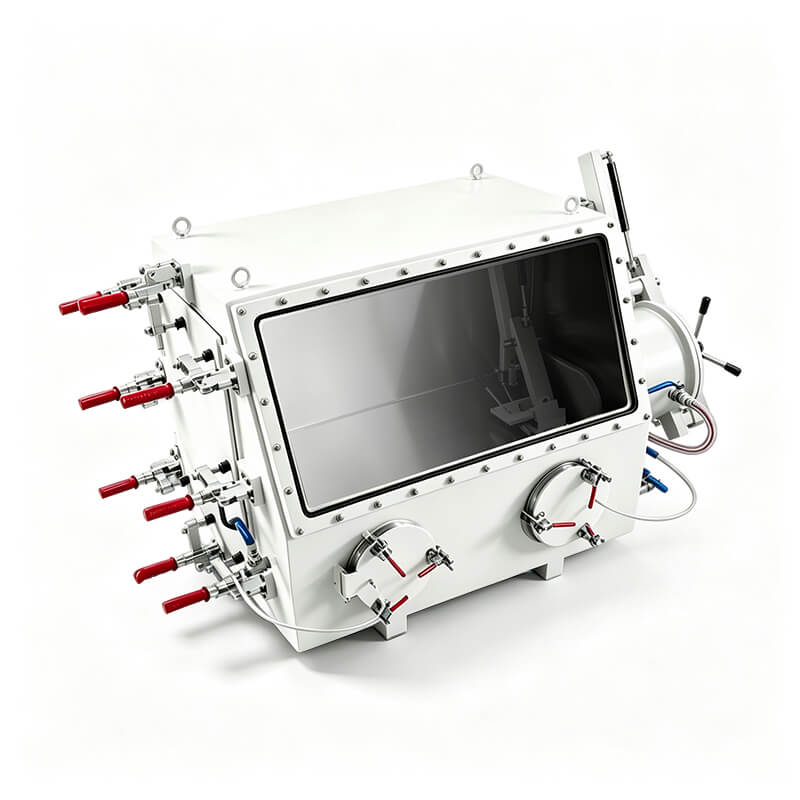
The GBV-2 Stainless Steel Vacuum Glove Box is a controlled-atmosphere workstation designed for laboratory powder handling, sample preparation, and processing of materials that require reduced exposure to ambient air, oxygen, or moisture.
The system uses vacuum evacuation and inert-gas replacement to establish a controlled working environment inside the sealed chamber. After evacuation, nitrogen, argon, or another process-compatible inert gas can be introduced according to experimental requirements. This makes the GBV-2 suitable for weighing, mixing, transferring, loading, packaging, and preparing sensitive powders and samples before subsequent laboratory processing.
Compared with the smaller GBV-1 configuration, the GBV-2 provides a larger 800 × 650 × 650 mm main chamber, offering additional workspace for samples, containers, tools, and small laboratory accessories. The official configuration also includes a Ø273 × 350 mm vacuum antechamber and Ø150 mm glove ports.
A large front viewing window provides clear visibility of the working area, while sealed glove ports allow materials to be manipulated without opening the main chamber. An independent vacuum antechamber enables tools and samples to enter or leave the glove box while minimizing disturbance to the atmosphere inside the main working chamber.
The GBV-2 is particularly suitable for powder metallurgy, advanced materials, ceramics, battery-material research, chemistry, materials science, and university or industrial R&D laboratories where a practical vacuum/inert-atmosphere workspace is required.
Technical Specifications
| Parameter | GBV-2 |
|---|---|
| Product Type | Stainless Steel Vacuum Glove Box |
| Overall Dimensions | 1295 × 715 × 675 mm |
| Main Chamber Dimensions | 800 × 650 × 650 mm |
| Internal Clear Dimensions | 660 × 460 mm (upper) 640 mm (lower) × 640 mm |
| Vacuum Antechamber | Ø273 × 350 mm |
| Glove Port Diameter | Ø150 mm |
| Optional Side Door | 360 × 480 mm |
| Optional Antechamber Drawer | 202 × 320 mm |
| Tool Chamber | Not included |
| Chamber Working Pressure Range | 0–0.1 MPa |
| Pressure Holding Time | 12 hours |
| Customization | Available |
Key Features
01. Stainless Steel Chamber
The main chamber is constructed from stainless steel and reinforced for reliable laboratory operation. The robust structure offers good durability and corrosion resistance, while smooth surfaces simplify routine cleaning after powder or sample handling. The product page identifies stainless steel construction and reinforced treatment as key structural features.
02. Large Working Chamber
The GBV-2 features a main chamber measuring:
800 × 650 × 650 mm
This provides sufficient internal space for powder containers, laboratory tools, sample holders, small instruments, and routine experimental operations. The overall dimensions listed for the GBV-2 are 1295 × 715 × 675 mm.
03. Wide Viewing Window
A large transparent front window provides a broad field of view, allowing operators to clearly observe samples, tools, and experimental procedures inside the chamber.
The design is particularly useful for operations requiring continuous visual monitoring, such as powder weighing, sample transfer, mixing, container loading, and experimental assembly.
04. Sealed Glove-Port Operation
Front glove ports allow operators to handle samples inside the sealed chamber without opening the main working space.
The GBV-2 uses Ø150 mm glove ports, providing convenient access for routine laboratory manipulation while helping maintain isolation between the internal working atmosphere and the surrounding laboratory environment.
05. Independent Vacuum Antechamber
The GBV-2 is equipped with a Ø273 × 350 mm vacuum antechamber, also referred to as a transfer chamber or airlock.
Samples, containers, tools, and accessories can be placed into the antechamber first. After the outer door is closed, the chamber can be evacuated and/or refilled with inert gas before the inner door is opened.
This arrangement reduces the need to repeatedly evacuate the entire main chamber and helps minimize atmospheric disturbance during routine material transfer.
06. Vacuum Ball Valves
Vacuum ball valves provide connection points for evacuation, gas introduction, and other compatible process utilities.
According to the operating requirements, users can connect the chamber to an appropriate vacuum source or gas supply system for evacuation and inert-gas replacement. The current product configuration lists two vacuum ball valves.
07. Vacuum and Inert-Gas Atmosphere Control
The glove box can first be evacuated to remove a substantial portion of the air inside the chamber and then filled with an inert gas.
Repeating the evacuation and backfilling process can further reduce atmospheric exposure before sensitive materials are introduced or processed.
This operating principle is especially suitable for laboratory applications requiring general oxidation and moisture protection without continuous gas purification.
08. Internal Lighting and Power Supply
The main chamber can incorporate internal lighting and electrical outlets, providing convenient power access for suitable small laboratory instruments and improving visibility during operation. These features are included in the current product description.
09. Reliable Sealed Structure
The chamber, viewing window, glove ports, transfer chamber, valves, and access components form an enclosed operating system designed to support vacuum evacuation and controlled-atmosphere operation.
The product page specifically highlights the sealing structure as being designed for reliable sealing and convenient opening.
10. Customizable Configuration
The GBV series can be customized according to experimental and process requirements, including modifications to:
Chamber dimensions · Construction materials · Chamber shape · Access openings · Transfer components · Other structural configurations
The manufacturer's product page explicitly lists material, dimensions, shape, and other requirements as customization options.
Working Principle
The GBV-2 Stainless Steel Vacuum Glove Box establishes a controlled working atmosphere through vacuum evacuation and inert-gas backfilling.
Before an experiment begins, the main chamber is sealed and connected to a suitable vacuum source. Air is evacuated from the chamber, after which an inert gas such as nitrogen or argon can be introduced.
Depending on the required atmospheric conditions, the evacuation and gas-refilling procedure may be repeated. This helps reduce the amount of residual oxygen, moisture, and ambient air within the working chamber.
Once the desired operating environment has been established, samples can be manipulated through the sealed glove ports while the main chamber remains closed.
For routine sample transfer, materials are first placed inside the independent antechamber. The outer door is then closed, and the transfer chamber is evacuated and/or filled with inert gas before the inner door is opened. This design reduces direct air exchange with the main chamber and avoids repeatedly evacuating the entire glove box. The two-door transfer-chamber design is specifically identified on the manufacturer's product page.
Product Features
The GBV-2 can be used for a wide range of controlled-atmosphere laboratory procedures, including:
- Powder weighing and dispensing
- Powder mixing and blending
- Sample preparation
- Material transfer
- Container loading and unloading
- Sample packaging under inert atmosphere
- Crucible loading
- Powder batching
- Specimen assembly
- Temporary storage of sensitive samples
- Preparation before ball milling
- Preparation before pressing or forming
- Preparation before sintering
- Sample preparation before characterization
- Handling materials requiring reduced exposure to ambient air
Industry Applications
1. Powder Metallurgy
The GBV-2 is well suited to laboratory-scale powder metallurgy and metal-powder research, where oxidation or moisture exposure may affect powders during weighing, blending, transfer, or sample preparation.
Typical operations include:
Metal powder weighing · Alloy powder batching · Powder blending · Sample transfer · Crucible loading · Container filling · Preparation before milling · Preparation before pressing and sintering
The larger GBV-2 working chamber provides additional space for powder containers, laboratory accessories, and sample-handling equipment.
2. Advanced Materials Research
Advanced material development frequently involves powders, precursors, or intermediate samples that require controlled handling conditions.
The GBV-2 provides an enclosed working environment for laboratory preparation of materials such as:
Metal powders · Alloy powders · Composite materials · Functional powders · Ceramic materials · Nanomaterials · Research-grade material formulations
Vacuum evacuation followed by inert-gas replacement helps reduce unnecessary exposure of these materials to the surrounding laboratory atmosphere.
3. Battery Material Research
The GBV-2 can support selected laboratory operations involving battery materials where reduced atmospheric exposure is desirable.
Typical applications include:
Electrode powder handling · Powder weighing · Material batching · Sample transfer · Container loading · Sample packaging · Preliminary battery-material preparation
For battery research requiring continuously maintained ultra-low H₂O and O₂ concentrations, particularly demanding lithium-metal, solid-state electrolyte, or long-duration cell-assembly processes, a glove box equipped with a dedicated gas purification system is generally the more appropriate product category.
This distinction is important because your current website separately lists purification glove boxes capable of sub-ppm water and oxygen control, whereas the GBV series is positioned as a vacuum glove box for more general atmosphere-control requirements.
4. Ceramic and Functional Powder Materials
Ceramic powders and functional materials may adsorb moisture or undergo undesirable surface changes during prolonged exposure to laboratory air.
The GBV-2 can provide a controlled workspace for:
Powder weighing · Formulation · Blending · Sample loading · Crucible preparation · Material transfer · Pre-treatment before milling, forming, or heat treatment
It is suitable for R&D laboratories working with ceramic powders, functional ceramics, composite materials, and specialty powder formulations.
5. Chemical and Air-Sensitive Materials
For suitable materials that need to be isolated from ambient oxygen or moisture during laboratory handling, the GBV-2 provides an enclosed workspace for operations such as:
Reagent preparation · Sample weighing · Mixing · Material transfer · Container loading · Temporary storage · Experimental assembly
Material compatibility and process safety should be evaluated before handling hazardous, volatile, flammable, corrosive, or toxic substances inside any glove box system.
6. Ball Milling and Powder Preparation
The GBV-2 can be integrated into laboratory powder-processing workflows before or after ball milling.
For oxidation-sensitive powders, operators can use the glove box to:
Load grinding jars · Prepare powder batches · Transfer milled materials · Seal containers · Prepare samples before vacuum or inert-atmosphere milling
This makes the glove box particularly relevant to laboratories conducting powder preparation alongside planetary ball mills, vacuum grinding jars, or other sealed powder-processing equipment.
7. Universities and Research Institutes
The GBV-2 is suitable for controlled-atmosphere experimental work in:
Materials Science · Powder Metallurgy · Chemistry · Ceramics · Energy Materials · Nanomaterials · Metallurgy · Laboratory Powder Processing
Its straightforward vacuum-and-gas replacement principle makes it suitable for research groups that require atmospheric isolation but do not necessarily require a continuously regenerated gas purification system.
Typical Materials
Metal and Alloy Powders
Metal powders, alloy powders, powder metallurgy samples, and other oxidation-sensitive research materials.
Ceramic Materials
Ceramic powders, functional ceramic materials, precursors, and composite powders.
Battery Materials
Selected electrode powders, conductive materials, and energy-storage research samples requiring reduced exposure to ambient air.
Advanced Materials
Nanomaterials, functional powders, composite materials, specialty powders, and experimental formulations.
Chemical Materials
Compatible moisture-sensitive or oxidation-sensitive chemicals and experimental intermediates, subject to process and safety evaluation.
Why Choose the GBV-2?
Larger Working Space
With an 800 × 650 × 650 mm main chamber, the GBV-2 provides significantly more internal workspace than the GBV-1 while remaining suitable for laboratory and R&D environments.
Controlled Atmosphere for Sensitive Materials
Vacuum evacuation combined with inert-gas replacement provides a practical method for reducing contact between sensitive powders or samples and ambient air.
Efficient Sample Transfer
The independent Ø273 × 350 mm vacuum antechamber allows materials and tools to enter or leave the glove box without routinely opening and reconditioning the main chamber.
Designed for Powder Processing Workflows
The chamber is particularly useful for laboratory operations involving powder weighing, mixing, loading, transfer, packaging, and preparation before grinding, pressing, sintering, or characterization.
Flexible Configuration
Optional access doors and antechamber drawers are available, while chamber dimensions, materials, shapes, and other structural configurations can be customized according to application requirements.
FAQ
-
What is a Glove Box Port Cover? A Sealing Accessory for Maintaining Inert Atmosphere in Glove Box Ports
A glove box port cover is a specialized sealing accessory designed to cover unused glove ports on inert atmosphere glove boxes. It plays a critical role in maintaining low moisture and oxygen levels by preventing gas leakage and contamination. Available in various materials and sizes, port covers are essential for labs requiring strict inert atmosphere control.
MORE >> -
What are Glove Box Butyl Rubber Gloves? A Critical Accessory for Maintaining Inert Atmosphere Integrity in Glove Boxes
Glove box butyl rubber gloves are essential accessories for maintaining ultra-low water and oxygen levels in inert atmosphere glove boxes. This guide explains their function, key performance metrics (permeability, tensile strength), material advantages, selection criteria, and how they compare with other glove materials like neoprene or latex for laboratory applications.
MORE >> -
What is a Glove Box Moisture Analyzer? A precision analytical instrument used for real-time moisture monitoring in inert atmosphere glove boxes
A Glove Box Moisture Analyzer is a critical accessory for maintaining ultra-low humidity environments inside glove boxes. It continuously measures trace water vapor levels (down to <0.1 ppm) using advanced sensor technology such as electrolytic or capacitive sensors, ensuring optimal conditions for moisture-sensitive materials like lithium-ion batteries, OLEDs, and perovskites. This article explains its working principle, key performance indicators, selection criteria, and applications in research and industry.
MORE >> -
What is a KF40 Ethernet Feedthrough? A Vacuum-Safe Data Feedthrough for Inert Atmosphere Glove Boxes
A KF40 Ethernet Feedthrough is a specialized vacuum component that enables reliable data transmission through the walls of a glove box, maintaining an inert atmosphere. It features a CAT6 rated RJ45 connector, ultra-low vacuum leakage rate below 1×10⁻⁹ Pa·m³/s, and is designed for use with KF40 flanges, ideal for semiconductor, battery, and materials research.
MORE >> -
What is a Glove Box Glove Port? A critical interface component for providing operator access in inert atmosphere glove boxes
A glove box glove port is a sealed interface on an inert atmosphere glove box that allows operators to safely handle moisture- and oxygen-sensitive materials. This article explains its function, key components, selection criteria, and applications in research and industry.
MORE >> -
What is a Large Glove Box Antechamber? A Sample Transfer Interface for Maintaining Inert Atmosphere in Glove Box Systems
A large glove box antechamber is a critical accessory for transferring materials into and out of an inert atmosphere glove box without compromising the ultra-low H₂O and O₂ environment. This article explains its core function, working principle, types, key specifications, and selection tips for research labs.
MORE >> -
What is a Two-Station Single-Sided Glove Box with Gas Purification System? An Inert Atmosphere Protection Device for Handling Moisture and Oxygen-Sensitive Materials
Discover the core functions, working principles, and key performance indicators of this specialized gas purification glove box. Learn how it creates and maintains ultra-low H₂O/O₂ environments for advanced materials research, from lithium-ion batteries to perovskite solar cells, and find selection guidance for your lab.
MORE >> -
What is a Glove Box Dry Scroll Vacuum Pump? An Oil-Free Vacuum Source for Inert Atmosphere Glove Box Systems
A glove box dry scroll vacuum pump is a contamination-free, oil-less vacuum solution designed for inert atmosphere glove box systems. It provides clean, reliable vacuum for antechamber evacuation, solvent degassing, and material drying without risking oil backstreaming, ensuring the integrity of sensitive experiments in materials science, battery research, and semiconductor processing.
MORE >> -
What is the GBV-1 Stainless Steel Vacuum Glove Box? A Professional Inert Atmosphere Platform for Air-Sensitive Material Processing
The GBV-1 stainless steel vacuum glove box provides a sealed, high-purity inert atmosphere environment for handling oxygen- and moisture-sensitive materials. This article explains its core functions, working principle of vacuum replacement, key performance indicators, and selection tips for labs in battery, OLED, and semiconductor research.
MORE >> -
What is a KF40 Electrical Test Lead Feedthrough? A Sealed Feedthrough Device for Electrical Testing Inside Glove Boxes
A KF40 Electrical Test Lead Feedthrough is a vacuum-sealed electrical interface that allows researchers to safely pass test leads, sensors, and measurement cables into an inert atmosphere glove box without compromising the low H₂O/O₂ environment. This article explains its working principle, key features, how to choose the right feedthrough, and its critical role in battery research, semiconductor fabrication, and material science experiments.
MORE >>