
Every transfer into an inert-atmosphere glove box starts with a compromise. The main chamber is valuable because its oxygen and moisture levels are controlled; the surrounding room is not. An antechamber, also called a transfer lock or airlock, creates a small intermediate volume where a sample, tool, or consumable can be separated from the room before the inner door opens. The Small Glove Box Antechamber is the accessory in focus here: a compact transfer chamber intended to make routine movement into and out of a controlled enclosure less disruptive.
Its value is not simply that it is small. Its value comes from matching the lock volume, door arrangement, purge or vacuum method, pump, seals, and mounting interface to the way a laboratory actually moves things. A small lock can be an excellent choice for vials, substrates, small fixtures, sensors, and repair parts. It can also become a bottleneck if the opening is too narrow, the pump is mismatched, or the chamber cannot be integrated cleanly with the host box. “Small” describes the envelope, not the performance.
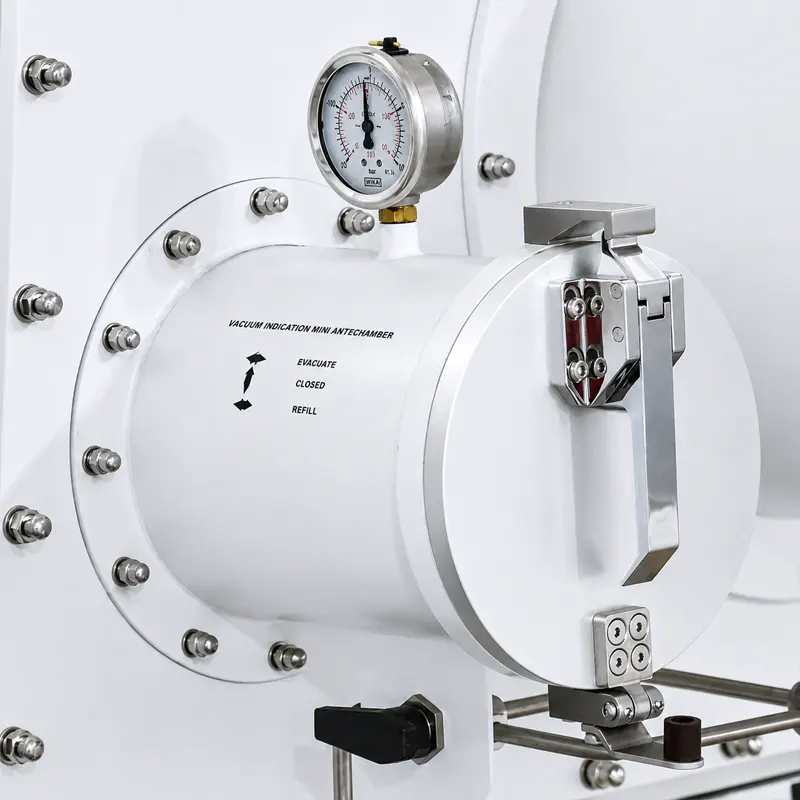
A transfer lock protects the atmosphere by controlling the exchange
The basic function of an antechamber is to divide one difficult transfer into two easier ones. The outer door opens to the laboratory while the inner door remains closed. The load goes into the lock, the outer door is sealed, and the lock atmosphere is adjusted by purging with inert gas, by vacuum-assisted exchange, or by a combination of both. Only then does the inner door open to the glove box. The main chamber never sees the room directly, and the operator does not have to pass objects through the glove ports.
This sounds simple, but the protection depends on several separate barriers. The first is mechanical: both doors must seal consistently, and the latch must produce even compression without requiring excessive force. The second is atmospheric: the lock must be purged or evacuated in a way that reaches the load and the chamber surfaces, not just the gas inlet. The third is operational: the user must allow enough exchange before opening the inner door. A well-made lock operated as a pass-through with no atmosphere adjustment is still a controlled opening between two environments, but it is not automatically a clean transfer.
The small format is useful because it limits the volume of air that has to be displaced. It also limits the surface area that can release moisture or solvent vapor after a load has been placed inside. That second point matters. A small chamber has a high surface-area-to-volume ratio, so contamination adsorbed on the walls, seal, window, or tray can be proportionally more important than it would be in a large room-sized chamber. Cleanliness and purge quality are not guaranteed by compact dimensions.
What the lock is not
An antechamber is not a miniature glove box, a drying oven, or a storage cabinet. It should not be treated as a place to keep moisture-sensitive material for hours while the main box is busy. Nor should it be assumed to be vacuum-rated, solvent-compatible, or fitted with a purification loop simply because it is sold alongside glove boxes. The TENCAN item is identified as a small glove box antechamber; whether a selected unit is purge-only, vacuum-capable, or supplied with particular ports, controls, and seals must be confirmed from the chosen configuration.
What the small chamber changes in practice
The most obvious benefit of a small lock is reduced gas consumption. If a chamber holds less free volume, a given purge flow should turn over that volume more quickly, and a vacuum-assisted exchange should remove a smaller inventory of air per cycle. The effect can be significant in a busy laboratory where dozens of small transfers occur each day. It is not a universal guarantee. The actual result depends on the purge path, dead legs, door sequencing, pump performance, seal leakage, and the load itself.
Small chambers can also improve workflow by separating routine transfers from large ones. A vial of air-sensitive powder, a small substrate, or a replacement component does not need the same opening as a bulky fixture. Giving frequent small items their own lock can reduce the number of times the main chamber is opened to the room and can make the transfer sequence more predictable. In a multi-user laboratory, that separation is often as valuable as the gas savings.
The trade-off is capacity and ergonomics. A small opening can make it difficult to insert a container without touching the seals. A shallow chamber can limit the length of tools or the height of a vial rack. A compact door may be awkward for users wearing gloves, especially if the latch, hinge, or window restricts hand access. Before selecting a small antechamber, measure the largest object that must pass through it, including the secondary container and any tool used to place the load. Confirm the clear opening, usable depth, internal height, and support surface rather than relying on an external footprint.
Why atmosphere disturbance is not only about air volume
When the inner door opens, gas from the lock mixes with gas in the main chamber. If the lock has been well exchanged, the disturbance should be modest; if it has not, the main chamber receives a pulse of oxygen, moisture, or solvent vapor. The size of that pulse depends on the concentration remaining in the lock, the volume of the lock relative to the box, and the way the doors are operated. A small lock is not automatically a small disturbance if the purge is incomplete or the inner door is opened too soon.
Pressure effects matter too. Opening a door against a pressure difference can draw room air into the lock, disturb the glove box pressure, or stress the seal. A controlled equalization step, whether through a valve, a bypass, or the control sequence specified for the equipment, is part of the transfer design. The correct procedure belongs in the operating instructions for the particular chamber and host box; it should not be improvised from generic advice.
Passive purge or vacuum assistance: choose by load, not habit
There are two broad ways to prepare a transfer lock. A passive or flow-purge design uses inert gas to sweep the chamber while one or both doors are closed. The gas dilutes the incoming air and carries it toward an outlet. The method is mechanically simple and can suit low-sensitivity transfers, frequent small items, or installations where a vacuum pump is undesirable. Its weakness is that displacement can be uneven. A short-circuit path from inlet to outlet may leave stagnant corners, and a large or absorbent load may release contaminants after the purge has ended.
A vacuum-assisted design reduces the air inventory by pumping the lock down and refilling it with inert gas. One or more cycles may be used, depending on the chamber, the load, and the procedure. Vacuum exchange can be more effective than a simple sweep, but only if the chamber is designed for it, the pump is compatible with the gases and any condensable materials present, and the door seals tolerate the pressure difference. A chamber that is not rated for vacuum should not be evacuated merely because a pump is available.
The choice should follow the load and the consequence of a failed transfer. A small, dry, sealed vial that will be used immediately is a different case from a porous substrate, a solvent-wet component, or a tool with crevices that trap air. Vacuum alone does not remove moisture that is chemically bound to a surface, and purging alone does not necessarily remove oxygen from a deep recess. In many installations a hybrid sequence is used: reduce the air inventory, refill with inert gas, and allow the lock to settle before opening the inner door.
| Method | Typical strength | Main limitation to confirm |
|---|---|---|
| Flow purge | Simple operation; no vacuum-rated chamber required | Dead spaces and short-circuiting; gas use over long cycles |
| Vacuum-assisted exchange | Reduces the air inventory before refill | Chamber must be vacuum-rated; pump and seal compatibility |
| Hybrid purge and vacuum | Can combine bulk removal with dilution | Sequence and controls must be specified and repeatable |
Do not turn a cycle count into a universal rule. The number of exchanges that is adequate depends on the starting atmosphere, the target condition, the pump, the chamber volume, the load, and the measurement method. A supplier may recommend a sequence for a specific configuration, but the user still needs a way to verify that the main box recovers as expected.
Sizing is a mechanical and ergonomic question
The first sizing exercise is not the internal volume; it is the object path. Measure the largest item in its transfer container, then account for the hand or tool that must place it. Check that the item can rest on the chamber floor or tray without blocking the inner door. If the lock is mounted at an awkward height, the operator may tilt the load and contact the seal. That is a contamination risk as well as a handling risk.
The second exercise is interface compatibility. An antechamber may connect to a host box through a fixed flange, a bolted opening, a short tunnel, or another interface defined by the manufacturer. The bolt pattern, port position, structural support, isolation valve, pressure relief, and electrical or signal connections all matter. A product name or a photograph is not enough to establish that a given lock fits a given glove box. If the host is an existing enclosure, the interface should be confirmed in writing before purchase.
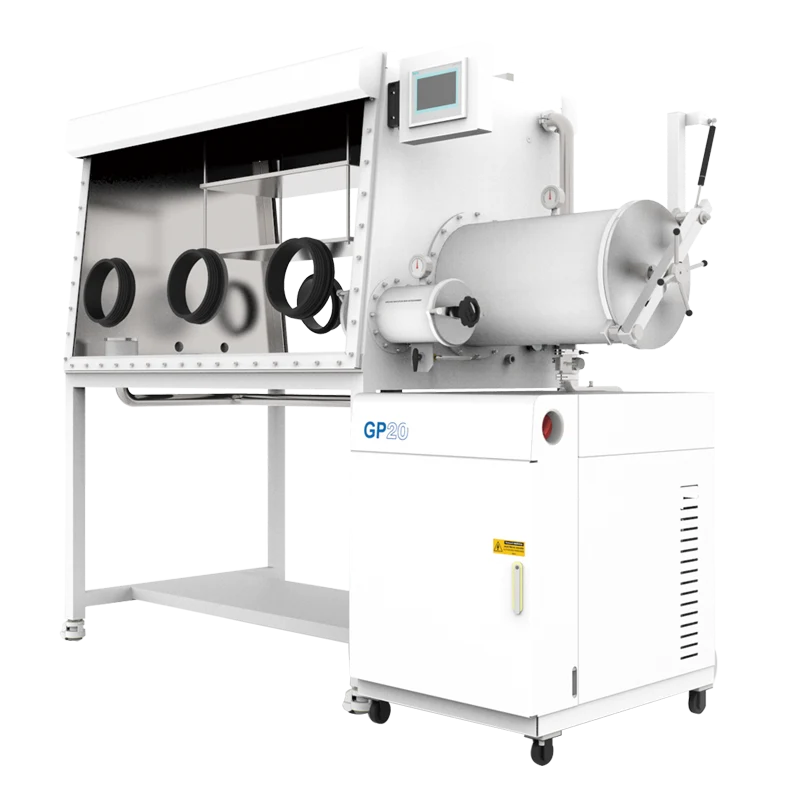
The same caution applies to larger systems. TENCAN’s six-glove double-sided glove box with gas purification system illustrates how transfer points interact with a larger, multi-user enclosure. A double-sided, six-glove layout may serve higher throughput or collaborative work, but its size does not imply that every small antechamber is compatible with it, or that a small lock is sufficient for every load. The correct question is how the lock opening, support structure, atmosphere control, and working practice fit the actual installation.
Seals, windows, and material compatibility
Small chambers often have a window to let the operator see the load. The window is useful, but it must be compatible with the cleaning agents and solvents used nearby. Seal elastomers vary too. A seal that performs well in a dry inert atmosphere may swell or degrade when exposed to a solvent vapor. Before introducing any chemical, confirm the wetted materials of the chamber, window, seal, and valve. This is not a reason to avoid small antechambers; it is a reason to specify them for the process rather than for appearance alone.
The accessories around the antechamber decide its behavior
A transfer lock is a small system, not just an enclosure. The pump, valves, tubing, gauge, purge-gas supply, pressure relief, and control sequence all shape its performance. A pump should be selected for the required pressure range, the gas being handled, the presence of condensable vapors, and the duty cycle. A pump that is oversized for the lock may pull down quickly but can also create sudden pressure changes that stress seals or disturb the host box. A pump that is undersized may extend every transfer and encourage users to skip steps.
Valves and tubing should be arranged to avoid dead legs and to permit the chamber to be isolated for leak checks or maintenance. A pressure gauge is not a substitute for a leak test, and a vacuum gauge reading is not proof that the chamber atmosphere is dry and oxygen-free. Those are different measurements. The lock may hold a vacuum while a seal on the inner door still allows a small air ingress path, or the pump may reach a low pressure while moisture remains adsorbed on the walls.
Analysis, filtration, and purification are distinct functions
An oxygen or moisture analyzer measures the atmosphere; it does not remove oxygen or water. A HEPA filter captures particles; it does not remove water vapor or solvent vapor. A solvent adsorption device may protect a purification system from organic vapors; it does not replace a water and oxygen purification loop, and it does not automatically make a solvent-wet load safe to transfer. If the process involves solvents, the correct configuration and procedure must be defined for the host system, not assumed from the presence of an accessory port.
Analyzer readings also need interpretation. Resolution is not the same as accuracy, and a displayed change may reflect sensor drift, calibration condition, sample location, or a real atmosphere event. If a reading moves after a transfer, the first step is to record the time, the load, the door sequence, and the purge or vacuum treatment. That record is more useful than a single number taken immediately after the inner door closes.
Reading oxygen and moisture excursions after a transfer
A temporary rise in oxygen or moisture after a transfer is not automatically evidence of a faulty antechamber. The lock may be delivering a concentrated pulse of room air because the purge was short, the load was large, the inner door was opened early, or the chamber has a dead volume that the flow does not sweep. The apparent excursion can also come from the location of the analyzer, from a glove or seal leak elsewhere, or from a purifier that is due for regeneration. Diagnosis requires separating the transfer event from the rest of the system.
A useful practice is to establish a baseline, perform the transfer without opening the main chamber to the room, and watch the recovery trend. If the reading returns to its usual range with the normal circulation and purification behavior, the lock may simply need a better exchange procedure. If the reading remains elevated, or if repeated transfers produce a cumulative rise, the next checks should include door seals, latch compression, valve closure, tubing connections, glove integrity, and the condition of the purification system. None of those checks should be replaced by guesswork about the lock alone.
| Observation | Plausible check | Not a valid short cut |
|---|---|---|
| Reading rises sharply each time the inner door opens | Verify purge path, exchange time, load size, and door sequence | Assuming a larger pump will fix every case |
| Reading stays high after the transfer | Check seals, valves, gloves, and purifier status separately | Treating the analyzer as a purification device |
| Moisture rises after a solvent-bearing load | Review material compatibility and solvent handling with the host system supplier | Using HEPA filtration as a substitute for vapor control |
The recovery behavior of the main box depends on its free volume, circulation, purification capacity, and sensor placement. A compact lock may reduce the disturbance, but it cannot compensate for a large wet load or an open door left unsealed. Operational discipline remains part of the system.
A specification checklist before ordering
For a small antechamber, the most useful specification is not a single headline dimension. It is a set of answers tied to the transfer task. Before requesting a configuration, prepare the following information for the supplier:
- The largest and heaviest load, including its secondary container and any placement tool.
- The required clear opening, usable depth, internal height, and preferred mounting height.
- Whether the process needs flow purge, vacuum-assisted exchange, or both, and why.
- The host glove box model, interface dimensions, port locations, and available support structure.
- The gases used, any solvent or particulate exposure, and the cleaning agents expected.
- The required pump service, pressure range, valve arrangement, and isolation method.
- Whether a pressure gauge, oxygen or moisture analyzer, interlock, or alarm is needed.
- The expected transfer frequency and the acceptable recovery time for the host atmosphere.
- The maintenance access needed for seals, windows, valves, and pump components.
- The acceptance checks: leak test, door operation, control sequence, and atmosphere recovery criteria.
Also ask for the operating procedure for the exact configuration, not only for the general product family. A small lock can be a strong addition to an inert-atmosphere workflow when its volume, opening, exchange method, and mounting interface are chosen together. It becomes a weak point when it is treated as a universal accessory, assumed to be vacuum-capable, or connected to a host box without confirming the interface. The useful comparison is not “small versus large”; it is “matched to the load and the atmosphere requirement versus merely available.”
