
Air-sensitive powders are unforgiving. A passivated metal coupon can survive a brief excursion; a hygroscopic hydroxide, a lithium salt, a perovskite precursor or a freshly reduced catalyst usually cannot. Between the storage vial and the measurement, every transfer step is a chance to change the surface chemistry of the particles, and therefore the result. Selecting a glove box for powder work is consequently less about a single headline specification and more about the sequence of operations the enclosure has to support.
This guide compares documented design emphases across three platforms used for air-sensitive powder handling: the TENCAN eight-station double-sided split-type glove box with gas purification system, the German-engineered MBRAUN range, and the French isolator range from Jacomex. It is a selection guide, not a ranking. No side-by-side bench testing was carried out for this article, no samples were run in parallel, and nothing below should be read as a third-party verdict or as a substitute for a factory acceptance test. TENCAN is described first because this site documents that configuration in most detail; the other two are described on the same dimensions and against the same evidence standard.
What Air-Sensitive Powder Handling Actually Requires
"Air-sensitive" is a shorthand that hides at least four separate problems: oxidation, hydrolysis, electrostatic charging and simple physical loss of fine material. Each is addressed differently, and a platform that handles one well does not automatically handle the others.
Three atmosphere questions, not one
Oxygen concentration, moisture concentration and enclosure pressure are independent variables and should be specified separately. A box can hold a modest positive pressure and still show poor moisture performance if the purifier is saturated or the leak rate is high. Conversely, a tight enclosure with an undersized purifier will drift under a heavy load of wet powder. Ask for an acceptance test that states how oxygen and moisture are measured, where the sensor sits, after how long a circulation period, and with what sample load inside the box.
It also matters which architecture is being quoted. A continuously recirculating purification system, in which gas is drawn from the box, passed through purifier columns and returned, is a different machine from a displacement or purge box, where the atmosphere is established by flushing with inert gas. Displacement boxes have their place, but they should not be described or purchased as if they were continuous purification systems, and a standalone purifier cabinet is not the same product as a complete glove box.
Transfer is the third question. The antechamber vacuum cycle is a transfer parameter: it removes the air carried in with an object and shortens the time the main chamber is exposed. It is not itself a statement about water and oxygen levels in the working volume, and the two should never be conflated in a specification table.
Why powders are harder than pellets
Powders present far more surface area per gram than pressed pellets or bulk parts, so a residual oxidant level that is harmless for a wafer can be enough to alter a fine hydroxide or a sulfide electrolyte. Powders also dust. Fine fractions adhere to gloves, windows, balance pans and the inside of antechambers, and they migrate. In a multi-user box, cleaning and cross-contamination control therefore become part of the technical specification rather than a housekeeping detail.
Static is the second powder-specific effect. Dry insulating powders in a low-humidity atmosphere charge readily, which makes weighing erratic and causes material to jump to the nearest surface. Grounding, ionisation and disciplined handling practice all matter, and so does the ability to bring a balance and its cabling into the box cleanly. That last point is an enclosure and feedthrough question rather than a chemistry question, and it often decides whether a chosen box is actually usable for gravimetric work.
Six Criteria Used in This Guide
The comparison below uses six dimensions that recur in powder projects. They are deliberately qualitative: they describe design emphasis and configuration options, which can be verified from manufacturer documentation and discussion, rather than scores that would imply testing nobody performed.
- Atmosphere architecture — continuous purification versus displacement, and how the acceptance value will be measured.
- Access geometry — number of glove ports and stations, single- or double-sided working, and usable working depth.
- Powder hygiene — interior finish, corners, spill control and how easily the box is cleaned between materials.
- Transfer path — antechamber size and cycle, pass-through options, and handling of awkward items such as crucible boats and balance draft shields.
- Electrical and instrument integration — feedthroughs, flange standards and the signal types they are intended to carry.
- Installation and footprint — how the enclosure reaches the room, how it is assembled and validated, and how service access is preserved.
The TENCAN Reference Configuration: Eight Stations, Two Sides, Split Construction
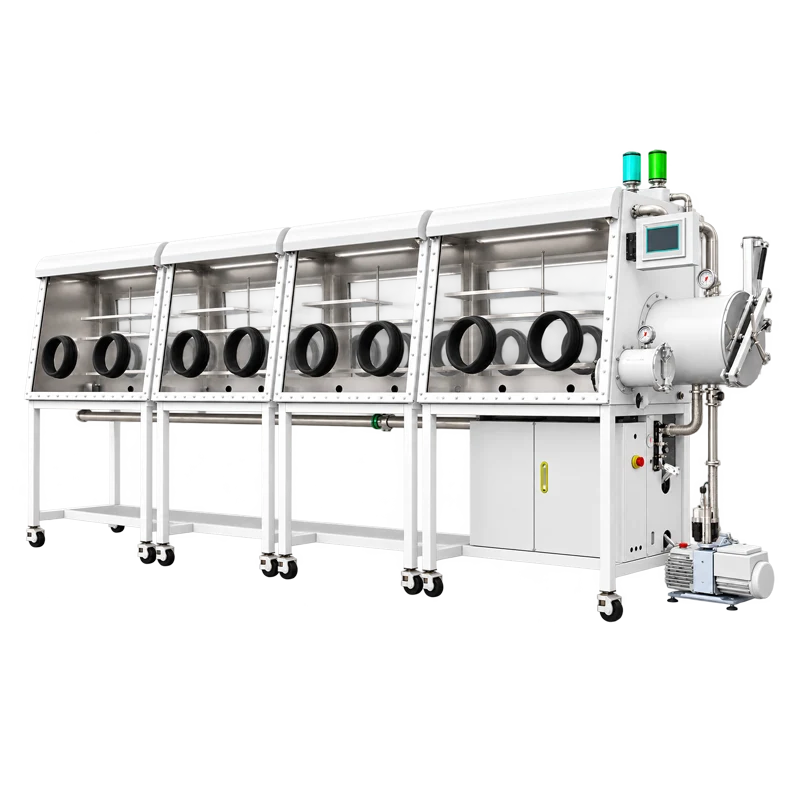
The TENCAN eight-station double-sided split-type glove box with gas purification system is worth reading feature by feature, because each of the four descriptors in its name answers a different operational problem.
Eight stations: throughput without duplicating hardware
Eight working positions change the economics of a shared facility. In a two- or three-port box, a powder programme tends to serialise: one person weighs, another waits, a third books the box for the afternoon. With eight stations, parallel tasks such as weighing, sieving, sampling into vials, sealing and preparing the next batch can be distributed along the enclosure while the atmosphere stays common. For laboratories running sample libraries, or where preparation and packaging happen in the same session, station count is often the specification that determines real daily output.
Double-sided access: two workflows, one atmosphere
Double-sided access means operators can work from opposite faces of the same enclosure. In practice this allows a division of labour: one side loads and prepares, the other seals, labels and transfers out. It also allows a long enclosure to act as a partition between a preparation area and a measurement area, with the sample never leaving the inert volume in between. For powder work specifically, it reduces the number of times a container is opened and closed in the same working zone, which is where most contamination events originate.
Split-type construction: getting a long box into a real building
A long multi-station enclosure rarely fits through a standard door or around a stairwell in one piece. Split-type construction addresses that constraint: the box is built in sections that can be transported separately and joined on site, which matters for basement laboratories, retrofit projects and rooms where the access route rather than the floor area is the limiting factor. The corresponding engineering task is the joint. Assembly, sealing and leak checking belong in the installation scope, and the acceptance test should be run after assembly rather than only at the factory.
The purification system, and what to fix in writing
An integrated purification system is supplied with the enclosure, so the gas circuit, the enclosure and the controls are engineered and delivered as one configuration instead of being assembled from separate purchases. What that system achieves in service depends on purifier capacity, enclosure leak rate, the moisture load introduced by the samples, the regeneration schedule and sensor calibration. Those are exactly the variables that should be pinned down in the purchase specification as a measured acceptance value under a stated load. A request for a low single-digit ppm figure without a stated test method, sensor location and load condition is not a specification.
Construction family should also be confirmed for the specific build. The wider TENCAN range covers purifying glove boxes, stainless-steel vacuum enclosures and acrylic boxes, and those families suit different duties; the material and pressure capability of this eight-station configuration should be fixed against the intended workload rather than inferred from a family name.
MBRAUN (Germany): Purification Engineering and Process Integration
MBRAUN is a German manufacturer whose name is closely associated with inert-gas glove box systems and with the purification engineering inside them. Its range spans laboratory workstations through to larger systems built around battery materials and process development, and the company's public positioning places heavy emphasis on the purification unit, on modular workstations, and on accommodating process or analytical hardware inside the inert volume rather than beside it.
For powder work that emphasis is relevant in two ways. First, purification is treated as a core engineering discipline rather than an accessory, which suits laboratories that intend to run continuous circulation under sustained sample load and want the gas circuit and the enclosure from the same engineering group. Second, the modular logic helps where a project is expected to grow: a workstation today, additional process hardware or a larger enclosure later. Programmes that plan to install pressing, deposition or analytical equipment inside the box will find that integration-minded approach useful, because feedthrough, power and thermal budgets have to be considered together.
The practical corollary is a procurement one. Because the range is broad and configuration-led, a quotation should be read at the level of the specific model, purification unit and acceptance test rather than at brand level.
Jacomex (France): Enclosure Engineering and Configuration Range
Jacomex is a French manufacturer of glove boxes and isolators, with a portfolio that extends beyond the laboratory inert-atmosphere box into containment work in the nuclear, pharmaceutical and electronics sectors. Its documented emphasis is on enclosure engineering: stainless-steel and transparent enclosures, custom geometry, and configuration around a specific containment or atmosphere task rather than a fixed catalogue shape.
That background is valuable for powder projects with unusual requirements. If the box has to fit an awkward footprint, accommodate a particular instrument, provide a specific transfer arrangement, or sit in a facility where containment and inert atmosphere are being addressed in the same enclosure, an engineering-led isolator supplier is a natural conversation to have. The breadth also means the same vendor vocabulary ("isolator", "glove box", "purification unit") can cover very different products, so the specification has to be explicit about which functions are being purchased.
One caution applies to all three platforms equally: an inert atmosphere is not a biosafety, radiological or explosion-safety certification. Where such requirements exist they must be raised with the manufacturer and with the facility safety function as separate, documented items.
Documented Design Emphases Compared
The table below places the three platforms on the same dimensions. Cells describe design emphasis and configuration options; they are not scores, and where a value depends on the selected model the cell says so. Every entry should be verified against the current datasheet and a project-specific quotation.
| Dimension | TENCAN eight-station double-sided split-type | MBRAUN (Germany) | Jacomex (France) |
|---|---|---|---|
| Atmosphere architecture | Integrated gas purification system supplied with the enclosure; recirculating purification is the design intent. Measured acceptance value and test method to be agreed in writing. | Purification engineering is a stated core strength; purification units are engineered alongside the workstations. Confirm model and acceptance test. | Enclosures configured with purification units to suit the task. Confirm whether the unit is integral or a separate cabinet. |
| Access geometry | Eight stations, double-sided; two operators can work simultaneously from opposite faces. | Multi-port workstations across a broad range; port count is model-dependent. | Port layout and geometry configured per project, including non-standard enclosures. |
| Construction and installation | Split-type sectional construction intended for transport and on-site assembly; joint integrity and leak test belong in the installation scope. | Modular workstation family; site assembly requirements depend on the selected model. | Custom enclosure engineering; installation planning is part of the project. |
| Transfer path | Antechamber specification to be fixed for the configuration; vacuum cycling treated as a transfer parameter, separate from the purity specification. | Transfer and antechamber options exist across the range; confirm size and cycle for the model. | Transfer and pass-through arrangements matched to the containment task. |
| Electrical integration | KF-flange feedthroughs offered as accessories, for example the KF40 BNC feedthrough connector; confirm port count and flange type on the chamber. | Integration of instrumentation and process hardware is a stated emphasis; confirm the feedthrough schedule. | Feedthrough provision specified per project. |
| Typical fit | Multi-user powder programmes needing many simultaneous positions and a long working run. | Projects that expect to add process or analytical hardware inside the box over time. | Projects with unusual geometry or combined containment and atmosphere requirements. |
Read the table as a map of questions rather than a verdict. Where a cell says "confirm", that is the item to put in writing before the purchase order is issued.
Matching the Platform to Powder Workflows
Four powder scenarios recur in battery, energy-materials and catalysis laboratories. Each pulls the specification in a slightly different direction.
Battery cathode, anode and solid-electrolyte powders
These materials are usually handled in quantity, weighed repeatedly, and often transferred to pressing or cell-assembly steps. The dominant requirements are station throughput, a stable moisture specification under load, and a transfer path that accepts tooling rather than just vials. A multi-station double-sided enclosure such as the TENCAN configuration fits that pattern well, because weighing, sampling and sealing can occupy different positions at the same time. MBRAUN's process-integration emphasis suits groups that will later add pressing or analytical hardware inside the box, and Jacomex's configurable enclosures suit lines where the box has to wrap around existing equipment.
Perovskite and hygroscopic precursor handling
Precursor salts are frequently weighed in small quantities, which makes balance stability more important than bulk capacity. Static control, a clean weighing position away from glove traffic, and a feedthrough route for balance power and data cables become the deciding details. Here a feedthrough such as the KF40 BNC connector is a useful example of the level of detail that matters: the enclosure must have the right flange port available, and the connector must be installed and leak-checked as part of the build. Every platform reviewed here can support instrumentation inside the box; the difference is how explicitly the feedthrough schedule is defined in the quotation.
Catalysts and air-sensitive supports
Reduced catalysts and reactive supports are often pyrophoric in air, so the transfer chain rather than the steady-state atmosphere tends to dominate the risk assessment. Sealed transfer, minimised container opening and a clearly written evacuation procedure matter more than the last increment of purification performance. Users in this category should ask each supplier for their standard transfer sequence documentation, and should treat the antechamber as a procedural step that is trained rather than a background function.
Shared facilities and multi-user laboratories
Where a box serves several groups, the failure mode is rarely the purifier; it is unlogged use, mixed materials and unclear cleaning responsibility. A larger station count distributes the traffic and reduces queue-driven shortcuts, which is a genuine operational advantage of the eight-station TENCAN layout. For MBRAUN and Jacomex, the equivalent advantage is configuration flexibility: access rules, zoning and instrumentation can be planned into the enclosure from the start.
Instrumentation Inside the Box: Feedthroughs and the KF40 BNC Connector
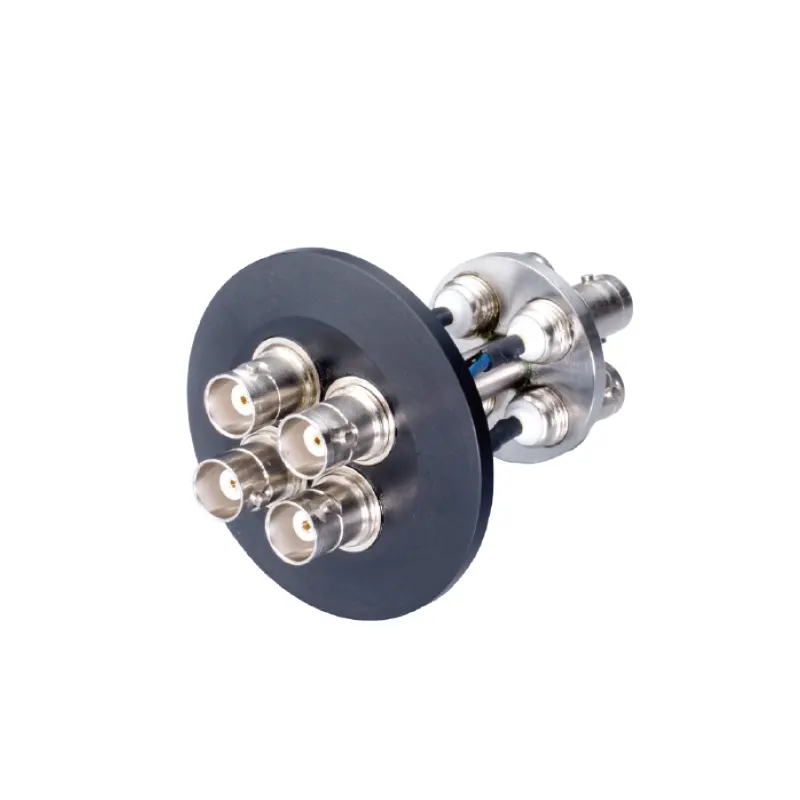
Almost every powder project eventually needs a cable inside the box. A microbalance, an electrochemical cell, a temperature sensor or a small motor all require a route through the enclosure wall that does not compromise the atmosphere. The KF40 BNC feedthrough connector is a compact example: a coaxial BNC connection mounted on a KF40 flange, intended for signal-level electrical connections rather than for high-current power equipment.
Three practical points follow. First, BNC is a signal connector, so it is the right choice for sensor and instrument signals and the wrong choice for driving heaters or large motors; power requirements need a different feedthrough type. Second, the flange interface has to exist on the chamber. A KF40 accessory requires a KF40 port in the enclosure or an available port on an existing flange, and that must be confirmed for the specific box rather than assumed. Third, the seal integrity of any installed feedthrough is part of the enclosure's leak performance, so installation and leak checking should be documented alongside the rest of the build. For a project specifying several instruments, it is worth preparing a feedthrough schedule at quotation stage covering type, flange size, quantity and position.
Procurement Checklist for Air-Sensitive Powder Projects
- State the powder chemistry, typical batch mass, particle-size range and the moisture or oxygen sensitivity that drives the requirement.
- Define the acceptance test: measurement method, sensor location, stabilisation period and sample load during the test.
- Specify oxygen and moisture targets separately from working pressure, and specify antechamber vacuum separately again.
- List every instrument that will sit inside the box, with its power, signal and heat output.
- Prepare a feedthrough schedule: connector type, flange standard, quantity and position on the chamber.
- Confirm construction material and the pressure or vacuum capability of the exact configuration, not the product family.
- Agree the installation route, the assembly scope, and who performs the post-assembly leak test.
- Ask for cleaning and cross-contamination procedures suitable for fine powders.
- Confirm which items are standard and which are options in the quotation, including purifier capacity and regeneration hardware.
- Require written operating and emergency procedures, and training for every user group.
What This Guide Does and Does Not Claim
This article compares design emphases that each manufacturer publishes about its own platform. It does not report measured performance, price, delivery time, certification or lifetime, and it makes no claim that one enclosure is universally superior for all powders. Suitability depends on the material, the batch size, the number of users and the local safety requirements. Where a decision is close, the reliable method is a sample evaluation: send the actual powder, the target atmosphere and the measurement you intend to make, and ask for a configuration proposal with a stated acceptance test.
Sources and Further Reading
- TENCAN, Eight-Station Double-Sided Split-Type Glove Box with Gas Purification System: product page.
- TENCAN, KF40 BNC Feedthrough Connector: product page.
- Brand-level background for MBRAUN (Germany) and Jacomex (France) was taken from manufacturer-published product literature describing their glove box and isolator ranges; no model-level performance figures, prices, certifications or test data from those manufacturers are reproduced here.
No independent laboratory testing was performed for this guide. All specifications should be re-confirmed with the relevant manufacturer before purchase.
