
A four-station double-sided glove box with a gas purification system is not simply a larger box. It is a shared controlled environment with more access points, more human traffic and a larger internal volume than a single-operator enclosure. Those differences affect how quickly the atmosphere recovers after a transfer, how much purification capacity is useful and how work should be scheduled. The supplied four-station double-sided glove box with gas purification system identifies the main elements: four stations, a double-sided layout and an integrated gas purification system. The precise port arrangement, antechamber volume, control architecture and available feedthroughs should still be confirmed against the current datasheet, because those details determine whether the box fits a particular workflow. This article focuses on the operational question behind the configuration: how to keep a shared atmosphere predictable when several people use the same enclosure, and what to verify before purchase or acceptance.
What the four-station double-sided format changes
The first consequence of a four-station double-sided format is that the atmosphere is shared. A reading at one end of the box is not a separate atmosphere for each station. If one operator introduces a moisture-laden sample, opens an antechamber or replaces a glove, the circulation loop distributes the effect. The layout can shorten the distance between preparation and inspection, but scheduling and housekeeping become part of atmosphere control.
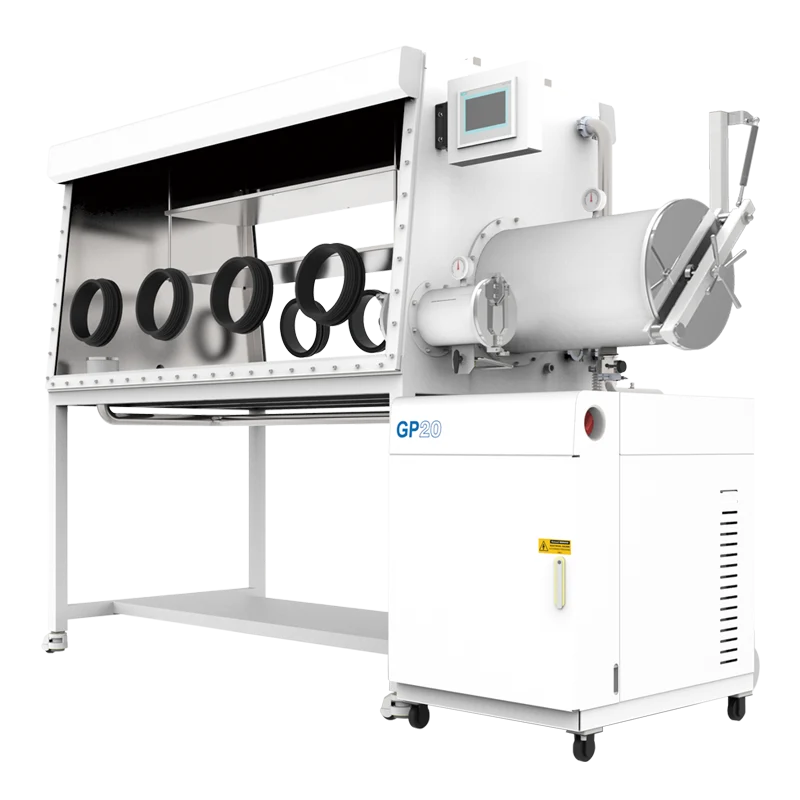
Double-sided access is valuable when two functions need to face each other: sample preparation on one side and inspection, weighing or sealing on the other. It can reduce walking and allow a colleague to assist without reaching around the enclosure. The trade-off is more interfaces to keep leak-tight and more coordination between users. The box should be laid out so that dirty transfers, clean sample handling and analytical equipment do not compete for the same bench space.
Four stations also change ergonomics. More glove ports can improve reach, but only if the working depth, window height and seating position suit the operators. A large enclosure that cannot be reached comfortably encourages leaning, fatigue and risky handling. Confirm how the four stations are arranged, how many operators can work at once without interference, and whether the controls and analyzers are visible from both sides.
Before comparing quotations, establish the intended number of simultaneous operators, whether every station needs the same atmosphere, the largest item that must pass through an antechamber, how often transfers occur, whether solvents or powders are used, and where analyzers and controls will be located. The product name supplies the category but not those values.
How closed-loop purification supports a shared atmosphere
The loop is a system, not a filter
A purification system is a loop. Gas from the enclosure is circulated through one or more purification columns, where water and oxygen are removed by adsorption or catalytic reaction, and returned to the box. The loop also includes valves, a circulator, sample lines, analyzers and a controller. If any part is outside its design condition, such as restricted flow, a saturated column, a valve in the wrong mode or a blocked analyzer line, the atmosphere can appear stable while the actual work zone is not.
Water and oxygen are different loads. Water can enter as vapor from air, be released from porous samples or desorb from surfaces; oxygen enters mainly with air during transfers or through leaks. A purifier that is effective for one does not automatically prove the other. Analyzers measure both, but they sample at a point. A reading at the return line may not represent the corner where a sample is opened. For critical work, define where the measurement is taken and how it relates to the work zone.
Work gas, control gas and regeneration gas
The phrase gas purification also covers several modes. Work gas is the inert atmosphere inside the box. Control gas operates valves and instruments. Regeneration gas is used, when the purifier design requires it, to restore the purification material. These are not interchangeable, and the exact gas, temperature, flow and sequence must come from the manufacturer's instructions. Regeneration is not the same as routine purging, and a regenerated column is not automatically ready for immediate use; the system must be returned to normal operation and the readings allowed to stabilize.
On a four-station box, the loop has more volume and more potential leak paths. That does not mean the atmosphere is inherently worse, but it does mean that the ratio of purification capacity to internal volume, the circulation path and the distribution of dead corners matter. The system should be judged as an integrated enclosure-and-purifier design, not as a box plus an unspecified add-on. Confirm the column arrangement, circulation path, sensor locations and regeneration method before assuming how the system will behave under a real workload.
Transfer events: where atmosphere disturbance begins
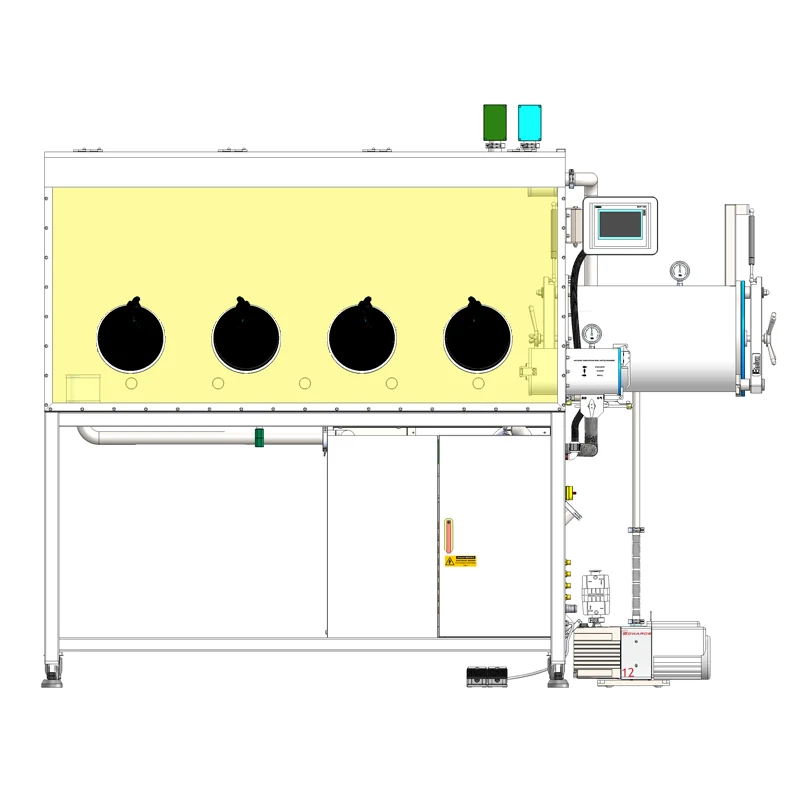
Every transfer is a small disturbance. The usual antechamber sequence is: close the inner door, open the outer door, load the item, close the outer door, evacuate the antechamber, refill with inert gas and repeat as required before opening the inner door. The details depend on the antechamber and the load. A single evacuation and refill may be adequate for a small, non-porous item but insufficient for a large surface, a porous material or a container holding air. The goal is not simply to vacuum once but to reduce the air concentration in the antechamber to a level consistent with the work.
Both doors should not be open at the same time unless the procedure specifically permits it. Door interlocks and seals are part of atmosphere control, not conveniences. If a door seal is damaged, if the antechamber is loaded beyond its usable volume, or if the inner door is opened before the cycle is complete, room air enters the work zone. The effect can be small or large depending on the volume and the purifier's recovery, but it is predictable in direction: oxygen and moisture rise, then the loop works to bring them down.
Gloves are another boundary. They are flexible, comfortable and necessarily permeable to some degree. Permeation depends on glove material, thickness, temperature and the specific substances involved; a pinhole or a poor seal at the glove port is a more direct leak. Glove selection is therefore not only a question of chemical resistance. Fit affects dexterity and the risk of accidental tearing, while material and thickness affect permeation and tactile feedback. The right choice for one solvent or one task may not be the right choice for another.
Particles need their own answer. A HEPA filter removes particulate matter from a gas stream; it does not remove water vapor, oxygen or solvent vapor. Solvent adsorption media can capture certain organic vapors, but they do not replace the water and oxygen purification function. If a process generates dust, the box needs a particle-control strategy and a cleaning plan that does not force the operator to compromise the atmosphere.
Diagnosing slow recovery without assuming a fault
When a reading rises after a transfer, that is not automatically evidence of a failed purifier. It may be the expected response to a genuine load. The useful question is whether the reading returns to the baseline within the expected time and under the same conditions. To answer it, log the event: what went in, how large the load was, how many antechamber cycles were used, which door was opened, how long it stayed open, and what the reading did. Without that record, a slow recovery is difficult to interpret.
| Observation | Plausible contributors | What to verify |
|---|---|---|
| Reading rises after transfers and returns slowly | Air or moisture carried by the load; insufficient antechamber cycling; a door seal that is not seating | Transfer log, load size and surface area, cycle procedure, door and glove-port seals, baseline at the same sensor |
| Reading drifts with no transfer | A leak, glove permeation, analyzer sample-line effects or calibration, purifier operating mode | Known leak points per the manual, glove inspection, calibration record, column status and valve positions |
| One area reads differently from another | Sensor location, local dead zone, circulation path, recent work near that point | Compare sensors, review the flow path and confirm which reading represents the work zone |
Analyzers are instruments with their own ranges, resolution, accuracy and calibration requirements. Resolution is not accuracy. A display that changes in small increments does not mean the measurement is that precise. The sample line can introduce lag or, if it is contaminated, bias. Calibration gases and service intervals must be followed. The controller may use the analyzer to display, alarm or control; those functions are not identical.
Leak rate, box working pressure, antechamber vacuum and pump ultimate vacuum are also different quantities. A pump that reaches a low ultimate vacuum on a clean, empty chamber does not prove that the assembled box has a low leak rate. A pressure hold test on the box answers a different question from a pump-down test on the antechamber. Keep the units and the object being measured attached to every number. If a data sheet mixes them, ask for clarification.
Finally, a purifier may need regeneration or service. If the system has regenerable columns, the regeneration cycle is a defined operating mode, not a reset button. Starting it without the correct gas supply, valve alignment or completion can leave the loop in a state that is unsuitable for sensitive work. Follow the manual and record the event.
Configuration decisions: layout, transfer, sensing and connectivity
Configuration starts with the work, not with a longer feature list. The four-station double-sided layout should be chosen because the workflow needs parallel positions or two-sided access, not because more ports sound more capable. If most work is done by one operator, a smaller enclosure may be easier to control and less expensive to operate. If several operators routinely work at once, the shared volume, antechamber capacity and circulation design become the deciding factors.
Antechamber size is a trade-off. A larger chamber can accept equipment, containers or tooling that a small chamber cannot, but it also presents a larger volume to evacuate and refill. A small chamber cycles quickly but can become a bottleneck if several people need it. The number and location of antechambers matter for the same reason. Confirm the usable internal dimensions, door clearance and the largest load the procedure can handle safely.
Sensor placement deserves the same attention. A single reading is a single point. Ask where the sample is drawn, how often the analyzer updates, and whether the displayed value is used for alarm or control. For a shared box, an alarm at the return line may not protect a workstation at the far end. Verification should include the work zone, not only the controller display.
Feedthroughs and data paths
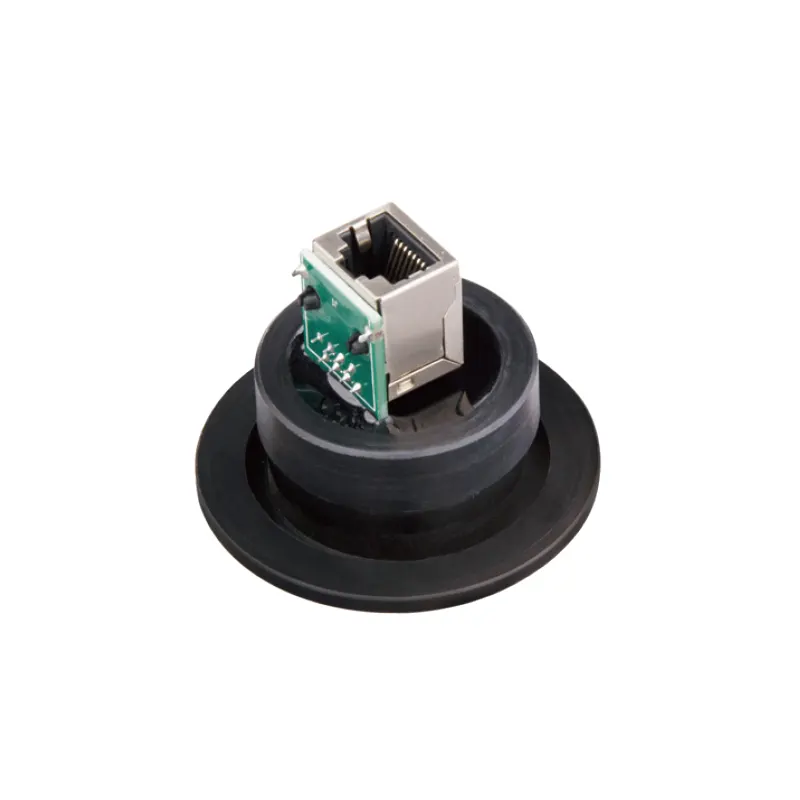
Connectivity is often overlooked until equipment is installed. If an internal balance, test stand or analyzer is to communicate with an external computer, the enclosure needs a suitable feedthrough. The supplied KF40 Ethernet Feedthrough identifies a KF40 flange interface and an Ethernet pathway. Before ordering, confirm that the box has a compatible KF40 port, that the feedthrough's vacuum and sealing performance suit the application, and that its connector type, cable requirements and grounding arrangement match the equipment. A KF40 Ethernet feedthrough is not a general-purpose power feedthrough, and it should not be treated as a substitute for proper cable management or atmosphere control.
Electrical and data interfaces should be planned as part of the box layout, not added as an afterthought. Cables can obstruct glove ports, hang in the work zone or create leaks if they pass through an unsuitable opening. Route them away from sample handling, secure them, and keep the number of penetrations to what the application actually needs. For each interface, record the connector, the protocol or signal, the cable length and the person responsible for testing it.
Materials compatibility also belongs in configuration. Solvents, acids, reactive powders and cleaning agents can attack gloves, seals, windows or internal surfaces. The correct question is not whether this is a good glove box material, but whether the material is compatible with the substances and cleaning method that will actually be used. Ask for the relevant compatibility information and test a representative sample before committing a sensitive process.
Acceptance and routine verification checklist
Acceptance should be a defined process, not a quick demonstration. The exact tests depend on the manufacturer's instructions and the application, but the following checklist is a useful structure.
- Mechanical and leak integrity: inspect door seals, glove ports, feedthroughs and internal surfaces; verify leak or pressure checks using the method and units specified by the manufacturer.
- Purifier start-up: confirm the correct gas supply, valve mode and any regeneration step; record the readings and the stabilization time.
- Analyzer calibration: record the calibration gas, sample-line condition and result; verify that the displayed value responds as expected.
- Antechamber cycle: confirm door interlocks, evacuation and refill sequence, and recovery after a representative load.
- Alarms and escalation: test what happens when a reading exceeds its limit and who responds.
- Gloves and seals: check fit, material, pinholes and replacement records.
- Documentation and training: cover operating limits, regeneration, service intervals and emergency procedures for every user.
Routine monitoring is simpler but more important. Keep a baseline reading at a defined condition, log transfers and regeneration, inspect gloves and seals at planned intervals, and calibrate analyzers. A single good reading on the day of installation is not a monitoring program. The useful record is a time series with annotations: what changed, when, and how long recovery took.
Write acceptance criteria in terms of the application. Low oxygen is not a specification. State the target, the measurement point, the allowed recovery time and the load condition. If a supplier provides a number, ask what it applies to: a clean, empty box, a specific purifier mode, a particular sensor, or a pump's ultimate vacuum. The answer determines whether the number is relevant to the work.
Application fit and the information to send before quotation
The system fits workflows where several sensitive operations must share a controlled atmosphere and where the cost of moving samples between isolated enclosures is high. Examples include lithium and solid-state battery materials, perovskite and OLED devices, air-sensitive chemistry and some additive manufacturing post-processing steps. In each case, the material's sensitivity and the process requirements determine the gas, the target moisture and oxygen levels, the allowed transfer time and the cleaning regime. The glove box provides the controlled environment; it does not make every material inert or every process safe.
Powder handling inside the box is one example of a task that needs a specific plan. Weighing, sieving, sampling or loading a crucible can generate dust and disturb the atmosphere. The plan should cover containment, cleaning, filtration and waste removal. None of these functions is provided by the water and oxygen purifier alone. Similarly, a solvent-heavy process may need solvent adsorption and a compatibility review, not just a higher circulation rate.
Boundaries matter. A purified glove box is not a cleanroom classification, a sterile environment, a biological safety cabinet or a certified hazardous-waste enclosure. It should not be presented as any of those. If the process involves infectious material, toxic gases, flammable atmospheres or regulated hazardous waste, a different risk assessment and possibly different equipment are required. Inert gas can also create an asphyxiation hazard if the enclosure or gas supply is not managed properly, so installation, ventilation and emergency procedures must follow the site's safety requirements.
Before requesting a quotation, prepare a short application brief: sample types and quantities; solvents, acids or powders; the largest item that must pass through an antechamber; required atmosphere and target readings with the measurement basis; how often transfers occur; equipment dimensions, heat load and utilities; data or network requirements; available floor space and ceiling height; number of operators; cleaning and maintenance access; and the documentation and training needed. Add any site-specific constraints, such as vibration, noise or gas supply.
With those inputs, the discussion can move from model names to configuration. The relevant questions become: how many work positions are genuinely needed, how large the transfer path should be, where the sensors are located, how the purifier is regenerated and serviced, and which feedthroughs and accessories are compatible. The four-station double-sided system is a starting point for that discussion, not a substitute for it. A shared atmosphere is only as predictable as the layout, transfer discipline and verification behind it.
