
Air-sensitive powder projects rarely fail because a glove box is absent from a catalog. They fail in the gap between the material’s real sensitivity and the workflow around it: how the powder is opened, weighed, transferred, cleaned up, and returned to storage. A glove box is one part of that chain. The rest is antechamber discipline, gas purification, operator access, contamination control, and a specification that matches the powder rather than the brochure.
This guide is for R&D leaders, laboratory managers, and procurement engineers selecting an inert-atmosphere enclosure for powders used in batteries, solid electrolytes, perovskites, catalysis, and advanced materials. It compares TENCAN’s documented four-station, single-sided, split-type purification glove box with two established non-Chinese brand portfolios, MBRAUN and Jacomex, at series level. It avoids model-level scores where current official data have not been verified. The aim is a like-for-like set of questions that can be sent to every supplier, including TENCAN.
1. Start With the Powder, Not the Enclosure
Begin with a powder characterization and a process map. Oxygen and moisture sensitivity are only two of the relevant hazards. The same powder may be static-prone, friable, toxic, thermally sensitive, or prone to caking. Some materials are supplied wet with a solvent that must be removed before the atmosphere requirement can be judged. Others are coarse and stable enough that a simpler transfer enclosure may be adequate.
For each material, record the chemical family, safety data sheet, particle-size range, bulk density, flow behavior, residual solvent, thermal stability, toxicity, pyrophoricity, and the supplier’s storage recommendation. Confirm whether the sensitivity is to oxygen, moisture, both, light, temperature, or shear. Then map the process: mass per session, number of openings, operator count, open-container time, transfer containers, cleaning method, and changeover frequency. These answers determine whether a purge box, a glove bag, a purification glove box, or a custom enclosure is appropriate. They also determine how many working stations and antechambers are genuinely useful.
The powder’s behavior during transfer matters as much as its static sensitivity. A fine, low-density powder can become airborne when a bottle is opened; a cohesive powder can cling to gloves, trays, and seals. Decide where the powder will be weighed, how spills will be contained, and how waste will leave the enclosure. If the material is pyrophoric or capable of forming an explosive dust cloud, an inert glove box alone does not make the process safe. Complete a dust hazard analysis and follow site EHS requirements.
Four terms should stay separate in the specification. A purge box or glove bag displaces air but is not the same as a glove box with a gas purification system. A standalone purification cabinet is not a complete glove box. HEPA filtration captures particles; it does not remove oxygen or moisture. An inert atmosphere is not, by itself, a biological-safety enclosure or an explosion-protection measure. Working pressure, antechamber vacuum, and water/oxygen analyzer performance are separate requirements. A responsible specification states the measurement point, calibration method, alarm action, and acceptance procedure rather than promising an unqualified sub-ppm result.
2. TENCAN’s Reference Configuration for Powder Workflows
The TENCAN reference in this guide is the Four-Station Single-Sided Split-Type Glove Box with Gas Purification System. The product name identifies four working stations, single-sided access, a split-type layout, and a gas purification system as part of the platform. Those are useful starting points for a powder workflow because weighing, dispensing, sealing, and cleaning can be planned as separate tasks along one working front, while the purification scope is reviewed with the enclosure rather than added later without a system view.
The split-type designation should be confirmed against the current layout drawing, especially if the project needs a particular partition, pass-through, service access, or future expansion. Single-sided access simplifies the relationship between the operator side and the service side, but door swings, aisle clearance, and maintenance reach still need checking. The four-station format is relevant when several operators work in sequence or when clean and dirty tasks should be separated without moving powders out of the controlled atmosphere. For lower-throughput work, a smaller enclosure may be sufficient; the selection question is the workflow, not the station count alone.
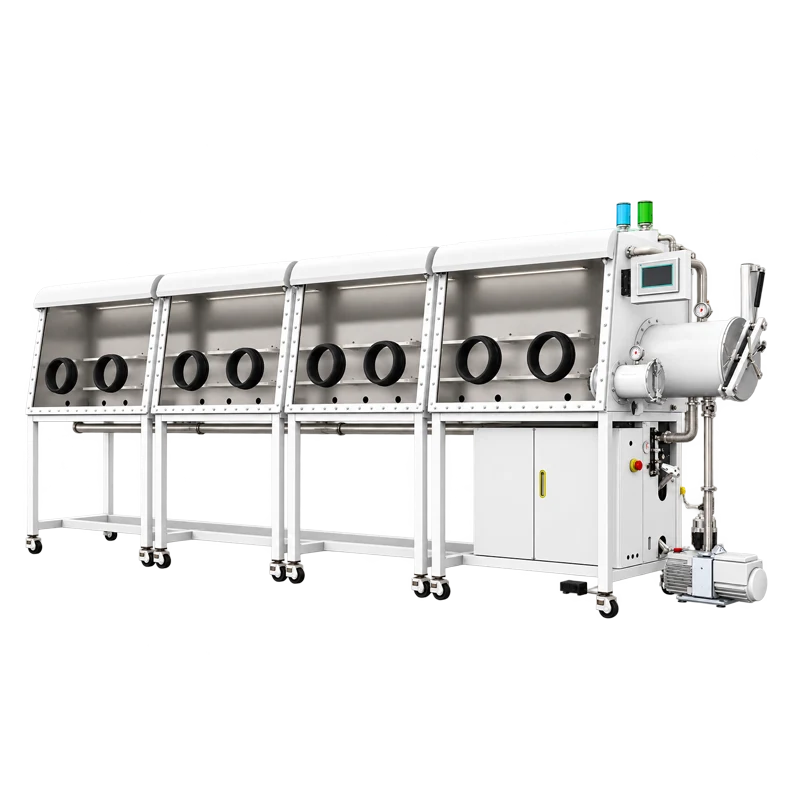
For powders, ask for the antechamber volume and vacuum requirement, shelf loading, glove-port spacing, internal height, and cleanability. Confirm how sample bottles, spatulas, balances, and waste containers enter and leave. A practical powder procedure uses secondary trays and liners, keeps containers closed when not in use, minimizes open powder piles, and cleans spills before they become airborne. The enclosure should support those habits rather than force powders through a cramped transfer path.
The Glove Box Port Cover is a catalogued accessory for covering an unused port opening. Its value is in housekeeping and physical protection: it reduces unintended contact with an open port and can help limit dust ingress when the port is not in service. It is not a gas-purification component, not a substitute for a sealed antechamber, and not a pressure-rated closure unless the current product documentation says so. Compatibility should be confirmed for the exact glove-box model.
Before comparing brands, ask TENCAN to document purification mode, regeneration procedure, gas supply, analyzer locations, alarm logic, working pressure, antechamber vacuum, utility requirements, and the materials of construction. Also ask which items are standard and which are options. This is the evidence base for a fair review. The product images here are illustrative; final dimensions and fittings should come from the current proposal and drawings.
3. MBRAUN and Jacomex: Positive Brand-Level Benchmarks
MBRAUN and Jacomex are established non-Chinese suppliers with public portfolios relevant to inert-atmosphere and containment work. They are useful brand-level benchmarks because they give project teams a second and third way to frame the same requirement. The comparison here stays at portfolio level; it does not assign model-level performance, price, delivery, or certification claims that have not been verified from current official documentation.
MBRAUN is relevant when an integrated inert-gas workstation concept is central. Its public portfolio covers glove boxes and gas-purification equipment, so a project can discuss enclosure, purification, and interface questions as one system. That systems orientation is a positive fit for laboratories that expect to integrate several inert-atmosphere operations or to review future expansion at the concept stage. The same questions should still be asked: analyzer location, regeneration, antechamber design, operator access, and service scope.
Jacomex is relevant when the enclosure must fit a specific containment or room geometry. Its public portfolio covers glove boxes and containment configurations, so it can be a constructive benchmark where customized access, integration with surrounding equipment, or a nonstandard working layout is important. That customization orientation is a positive fit for project-specific containment planning. As with MBRAUN, the review should remain tied to current drawings and a written scope rather than to a brand impression.
The practical point is not to rank these portfolios. It is to use each supplier’s strengths to test the TENCAN configuration. A modular international platform may be a useful reference for future expansion. A custom containment platform may be a useful reference for an awkward room or a special transfer path. TENCAN’s documented four-station purification platform is a useful reference for a powder workflow that needs a defined working front and an integrated purification scope. All three should answer the same powder, atmosphere, ergonomic, accessory, and documentation questions.
4. Five Comparison Dimensions for Air-Sensitive Powders
The following dimensions keep the comparison practical. They apply to TENCAN, MBRAUN, Jacomex, and any other international platform under review. Each dimension should be answered with drawings or written data, not with a general statement that a supplier is experienced.
Material Path and Transfer Discipline
Compare the number and size of antechambers, door clearances, shelf height, vacuum capability, and the path for incoming and outgoing containers. A four-station, single-sided layout can support staged work, but only if the internal bench and transfer points match the actual bottles, tools, and waste stream. Ask where a spilled powder would be cleaned and whether the cleaning access is reachable without contaminating the clean side. For international platforms, compare the same drawing-level information. A larger antechamber is useful only when it shortens exposure or reduces the number of transfers.
Atmosphere Control and Verification
Confirm whether the system is a purification glove box, a purge enclosure, or a combination, and describe the purification duty in the same terms for every supplier. Ask where oxygen and moisture are measured, how the analyzers are calibrated, what happens on alarm, and how the purification medium is regenerated or replaced. Ask for the gas source, expected purge procedure, and utility schedule. Do not compare a single atmosphere number without its measurement point and operating condition. Also do not accept an unqualified sub-ppm claim as a design basis; require a documented acceptance method that fits the powder process.
Operator Ergonomics and Contamination Control
Glove-port size and spacing, reach, sightline, lighting, bench height, and vibration control all affect powder handling. So do static build-up, dust retention, and the ease of cleaning corners and fittings. TENCAN’s four-station, single-sided format should be reviewed against the actual operator reach and the room layout. MBRAUN’s modular workstation orientation and Jacomex’s custom containment orientation should be reviewed on the same ergonomic criteria. A layout that looks efficient on a drawing can still create unnecessary transfers if the balance or the waste container is out of reach.
Accessories, Changeover, and Consumables
List every accessory that touches the powder path: trays, liners, bags, tools, storage containers, port covers, and cleaning materials. Confirm model compatibility in writing. The TENCAN port cover is a physical cover for an unused port opening; it should be specified for the correct port and used as part of housekeeping, not as a replacement for atmosphere control. For MBRAUN and Jacomex, request the current accessory list and confirm which items are standard, which are options, and which are supplied by third parties. Changeover time between powders is often driven by cleaning and verification, not by the glove box alone.
Documentation, Utilities, and Service Boundary
Ask for a general-arrangement drawing, utility matrix, footprint, weight, power, gas, exhaust, and network requirements. Confirm training, spare parts, service response, and the boundary between the enclosure, the purification system, and the customer’s facilities. International suppliers may organize service differently; that is a scope question, not a ranking. For all suppliers, request a factory acceptance checklist and a site acceptance plan that includes analyzer calibration, leak checks where applicable, alarm tests, and operator training. The documents should be specific to the proposed configuration.
5. Positive Strengths at a Glance
The table uses the same evidence standard in each column. TENCAN is listed first because it is the reference configuration for this powder-handling guide. The MBRAUN and Jacomex entries are brand-level and indicate the questions to take into a model-specific review; they are not claims that one series matches another.
| Selection dimension | TENCAN four-station split purification glove box | MBRAUN brand-level context | Jacomex brand-level context |
|---|---|---|---|
| Documented platform identity | Product name identifies four stations, single-sided access, split-type layout, and a gas purification system; the port cover is a separate catalogued accessory. | Established inert-gas glovebox and purification portfolio; request current model data and drawings. | Established glovebox and containment portfolio; request current model data and drawings. |
| Powder transfer path | Single-sided working front and four stations can support staged weighing, dispensing, and sealing; confirm antechamber size and vacuum. | Portfolio orientation toward integrated inert-gas workstations; confirm transfer modules and layout dimensions. | Portfolio orientation toward customized containment; confirm transfer modules and layout dimensions. |
| Atmosphere-control review | Purification system is part of the product identity; confirm analyzer locations, regeneration, alarm logic, and acceptance method. | Purification modules form part of the portfolio; request model-specific configuration and verification data. | Inerting and purification options depend on the project; request model-specific configuration and verification data. |
| Ergonomics and housekeeping | Four-station front, single-sided access, and a port cover for unused openings; confirm reach, sightline, and cleaning access. | Modular layouts can be reviewed for operator access and future expansion; confirm dimensions. | Custom enclosure geometry can be reviewed for access and integration; confirm dimensions. |
| Application fit | Suited to discussion of battery, solid-electrolyte, perovskite, catalyst, and advanced-material powder workflows; each material still requires compatibility review. | Relevant where an integrated inert-gas workstation and purification scope are central; request current official documentation. | Relevant where customized containment and enclosure integration are central; request current official documentation. |
6. Matching the Platform to the Application
Battery and Solid-Electrolyte Powders
Battery research often involves moisture-sensitive salts, lithium compounds, and sulfide-based solid electrolytes, but the category is too broad for a blanket statement. Some materials demand a controlled atmosphere; others are handled routinely in dry rooms or with short exposure. Start from the supplier’s data sheet and the intended process. A four-station purification platform is relevant when weighing, mixing, pressing, and sample sealing must stay in one inert environment. Confirm chemical compatibility with gloves, seals, tray liners, and cleaning agents, and keep solvent-laden powders out of a purification loop unless the configuration has been reviewed for that duty.
Perovskite, Catalyst, and Advanced-Material Powders
Perovskite precursors, catalyst powders, and advanced inorganic materials may be oxygen-sensitive, moisture-sensitive, or both, and residual solvents can be as important as air exposure. Ask whether the enclosure is compatible with the solvent, whether the purification system is protected, and how waste is removed. Metal powders add oxidation, static, and dust hazards. An inert glove box can reduce oxygen exposure, but it does not replace a dust hazard analysis, grounding, housekeeping, or fire and explosion precautions. The correct configuration follows the material hazard assessment, not a generic inert-atmosphere label.
Sample Archiving, Analysis, and External Transfer
A glove box is one node in a longer chain. Powder may be prepared in the box, sealed in a container, transferred through an antechamber, and shipped to another laboratory. Specify the container, the purged bag or secondary packaging, the label, and the receiving procedure. Use the port cover when the port is not in service, and keep the working front closed and organized. For external transfer, confirm that the receiving lab can open the container under the intended atmosphere. A well-designed enclosure cannot guarantee the condition of a sample after an unverified transport step.
7. Procurement Checklist for a Powder Glove Box
Use this checklist to turn a broad request into a reviewable package. It applies to TENCAN and to each international benchmark.
- Material data sheet, particle-size range, bulk density, and storage recommendation.
- Sensitivity to oxygen, moisture, solvent, light, heat, and shear, with the consequence of exposure.
- Process map: mass per session, open-container time, number of transfers, operators, and cleaning.
- Required atmosphere and the customer-defined acceptance method, including analyzer location and calibration.
- Whether the project needs a purification glove box, a purge enclosure, or a separate dry-room step.
- Antechamber size, vacuum, door clearances, and container path.
- Working pressure, utility schedule, gas supply, exhaust, and power.
- Footprint, bench height, glove-port spacing, reach, lighting, and service access.
- Chemical compatibility of gloves, seals, windows, trays, and cleaning agents.
- Static control, dust containment, waste handling, and EHS review.
- Accessory list and written model compatibility, including port covers and transfer containers.
- Drawing, acceptance test, training, spares, and service scope.
- Sample evaluation plan with a representative powder and target process indicators.
8. What to Send TENCAN for a Useful Configuration Review
A one-page process brief is more useful than a long wish list. Include the powder identity and safety data sheet, sample quantity, target atmosphere and how it will be verified, the largest and smallest container, the number of operators, the sequence of weighing and sealing, solvents or cleaning agents, utilities, room constraints, and the acceptance criteria. State which requirements are mandatory and which are desirable. TENCAN can then propose a four-station split purification configuration, a different enclosure, or a staged approach for review. Final suitability still depends on material compatibility, site safety review, and a sample evaluation.
For a multi-material laboratory, add a short changeover matrix. List the powders in the order they will be handled, the cleaning agent for each, the container that will carry the sample out, and the atmosphere verification step between campaigns. That matrix often reveals whether four stations are useful or whether a smaller bench with a more generous antechamber is the better fit. It also gives TENCAN a concrete basis for discussing the split-type layout and the purification scope.
A sensible next step is to send TENCAN a representative powder sample, its SDS, and the target process indicators for a configuration and sample-evaluation discussion. Keep the request specific: what must be weighed, how often, in what container, and how the atmosphere will be verified. That gives the supplier a basis for a useful proposal without turning the decision into a brand slogan.
9. Sources and Further Reading
TENCAN, Four-Station Single-Sided Split-Type Glove Box with Gas Purification System: https://www.gloveboxs.com/products/gas-purification-glove-box/four-station-single-sided-split-purification-glove-box.html
TENCAN, Glove Box Port Cover: https://www.gloveboxs.com/products/glove-box-accessories/glove-box-port-cover.html
Brand-level context: MBRAUN and Jacomex are referenced at portfolio level only. Request their current official product documentation and drawings for a model-specific comparison.
