
The main chamber of a glove box is easiest to protect when its inner door stays closed. Every opening to the room brings moisture, oxygen, particles, and solvent vapor toward the working volume, and the purification loop must then remove the added load. An antechamber exists to reduce that exchange.
An antechamber is a small airlock mounted to the enclosure. The operator loads an object through an outer door, seals the chamber, conditions the interior by purging or, where the design permits, vacuum cycling, and then opens the inner door to move the object into the box. The useful function is not storage. It is controlled transfer.
TENCAN's Large Glove Box Antechamber is aimed at cases where a standard transfer chamber is too small: fixtures, tooling, cell hardware, sealed containers, or batches that cannot be broken down. The product listing identifies the accessory, but the physical envelope, door clearances, vacuum capability, and seal specification still have to be confirmed for the actual box.
The central judgment is therefore not whether a large chamber sounds more capable than a small one. It is whether the larger opening and volume solve a real handling problem without creating a purge, pressure, or sealing problem that the rest of the system cannot absorb.
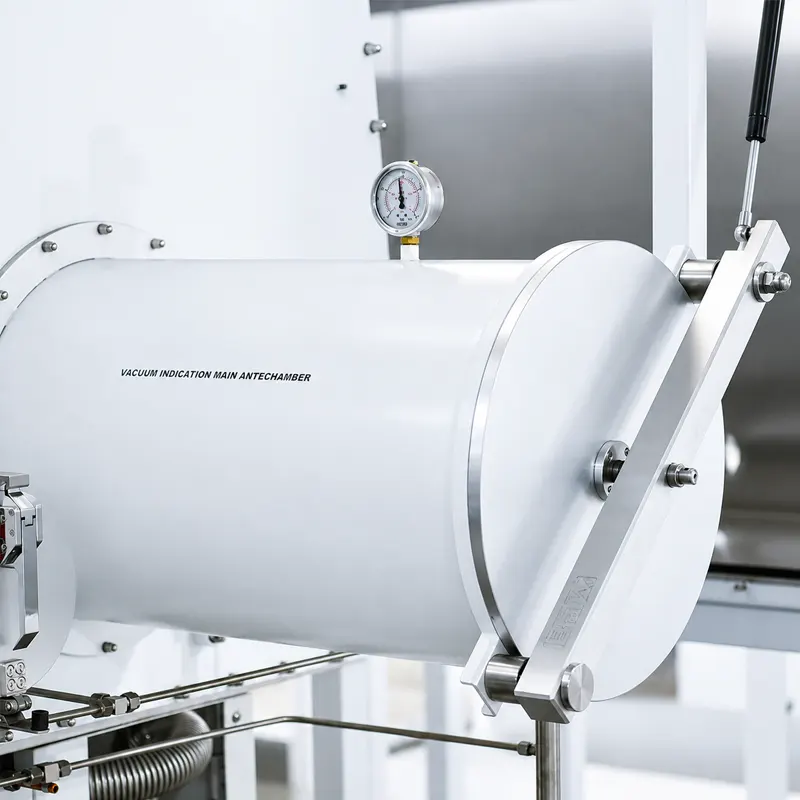
The antechamber is a transfer airlock, not a storage chamber
The basic sequence looks simple: load, close, condition, transfer. The engineering lies in the word condition. A chamber filled with room air cannot be made inert merely by closing the door. Residual air must be diluted by inert gas, removed by vacuum and refill cycles, or displaced by a combination of both, according to the manufacturer's procedure. The inner door should not be opened until the chamber state is acceptable for the material being moved.
Pressure equalization is not atmosphere equalization. A chamber can be at nearly the same pressure as the box while still holding a different gas composition. Equalizing pressure protects the doors and the box from a sudden surge, but it does not prove that water and oxygen concentrations are low. That distinction matters when a large chamber is opened slowly and appears to behave correctly while an oxygen sensor elsewhere in the system begins to drift upward.
An antechamber also does not replace the main purification loop. Purging dilutes contaminants; vacuum cycling removes a fraction of the chamber atmosphere; a purification system removes water and oxygen from circulating gas. These are different processes with different limits. A large transfer chamber can reduce the number of times the main chamber is exposed to room air, but it cannot turn a momentary purge into continuous atmosphere control.
Using the antechamber as a temporary shelf is a common operational mistake. Containers, gloves, tools, and solvent-bearing items left inside keep introducing vapor and particles into the chamber and can obstruct the gas path. The accessory works best when it is loaded, cycled, emptied, and kept closed, with the inner door treated as a controlled interface rather than a convenient opening.
Large chambers make this discipline more important, because the interior is more inviting to casual storage and because a forgotten item can sit in a volume that is not continuously purified. If the process needs material to remain under inert gas between steps, that requirement should be met inside the main box or in a properly specified storage vessel, not assumed from the presence of an antechamber.
What large changes in the transfer cycle
The word large may refer to the outside footprint, the chamber volume, the door opening, or the usable internal height. These are not interchangeable. A tall chamber with a narrow door may accept a tall vessel but not a wide fixture. A wide door may admit a tray that cannot be turned inside the chamber. The first selection step is to define the object envelope, including gloves, fixtures, cables, and any clearance needed for lifting.
A larger chamber can improve throughput when several items travel together. One purge cycle for a loaded rack may be more efficient than five cycles for five small parts, especially if each small transfer would otherwise require opening the main chamber. The benefit depends on cycle time, gas use, and how often the batch is ready. A large chamber used for one small item per cycle is usually a poor trade.
The penalty is that every cycle conditions more volume and more internal surface. The relationship is not simply proportional: purge effectiveness depends on flow patterns, inlet and outlet placement, dead zones, and whether the chamber can be evacuated. A large chamber with good mixing may outperform a small chamber with poor gas distribution, but a large chamber with hidden pockets will consume gas without reaching the same condition.
| Factor | What a larger chamber tends to do | What to confirm |
|---|---|---|
| Object envelope | Accepts larger or grouped loads | Door clearances, internal height, shelf load |
| Cycle time | Longer conditioning per batch | Purge method, vacuum capability, pump matching |
| Gas use | More gas per cycle | Working gas supply and refill strategy |
| Mixing | Can create longer paths and dead zones | Port locations, baffles, loading practice |
| Pressure behavior | Larger volume and door area can create transients | Box pressure control and interlocks |
| Handling | Reduces fragmentation of large items | Door swing, lifting height, floor space |
Throughput is a batch question
One large load can reduce the number of outer-door and inner-door operations, but it also makes each operation more consequential. If a batch is delayed, the whole chamber sits conditioned and idle; if one item is missing, the operator may be tempted to reopen the outer door and restart. The planning question is whether the workflow naturally produces full batches. When it does not, a large chamber can create a false economy: fewer theoretical transfers, more partial loads, and more gas consumed for the same number of parts.
Pressure behavior deserves separate attention. During pump-down or refill, the chamber and the box interact through the inner door, the mounting interface, and the control system. A large volume does not necessarily produce a large pressure spike, but it changes the amount of gas that must move and the time over which the change occurs. The box should be designed to tolerate the transfer sequence, not merely the static load of the accessory.
Purging and pump-down are different conditioning methods
Purging uses inert gas to dilute the residual atmosphere. A simple fill-and-vent cycle reduces the contaminant fraction, and repeating the cycle reduces it further. The result depends on the starting concentration, the purity of the supplied gas, the number of exchanges, and the completeness of mixing. A single purge of a large chamber is rarely equivalent to several well-distributed exchanges, and the correct procedure belongs in the operating instructions for the specific model.
Vacuum cycling removes part of the atmosphere by pumping the chamber down and refilling it with inert gas. It can be effective for removing bulk air, but it is not a selective water or oxygen purifier, and it does not guarantee a particular concentration. The achievable pressure, the pump's compatibility with the gas, the chamber's structural rating, and the door seal all set limits. A pump with a low ultimate pressure does not by itself establish a low oxygen reading.
Not every antechamber is intended for vacuum service. Some are designed for gas purge only, and some are built with doors and seals that are suitable for a modest pressure differential but not for repeated deep evacuation. Applying a vacuum sequence to a chamber that was not specified for it can distort a door, damage a seal, or create an unsafe condition. The product name alone is not evidence of vacuum rating; the order specification must state it.
The geometry of a large chamber matters because gas exchange is not uniform. Inlet jets can short-circuit toward the outlet, shelves can shield the lower volume, and recessed corners can retain the original atmosphere. The same issues exist in small chambers, but a larger chamber gives them more room. Loading patterns, port positions, and any internal baffles should be considered together rather than treating chamber volume as a single well-mixed number.
Measurement has to match the claim. An oxygen or moisture analyzer reports the condition at its sampling point, with its own range, resolution, response time, and calibration. Resolution is not accuracy, and a reading in the main box is not direct proof of the chamber interior. If the transfer procedure needs verification, the sampling location and method should be defined, and the instrument should be appropriate for the expected gas and concentration range.
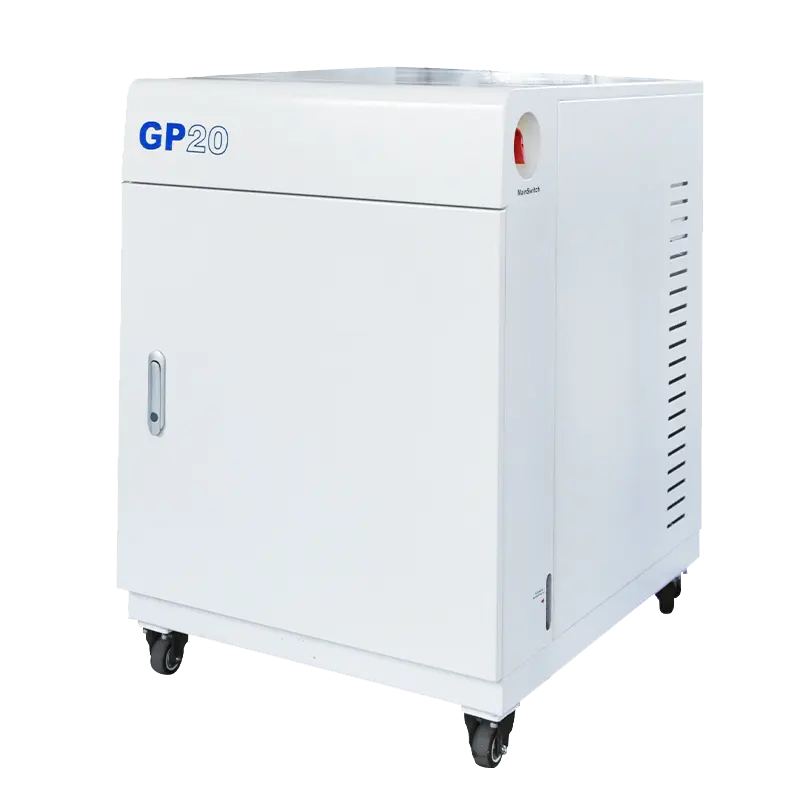
A separate purification cabinet such as the GP20 Gas Purification System Cabinet belongs to this discussion only as background. It is a gas purification system cabinet, not a complete glove box with working space, and it should not be assumed to connect to a given chamber or enclosure without engineering confirmation. Its role is to support the atmosphere in a compatible system; the antechamber's role is to limit the contamination introduced during transfer. Neither replaces a verified procedure for the other. A particle filter, where fitted elsewhere in the system, addresses particles; it does not remove water or oxygen and should not be treated as an alternative to purge or vacuum.
Seals, doors, and mechanical fit decide compatibility
A large antechamber concentrates mechanical risk at its doors. The outer door is the barrier to room air, the inner door is the barrier to the box, and both depend on a continuous seal, uniform compression, and stable hinges. A larger opening increases the seal perimeter and the leverage on the door. If the door sags or the latch pulls unevenly, a local gap can remain even when the hardware appears closed.
The mounting interface is equally important. The chamber must mate with the box wall through a gasket, flange, or frame that suits the box construction. Fastener spacing, cutout dimensions, and structural reinforcement are not accessories that can be chosen after the fact. A heavy chamber with a long door and a loaded shelf imposes loads that a thin panel may not tolerate, and the resulting deflection can affect the inner seal.
Material compatibility covers more than the chamber shell. Seal elastomers, window materials if present, gloves, tubing, and any internal fixtures can be affected by solvents, acids, or process vapors. A large chamber may be used with bigger solvent-containing apparatus, which increases the total vapor load. The correct question is not whether the chamber is generally chemical resistant, but whether the specific wetted materials are compatible with the specific substances and cleaning agents.
Layout is part of compatibility. A large outer door needs swing clearance. The chamber needs enough working height for loading, and the surrounding area needs access for leak checking, port connections, and service. If the chamber is mounted where the door cannot open fully or where the operator must reach across equipment, the practical transfer will be slower and the seal may be stressed by repeated awkward loading.
Ports, fixtures, and the path into the box
Ports and internal fixtures can quietly change the effective chamber. A large chamber may need a shelf, a carrier, or a fixture to keep a heavy object stable, and that hardware can block gas flow or trap air. Additional ports for gas, vacuum, or measurement are useful only if their locations support the purge pattern and if their seals are compatible with the process. Every added penetration is another joint to specify, leak-test, and maintain.
Match transfer capacity to the workflow, not just the largest sample
A large chamber is justified when the largest object is genuinely part of the routine workflow. If the large item appears once a month, a smaller chamber plus a planned procedure may be more sensible, provided the object can be broken down or transferred another way. If large fixtures, battery modules, or sealed carriers arrive regularly, the handling benefit can outweigh the extra conditioning load.
Throughput should be calculated in batches per hour, not liters. The relevant cycle includes loading, sealing, purging or pumping, equalization, opening the inner door, transferring, closing, and restoring the chamber. A large chamber that holds six parts may beat a small chamber that holds one, but only if the six parts are ready at the same time and the longer cycle does not create a queue. The main box's recovery time after each inner-door opening also belongs in the calculation.
The purification system has to absorb the disturbance that the transfer creates. This is an indirect relationship: the antechamber does not purify the box, and the box's purifier does not condition the antechamber unless a specific design provides for it. A large transfer can change box pressure, add moisture and oxygen, and consume working gas. The system's sensors, pressure control, and purification capacity should be reviewed against the expected transfer frequency, not only the steady-state leak rate.
Frequent small transfers may favor a different strategy from occasional large transfers. A large chamber used constantly for small items adds cycle time and gas use without much handling benefit. A small chamber used for an oversized object may require partial disassembly, which adds its own contamination and damage risk. The right answer is usually a primary chamber sized to the routine load and a documented plan for the rare oversized item.
What to confirm before specifying a large antechamber
The specification should begin with the object and the atmosphere, not the chamber name. List the largest item, its weight, its material, whether it has sharp edges, and how it will be supported. State the required atmosphere, the acceptable transfer time, the expected frequency, and whether the chamber must be vacuum-rated or only purge-rated. Then compare those requirements with the box's available mounting area and pressure-control capability.
Ask for the details that are easy to leave out of a catalog summary: internal dimensions at the door and at the shelf, usable depth after the inner door swings, seal material, door latch type, port schedule, allowable pressure differential, vacuum performance if offered, leak-test method, and the control interface. If a value is not stated, it should not be inferred from a photograph or from the word large.
- Largest object envelope and weight
- Required internal clearance and shelf support
- Vacuum or purge-only requirement
- Allowable pressure differential
- Seal and wetted material compatibility
- Gas supply, port size, and purge path
- Pump type and compatibility if vacuum is used
- Leak-test and acceptance method
- Oxygen or moisture verification method
- Interlock and pressure-control interface
- Door swing, lifting height, and service access
- Cleaning procedure and solvent exposure
Acceptance should be based on the agreed method. A pressure-decay check, a helium leak test, a purge verification, and an oxygen measurement answer different questions. The chamber should be tested in the configuration in which it will be used, including the doors, seals, ports, and any shelf or fixture. A factory result for a bare chamber does not automatically describe the installed system.
Finally, give the supplier the workflow, not just the dimensions. Explain what arrives, how often, how it is packaged, and what happens if the transfer waits. A large antechamber is a useful accessory when it removes a real handling constraint and when its purge, sealing, and pressure behavior have been engineered as part of the box. It is a liability when size is the only specification.
