
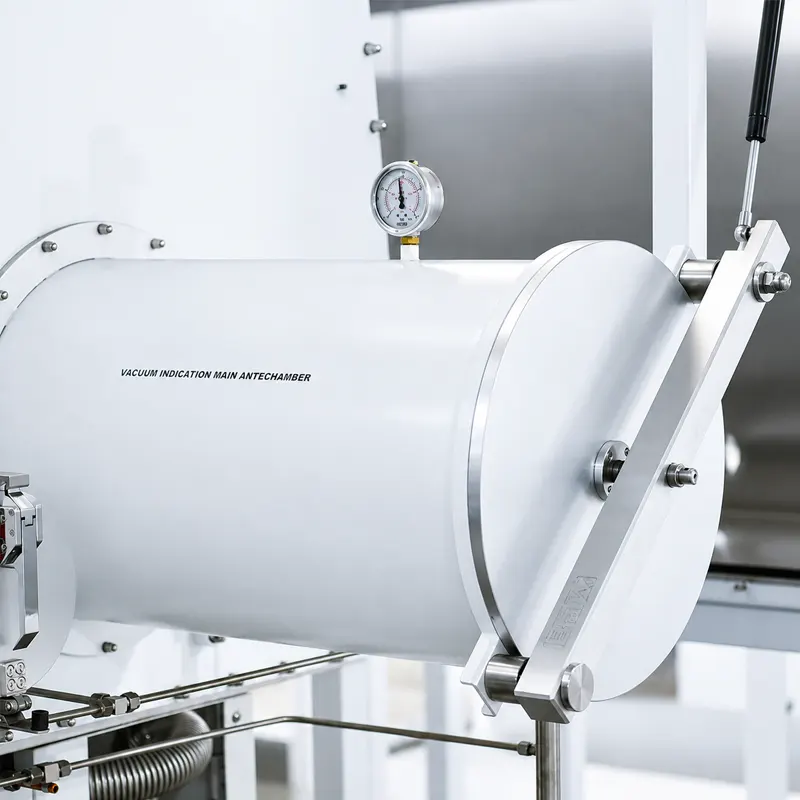
Moving a fixture, cell holder, or bulky sample into a purified glove box is not a matter of opening a door quickly. Every direct opening exposes the working atmosphere to the room, and the purification system must then remove the oxygen and moisture that entered. A large antechamber is one way to manage that exchange: it creates an intermediate volume where the load can be isolated, evacuated or purged, and then transferred into the box with less disturbance. The TENCAN Large Glove Box Antechamber is the accessory in focus here. The question is not simply whether a bigger lock is convenient. It is whether the larger opening, internal volume, sealing system, and control sequence fit the host box, the load, and the way the laboratory actually works.
Why a Large Antechamber Exists
An antechamber is often described as a door, but that understates its role. It is a small, separately sealed chamber attached to the glove box. One door faces the room; the other faces the controlled workspace. The operator places material in the chamber, closes the outer door, and uses the chamber's controls to reduce the unwanted atmosphere before opening the inner door. The working volume of the glove box therefore stays isolated from the room for most of the transfer.
The real cost of an open door
Opening a glove box directly to the room does more than let in visible dust. It introduces oxygen, moisture, and other gases that the purification system must capture. It also disturbs the pressure balance and can move particles toward the work zone. Many purified boxes operate at a slight positive pressure, but that does not make an open door a clean transfer. The larger the opening and the longer it stays open, the more the atmosphere has to recover. A lock does not eliminate exchange; it gives the operator a controlled place to perform that exchange.
A buffer for the workflow, not just for the sample
A large antechamber changes the workflow as well as the atmosphere. It can accept a loaded carrier, a tool, a small assembly, or a container that would be awkward to pass through a narrow lock. That can reduce the number of times the main box is opened, because several items can be staged together. It can also make the transfer less dependent on hand speed. However, the accessory only helps if the host box has a compatible opening and if the chamber can be brought back to a suitable condition within the time the process allows. Size alone does not guarantee either result.
How an Antechamber Works in a Purified Glove Box
The function of an antechamber is based on isolation and controlled exchange. The outer door closes the chamber from the room; the inner door closes it from the glove box. The chamber then becomes a small volume that can be treated independently. Depending on its design, it may be evacuated with a pump, filled with working gas, purged by flow, or managed through a combination of these steps. The goal is to reduce the amount of room air that enters the main box when the inner door opens.
The lock cycle in practice
A typical cycle begins with both doors closed and the chamber at a known state. The operator opens the outer door, loads the item, and closes the outer door. The chamber is then treated, and only after that treatment is the inner door opened. The sequence matters. If both doors are open at the same time, the chamber is no longer a lock; it is a passage. Interlocks, clear indicators, and a written sequence help prevent that mistake, especially when several users share the system.
Vacuum, purge, and dilution are not the same
Evacuation removes gas by lowering pressure. A purge uses a flow of gas to dilute and carry away contaminants. The two can be combined, but they place different demands on the chamber and the surrounding system. A vacuum-capable antechamber must be built to withstand external pressure and must be paired with a suitable pump and gauge. A purge-only chamber may avoid those requirements, but it can use more gas and may take a different amount of time to reach a usable condition. Neither method should be confused with the glove box's continuous purification loop. The antechamber treats its own volume; the purifier manages the main box atmosphere.
What the chamber does not do
An antechamber does not sterilize a load, remove every particle, or certify a material as clean. It does not replace the box's oxygen and moisture analyzers, and it does not make an incompatible material safe. If the load carries solvent vapor or fine powder, those contaminants can enter the chamber and then the box. The accessory is part of an atmosphere-control strategy, not a universal barrier against every kind of contamination.
Where Large Size Helps and Where It Creates New Constraints
Large antechambers are specified when the load envelope is the limiting factor. A narrow lock may be sufficient for small vials and hand tools, but it may not accept a fixture, a sealed container, or a component that cannot be disassembled. A larger chamber can make the transfer more practical and reduce handling risk outside the box. The decision should be based on the actual objects that must pass through, not on a wish for maximum size in the abstract.
Loads that justify the volume
The strongest case for a large antechamber appears when the object cannot be reduced in size without compromising the experiment. Examples may include a mounting frame, a battery test fixture, a sealed transport container, a large substrate holder, or a set of parts that must remain together during transfer. A larger chamber can also support batch transfer: several smaller items are staged at once, so the inner door is opened fewer times. In a multi-user laboratory, that can matter more than the nominal volume, because it changes how often the box is disturbed.
The penalties of volume
A larger chamber is not simply a scaled-up version of a small one. Its internal surface area is greater, its gas volume is greater, and its doors and seals are larger. Those differences affect evacuation time, purge gas consumption, sealing reliability, and the effort needed to handle the door. A large door can be more susceptible to misalignment or seal contamination if it is not supported and maintained. The load path also becomes more important: the operator must be able to place and remove the item without scraping the seal or forcing the door. If the chamber is large but the access route to it is cramped, the practical benefit falls.
Size is a fit question, not a performance badge
It is tempting to treat the largest available antechamber as the safest choice. In practice, an oversized chamber can slow every transfer if the pump and purge system are not matched to it, and it can consume more gas than the process justifies. An undersized chamber creates a different problem: the load may not fit, or it may have to be partially disassembled outside the box. The right size sits between those extremes and is supported by a compatible host interface, a workable cycle, and a load-handling plan.
Compatibility Begins With the Host Box, Not the Accessory
An antechamber is not a universal bolt-on accessory. It is an interface between the room and a controlled atmosphere, and it often forms part of the pressure boundary of the system. The host box determines the opening size, the mounting condition, the door swing, and the available space. The accessory determines the internal volume, the sealing arrangement, and the treatment method. Compatibility has to be established at both levels.
Mechanical and structural interface
The first check is dimensional. The chamber opening must align with the glove box port, and the door must be able to open without interfering with the box, the wall, or nearby equipment. The mounting must suit the box structure, not just the port cutout. For a vacuum-capable chamber, the mechanical design must account for pressure loads; for a purge-only chamber, the structural requirement may differ. A drawing review is more reliable than a nominal size comparison. The review should include the chamber footprint, door clearance, load insertion path, and the space needed for maintenance.
Atmosphere and workflow interface
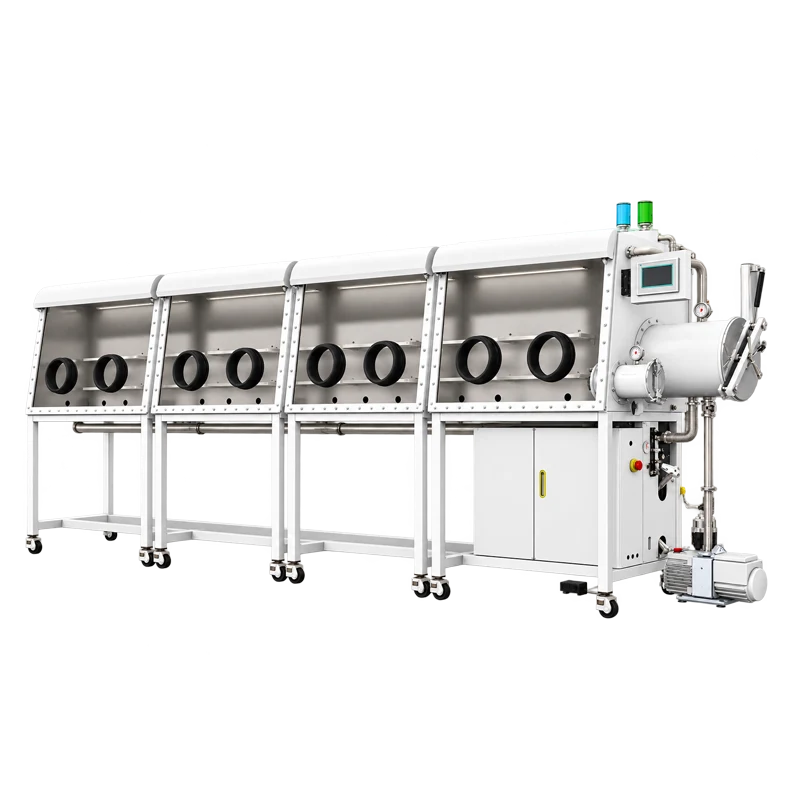
The antechamber shares the box atmosphere when the inner door is open, so its volume and cycle affect the purification load. On a four-station single-sided split-type glove box with gas purification system, for example, the lock would be shared infrastructure across the work zones. A large chamber may suit the transfer of shared equipment, but only if the box layout, opening, and purification capacity are considered together. The existence of a large lock does not by itself prove compatibility with a particular box. It is one part of the system, and the system has to be specified as a whole.
Pump, gauge, and control integration
If the chamber is evacuated, the pump must be matched to the chamber volume, the intended pressure range, and the required cycle time. A pump that performs well on a small chamber may take much longer on a large one. The gauge must be appropriate for the pressure range being used, and its reading should not be mistaken for the box's oxygen or moisture reading. Controls should make the sequence visible: which door is open, whether the chamber is under vacuum, whether the purge is active, and when transfer is permitted. Interlocks are valuable because the cost of a wrong sequence is paid by the whole atmosphere.
Seals and materials
The load and the laboratory routine also affect compatibility. Solvent vapor, acidic residues, fine powders, and repeated cleaning can attack seals or leave deposits on sealing surfaces. A large door has a longer seal path, so a small amount of contamination can have a larger effect. The chamber's materials should be discussed with the supplier in the context of the actual samples and cleaning agents. This is not a reason to avoid a large antechamber; it is a reason to include the load chemistry in the specification.
Selection Checklist for a Large Glove Box Antechamber
A specification checklist helps separate the necessary from the convenient. The aim is to define the transfer problem, the host interface, and the operating routine before choosing the accessory. The table below is a starting point, not a substitute for a drawing review or a site assessment.
| Selection area | Why it matters | Information to confirm |
|---|---|---|
| Load envelope | Determines whether the chamber is useful | Maximum dimensions, mass, carrier type, and number of items per transfer |
| Host interface | Prevents a chamber that cannot be mounted or sealed | Port dimensions, bolt pattern, door swing, wall structure, and available footprint |
| Treatment method | Matches the cycle to the material and throughput | Vacuum, purge, or both; target condition; acceptable cycle time |
| Pump and gauge | Supports the intended evacuation without becoming a bottleneck | Volume, pressure range, connections, and readout location |
| Sealing and materials | Protects the atmosphere and the service life | Seal type, load chemistry, cleaning agents, and replacement access |
| Controls and safety | Reduces sequence errors and operator risk | Interlocks, indicators, emergency access, and training needs |
The checklist should be answered with the actual load, not a hypothetical one. If the chamber is intended for a long carrier, the drawing should show that carrier in place with clearance for hands, gloves, and door movement. If the chamber is meant for a pump-down routine, the pump and gauge should be selected for the chamber's volume and the target pressure. If the chamber is intended mainly for purge, the gas supply and exhaust path deserve the same attention. These details are more informative than a general statement that the chamber is large.
A second pass should test the routine. Where will the load be staged before transfer? Who opens the outer door? How is the chamber checked before the inner door is opened? What happens when a cycle is interrupted? A large antechamber changes the physical path through the laboratory, so the answers are part of the selection, not an afterthought.
Transfer Procedure and Atmosphere Recovery: What to Verify After Installation
Once the chamber is installed, the first question is whether it behaves as a boundary. That means checking the doors, seals, and connections before treating a slow atmosphere recovery as a purifier problem. A new accessory can reveal a leak, an outgassing load, or a procedural error that was not obvious during installation. The aim is to separate those causes rather than assume the worst.
Verify the boundary first
A pressure hold check, where the chamber design allows it, can show whether the chamber and its connections hold. Door seals can be inspected for alignment, cuts, and contamination. Vacuum lines, gauges, and feedthroughs should be checked for the correct connection. If the chamber has a purge path, confirm that gas enters and exits where intended and that the chamber is not being asked to purge through a closed valve. These checks do not prove that every future load is clean, but they establish whether the accessory is doing its basic job.
Slow recovery after a transfer
A slow return of oxygen or moisture readings after a transfer can have several causes. The chamber may have admitted more room air than expected because a door was not fully closed or a seal was disturbed. The load may be releasing moisture or solvent vapor. The purge or evacuation cycle may be too short for the chamber volume. The box may have been opened directly at the same time. The analyzer itself may need attention. It is also possible that the purification system is saturated, but that should be investigated after the simpler causes, not assumed from a single reading. Diagnostic evidence should come from the sequence log, leak checks, and the behavior of the chamber before the inner door is opened.
Make the transfer routine observable
A simple log can be more useful than memory. Record the load type, the cycle used, the chamber condition before the inner door is opened, and any unusual event. If recovery is slow, the log shows whether the problem follows a particular load, a particular operator, or a particular time of day. Large antechambers are often shared, so the log also helps the team agree on what ready means. The routine should include a final check of the inner door area before opening, because a glove or a tool left near the seal can create a leak path that is easy to miss.
What to Send a Supplier Before Requesting a Large Antechamber
A supplier can only judge compatibility with a complete description of the application. The following information is more useful than a request for a large antechamber by name. It gives the supplier a basis for checking the host interface, the treatment method, and the load path.
- Host glove box model, drawing, and port dimensions, including the condition of the existing opening.
- Load envelope: length, width, height, mass, carrier type, and the number of items per transfer.
- Load chemistry: solvents, powders, acidic or basic residues, and any material that may outgas.
- Required chamber treatment: purge only, vacuum capable, or a combination, with the intended target condition.
- Acceptable transfer time and the frequency of transfers per shift.
- Available pump, gas supply, exhaust, and control connections, with their locations.
- Door orientation, swing direction, and clearance for the operator, gloves, and nearby equipment.
- Seal and material preferences based on cleaning agents and sample compatibility.
- Need for shelves, rails, carriers, or internal supports, and whether they are part of the accessory scope.
- Site constraints: floor space, access route, lifting equipment, and maintenance clearance.
With that information, the discussion can focus on the actual interface rather than a nominal chamber size. If the host is a multi-station purification box, the review should include how the lock will be shared and how its cycles will affect the work zones. If the host is a different box type, the same logic applies: the antechamber must match the port, the pressure boundary, and the atmosphere-management strategy. The TENCAN Large Glove Box Antechamber should be evaluated in that system context, not as an isolated box with a door.
The final decision is usually a trade-off between load access and atmosphere stability. A large chamber can make difficult transfers possible, but it also adds volume, sealing surface, and cycle time. The right choice is the one that accepts the real loads, fits the host, and can be operated consistently. Confirm the drawings, the treatment method, the pump and gauge arrangement, and the load chemistry before ordering. That is the point at which an accessory becomes part of a controlled process rather than an extra opening in the box.
