
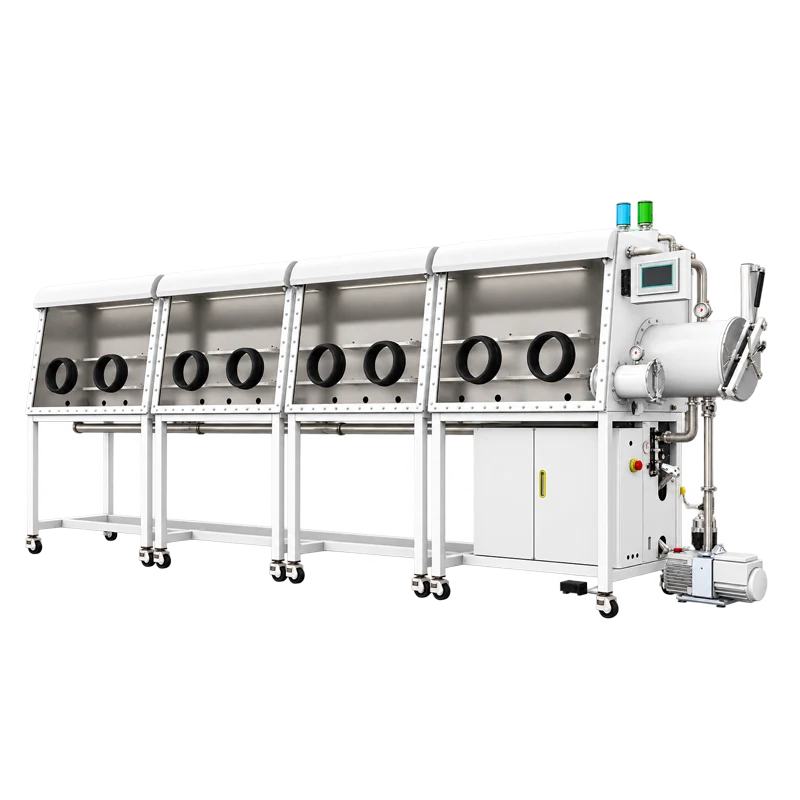
A four-station, single-sided, split-type glove box with a gas purification system addresses a practical contradiction in sensitive-material work: more people need access to a controlled atmosphere, yet every workstation, transfer, and interface can disturb that atmosphere. The configuration named in the supplied product information is not simply a larger one-person box. It combines four workstations with one-sided operator access and split-type construction, while the gas purification system manages the recirculated atmosphere. Those attributes shape workflow, footprint, serviceability, and the interpretation of atmosphere data. Before comparing accessories or requesting a quotation, separate what the layout contributes from what the purification loop contributes, because they solve different problems.
Why a Four-Station Split Layout Changes the Atmosphere Problem
Four workstations help when several tasks must proceed in parallel without moving samples between rooms or opening a shared box repeatedly. One operator may prepare a battery precursor, another may seal a cell, and a third may weigh an air-sensitive powder. In a one-station box, each opening interrupts everyone. A multi-station enclosure reduces that interference by giving each task a defined position, but it does not eliminate the shared atmosphere. The loop, plenum, and transfer path still connect the stations, so a pressure pulse or glove change at one position can be visible elsewhere. The benefit is organizational as much as technical: clearer zoning, fewer unnecessary door movements, and better separation of clean tools from dirty consumables.
Single-sided access is a deliberate space-saving choice. It concentrates operators, services, and viewing surfaces on one face, which can make the installation easier to fit into a laboratory and simpler to supervise. The trade-off is reach and collaboration. Two operators at adjacent stations need clear rules about who opens the antechamber, who changes gloves, and where carts or instruments are parked. Single-sided boxes reward careful internal layout. Heavy equipment should not block the sight line to the far end, and frequently used tools should sit within comfortable reach rather than forcing an operator to lean through a port.
Split-type construction adds another layer. A long enclosure can be divided into modules for transport, installation, or service, but each split introduces a sealing and alignment interface that must be designed and maintained. The product name confirms a split-type arrangement; it does not confirm whether the sections share one continuous plenum, whether dampers isolate them, or how the purification loop is distributed. Those details belong to the model drawing. A split design can help in a building with restricted access, yet it should not be treated as a casual way to expand later. Adding a module after installation is a different project from specifying the final volume at the outset.
What the Gas Purification Loop Does, and What It Cannot Do
A gas purification system maintains a recirculating atmosphere by passing box gas through purification material that removes moisture and oxygen. A blower or circulator keeps the gas moving; sensors monitor the atmosphere; controls manage the operating sequence and regeneration. The purification columns are serviceable components, not a permanent guarantee. Regeneration is a separate procedure that restores the purification material under controlled conditions, and it should follow the manufacturer's instructions for the exact model. The working gas that fills the box, the control gas used by valves and instruments, and any regeneration gas should not be conflated. They may come from the same supply, but they perform different functions and can have different purity requirements.
The most common misunderstanding is to treat purification as if it were the same as initial inert-gas replacement. Purging with inert gas reduces the concentration of ambient air, but it does not create a continuously maintained condition. A closed-loop purifier can remove water and oxygen that enter through leaks, gloves, transfers, or material outgassing, yet its capacity is finite and its performance depends on the enclosure, the load, and the operating schedule. A box that reaches a low reading after a long settling period does not necessarily recover quickly after a large transfer. Recovery time is a system-level property: volume, circulation path, purifier condition, sensor location, and the amount of moisture or oxygen introduced all matter.
Purification Is a Loop, Not a One-Time Purge
A loop has a direction, a flow path, and dead zones. If a workstation is poorly swept, gas near that position may exchange slowly even when the analyzer sample point looks acceptable. If the sample point is close to the purifier return, it may not represent the atmosphere at the gloves. Sampling-line placement, return-duct routing, and internal obstructions created by equipment affect how representative a reading is. This is why a four-station box needs a layout review, not just a purifier sizing calculation. The analyzer measures the atmosphere; it does not improve it. Its value depends on where it samples, how it is calibrated, and whether the operator understands its response time.
Where Particles, Solvents, and Oxygen Control Diverge
Particle filtration, solvent adsorption, and water or oxygen removal address different contaminants. A HEPA filter captures particles; it does not remove water vapor, oxygen, or solvent vapor. Solvent adsorption can protect the purifier and reduce organic contamination, but it does not replace water and oxygen removal. If a process releases solvents, the compatible configuration may require a solvent trap and a review of glove and seal materials. If a process generates fine powder, local filtration and cleaning practice matter. Treating one control as a substitute for another is a common specification error. The right question is not whether the box has a filter, but which contaminant the filter is intended to control and where it sits in the flow path.
Reading the Four-Station Single-Sided Configuration Before Ordering
The supplied product name points to a specific configuration: the TENCAN four-station single-sided split-type glove box with gas purification system. That page is the correct starting point for the current layout, but the name alone should not be used to infer dimensions, port spacing, antechamber volume, purification capacity, or achievable atmosphere levels. Those are model-specific values. When requesting a review, use the product page as the reference and ask for the current drawing, utility requirements, and configuration list. This keeps the discussion anchored to the actual product rather than a generic description of a purified box.
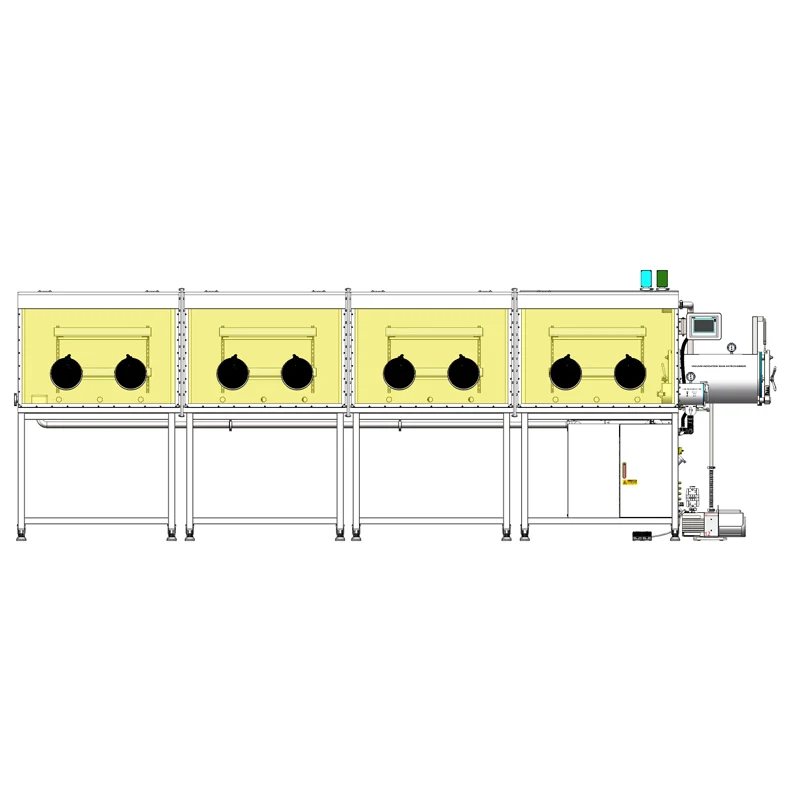
Zoning starts with the process, not the number of ports. Map each task to a station: weighing and sample preparation, cell assembly, sealing, inspection, or a small analytical operation. Decide which tasks produce dust, which release solvent, and which demand the most careful atmosphere. Keep the dirtiest operation away from the cleanest one, and avoid carrying open containers past every station. If different teams will use the four stations, assign ownership of consumables and cleaning. A four-station box can otherwise accumulate clutter that blocks airflow and makes transfer errors more likely. The layout should show glove positions, shelves, the antechamber, and the sample path from entry to exit.
On a single-sided box, the operator's reach defines the usable working depth. Ask for a dimensioned section showing glove-port height, the distance from the ports to the rear wall, and the space available for equipment. A large box with an awkward reach is less useful than a smaller one with a sensible working plane. Viewing panels and lighting should allow inspection without opening the box, and feedthroughs should be placed where cables will not cross the working area. If a microscope, balance, or sealing tool is planned, confirm its footprint, heat load, and cable route early. Equipment integration changes the internal flow pattern.
Evaluate the split-type arrangement at its interfaces. Ask how the sections are sealed, how alignment is maintained, and whether the joint can be inspected or serviced. If the sections can be isolated, the operating procedure changes: one side may be opened for maintenance while the other remains protected, but only if the isolation method and purification loop are designed for that mode. If they cannot be isolated, a service event affects the whole box. Neither answer is automatically better; the choice depends on whether the priority is service access, transport, or uninterrupted operation. The supplier's description and the site procedure must agree.
Sample Transfer and Pressure Events: Where Stability Is Won or Lost
Every transfer is a pressure event. When an antechamber is evacuated and refilled, the box atmosphere sees a disturbance; when a glove is changed, a port is opened; when a large item is inserted, the internal volume and temperature change. These events do not automatically indicate a fault. They do mean that transfer procedure, antechamber size, and pressure monitoring belong in the same discussion. A small antechamber may require more cycles for a large object, while a large antechamber may create a bigger pressure swing per cycle. The right compromise depends on the size and number of items moving into the box, the sensitivity of the process, and the operator's ability to follow a repeatable sequence.
Pressure monitoring is often treated as a single number, but several pressures can exist in one installation: box working pressure, antechamber pressure during evacuation, the pump's ultimate pressure, and the pressure across a filter or transfer line. These are different measurements with different reference points. A gauge that reads box pressure does not tell you the antechamber vacuum, and a pump's ultimate vacuum does not tell you the pressure seen by a sample during transfer. Before adding an instrument, define the measurement point, the reference, the range, the required resolution, and the calibration method. A reading without those details is difficult to use for diagnosis or acceptance.
What a Pressure Transmitter Can and Cannot Tell You
Where pressure monitoring is part of the configuration, a dedicated transmitter can provide a more useful signal than an occasional glance at a mechanical gauge. The TENCAN high-precision pressure transmitter is listed in the glove-box accessories category. Its suitability depends on the actual pressure range, connection, wetted materials, output signal, and compatibility with the box or antechamber being monitored. Those details must be confirmed against current product information and the system drawing; the accessory name alone is not a compatibility statement. It is also not an oxygen or moisture analyzer. It measures pressure, and pressure data can support leak checks and transfer discipline only when the measurement chain is calibrated and the sampling point is understood.
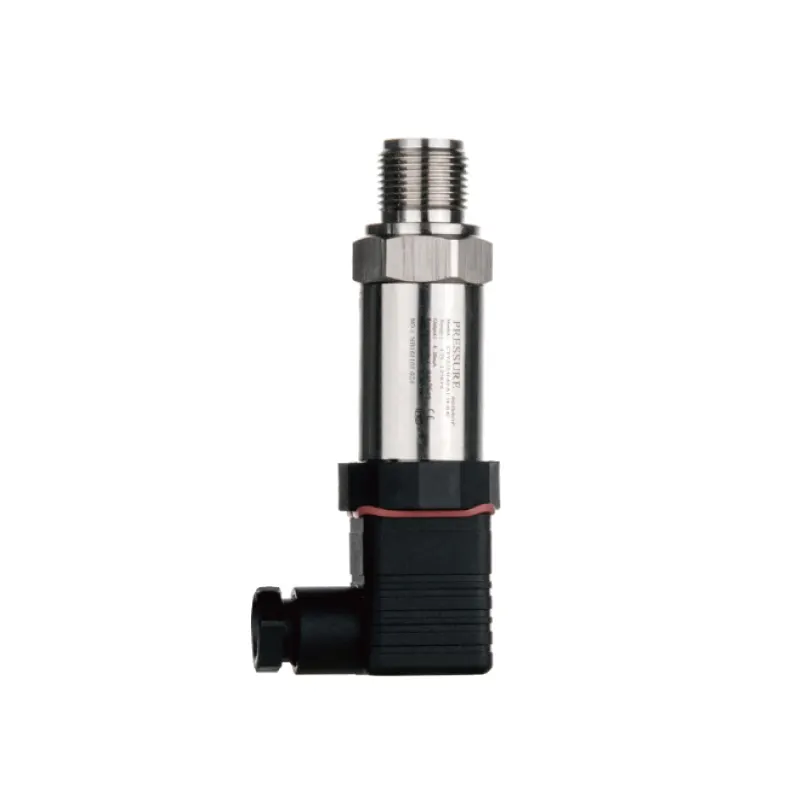
A high-resolution display can create false confidence. Resolution is the smallest change an instrument can display; accuracy is how close the reading is to the true value. A transmitter with fine display increments may still have an uncertainty larger than those increments. For glove-box work, the important questions are whether the range covers the normal operating band without losing useful resolution, whether zero can be checked, whether the signal is stable over time, and whether the transmitter sees the same gas and pressure excursions as the box. If the instrument is used for acceptance testing, the calibration method matters as much as the transmitter. Pressure trends should be recorded with consistent units and references.
Matching Sensitive-Material Applications to the System
The four-station purified box is relevant where air-sensitive materials must be handled, stored, or assembled under a controlled atmosphere. Examples include lithium-metal and solid-state battery components, perovskite and OLED materials, semiconductor samples, air-sensitive organometallic chemistry, and advanced materials that degrade in ambient humidity. The common thread is sensitivity to water, oxygen, or both, not a particular industry label. The system should be selected against the actual material, acceptable exposure time, required handling step, and analytical method used to verify the atmosphere. A glove box is not automatically sterile, a cleanroom of a stated class, a biosafety enclosure, or a certified dangerous-goods containment system unless a specific validated design says so.
Material compatibility runs beyond the sample. Solvents can attack gloves, seals, and plastic components; fine powders can migrate into seals and filters; hot tools can create local convection and pressure effects. Not every gas is inert to every sample. Nitrogen may suit one material and be unsuitable for another, while argon may be preferred for density or chemistry reasons. The supplier should know the gas, solvent, maximum sample mass, and expected transfer frequency. Those inputs affect glove selection, solvent trapping, purifier protection, and cleaning procedure. A process that looks like a simple weighing step can become a compatibility problem if the sample is volatile or the container is not clean.
Additive manufacturing and advanced-materials work often combine pre- and post-processing. Powder handling, sieving, sampling, and packaging may need a controlled atmosphere, while the printing equipment itself may not fit inside the box. The practical question is where the sensitive step occurs and how the sample is transferred without unnecessary exposure. A four-station layout can support a sequence such as receiving, weighing, conditioning, and sealing, but only if the flow avoids back-tracking. Battery or semiconductor workflows may also need a small vacuum step, a heated stage, or an electrical feedthrough. Each added function changes internal volume, cable routing, and heat load, so include it in the initial layout review.
A Verification Plan That Separates Different Measurements
Atmosphere verification should separate unlike measurements. Oxygen and water analyzers answer different questions from a pressure transmitter, and both answer different questions from a leak test or a purifier capacity check. The table below is a reasoning aid, not a substitute for model-specific acceptance criteria. Any numerical limit should come from current product documentation and the agreed test method. If a document gives a value without stating whether it is a reachable value, a steady-state guarantee, or a transient reading, ask for clarification. That is especially important for multi-station boxes, where the sample point and operating state can change the result.
| Measurement | What it indicates | What it does not establish |
|---|---|---|
| Oxygen reading | Oxygen at the sample point and time | Moisture level or whole-box uniformity |
| Water reading | Moisture at the sample point and time | Oxygen level or solvent removal |
| Box pressure | Operating pressure relative to a reference | Oxygen and water quality or leak rate |
| Antechamber pressure | Transfer evacuation state | Box atmosphere quality |
| Leak-test result | Enclosure integrity under test conditions | Continuous performance in every cycle |
| Purifier service state | Regeneration or service need | Actual sample protection without atmosphere data |
The sample point deserves explicit attention. In a four-station box, one analyzer may sample a common return line while the operator works at the far end. If the return is well mixed, the reading may be representative; if there are dead zones or large obstructions, it may not be. Ask where the sample is drawn, how long the line is, and whether the analyzer has a pump or relies on loop pressure. A slow response can be a characteristic of the sampling system rather than a sudden purifier failure. Calibration gases and schedules should be documented. When a reading drifts, check the sensor, sample line, and operating state before adjusting the purification system.
A practical verification plan uses stable states and repeatable events. Establish a baseline after a defined settling period, record the reading at each workstation if sampling allows, then perform a controlled transfer and observe recovery. Compare the same event across days rather than comparing a quiet weekend reading with a busy afternoon. Keep a log of glove changes, antechamber cycles, materials introduced, and purifier regeneration. That log turns scattered numbers into a diagnostic history. If multiple teams use the box, assign one person to review the log and one procedure for reporting an abnormal trend. Verification is the evidence that operating discipline still matches the design.
Configuration Details to Confirm With the Supplier
A supplier review is most productive when the request describes the work, not just the box. Provide the material class, gas, solvents, largest and heaviest item, transfer frequency, number of simultaneous operators, and instruments that must be inside. State whether the four stations are independent tasks or one sequence, and whether any station needs isolation during maintenance. Ask for a dimensioned layout, internal volume, antechamber size, purification-loop arrangement, analyzer sample points, and pressure-monitoring points. If a pressure transmitter is proposed, specify the measurement point and reference. These details let the supplier check compatibility instead of guessing from a product title.
- Workstation map with glove positions, shelves, and the sample path.
- Internal dimensions and reach from the single operating face.
- Antechamber volume and the largest item that must pass through it.
- Purification-loop layout, service access, and regeneration requirements.
- Analyzer and pressure-measurement points, ranges, references, and outputs.
- Glove material, solvent exposure, particle filtration, feedthroughs, and heat loads.
Also ask what the current product page does not establish. A product name can confirm the category and headline configuration; it cannot confirm every interface detail. If the drawing shows a split joint, ask how it is sealed and inspected. If the purification loop is shared, ask how a service event on one section affects the others. If an accessory is listed separately, ask for its compatible connection and calibration requirements. The final decision should rest on the process sequence, enclosure layout, and measurement plan together. A four-station split-type purified box can support more parallel work than a single-station enclosure, but it creates more interfaces to manage. Specify the work first, then the layout, then the instrumentation, and confirm each choice against current TENCAN information and drawings.
