
A six-station glove box with gas purification is usually specified when a laboratory needs several operator positions but does not want each position to become an independent atmosphere-controlled enclosure. A shared purification loop, a common monitoring system, and direct movement between adjacent work areas can reduce duplicate equipment and make collaborative work more practical. The difficulty is that every added station, door, glove port, and feedthrough changes the atmosphere load. A large box is not automatically a more capable box; it is a different system with different recovery behavior and different operating discipline.
TENCAN's TENCAN six-station double-sided split-type glove box with gas purification system belongs to this system-level category. The product name carries three design signals—six work positions, access from two sides, and a split enclosure—and each should be assessed separately. The useful question is not whether six stations exist, but whether the layout, purification loop, transfer path, and instrumentation fit the work that will take place inside.
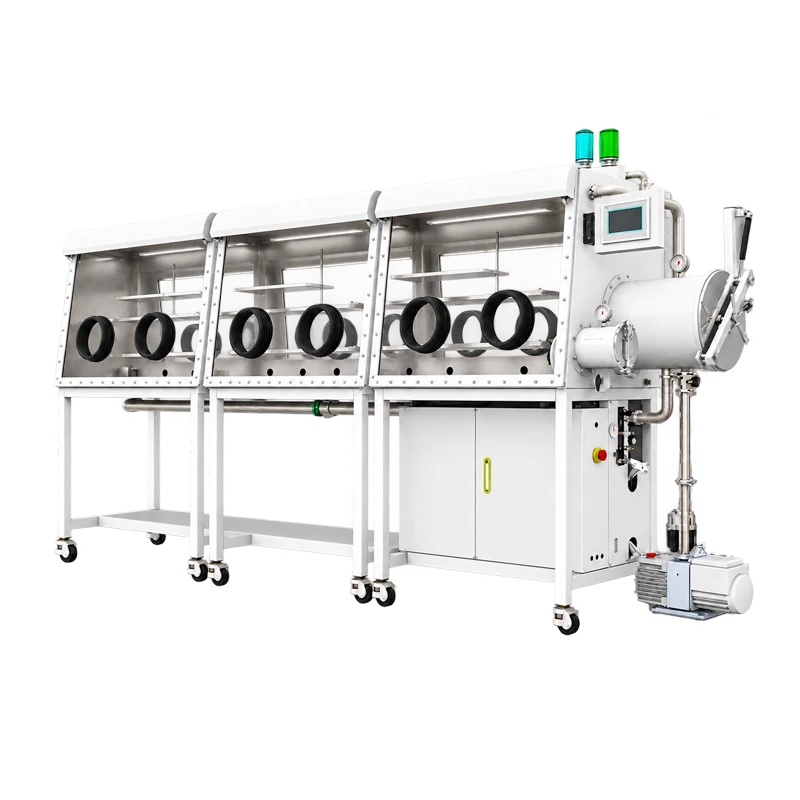
The Requirement Behind a Six-Station Purified Glove Box
A purified glove box is more than a sealed cabinet with gloves. It is a closed working volume connected to a gas purification loop that circulates the internal atmosphere, removes moisture and oxygen, and returns treated gas to the enclosure. The enclosure provides the physical barrier and operator access; the purification system provides ongoing atmosphere management. A six-station version increases the working volume and the number of access points, so the two parts have to be sized and configured together rather than treated as separate purchases.
The process list should come before the layout. Typical work in this category includes lithium and solid-state battery materials, perovskite and OLED device layers, air-sensitive chemistry, semiconductor or advanced-material handling, and additive-manufacturing pre- or post-processing. These duties are not equivalent. A process that releases solvent vapor, generates particles, or uses a heated stage places a different load on the box from simple weighing and sample storage. The first configuration question is therefore what will be opened inside, how often, for how long, and with what materials.
The second question is concurrency. Six stations can mean six people working at once, or one or two people moving between positions while most ports remain closed. The first case demands attention to shared purification capacity, local atmosphere movement, and conflict between processes. The second may be overbuilt. A multi-user box is justified when samples and operators need a common atmosphere and when transfer between tasks is frequent enough that separate boxes would add handling risk. It is less compelling when incompatible processes would compete for the same atmosphere or when one process dominates the schedule.
What the Double-Sided Split Layout Changes
Two-sided access is a workflow decision
Double-sided access is a workflow decision before it is a hardware feature. It can separate sample introduction from active manipulation, allow two teams to work face-to-face, or place instrumentation on one side and sample preparation on the other. It also doubles the number of gloves, ports, and potential seal interfaces. More access points are not automatically better. Each port has to be reachable, comfortable for the operator, and compatible with the tools that pass through it. The layout should be reviewed as a workflow drawing, not only as a cabinet outline.
For a six-station box, sightlines and reach matter. A station that is difficult to reach may remain unused or encourage awkward manipulation that increases spill and leak risk. The split construction adds another layer. It can make transport and installation more practical and can define separate enclosure sections, but it does not, by itself, prove that each section is independently isolatable or independently purified. Confirm whether the sections share one circulation loop, whether they can be valved off, and how the joints are sealed and leak-tested.
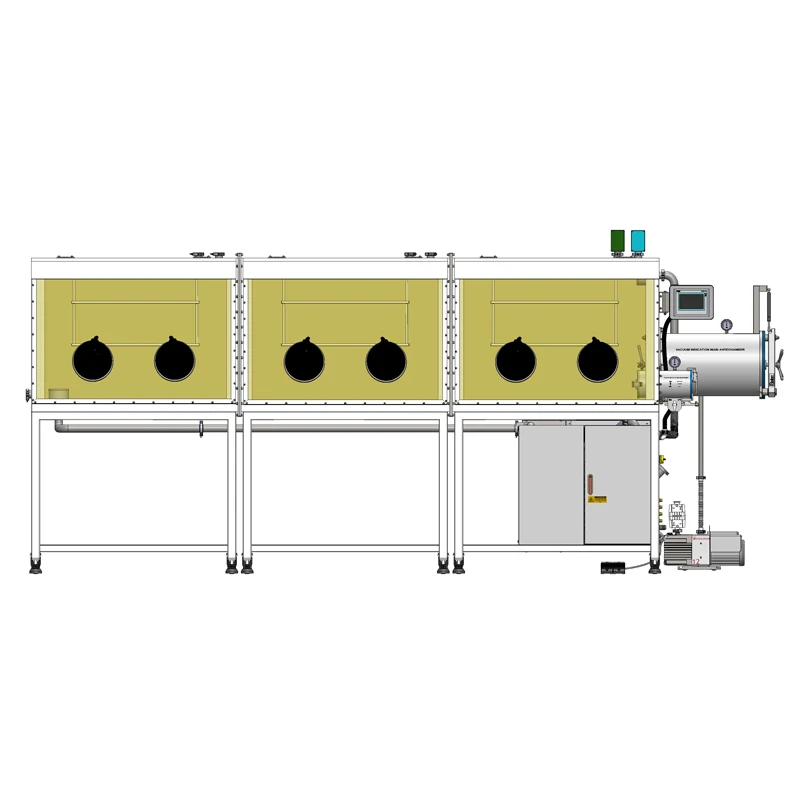
Where the additional stations help
Additional stations help when several samples must be prepared in parallel under the same atmosphere, when a central analytical instrument serves multiple users, or when a large enclosure reduces the need to move samples through antechambers. They can also support training and supervised work without creating a second atmosphere. They become less useful when the work is intermittent, when only one operator is present for most of the day, or when the larger volume and surface area make atmosphere recovery slower after each opening. The trade-off is not station count alone; it is station utilization versus atmosphere volume and access frequency.
A split design also raises an installation question. If the enclosure arrives in sections, the joints become part of the pressure boundary. They need a defined sealing method and a leak check before the box is accepted. The same applies to any blanking plate, window, or service panel added during site assembly.
How the Purification Loop Governs Atmosphere Stability
A gas purification system is often described as the heart of the glove box, but it is more useful to think of it as a loop with several functions. A blower circulates internal gas through purification columns, where moisture and oxygen are removed by reactive or adsorptive media; the treated gas returns to the enclosure. Valves direct flow during normal operation and regeneration. Analyzers sample the atmosphere and provide the readings operators use to judge whether the box is fit for work. The enclosure, the loop, and the monitoring system have to be designed as one system.
The loop does not make the box immune to contamination. Every opening, transfer, glove change, and feedthrough creates a disturbance. The loop removes incoming moisture and oxygen over time, but the rate of recovery depends on the volume of the box, the size of the opening, the condition of the gloves and seals, the amount and nature of material introduced, and the capacity of the purification media. A stable display before a transfer is not evidence that the box will remain stable during and after it.
Water and oxygen readings are system-level indicators
The oxygen and moisture analyzers report at their sampling points. They do not average the entire enclosure, and they do not reveal a stagnant pocket behind a baffle or inside an antechamber. Placement, sample flow, and calibration therefore matter as much as the sensor specification. A reading should be interpreted with the operation log: what was opened, what was introduced, how long the loop ran, and whether the reading returned to its previous baseline. Resolution is not the same as accuracy, and a precise-looking display can still mislead if the sensor is due for calibration or installed in an unrepresentative location.
Regeneration and solvent load belong in the operating plan
Purification media have finite capacity. Regeneration is a planned maintenance cycle, not a routine filter swap, and it has to follow the manufacturer's procedure for the specific system. The need for regeneration should be anticipated in the laboratory schedule because it affects availability. Solvent vapors and certain process emissions can also challenge the purification loop. A solvent trap or other appropriate protection may be needed, but it cannot replace water and oxygen removal. HEPA filtration addresses particles, not moisture or oxygen, and should not be presented as atmosphere purification.
This is why a six-station box needs an operating plan, not only a larger purification unit. If several users open the box throughout the day, the loop may never see a long quiet period. If one user performs a solvent-heavy procedure, the whole shared atmosphere may be affected. Scheduling and a clear rule for closing ports are operational controls that complement the hardware.
Transfers, Pressure, and Atmosphere Disturbance
Sample transfer is usually the largest routine disturbance. An antechamber allows an object to be moved from laboratory air into the inert atmosphere without opening the main work volume directly. The transfer may involve vacuum and inert-gas backfill, or a simpler purge cycle, depending on the antechamber and the product configuration. The objective is the same: reduce the air burden entering the box. The details are not universal, so the number and duration of cycles should be established for the actual antechamber volume, door size, and load.
Antechamber design and transfer discipline
A larger antechamber can accept larger tools or containers, but it also presents a larger volume to evacuate or purge. A small antechamber may require more transfers or may not accept the equipment the process needs. Door seals, shelf placement, and the ability to reach the inner door without contaminating the work zone all matter. The transfer procedure should be written and taught, because inconsistent purging is a common source of unexplained atmosphere excursions. The box should be allowed to recover before sensitive work begins; recovery time is a property of the system and the load, not a fixed rule.
Pressure is not a purity specification
Glove box working pressure, antechamber vacuum, pump ultimate vacuum, leak rate, oxygen content, and moisture content are different quantities with different test conditions. A pressure gauge can show that the box is slightly positive relative to the room, but it cannot show that the atmosphere is low in oxygen or moisture. A pump specification can describe evacuation capability, but it does not describe the achievable atmosphere in the box after a transfer. A leak-rate test can characterize enclosure integrity, but it does not replace a calibrated analyzer reading.
Keep original units and the object of each specification. If a supplier states a value for a particular configuration, do not assume that the same value applies to a larger six-station box, a different antechamber, or a different purification option. Where a data sheet is ambiguous, ask for the test condition: at which point, under what load, after what stabilization period, and with which analyzer.
Instrumentation: Measuring the Atmosphere, Not Fixing It
An analyzer is a measurement device. It does not remove oxygen or moisture, and it does not improve the atmosphere by being more sensitive. Its value lies in telling the operator whether the purification loop and enclosure are performing as expected. For a shared six-station box, the monitoring arrangement should reflect how the box is used. A single sample point may be adequate for a well-mixed enclosure, but it may not represent a separated section, a transfer chamber, or a local process zone.
Placement, calibration, and response time
Ask where the sample is drawn, how long the sample line is, and whether the analyzer sees the main work volume or a bypass. Calibration intervals and the calibration gas or reference method should be stated in the maintenance plan. Response time matters when users are waiting to begin work after a transfer. A fast display update is not the same as a fast sensor response, and neither is the same as the time required for the whole box to recover.
Trends are more informative than a single number
A single reading taken at the start of the day says little about the box's behavior during use. A trend log showing baseline, disturbance, and recovery is more useful. If the reading rises after every transfer and takes longer to recover, the cause may be transfer practice, a glove or seal issue, or an increased process load. If the reading drifts while the box is closed, the enclosure or the purification loop deserves attention. These are diagnostic possibilities, not a diagnosis of a specific fault; the response should be investigation, not an immediate claim that the system has failed.
For a multi-user installation, agree on what the displayed value means and who is authorized to act on it. A reading near a chosen limit should trigger a defined response: stop opening the box, check the transfer record, inspect gloves and doors, and consult the maintenance plan. Write that response into the user instructions so that one person's quick transfer does not unknowingly affect the next person's starting condition.
Feedthroughs and Accessories: Useful Only When Properly Integrated
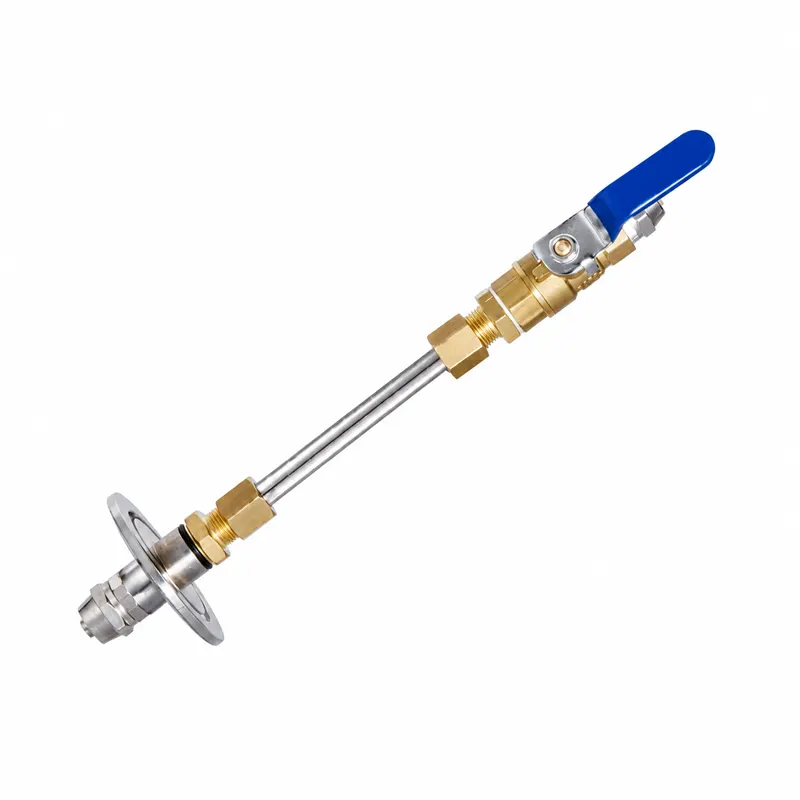
A glove box becomes more useful when power, signals, gases, or liquids can pass through the enclosure without opening a door. A feedthrough is a controlled interface, and its quality depends on the same principles as any other penetration: the right port, a compatible seal, a sound mechanical fixing, and a leak check after installation. TENCAN lists a gas and liquid feedthrough among its glove box accessories. As with any accessory, it should be selected for the specific box, medium, pressure, and connection standard rather than assumed to fit every enclosure.
Match the feedthrough to the line and the box
For a gas line, establish the gas, supply pressure, flow requirement, tubing size, and whether the line will be purged or evacuated. For a liquid line, establish the fluid, compatibility with wetted materials, cleaning method, and the consequence of a leak inside the box. The enclosure side is equally important: available port size, thread or flange standard, seal material, and whether the feedthrough can be installed without compromising the internal work area. A feedthrough that is mechanically convenient but chemically incompatible is not a suitable choice.
Accessories interact with the atmosphere
The same system view applies to gloves, glove ports, seals, antechambers, vacuum pumps, valves, KF interfaces, electrical and signal feedthroughs, HEPA filters, solvent adsorption, and cooling devices. Each has a primary function, and none should be asked to perform another function. Gloves are selected for size, permeability, and material compatibility; an antechamber is selected for transfer volume and sealing; a pump is selected for the gas and load; a filter is selected for particles; a solvent trap is selected for solvent vapor. Adding these items without checking port availability, internal clearance, and leak paths can make the system harder to operate.
Compatibility is not a paperwork detail. If the box has a shared purification loop, a new feedthrough or solvent source can change the load on that loop. If the box is split into sections, the accessory may be installed in one section while the analyzer samples another. These are configuration questions for the supplier, and they should be answered before the accessory is ordered.
Configuration Checks Before You Specify the System
A six-station double-sided split-type purified glove box can be an efficient platform for a busy materials laboratory, but only when the layout and atmosphere strategy are defined together. The following checks turn a general request into a configuration that can be evaluated.
| Check | What to define | Why it matters |
|---|---|---|
| Work positions and access | Number of simultaneous operators, tasks that need two-sided access, reach and sightlines | Determines whether six stations are used efficiently or become unused ports |
| Enclosure sections | Shared or isolated purification, valving, joint sealing, leak-test method | Defines whether a split design can be treated as one atmosphere or several |
| Transfer path | Antechamber size, door clearance, purge or vacuum method, recovery procedure | Transfer is a major routine disturbance and must match the loads |
| Monitoring | Analyzer locations, calibration, logging, response time, alarm response | A reading is useful only when it represents the working volume and is acted on |
| Feedthroughs | Port standard, medium, pressure, seal compatibility, installation leak check | Every penetration is a potential leak path and must fit the box |
| Process duty | Materials, solvents, particles, heat, frequency, cleaning | These inputs determine purification load and operating schedule |
Provide the supplier with a process list, not just a box size. Include materials, quantities, frequency, solvents, particles, heat loads, tools, required connections, and the number of trained operators. State which processes must remain isolated and which can share an atmosphere. Ask for a layout drawing with glove port heights, antechamber access, and feedthrough positions. Ask how the purification loop is sized for the stated duty and how regeneration affects availability.
Also ask what will be measured, where, and how the reading will be verified after installation. A factory acceptance test or site test should be defined in terms of the actual configuration, not a generic claim. The aim is not to collect the largest number of features; it is to know which features the process depends on and which assumptions remain unverified.
The product page for the six-station double-sided split-type glove box with gas purification system is the starting point for a configuration discussion, not a substitute for it. A well-matched system gives several operators a common, monitored atmosphere with deliberate transfer and accessory integration. A poorly matched one gives a large enclosure that is difficult to recover after every opening. The difference is usually settled long before installation, in the process data and the questions asked at specification.
