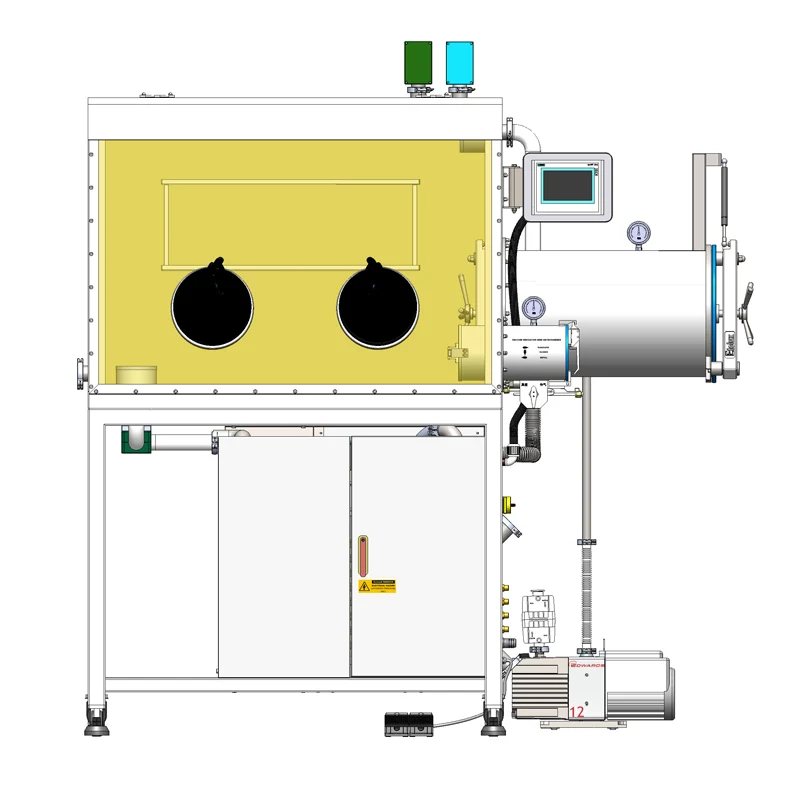
A glove box rarely fails dramatically. More often it drifts. The oxygen or moisture reading climbs after a transfer, and instead of falling back within a few minutes it lingers for an hour, then two. Someone shortens the regeneration interval, someone else replaces a sensor, and the behaviour improves just enough to be explained away. In most of these cases the purifier was never the problem. What the reading reflects is the time the circulation loop needs to remove a quantity of contamination that entered through the transfer path, the gloves, the load itself, or a small leak, and on a two-station double-sided cabinet that quantity is easy to underestimate.
This article is about the recovery phase specifically: why a two-station double-sided glove box with gas purification system can take longer than expected to return to its working setpoint after a transfer, which parts of the system are involved in that delay, and which configuration details are worth settling before the cabinet is ordered. Slow recovery is treated here as a diagnostic question rather than a fault report. Where a value would depend on the installed configuration, it is left to the manufacturer's data sheet rather than guessed.
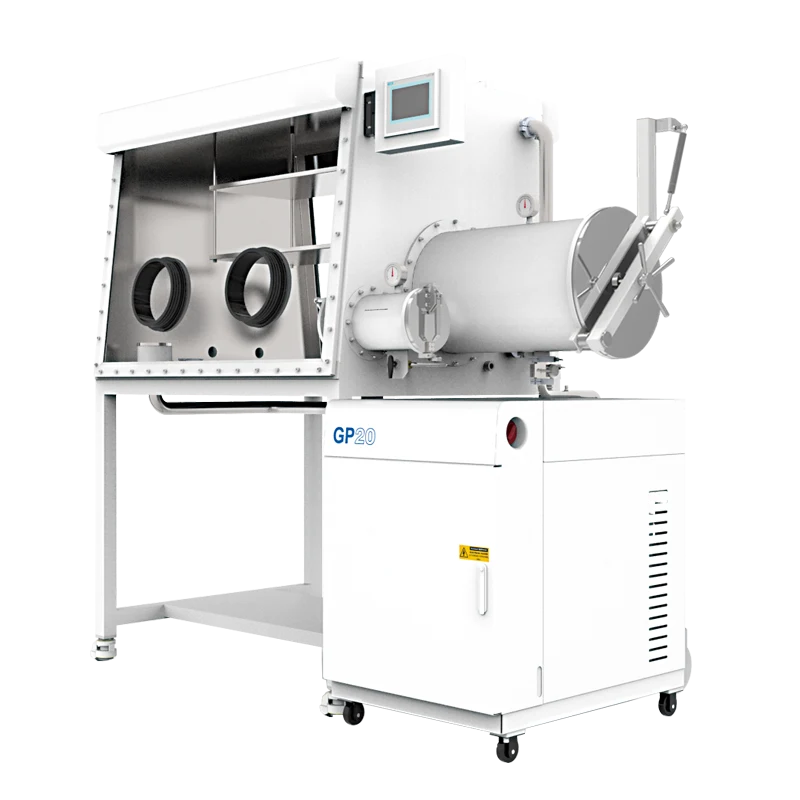
Slow Recovery Is a System-Level Symptom
A purification glove box is a closed loop made of four things that are easy to think about separately and impossible to diagnose separately: the box volume, the circulation path, the purification column, and the instrumentation. Gas leaves the working space, passes through the column where water and oxygen are adsorbed, and returns. Sensors sample that returning gas and report a concentration. The reading an operator watches is therefore not a measurement of the box at rest. It is a measurement of the gas at the sensor's location at that moment, in a system that is actively trying to change it.
This matters because two very different situations produce the same display. In the first, the box genuinely holds a higher concentration and the loop is removing it at a normal rate. In the second, the box is nearly clean but the sensor is seeing a local pocket, a dead leg in the piping, or the tail of a slow desorption from a surface. The first calls for better transfer discipline or a larger column. The second calls for attention to flow path and sensor placement. Telling them apart requires watching the shape of the recovery curve rather than a single number.
Recovery time is roughly the contaminant load divided by the removal rate. Both terms move. A larger box volume dilutes an incoming slug of air but also means more gas must be processed before the whole volume turns over. A high circulation rate shortens mixing time but does nothing for a leak that is still admitting air. A column with remaining capacity removes water and oxygen quickly; a column that is saturated, or that has just come off regeneration and is not yet fully cooled and purged, removes almost nothing. If only one of these is examined, the conclusion is usually wrong.
It also helps to be precise about what the instruments report. Resolution is the smallest change a sensor can display. Accuracy is how close that display is to the true value. A moisture sensor reading in the low single digits with three decimal places looks authoritative and may still carry an uncertainty several times larger than the last digit. When recovery appears stalled at a plateau, the plateau may be the sensor's floor, not the box's atmosphere.
What the Two-Station, Double-Sided Layout Changes
One loop, two workstations
A two-station cabinet provides two operator positions sharing a single controlled atmosphere. The practical benefit is throughput: one person can load and manipulate while another works, or a long experiment can remain undisturbed while a second task proceeds. The atmosphere, however, does not respect the division. Air admitted at one station, or contamination released by a sample at one station, is distributed through the shared volume by the circulation loop.
This has a direct consequence for recovery. When only one station is active, the effective volume being disturbed is a fraction of the total, and the local concentration near that station spikes higher than the box average before mixing dilutes it. If the sensor samples far from the disturbance, the reading rises slowly and falls slowly, and the operator may conclude that purification is weak when in fact the mixing time is simply long. Uneven distribution between stations, rather than insufficient column capacity, is a common reason a cabinet seems to recover poorly during busy periods and perfectly well overnight.
Double-sided access and airlock discipline
A double-sided cabinet has access from both faces, which changes workflow in ways that are easy to overlook at the specification stage. Material can enter from one side and leave from the other without crossing the working area, which shortens handling paths and reduces the time a port stands open. That is a genuine atmosphere benefit. The same arrangement also means more doors, more glove ports, and more opportunities for one of them to be left unsealed.
Where the two sides face different rooms, the cabinet effectively couples those rooms through a shared atmosphere. Draughts, local humidity, and traffic near one face influence what the seals and gloves see. Before blaming the purification system for a slow overnight recovery, it is worth confirming that the cabinet is not sitting in a pressure differential that continuously loads one set of seals.
Four Mechanisms Behind a Lagging H2O or O2 Reading
With the loop described, the possible causes reduce to a short list. Each has a different signature on the recovery curve, and each is addressed differently.
Air carried in on the load
Every object that enters the antechamber arrives coated with adsorbed water and accompanied by a boundary layer of room air. A flat metal plate carries little; a porous ceramic, a fibrous mat, a powder in a loosely closed container, or a stack of separator sheets carries a great deal. The antechamber removes the free air through evacuation and refill cycles, but it cannot remove water that is chemically or physically bound to the surface. That water is released inside the working space, over minutes or hours, after the inner door opens.
This is the single most common reason recovery takes far longer than the loop's nominal turnover time. The purge cycles were adequate; the load was not conditioned. The diagnostic clue is timing: recovery proceeds normally up to the moment the inner door opens, then the curve breaks upward and decays slowly and smoothly, in the shape of a desorption process rather than a step.
Outgassing from samples, gloves, and containers
The gloves themselves are a large, thin, permeable surface, and they are the component most often ignored in atmosphere budgets. Elastomer choice, wall thickness, and condition all affect transmission. A glove that has absorbed solvent during a previous session will release it for a long time. Solvent vapour is not water and not oxygen, and the purification column is not designed to remove it; if the cabinet has a solvent adsorption path, that path handles organics, and it does not substitute for water and oxygen removal. Adding solvent adsorption to fix an oxygen problem will not work, and neither will increasing regeneration frequency to fix a solvent problem.
Samples deserve the same scrutiny. Lithium salts, some oxides, sol-gel intermediates, and many cathode or solid-electrolyte precursors release water or oxygen-containing species when first exposed to a dry atmosphere. The cabinet is doing its job; the sample is simply a continuing source. In that case recovery is not delayed, it is continuous, and the reading will only fall once the outgassing flux drops below the removal rate.
Purifier condition and regeneration state
A dual-column purification system typically runs one column in service while the other is regenerated, so the box is never left without purification. During changeover, capacity margins narrow. A column that has just returned to service may still be cooling or may still be releasing traces of the regeneration gas, and it will not perform at its steady-state capability until it has stabilized. Operators who watch recovery only in the hours after a changeover sometimes conclude that the system has degraded when it is simply transitioning.
Column life depends on cumulative contaminant load, not on calendar time. A cabinet used for frequent transfers of porous material will exhaust its columns far sooner than one used for occasional handling of dense metal parts, even if both show similar daily readings. Regeneration procedures, temperatures, and gas compositions belong to the manufacturer's instructions for the specific model; they are not interchangeable between systems, and improvising them risks damaging the purification material.
Leak and seal paths
A leak is a constant load, and its signature is a floor. The reading falls toward a value and stops, no matter how long circulation continues, then rises again when the cabinet is left idle overnight. Suspects are predictable: glove port O-rings, antechamber door seals, the main door gasket, feedthrough fittings, sensor housings, and any connection that has been opened and remade. A vacuum leak test performed on the antechamber verifies the antechamber only. It says little about the main chamber, whose working pressure is near ambient and whose leak paths behave differently.
Two distinctions are worth keeping. First, chamber working pressure, antechamber vacuum, and pump ultimate vacuum are separate quantities with separate specifications, and a good number in one does not imply a good number in another. Second, a pressure decay test and a trace-oxygen rise are different measurements; the first finds gross leaks, the second finds the small ones that matter for a sensitive process.
Antechamber Practice That Shortens Recovery
The antechamber is the cheapest place to improve recovery, because the contaminant load is removed before it reaches the working space. The principle is dilution: each evacuate-and-refill cycle reduces the residual air fraction by a factor that depends on the vacuum reached and the refill pressure. Reaching a deeper vacuum on the same number of cycles removes more air than adding cycles at a shallow vacuum, up to the point where the pump's capability or the antechamber's design limits further improvement.
Practical measures follow from this. Give the antechamber time to reach its intended vacuum instead of triggering the refill at a fixed timer. Use more cycles for porous or high-surface-area loads and fewer for dense, clean metal. Bring samples to thermal equilibrium inside a closed container before transfer where the material permits. Keep the inner door closed until the antechamber has been refilled and the reading is stable. And where the process allows, stage humidity-sensitive items in a dry container rather than an open tray.
Equally important is what not to do: do not use the antechamber as short-term storage, and do not open the inner door part way through a cycle to save time. Both practices defeat the purpose of the airlock and are among the most common reasons a cabinet with an adequate purification system never seems to recover as expected.
Where a KF Flexible Bellows Fits in the Vacuum Path
The vacuum side of the cabinet is a mechanical assembly, and mechanical assemblies tolerate misalignment poorly. A KF stainless steel flexible bellows is a short compliant section installed in a vacuum line between rigid components, typically at a KF clamp connection. Its role is to absorb the dimensional mismatch between a pump or valve and the port it serves, and to keep pump vibration from being transmitted directly into the cabinet structure.
That second point matters more than it first appears. A rigidly connected roughing pump transmits vibration into the antechamber walls, door seals, and any fitting on the same bracket. Over time that vibration works on clamped joints and can produce the small, intermittent leak that shows up as an unexplained recovery floor. A bellows section interrupts the path. It also simplifies maintenance, because a pump can be removed and refitted without stressing the port or re-aligning the whole line.
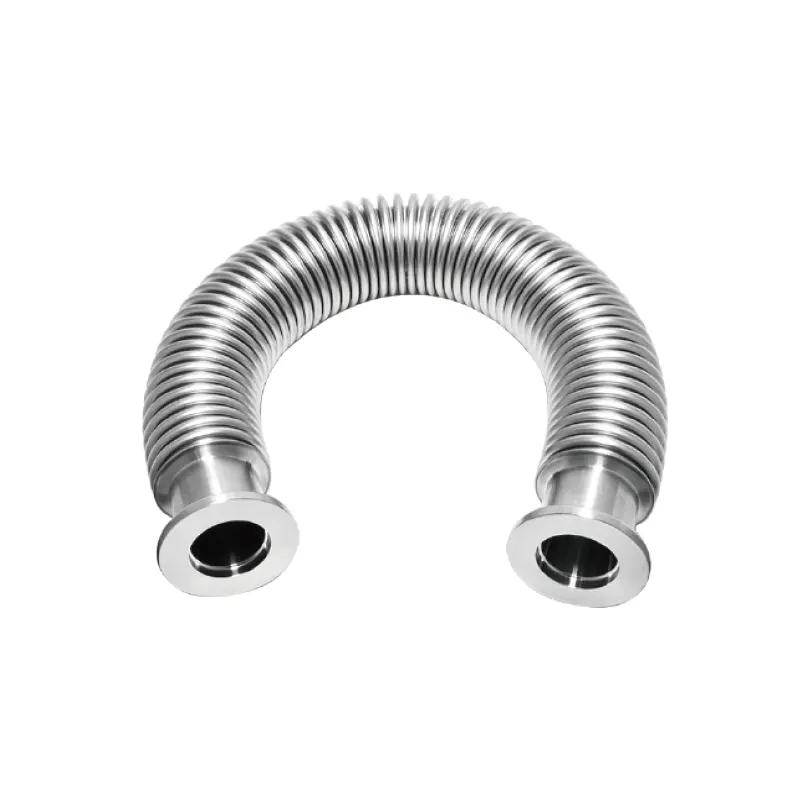
The selection logic for this component is unglamorous but specific. The flange size must match the existing KF connection, and the bellows must be rated for the pressure range it will actually see, including positive pressure if the line is ever backfilled. The bore must not throttle the pump's pumping speed at the working pressure. The material must be compatible with the gas being handled and with any solvent vapour that may pass through the line. The bellows is not a filter, not a trap, and not a substitute for a leak-free joint; it is a compliant connector, and it should be specified as one.
Configuration Decisions Worth Settling Before Order
Most recovery complaints trace back to a mismatch between how a cabinet was specified and how it is used. The two-station double-sided format amplifies several of these because it serves more operators, more material flow, and more simultaneous activity than a single-station cabinet. The table below collects the decisions that most directly affect atmosphere stability.
| Decision | Why it affects recovery | What to confirm |
|---|---|---|
| Number of glove ports per side | More ports mean more glove surface and more potential leak paths | Glove material and thickness for the solvents and pressures in use |
| Antechamber size and quantity | Oversized chambers waste purge gas; undersized ones encourage partial cycles | Largest routine load and the cycle count needed for it |
| Circulation and distribution | Poor distribution creates stagnant zones that read clean while the box is not | Sensor locations relative to the return path |
| Instrumentation | Resolution is not accuracy; range must match the working setpoint | Sensor type, calibration interval, and stated accuracy |
| Solvent management | Organic vapour loads the wrong part of the system if unaddressed | Whether a dedicated adsorption path is required |
| Vacuum connections | Vibration and misalignment produce slow, intermittent leaks | Flange standard, bore, and pressure rating of the line |
Two common specification errors are worth naming. The first is sizing the cabinet for peak headcount rather than steady throughput, which produces a large shared volume that is slow to mix and expensive to keep clean for the work actually being done. The second is treating the purification system as a standalone performance figure rather than as one element of a loop whose speed also depends on the box, the airlock, and the operator. A cabinet that meets its atmosphere specification on commissioning can still recover slowly in service if the transfer routine it was designed around is not the one used.
What to Send the Supplier
Because recovery behaviour depends on the application rather than on the cabinet alone, a useful enquiry describes the process, not just the box. Include the materials to be handled and their sensitivity, whether they are powders, porous bodies, or dense solids, the solvents involved, typical load size and transfer frequency, the target oxygen and moisture levels with the accuracy required, and the number of operators working simultaneously on each side. Add the available floor space, the room conditions at both faces, and any vacuum or gas supply constraints.
Then ask the questions that close the remaining gaps: how the atmosphere is distributed between the two stations and where the sensors sit in that path, how the antechamber cycle is specified and how many cycles a representative load requires, what the purification columns are rated to remove and how their condition is indicated, which consumables and seals need periodic replacement, and how the vacuum lines are connected. For a slow-recovery investigation on an installed cabinet, send the recovery curve itself along with the transfer log, the regeneration history, and the last leak test. The shape of that curve usually identifies the mechanism in a single glance, and it is far more informative than the reading alone.