
When the oxygen or moisture reading climbs after a sample transfer, the first instinct is often to suspect the purifier. In a two-station single-sided split-type glove box with a gas purification system, however, the reading is the end of a chain that includes the antechamber, the gloves, the enclosure, the circulation loop, the purification column, and the analyzer itself. A slow return to baseline can come from a large transfer load, a small leak, poor mixing at the sample point, a purifier that is online but not effective at that moment, or an analyzer that is responding more slowly than the atmosphere. Treating any one of those as the default explanation can lead to unnecessary service calls or to accepting a real ingress problem as normal.
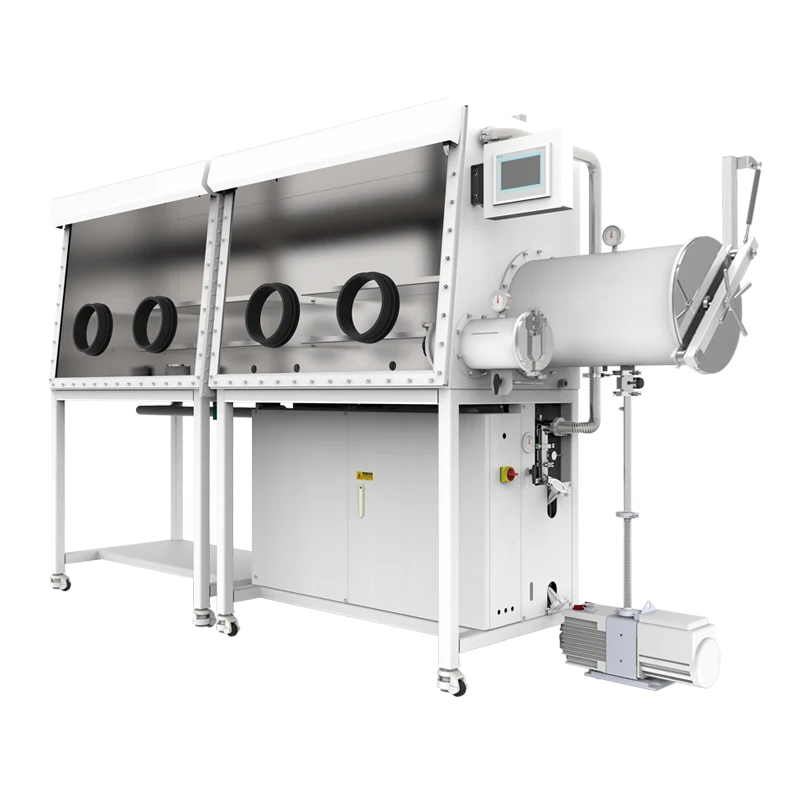
This guide is about diagnosis and configuration, not about declaring a specific unit faulty. The reference system is the Two-Station Single-Sided Split-Type Glove Box with Gas Purification System. The same reasoning applies to other purification boxes, but the exact recovery time, working levels, and acceptable drift must come from the manufacturer's documentation and the application's requirements. Where a specification is unavailable, identify the missing condition rather than borrowing a number from another box.
Recovery Is a System Behavior, Not a Single Reading
A purification glove box is a closed loop. Gas is circulated from the enclosure through purification hardware and back again, while analyzers sample the atmosphere and report oxygen and moisture levels. The purifier removes contaminants, but it does not instantaneously homogenize the entire enclosure. The reading at the analyzer reflects the gas at the sample point, the flow that carries gas there, and the rate at which surfaces and materials release or absorb water and oxygen. That is why a box can show a clean reading before a transfer, a sharp change during the transfer, and a gradual return afterward without any single component being defective.
The first useful distinction is between a baseline problem and a recovery problem. A baseline problem means the box cannot reach its normal working level even after a long settling period. A recovery problem means the box returns to its normal level, but more slowly than the workflow requires. The two call for different investigations. A baseline problem points toward a leak, a purifier that is offline or exhausted, an unsuitable material load, or an analyzer that needs calibration. A recovery problem points toward transfer volume, mixing, purifier capacity, flow path, or the way the transfer was performed.
Three questions hidden in one reading
Before changing hardware, separate the observation into three questions. The answers make the next check more targeted.
- What is the baseline? Record the stable reading at rest, with no transfer and no new material in the box. Without a baseline, there is no reliable reference for recovery.
- How large was the disturbance? Note the size and porosity of the item, the number of antechamber cycles, whether the antechamber was evacuated or only purged, and how long the door was open.
- How fast should this system recover? The acceptable recovery time depends on the enclosure volume, the purifier configuration, the load, and the process requirement. It is not a universal number, and a value from another box should not be treated as a specification for this one.
Without that context, a slow curve is only a symptom. With it, the curve becomes evidence. A recovery that is repeatable and proportional to the transfer load is different from a recovery that becomes slower week after week, or one that never reaches the previous baseline at all.
The Transfer Event: Where the Disturbance Begins
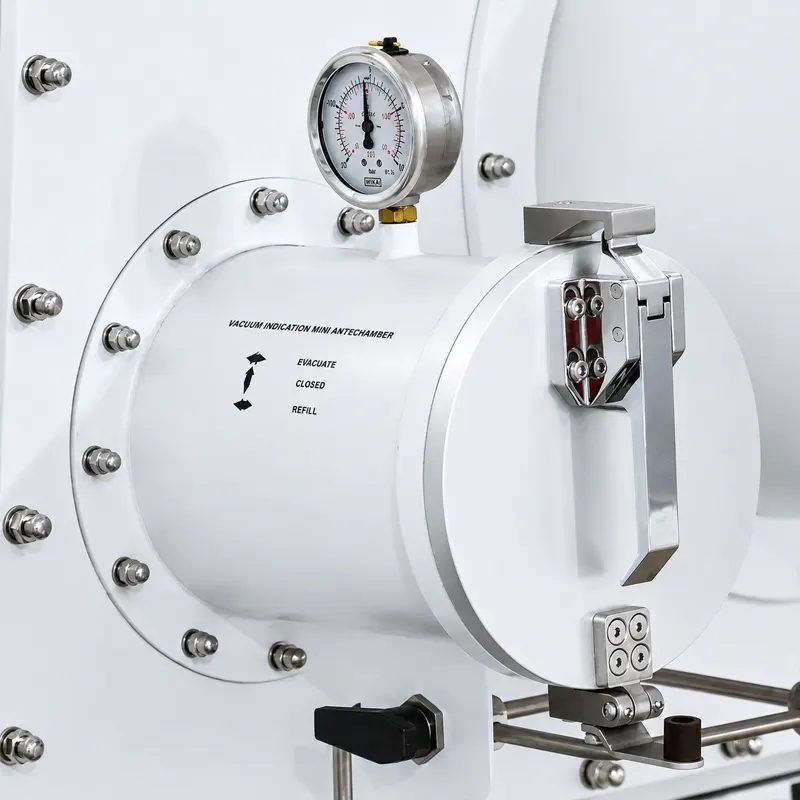
Every antechamber transfer introduces a small package of outside atmosphere and a larger package of surface contamination. Air is carried in the chamber volume, on the item, on the container, and on the gloves. The antechamber then has to remove that load before the inner door is opened. If the chamber is purged but not evacuated, dilution depends on the number of purge cycles and how the gas enters and leaves. If the chamber is evacuated, the vacuum level, hold time, and refill sequence matter. Neither approach removes material that is already outgassing from the sample, and neither can compensate for a door seal that does not close cleanly.
The sequence matters as much as the hardware. Opening the outer door, placing an item, closing the door, evacuating or purging, refilling, and opening the inner door creates several pressure changes. A rushed cycle can leave residual air in a corner or in a container. A porous sample can hold air in its internal structure and release it slowly inside the box. A solvent-wet item can add a continuous load that the water and oxygen purifier is not designed to remove. These are transfer and material issues, not proof that the purification loop has failed.
Why a smaller antechamber can help, but not automatically
The Small Glove Box Antechamber is a separate accessory for handling small items. A smaller chamber volume can reduce the amount of gas that must be purged or evacuated per transfer, and it can shorten the handling cycle for small parts. That does not make it a universal upgrade. Before treating a small antechamber as a solution, confirm the port and flange geometry, the door and seal arrangement, whether the chamber is intended for vacuum or purge operation, and whether the main box's transfer strategy supports that configuration. A chamber that is not compatible with the enclosure is not an improvement, however small its volume.
The item itself also deserves attention. A sealed vial presents a different load from an open dish of powder. A fibrous or porous material can trap air and moisture. A polymer component may continue to outgas after the transfer is complete. If the slow recovery follows one class of sample and not another, the sample is part of the explanation. The right response may be a longer antechamber cycle, a different container, or a pre-treatment step, but only after the material's compatibility with the box atmosphere has been checked.
Purifier Loop Dynamics: Clean Gas in One Place Is Not Clean Gas Everywhere
The purifier is not a passive filter sitting in a corner. It is part of a circulation loop, and its effect depends on flow, contact with the purification media, and the state of the media. A purifier that is running is not necessarily purifying at full effectiveness. It may be in regeneration, isolated by a valve, limited by a bypass, or due for service. It may be removing water and oxygen while a separate solvent load continues to circulate. The controller status, valve positions, and recent operating history are therefore more useful than the display alone.
Flow path is the second issue. In a two-station box, the two working positions belong to one controlled atmosphere, but the local environment can still differ. Gas may move more actively near one glove port than another. A sensor may sit in a relatively stagnant pocket, or downstream of a component that releases moisture. If the reading at one station lags the other, the cause may be mixing rather than a second leak. The question is not only whether the purifier works, but whether the gas being measured has actually passed through it and mixed with the rest of the enclosure.
Loads that the purifier cannot remove quickly
Water and oxygen are the primary targets of a purification loop, but they are not the only things released inside a glove box. Solvent vapor, organic outgassing, particles, and heat can all affect the process or the measurement. Some of these loads require a different control strategy, and some cannot be removed by the water and oxygen purifier at all.
- Surface moisture: Water adsorbed on gloves, containers, and interior surfaces can be released slowly, producing a long moisture tail after an otherwise clean transfer.
- Porous solids: Powders, foams, and fibrous materials can carry air into the box and release it over time, so the apparent recovery curve reflects the sample as much as the purifier.
- Solvent vapor: A solvent adsorber may be needed for solvent handling, but it does not replace water and oxygen purification. Each function addresses a different contaminant.
- Particles: A HEPA filter removes particles. It does not remove water, oxygen, or solvent vapor, and a particle filter should not be used as evidence that the atmosphere is clean.
- Heat: A warm item or a heated process can change outgassing and sensor response. Temperature control and atmosphere control are separate requirements.
The practical conclusion is that not every slow recovery is a purifier capacity problem. If the load is dominated by solvent or by a porous solid, a larger purifier may not address the actual source. The first step is to identify what is entering the box and which part of the system is responsible for it.
Leak Paths and Pressure Transients
Leaks are often discussed as if they were a single yes-or-no condition. In practice, leak rate, working pressure, antechamber vacuum, pump ultimate vacuum, and analyzer reading are different quantities. A box can hold a vacuum test acceptably and still show a slow oxygen rise in daily operation if a glove, seal, or feedthrough leaks only under a particular pressure or movement. A pump can reach a low ultimate pressure while the enclosure still has an ingress path. None of these measurements substitutes for the others, and a value quoted for one item should not be generalized to the whole system.
On a two-station single-sided box, the atmosphere boundary includes more than the main door. There are glove ports and gloves, window seals, antechamber doors, feedthroughs, valves, tubing joints, and possibly a split connection between the enclosure and the purification section. Each is a potential path. The fact that a path exists does not mean it is leaking, but it does mean that a leak check should be organized rather than random.
- Inspect glove cuffs and glove surfaces for cuts, hardening, swelling, or a poor fit at the port.
- Check door seals for trapped material, compression marks, and clean contact around the full perimeter.
- Review feedthroughs and KF connections for mechanical strain or a disturbed seal after maintenance.
- Confirm that valves are in the intended position and that a bypass has not been left open after service.
- Record the box pressure during transfer. A pressure transient can draw outside air inward or push gas out through a path that is otherwise marginal.
| Observation | Plausible contributors | Useful next check |
|---|---|---|
| Both oxygen and moisture rise after transfer, then fall steadily | Antechamber load, air carried on surfaces, normal mixing lag | Log transfer size, purge or vacuum steps, and the recovery curve before changing hardware |
| Both rise while the box is idle | Leak, outgassing, purifier offline or exhausted, analyzer issue | Check purifier status and recent regeneration; inspect seals and gloves; verify the analyzer |
| Oxygen rises while moisture stays near baseline | Possible leak, sensor cross-sensitivity, or different response speeds | Confirm sensor type and placement; do not assume one reading explains the other |
| Moisture rises after a solvent or porous material is introduced | Outgassing or solvent load; a dedicated adsorption function may be needed | Review material compatibility and whether solvent removal is part of the configuration |
| One station reads higher than the other | Local flow, sensor location, glove leak, or recent door use | Compare sample points and gas flow; verify the sensors before treating it as a second leak |
| Recovery becomes slower over weeks | Media exhaustion, seal aging, changed workload, calibration drift | Review service records and baseline data; schedule qualified maintenance |
| The low-level reading is erratic | Resolution, calibration, sampling, or electrical noise | Check calibration and sampling conditions; resolution is not accuracy |
A pressure transient during transfer deserves particular attention because it links the antechamber to the main enclosure. If the box is under a slight positive pressure relative to the room, ordinary small paths tend to leak outward. If a transfer or valve change creates a negative excursion, the direction can reverse. The correct operating pressure and the allowed excursion are configuration details, not universal rules, so they should be confirmed for the specific box and its pressure-control scheme.
Reading the Analyzers Correctly
An analyzer measures the gas at its sample point, not the average atmosphere of the whole box. Its reading is affected by where the sample is drawn, how fast the sample reaches the sensor, whether the line is purged, and whether the sensor is calibrated for the gas and range in use. A display may show a fine resolution without having comparable accuracy. A change of one small digit is not automatically a meaningful atmospheric change, and a stable display is not proof that the sensor is correct.
Response time also differs between oxygen and moisture measurement. Oxygen mixes relatively quickly in the gas phase, while water interacts with surfaces and can be released slowly. That is one reason a moisture reading may remain elevated after an oxygen reading has returned to baseline. The difference does not prove a leak. It may simply reflect the different physical behavior of the two contaminants and the materials inside the box.
Why the two stations may disagree
In a two-station enclosure, a single analyzer may not represent both working positions equally. The sample point may be closer to one station, downstream of the purifier return, or in a region with different flow. A glove movement can push gas from one area to another. A local release from a container can affect one side before it mixes. These are reasons to ask where the sample is taken and how the gas circulates, rather than assuming that one reading applies everywhere.
- Confirm the sample point and whether it is shared or switched between locations.
- Check whether the analyzer line is purged after maintenance or a filter change.
- Verify calibration and the intended measuring range before comparing historical readings.
- Look for a physical cause near the affected station, such as a glove, door, or recent material placement.
Configuring a Two-Station Split-Type Box for Faster Recovery
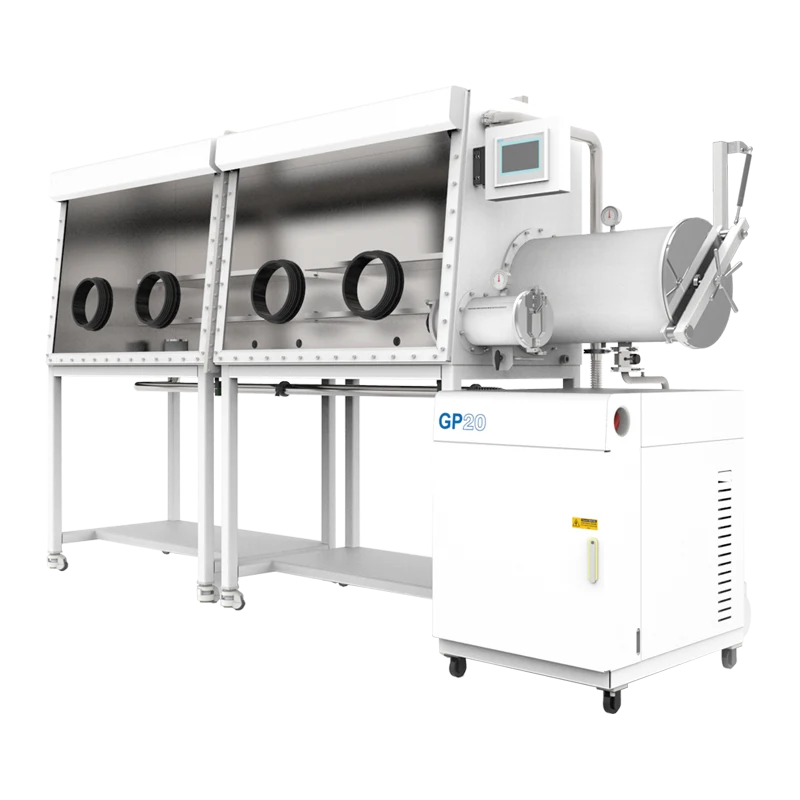
The two-station, single-sided, split-type format is a workflow decision before it is a maintenance decision. Two working positions allow two operators, or one operator moving between related tasks, to share one controlled atmosphere. Single-sided access keeps the glove ports on one face, which can simplify sight lines and room layout. A split-type arrangement places part of the purification or utility equipment outside the main working enclosure; that can improve service access and reduce clutter around the gloves, but it also means that tubing, wiring, and connections between sections must be routed and checked. Confirm the actual boundary between enclosure and utilities with the supplier rather than assuming a layout from the model name.
Recovery performance should be designed around the workflow, not around a single headline number. A box used for occasional small transfers has a different load profile from one used for continuous production, large fixtures, or solvent-bearing samples. The purifier, antechamber, glove type, and monitoring arrangement should be selected together. A larger purifier may help with a genuinely high water and oxygen load, but it will not fix an open solvent source, a leaking glove, or a sensor that is reading a stagnant pocket.
Match the purifier and antechamber to the workflow
The following configuration questions are more useful than a generic claim about fast recovery. Each answer should come from the actual product documentation and the intended process.
- Transfer size: What is the largest item that must pass through the antechamber, and how often? A small chamber can reduce cycle volume for small parts but may not accept fixtures or containers.
- Transfer method: Is the antechamber intended for purge, vacuum, or both? Confirm the door and seal design, the pump requirement, and the permitted cycle.
- Atmosphere target: What oxygen and moisture levels does the process actually need, and at what point in the workflow? The target should be stated with the measurement location and conditions.
- Material load: Which samples, solvents, and containers will be used? Check compatibility with gloves, seals, windows, and any solvent-removal function.
- Monitoring: Where are the analyzers sampled, what ranges are installed, how are they calibrated, and are readings logged for comparison over time?
For a two-station box, also think about how the stations will be used together. If one station is opened frequently while the other must remain stable, the layout and flow path matter. If both stations handle the same high-load material, the recovery demand is different from a box used mainly for sealed containers. These are application facts that belong in the selection discussion.
A Practical Verification Sequence and What to Tell the Supplier
A useful troubleshooting record starts with a controlled comparison, not with a repair. Begin with a stable baseline, perform one defined transfer, and record the readings at fixed intervals along with the conditions. The goal is to see whether the recovery pattern is repeatable and whether it changes with the load. If the pattern is not repeatable, the next check should focus on the variable that changed.
- Record the baseline oxygen and moisture readings at rest, together with the purifier status and the time since the last regeneration or service.
- Describe the item transferred: size, material, porosity, container, and whether it was sealed or open.
- Record the antechamber sequence, including purge or vacuum steps, door-open time, and the pressure before the inner door was opened.
- Log the readings immediately after transfer and at regular intervals until the values stabilize or the test is stopped.
- Repeat with a similar load to see whether the curve is consistent. Do not change several components between tests.
- If the box is idle, check whether the readings remain stable. A rise at rest points to a different set of causes from a rise only after transfer.
- Verify the analyzer sample point, calibration date, and range before comparing readings with earlier records.
The distinction between a transfer load and a leak is not always visible in a single graph. A load usually produces a rise that tracks the transfer and then decays; a leak may produce a continuous rise or a baseline that never fully returns. A sensor problem can mimic either pattern. That is why the record should include the purifier status, pressure, and analyzer information alongside the oxygen and moisture values.
When requesting support, provide the box model, the number of stations, the single-sided or double-sided configuration, the split layout, the antechamber type and volume, the pump arrangement, the gases used, the intended working levels, the materials handled, and the solvents or heat sources present. Also state what the readings do at rest, what they do after a transfer, and how the two stations compare. These details let the supplier distinguish a configuration question from a service question without guessing.
For the system discussed here, start with the two-station purification glove box specification and confirm the antechamber, purifier, and analyzer arrangement as a single working system. A slow recovery is best treated as information about the load, the loop, and the measurement, not as an automatic verdict on the purifier.
