
Most glove box conversations begin with oxygen and water. Those two readings are central because they are measurable, continuous, and tied directly to the gas purification loop. Solvent vapor is a different problem. It may never appear on an O2/H2O analyzer, yet it can accumulate in a closed atmosphere and affect samples, seals, windows, sensors, and the perceived performance of the box. An organic solvent vapor adsorption system is a targeted accessory for that load, not a replacement for the purification system.
Solvent vapor enters the box from samples, cleaning agents, coatings, electrolytes, printing inks, or spill residues. In a sealed enclosure with limited exchange, the vapor has few exit paths. It can be retained on surfaces, re-emitted later, carried into antechambers, or pushed toward other atmosphere-control components. The result is not necessarily a visible cloud. Often the first sign is an odor, a film, a change in sample behavior, or a maintenance interval that no longer matches experience.
TENCAN Glove Box Systems lists an organic solvent vapor adsorption system within its glove box accessory range. Its purpose is to reduce organic vapor concentration in a compatible circulation design. It does not generate inert gas, remove oxygen, or dry the atmosphere. Those functions remain with the gas purification system and the box's sealing and purge strategy. The useful question is therefore not whether the accessory makes the box clean in a general sense, but which solvent load it is meant to capture, where the gas passes, and how breakthrough is detected.
Why Solvent Vapor Load Is a Separate Atmosphere-Control Problem
Water and oxygen are reactive contaminants with well-established control methods. A purification loop circulates gas through media that remove them, and analyzers report the result. Organic solvent vapor is handled differently because the target is not a single molecule with a single sensor response. It may be a mixture of alcohols, ketones, esters, ethers, aliphatic or aromatic hydrocarbons, chlorinated compounds, or specialty formulation ingredients. Each has its own vapor pressure, polarity, affinity for surfaces, and response to adsorbent media.
A sealed glove box is not a fume hood. It has limited deliberate exchange with the outside atmosphere. Solvent vapor that enters the box has few places to go unless it is removed by an adsorption stage, lost through leaks, or taken up by surfaces and materials. That is why a small solvent volume can produce a persistent background. The vapor can also desorb slowly from gloves, seals, tubing, and sample vessels, making the source difficult to identify after the original container is closed.
Particle filtration does not solve this problem. A HEPA filter captures particles; it does not capture solvent molecules. Water and oxygen analyzers do not, by design, report organic vapor concentration. An O2/H2O purifier may remove its intended contaminants while the solvent load continues to circulate. These are separate functions, and treating one as a substitute for another leads to poor configuration decisions.
Solvent vapor can also influence the interpretation of other readings. Deposits on optical surfaces, cross-sensitivity in some sensors, or changes in surface chemistry can make the atmosphere appear to behave differently. That does not prove an analyzer is faulty or a purifier has failed. It means the solvent load should be investigated as its own variable before conclusions are drawn about the whole system.
What the Organic Solvent Vapor Adsorption System Does in the Loop
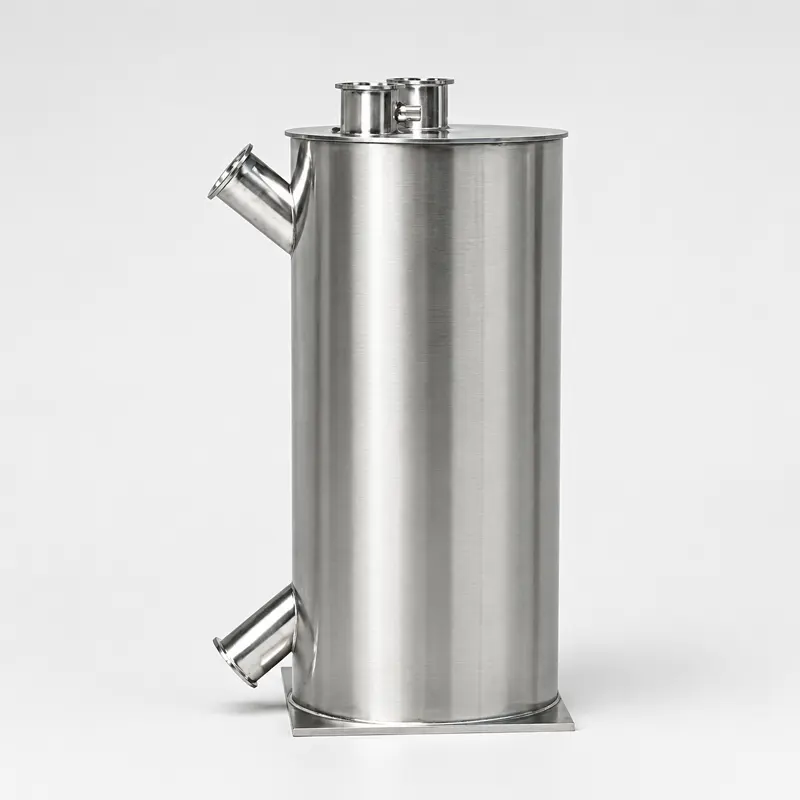
At a functional level, an adsorption system presents a bed or cartridge of media to the gas stream. Organic molecules contact the media and are retained on its surface or within its pore structure. The treated gas returns to the box or to the circulation path. The arrangement can vary by product and by box design: a dedicated adsorption branch, a serviceable module, or an exchangeable cartridge may be used. The exact flow path, media type, capacity, and control interface are configuration details that must be confirmed for the specific system.
The key word is capacity. Adsorption is not an unlimited chemical sink. Media has a finite number of active sites and a finite useful life. While the bed is fresh, outlet concentration may remain low even when inlet concentration is significant. As the bed loads, the mass-transfer zone moves through it. Eventually the outlet concentration rises, a condition usually described as breakthrough. After breakthrough, the accessory may still look installed and intact while providing little protection.
Media may be disposable or regenerable depending on the product design. A regenerable system requires a defined regeneration gas, temperature, and vent or purge path. Those conditions are not interchangeable with gas purifier regeneration. Heating an adsorption module without the correct procedure can release previously captured solvent into the box, damage the media, or create a safety problem. If the supplied configuration does not explicitly support regeneration, the safe assumption is that the media is replaced rather than regenerated.
What the Accessory Is Not
An organic solvent vapor adsorption system should not be described as any of the following:
- A water or oxygen purifier. It does not replace the purification column or the box's leak and purge strategy.
- A particulate filter. HEPA filtration and molecular adsorption address different contaminants.
- A measurement device. It reduces vapor load; it does not report concentration unless a separate analyzer is supplied and validated.
- A guarantee that every solvent is safe, compatible, or fully captured. Media selection and operating conditions determine performance.
- A substitute for spill control, inventory reduction, or safe solvent-handling practice.
Where It Fits in a System
Three gas streams should be distinguished before discussing integration. The working gas is the atmosphere inside the box. Control gas may be used for valves, purge, or actuation. Regeneration gas, if applicable, is a separate stream with its own quality and disposal requirements. Confusing these streams can lead to a design that looks correct on a diagram but cannot be operated safely.
The adsorption stage must also be matched to the circulation path. If only a fraction of the box atmosphere passes through the stage, the effective capture rate is lower than the nameplate flow suggests. If the stage creates too much pressure drop, circulation may fall, and mixing may become uneven. A large box with multiple workstations can have zones that exchange slowly with the main circulation loop. The accessory should be positioned where it sees the intended gas stream, not simply where there is free space.
Matching the Accessory to the Solvent and the Process
Solvent Family and Load
The first selection input is a solvent list, not a single generic description. Polar and nonpolar solvents behave differently on adsorbent media. Low-boiling solvents can break through quickly because they remain in the gas phase; higher-boiling solvents may condense on surfaces and desorb over time. Chlorinated or acidic species may require different materials or may be outside the intended scope of a standard organic vapor stage. Reactive monomers, amines, and formulation additives can also create deposits or odors that are not equivalent to a simple solvent.
Mixtures are harder than single solvents. Components compete for adsorption sites. A weakly retained component may appear at the outlet before the total solvent load seems exhausted. Water can also compete for sites on some media, so a high-humidity load or a water-miscible solvent may shorten useful life. The right question is not only what solvent is used, but how much, how often, and in what worst-case quantity.
Duty cycle matters. A small intermittent use profile may be served by a modest replaceable cartridge. A continuous coating or electrolyte-handling process may need a larger bed, a different changeout schedule, or source capture at the point of use. A single spill can dominate the design load. The accessory should be selected for the credible worst case, not only the routine average.
Flow, Residence Time, and Pressure Drop
Adsorption depends on contact. For a given media and bed geometry, performance is influenced by flow rate, residence time, temperature, and inlet concentration. A bed that is too small for the circulation flow may provide insufficient contact before the gas exits. A bed that is oversized for the available pressure may reduce total loop flow, which can be equally counterproductive. The supplier needs the intended flow range and allowable pressure drop, not just the box volume.
Pressure drop is a practical constraint that is often overlooked. Adding an accessory to an existing loop changes the hydraulic balance. If the circulation blower or purifier loop has little margin, the new stage may reduce flow through the entire system. A bypass may protect flow, but an open bypass also allows untreated gas to avoid the adsorbent. The design should state how flow is balanced and how the accessory is commissioned.
Regeneration and Changeout
If the system is regenerable, the procedure must be defined by the manufacturer. It should identify the regeneration gas, allowable temperature, cooling steps, vent path, and validation criteria. It should also state what happens to desorbed solvent. Returning it to the glove box defeats the purpose of the accessory. Venting it to a safe location requires an engineered path and an understanding of the solvent's hazards.
Disposable media avoids regeneration complexity but creates a different obligation: changeout discipline. The service interval should be based on solvent inventory, measured or estimated loading, and a conservative margin. A fixed calendar interval may be adequate for a stable process, but it is weak for a laboratory with changing experiments. Records of solvent use, spill events, and pressure-drop trends are more useful than a single replacement date.
Monitoring and Breakthrough
There is no universal way to infer remaining capacity from the box's O2/H2O display. Monitoring should be agreed at the component level. Depending on the supplied configuration, useful indicators may include elapsed service time, cumulative solvent use, weight change, pressure drop, a breakthrough indicator, or an organic vapor analyzer. If an analyzer is used, its measurement range, resolution, accuracy, calibration, and sample point matter. A reading at the box wall is not the same as a reading at the adsorber outlet.
Resolution is not accuracy, and a low displayed number is not proof that the bed is fresh. Cross-sensitivity to other vapors, sample-line losses, and calibration drift can all affect interpretation. The monitoring plan should define who reviews the data, what triggers a changeout, and how an alarm or maintenance action is verified.
Compatibility Boundaries: What the Accessory Does Not Solve
An adsorption accessory is not a chemical compliance system. It does not make a glove box suitable for unlimited solvent handling, and it does not remove every hazardous property from the atmosphere. Flammable solvent vapor can still form a flammable mixture if air enters the enclosure. Adsorption does not remove that risk. Large open containers, heated solvent baths, and spill events require their own assessment, and the accessory should not be used to justify practices that would otherwise be unacceptable.
Material compatibility extends beyond the adsorbent. Solvent vapor contacts gloves, seals, windows, tubing, and sensor surfaces. Some materials may swell, soften, craze, or retain odor. The glove box owner should confirm compatibility with the actual solvent list and operating temperature. A solvent that is acceptable in a small vial may behave differently when heated, sprayed, or used over a large area.
Water removal and oxygen removal remain separate requirements. A solvent adsorption stage may reduce organic vapor while water and oxygen continue to rise because of a leak, a wet sample, or a purifier issue. If the box cannot recover its O2/H2O readings, the first response should be to check seals, purge, antechamber practice, and purification status, not to assume the solvent accessory will correct the problem. Likewise, a solvent odor can persist after the O2/H2O readings look acceptable. The two observations belong to different diagnostic tracks.
Diagnosing Poor Solvent Control Without Assuming a Fault
When solvent control seems poor, the useful approach is to separate observation from diagnosis. A persistent odor, a film on the window, a shorter media life, or a pressure-drop change can have several explanations. The table below is a starting point for data collection, not a finding of equipment failure.
| Observation | Plausible contributors | Data to collect first |
|---|---|---|
| Persistent solvent odor | Saturated media, open bypass, increased solvent use, incompatible solvent, spill residue | Solvent log, changeout date, flow status, pressure drop, recent spill history |
| Fogging or film on windows | High vapor concentration, low circulation, cold surfaces, condensed solvent | Solvent inventory, circulation settings, cleaning history, window temperature |
| Short media service life | High inlet concentration, water competition, incorrect media, excessive duty cycle | Solvent family, humidity load, process schedule, inlet conditions |
| Rising pressure drop | Loaded or compacted media, incorrect installation, blocked inlet | Pressure readings, installation check, maintenance record |
| O2/H2O readings unchanged after a solvent event | Solvent is not the target of the purifier; analyzer is not solvent-specific; sample point differs | Analyzer type, sample location, purge and leak status, solvent event record |
If the odor appears only after a specific experiment, the solvent list and the quantity used are more informative than a general atmosphere reading. If it persists after the experiment is removed, surface desorption or a saturated bed becomes more plausible. If pressure drop rises at the same time, the bed or its inlet may be restricted. If O2/H2O also drifts, a leak or antechamber practice may be contributing. These are different problems and should not be collapsed into one.
Do not regenerate or bake a module solely because an odor is present. The media may not be regenerable, the procedure may be different from purifier regeneration, and heating can release solvent into the box. Follow the product documentation and the supplier's instructions. When the configuration is unclear, isolate the accessory from the box according to the approved procedure and ask for guidance.
Specifying the Accessory for a Multi-User or Multi-Station Box
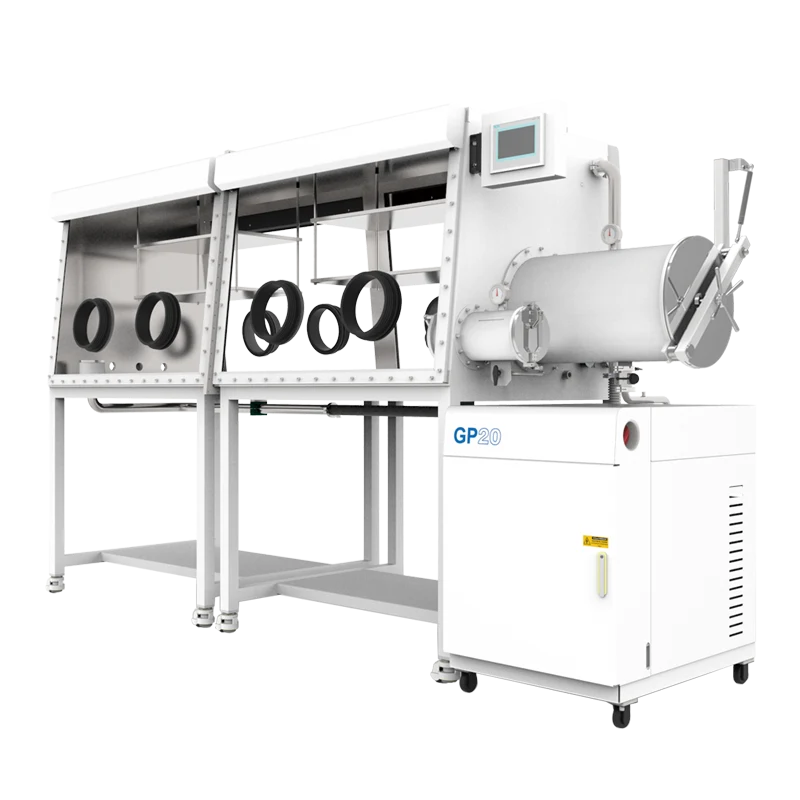
A larger enclosure introduces more than a larger volume. It can create several solvent-use points, different operator practices, and uneven mixing between workstations. The four-station double-sided split-type glove box with gas purification system is an example of a multi-station configuration in which atmosphere control and workflow are distributed across a shared enclosure. That does not establish compatibility with a particular adsorption accessory. It shows why the integration question must be answered against the actual box design.
For a multi-user box, the solvent inventory is likely to change without a single owner noticing. One group may use alcohols for cleaning, another may use esters or ketones, and a third may introduce a formulation with several components. A single generic changeout interval may not represent the combined load. The accessory specification should include a controlled solvent list, a process for approving new solvents, and a record of worst-case quantities. Without that discipline, the adsorption stage becomes an unmonitored component.
Space and service access also matter. A cartridge that is difficult to reach will be changed late. A module installed without isolation valves may be hard to service without disturbing the box atmosphere. A control interface that is not integrated with the box's alarms may be ignored. These are practical selection factors, not cosmetic ones.
A Practical Configuration Review Before Purchase
Before selecting an organic solvent vapor adsorption system, provide the supplier with the information needed to judge fit. A concise application package is more useful than a request for a generic accessory.
- List every solvent and formulation component likely to be used, including cleaning agents and incidental solvents.
- State the maximum volume per experiment, frequency, duration, and credible worst-case spill.
- Describe the glove box volume, number of workstations, circulation design, and available ports.
- Identify the existing gas purification system, analyzers, HEPA stage, antechamber, and pressure-control philosophy.
- Confirm the allowable pressure drop and the effect of the accessory on total loop flow.
- Ask whether the media is disposable or regenerable, and obtain the regeneration conditions if applicable.
- Define the monitoring method, changeout trigger, and record-keeping responsibility.
- Check material compatibility for gloves, seals, tubing, windows, and sensor surfaces.
- Plan for solvent waste, loaded media disposal, and any local regulatory requirements.
- Agree on commissioning and acceptance checks based on the actual installation, not only catalog data.
The accessory is most useful when it is treated as part of an atmosphere-management strategy rather than as a stand-alone purifier. It addresses organic vapor load while the gas purification system addresses water and oxygen, the enclosure addresses leakage, and operating practice addresses the amount of solvent that enters the box in the first place. A realistic specification connects those functions and defines how each one is verified.
If the application involves a large multi-station box, changing solvent inventories, or a solvent that may be incompatible with the available media, the safest next step is to confirm the configuration with the supplier before purchase. The organic solvent vapor adsorption system product page is the appropriate reference for the accessory, while the box documentation should be used to confirm integration, flow, and control. Clear inputs on solvent load, circulation, and maintenance access will do more for performance than a broad claim about removal.
