
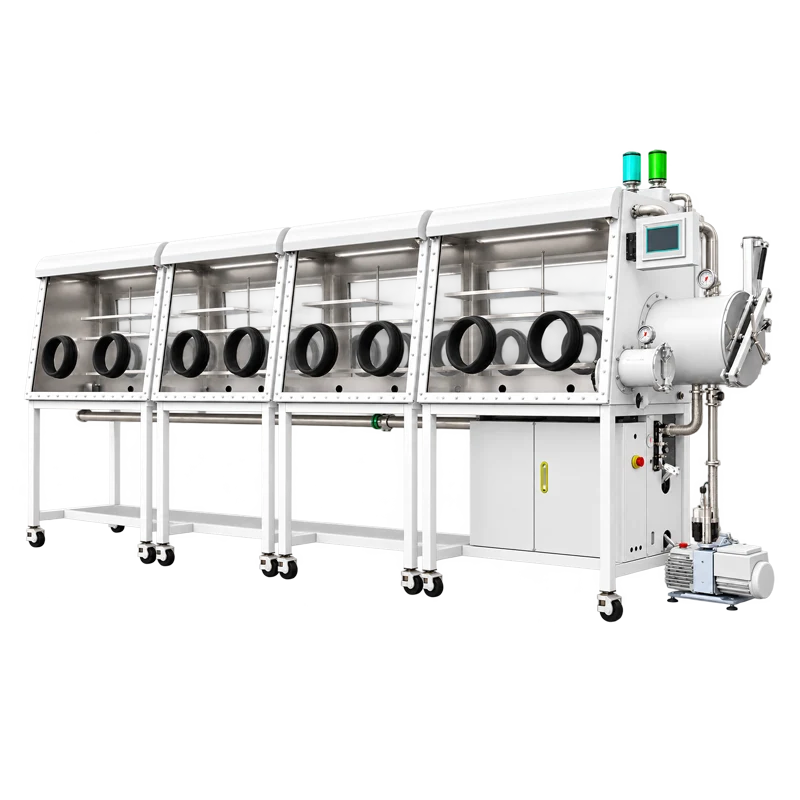
An eight-station glove box with a gas purification system is not simply a larger single-station enclosure. At that scale, atmosphere control becomes a system and workflow problem: more operators, more transfers, more gloves in motion, and more opportunities for moisture, oxygen, and solvent vapor to enter the recirculating gas. The supplied TENCAN product is described as an Eight-Station Double-Sided Split-Type Glove Box with Gas Purification System. That name identifies the layout and the presence of purification, but it does not by itself establish recovery time, achievable moisture and oxygen levels, leak performance, or the correct vacuum accessory. Those depend on the complete configuration and on how the box is used.
What the eight-station, double-sided, split layout changes
Station count is not cosmetic. Eight workstations typically mean more glove ports, more operator positions, and a larger working volume than a single- or two-station box. Each glove movement, antechamber door opening, and material transfer disturbs the internal atmosphere. When several people work at once, those disturbances overlap. The purification loop can be functioning correctly while the displayed moisture and oxygen readings still take time to return to their usual baseline.
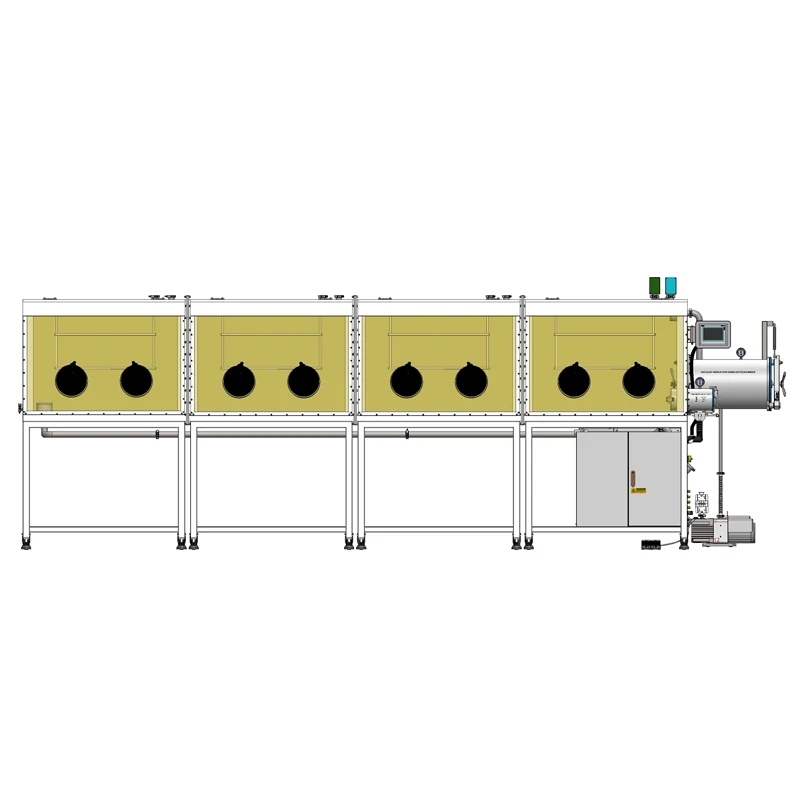
The double-sided arrangement adds a second access face. In a suitable layout it can support parallel work, a cleaner separation between sample preparation and inspection, or two teams working from opposite sides without walking around the enclosure. It does not automatically provide two independent atmospheres. Unless the design includes separate compartments or isolation, the gas volume is shared, so a disturbance on one side can be visible on the other. Port positions, antechamber locations, and partition details belong on the arrangement drawing, not in an assumption based on the product name. The benefit is logistical, not a guarantee of isolation.
Split-type is a configuration description, not a performance rating. It should be read from the arrangement drawing: confirm which parts are separated, how the enclosure and purification unit are connected, and where service access is provided. That boundary affects duct runs, sensor placement, and the number of sealed connections. A short, direct circulation path with few branches is easier to reason about than a long run with several bends. During selection, ask for the layout drawing, the direction of gas circulation, the location of the purification unit, and the position of every moisture and oxygen sensor. These are specification questions, not assumptions about performance.
For the product supplied here, the useful starting point is the actual configuration page rather than a generic assumption about an eight-station box. The eight-station double-sided split-type glove box with gas purification system should be evaluated as a complete atmosphere system: enclosure, transfer chambers, purification loop, controls, and monitoring. Missing from the name are the details that determine day-to-day performance, including purifier capacity, circulation arrangement, antechamber volume, and control philosophy. The page can confirm the category, but the engineering data still has to be supplied.
How a purification loop actually removes water and oxygen
A glove box with a gas purification system recirculates the internal atmosphere through purification columns and returns it to the enclosure. The columns remove water and oxygen from the gas stream; the circulation system is what brings contaminated gas to them. This is why purification is not the same as a one-time gas flush. A flush dilutes contaminants and a vacuum cycle removes some gas, but continuous purification depends on flow, contact, and the condition of the purification media. If circulation is poor, a clean purifier can coexist with a contaminated corner of the box.
The loop has capacity and kinetics, and they are different. Capacity is the total amount of water or oxygen the media can hold before regeneration or replacement. Kinetics is how quickly the loop can remove a given ingress at a given flow. A large enclosure with several workstations has more gas volume and more internal surfaces, and it may have longer circulation paths. The same purifier that serves a small box may perform differently when connected to a larger, busier system. Without the supplied performance data, the correct conclusion is not a number. It is a request for the purifier sizing basis, circulation data, and the conditions under which any claimed moisture or oxygen value applies. This is why the same purifier cannot be judged by the box name alone.
Regeneration is another distinction. During regeneration, the purification media is heated and flushed according to the manufacturer's procedure so that captured water is driven off and the media is prepared for service. Regeneration is not the same as normal purification, and it is not a substitute for finding a leak. The sequence, interlocks, gas supply, and cooling requirements must come from the specific manual. If the box is heavily used, the operating schedule should account for regeneration rather than treating it as an invisible background event.
Particle filtration is separate again. A HEPA filter traps particles; it does not remove water vapor or oxygen. Solvent adsorption is also a separate function: it can reduce organic vapor loading, but it does not replace water and oxygen purification. An analyzer measures the atmosphere; it does not purify it. These distinctions matter in an eight-station laboratory because one missed distinction can lead to the wrong accessory being purchased or the wrong alarm being trusted. And a leak can overwhelm all of them.
Why readings recover slowly after a transfer
A slow return to baseline after a transfer is a symptom, not a diagnosis. In a multi-station box, the most common explanation is that a larger or repeated load entered the atmosphere. The second is that the load was distributed unevenly, or that several operations overlapped. The checks below help separate normal recovery from a problem that deserves maintenance attention.
The transfer load itself
Material surface area matters. A dense metal part presents little adsorbed moisture; a porous powder, a fibrous sample, a solvent-wet substrate, or a tray of many small parts can release moisture and oxygen for much longer. The antechamber cycle matters because every opening exchanges gas. So does door discipline: opening the inner door before the antechamber has completed its cycle, or leaving a port open while gloves are changed, creates an avoidable load. With eight stations, a single poorly timed transfer can overlap with several other operations.
Circulation and purifier condition
If the recovery pattern is slower than it used to be, consider circulation and purifier condition before assuming a sensor fault. Check that valves are in their normal operating positions, that the circulation path is not restricted, and that the purifier is not in regeneration or near the end of its service interval. Also consider the distribution of gas inside the box. An eight-station enclosure may have work areas far from the return path, so a localized reading can differ from the bulk atmosphere.
Leakage, pressure, and transfer-chamber practice
Leak rate, enclosure working pressure, antechamber vacuum, and pump ultimate pressure are different quantities. A pump that reaches a low pressure on an empty, dry chamber does not prove that the glove box is leak-tight. A stable box pressure can be maintained while a small leak continues to admit moisture. Gloves, glove-port seals, feedthroughs, door seals, and tubing connections are all candidates for inspection. The point is not to declare a fault; it is to collect evidence in the right order.
Monitoring and interpretation
A moisture or oxygen sensor reports at its location. Its resolution is not the same as its accuracy, and a calibrated analyzer is not necessarily sampling the most critical part of the box. Ask where the sample is drawn, how the sample line is purged, when calibration was last performed, and whether the reading is comparable to the baseline method used previously. A single spot reading after a transfer cannot describe the whole enclosure. Compare the sensor reading with an independent check only when the procedure is safe and approved.
| Observation | Possible contributors | Useful evidence |
|---|---|---|
| Reading rises during transfer and later returns | Normal ingress, open door, high-surface-area load | Event log, door timing, load description |
| One side recovers more slowly | Shared volume, uneven circulation, local load | Sensor map, circulation layout, valve positions |
| Recovery becomes progressively slower | Purifier loading, regeneration state, leak, sensor drift | Service hours, regeneration record, leak check, calibration |
| Oxygen and moisture trends differ | Different sources, sensor response, solvent use | Material history, cleaning records, calibration records |
| Box pressure is unstable | Leak, pressure control, valve issue | Pressure trend, leak check, control settings |
| Antechamber vacuum is poor | Pump match, seal condition, cycle, condensables | Pump model, chamber volume, seal inspection, cycle log |
| A new material causes a persistent rise | Outgassing, solvent, powder, surface area | Sample preparation, material history, transfer practice |
| Alarm appears without a reading change | Sample line, sensor, control logic | Analyzer status, calibration, alarm log |
These are starting points, not a fault tree with a guaranteed answer. The useful next step is to compare the event with a baseline taken under known conditions. If a slow recovery follows every transfer regardless of load, or continues when the box is idle, the investigation should move toward leakage, circulation, purifier condition, and instrument verification. In that case, the question changes from how the operator should behave to what the system data can prove.
Where transfer hardware, vacuum pumps, and accessories fit
Transfers are the main routine disturbance in a multi-station box, so transfer hardware deserves the same attention as the purifier. An antechamber is a buffer volume: it lets material enter without exposing the main enclosure directly to room air. Its usefulness depends on volume, door sequencing, pump connection, and the way operators use it. A large antechamber can accept bulky items but may take more effort to condition; a small one may require more frequent cycles. Neither is inherently better without a defined workflow.
A vacuum pump and a gas purifier solve different problems. The pump removes gas from a chamber; the purifier removes water and oxygen from gas that is circulated through it. Replacing one with the other, or expecting a pump to compensate for a saturated purifier, leads to confusing results. The same applies to analyzers, solvent traps, and HEPA filters: each has a defined role in the system and a defined set of limits. The practical question is which component is limiting the recovery you observe.
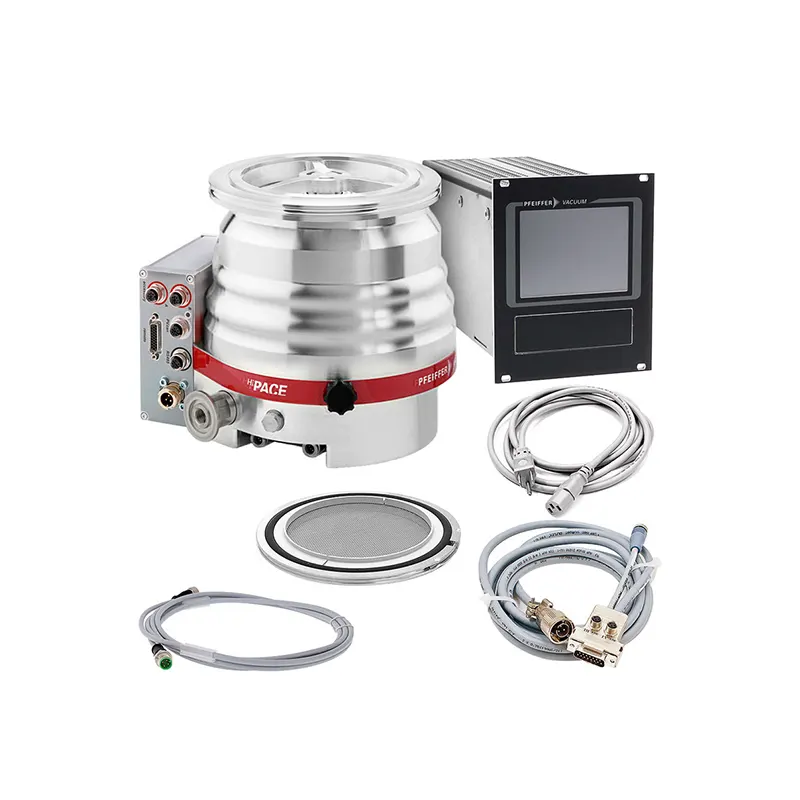
The supplied accessory is a Glove Box Turbomolecular Vacuum Pump. It should be considered for a defined vacuum duty, not as a universal upgrade. Compatibility depends on the chamber being evacuated, the required pressure, the gas load, condensable vapors, the backing arrangement, and the control interface. The pump is not a substitute for the purification loop, and it should not be assumed to connect to every antechamber or process chamber without checking the flange, sealing, and operating sequence. Those details must be confirmed against the actual equipment.
Pump selection starts with the duty. Define the chamber volume, the starting pressure, the target pressure, the allowable pump-down time, and the nature of the load. Then check whether the pump is suitable for the gas and vapor present, how it is isolated after use, and what happens if power or cooling is interrupted. For an eight-station box, the transfer schedule may matter as much as the pump itself: several operators pulling vacuum at once can create a utility and control problem even when each individual transfer is acceptable. Document the pump's intended duty before purchase.
Workflow design for two-sided, eight-station operation
An eight-station box rewards planning. Assign work zones by contamination risk rather than by convenience. Sample preparation that produces dust, solvent vapor, or frequent transfers should not share the same traffic pattern as final inspection or a long-duration sensitive experiment. In a double-sided layout, one side can be reserved for incoming material and the other for cleaner operations, but only if the actual partitions and airflow support that separation. The drawing should show which ports and antechambers serve which zone. Traffic is part of the atmosphere budget.
Scheduling is a form of atmosphere control. If several users open the box at the same time, the purification loop sees a combined load. Staggering major transfers, limiting the number of open ports, and reserving high-load work for periods when the box is not needed for sensitive work can reduce the depth of each disturbance. This does not replace adequate purification capacity, but it prevents a well-sized system from being judged on its busiest five minutes.
Solvents and powders need explicit rules. A solvent trap can reduce organic vapor loading, but it does not remove water and oxygen. A HEPA filter can capture particles, but it does not protect the purifier from a solvent stream. The correct combination depends on the material and the process, and the manufacturer's compatibility guidance should be followed. For powders, transfer practice, surface area, and cleaning frequency can matter more than the nominal enclosure volume.
Training and records turn a multi-user box into a controlled system. Operators should know which antechamber to use, how long a cycle must run, when the inner door may be opened, and what to do when an alarm appears. A simple log of transfers, maintenance, regeneration, and calibration gives the next investigator a sequence of events instead of a single alarming number. Eight stations are an advantage only when the people using them follow a shared operating discipline. The log does not need to be elaborate; consistency matters more than detail.
Configuration checks before specification or troubleshooting
The product name is a starting point; the specification should answer the questions that determine whether the system fits the work. Before comparing suppliers, or before diagnosing a slow recovery, collect the following information.
- Arrangement drawing with enclosure dimensions, port positions, and side-to-side access.
- Station allocation: how many operators are expected to work at once, and on what tasks.
- Antechamber count, volume, door sequence, and whether each chamber has its own vacuum connection.
- Purifier type, purification media, capacity basis, and expected service or regeneration interval.
- Circulation path, flow control, and any isolation valves that can alter distribution.
- Regeneration procedure, utilities, interlocks, and the conditions under which purification is unavailable.
- Moisture and oxygen sensor type, range, calibration method, sample points, and data logging.
- Pressure-control method and the difference between working pressure, antechamber vacuum, and pump ultimate pressure.
- Leak-test procedure and the acceptance criteria used for the assembled system.
- Vacuum pump compatibility, including flange, sealing, gas and vapor tolerance, and backing arrangement.
- Solvent adsorption and particle filtration provisions, with a clear statement of what each does not remove.
- Control system alarms, user access, event logs, and the information needed for remote support.
A supplier should be able to explain how the purification loop is sized for the enclosure and transfer load, not only state the number of stations. If a claimed moisture or oxygen value is offered, ask whether it is a typical value, a best-case value after prolonged circulation, or a continuous guarantee. Ask what load and what sensor location the value refers to. Those questions are more useful than a single headline number. For troubleshooting, the same list becomes an evidence checklist.
A practical atmosphere-control plan
Start with a baseline. Record moisture, oxygen, pressure, and circulation status when the box is idle and settled, then record again after a defined transfer. Use the same sensor path and the same waiting period each time. A baseline that is not documented is difficult to defend when performance appears to change.
Log the events that disturb the atmosphere: door openings, antechamber cycles, new materials, solvent use, glove changes, purifier regeneration, and maintenance. When a reading changes, compare the trend with those events before replacing parts. In a shared laboratory, the event log often explains more than a spot check. It also shows whether the issue is confined to one workstation, one material, or one shift.
Finally, treat configuration changes as experiments. A new pump, a different transfer routine, or a revised purifier schedule can change the recovery pattern. Record what changed, allow the system to stabilize, and compare like with like. The aim is not to chase a perfect display value. It is to know which operating conditions the box can tolerate, which signs indicate a real maintenance need, and which details must be confirmed with the supplier before the next upgrade.
