
A four-station glove box can show a stable oxygen and moisture reading before a transfer, then take far longer than expected to return after the antechamber has been used. The purifier is the first component people suspect, yet it is only one part of a chain that includes the antechamber, the enclosure volume, the gloves and seals, the circulation path, the analyzer, and the material being introduced. In a single-sided split-type enclosure with four working positions, that chain has more joints, more glove ports, and more operator activity concentrated on one face. Recovery is therefore a system behavior, not a single instrument response.
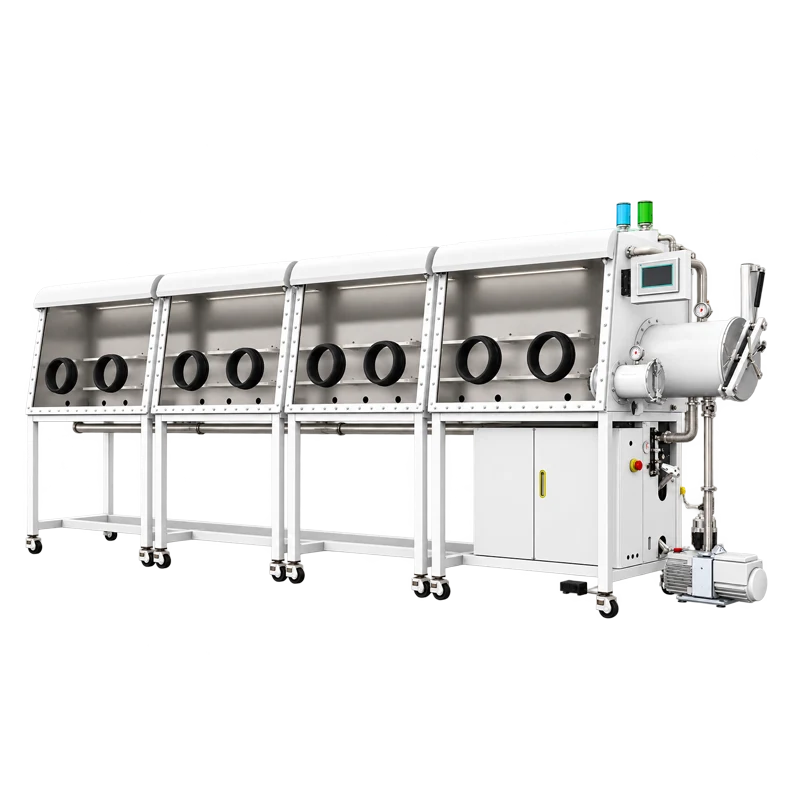
This article addresses one practical question: why the atmosphere can take so long to recover after sample transfer, and what to check before assuming the purification system is at fault. TENCAN's four-station single-sided split-type glove box with gas purification system is the reference configuration. Because published product details may not cover every installation, the discussion separates principles from values that must be confirmed against the current drawing and operating manual.
Start With the Transfer Event, Not the Reading
“Recovery” describes two different processes. The first is physical: water and oxygen that entered with the sample, the container, the tools, or the operator's gloves must be removed from the gas phase and from surfaces. The second is representational: the analyzer must see a gas sample that reflects the enclosure atmosphere, and its reading must respond to the change. A slow return can come from either process. Treating the reading as a direct, instantaneous measurement of the whole chamber is the most common source of misdiagnosis.
A transfer introduces contaminants in several forms. The antechamber air contains oxygen and moisture. Containers and tools carry adsorbed water on their surfaces. Gloves can transfer moisture and can permit slow permeation depending on their material and condition. Some samples outgas solvents or water after they are inside. The mass of water adsorbed on a stainless steel surface or on a glove is small in absolute terms but can be large relative to the amount that a purification loop is designed to remove during a short interval. That is why the first minutes after transfer are often dominated by surface exchange rather than by the bulk gas volume alone.
The transfer procedure matters as much as the hardware. The inner and outer antechamber doors should not be open at the same time. The chamber should be allowed to complete its evacuation or purge sequence before the inner door is opened. The sample should be transferred with deliberate, limited movement; a long open-door period with several people reaching in and out adds moisture and particulates and disturbs the internal flow pattern. None of these observations replace the manufacturer's operating procedure. They explain why two sites with the same enclosure can report different recovery behavior while using what looks like the same purifier.
What the Four-Station Single-Sided Split Layout Changes
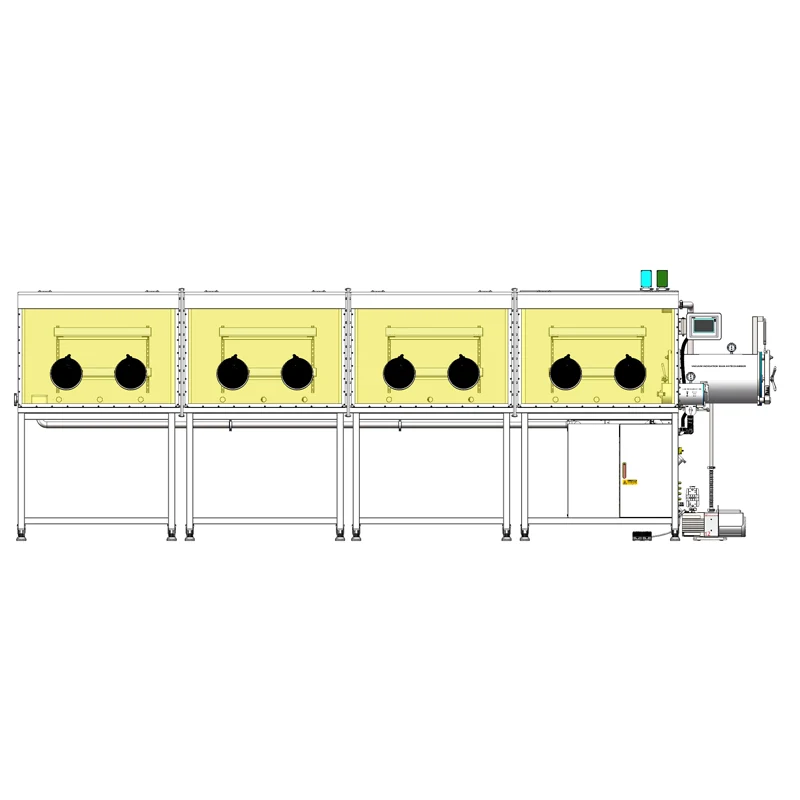
The name describes a four-station enclosure operated from one side, built in a split-type arrangement and served by a gas purification system. Those terms describe architecture and access, not a guaranteed atmosphere class. The product drawing should confirm dimensions, port spacing, antechamber volume, purification capacity, and control philosophy.
Shared atmosphere, distributed risk
Four working positions on one face means four glove ports, four glove assemblies, and a concentrated zone of operator movement. Each port must seal against the glove and the enclosure. Each glove is a flexible polymer component that can be abraded, punctured, or degraded by the materials it contacts. When several operators work at adjacent stations, local pressure and flow can change, and one open port or a glove temporarily removed from its ring can affect the atmosphere seen by neighboring stations. A single-sided layout is efficient for supervision and for services routed along the back or top, but contamination events are not physically separated into independent rooms. The stations share one atmosphere, whether or not they share one purification loop.
Where a split construction affects recovery
A split-type enclosure is assembled from sections rather than formed as one uninterrupted shell. The reason may be transport, installation access, cleanroom entry, or process integration. Every split introduces a joint or connection that must be designed, sealed, and maintained. The relevant questions are not whether “split” is good or bad. They are: where are the split lines, what seals them, are those seals accessible for inspection, does the internal circulation cross the joints, and are the joints included in leak testing? A mechanically sound joint can still create a local dead zone if the circulation design does not sweep it.
The split arrangement also affects service. If the purification system and enclosure are separate modules, interconnecting lines, valves, and electrical interfaces become part of the controlled boundary. They should appear on the piping and instrumentation diagram, not be treated as installation details. After a move or service visit, these connections deserve the same attention as the glove ports.
Follow the Atmosphere Path Before Blaming the Purifier
A purification system performs several distinct functions: it circulates gas through the enclosure, it removes water and oxygen in purification columns, it monitors the atmosphere, and it manages regeneration of the purification material. These functions are related but not interchangeable. Vacuum removes gas from a volume; purging dilutes contaminants with fresh inert gas; circulation distributes gas and brings it to the purification material; purification removes contaminants; regeneration restores the purification material. A system can circulate effectively while its columns are saturated, or purify effectively while a poorly placed analyzer reports a misleading value.
Vacuum and purge are removal steps, not purification
An antechamber cycle reduces the amount of air carried into the enclosure. Evacuation removes a fraction of the original gas volume, and a purge with inert gas dilutes what remains. Repeating the cycle improves the result, but effectiveness depends on antechamber volume, vacuum level, purge gas volume, number of cycles, and how the chamber is loaded. A container with a large internal volume or a porous surface can hold air and moisture that the cycle never reaches. This is why an apparently correct cycle can still be followed by slow recovery: the contamination was never in the antechamber gas phase when the inner door opened.
Purging the main enclosure can temporarily improve a reading, but it is not a substitute for leak control or purification. It dilutes contaminants and raises gas consumption. If a leak or outgassing source remains, the reading will drift back once the purge stops. Purging also changes the thermal and pressure environment, which can affect samples and analyzer response. Use purge as a deliberate procedure, not as a way to hide a persistent ingress path.
Circulation determines how quickly the purifier sees the contamination
The purification column can only remove contaminants that reach it. In a four-station enclosure, the internal volume is not perfectly mixed. Gas leaving the antechamber may travel along the ceiling, down one wall, or across the working area before entering the return path. Baffles, shelves, equipment, and the operator's arms change the flow. If the return is at one end and the transfer occurs at the other, the analyzer may respond before the purifier has processed the contaminated parcel, or the reverse may occur depending on sensor location. A slow recovery can therefore indicate a flow distribution problem rather than a saturated column.
Circulation flow should be high enough to mix the enclosure within a reasonable period, but not so high that it creates noise, heat, or excessive disturbance at the working surface. The balance is installation-specific. The general arrangement should show supply and return locations, the expected flow path, and the analyzer sample point. Without that information, a user can observe slow recovery but not why.
Why the analyzer can look slow
An oxygen or moisture analyzer measures the gas at its sample point. Its response depends on the sample line, filter, flow rate, sensor technology, calibration, and the time needed for the sensor to equilibrate. A sensor in a stagnant corner or behind a restrictive filter can lag the working zone. A reading that falls slowly may be accurate locally while missing a faster change elsewhere. Conversely, a fast sensor can show a sharp drop during purge and then a rise as enclosure gas mixes back into the sample stream.
Do not infer accuracy from resolution. A display reading to two decimal places is not necessarily accurate to that degree, and a stable number does not prove the whole enclosure is uniform. Calibration, sensor replacement, and sample-line maintenance belong in the routine schedule. If a reading conflicts with a known transfer, verify the sample location and analyzer response first.
Sealing Is a Distributed Function
In a four-station box, sealing is not one gasket. It is a set of interfaces: glove to port, port to panel, panel to frame, door to antechamber, joint to joint, feedthrough to wall, and valve to line. Each interface has its own material, compression, and inspection requirement. A leak at any one of them can produce the same symptom—slow recovery after transfer—while leaving the purifier fully functional.
Gloves and port seals
Gloves are the most frequently disturbed seals in normal operation, and they are also among the most variable. Material, thickness, length, cuff design, and chemical compatibility determine how well a glove resists permeation and mechanical damage. A glove appropriate for one solvent may be poor for another. A pinhole too small to see can admit enough moisture to keep the analyzer from settling. Inspect gloves before use and replace them according to condition and manufacturer guidance, not only on a calendar interval.
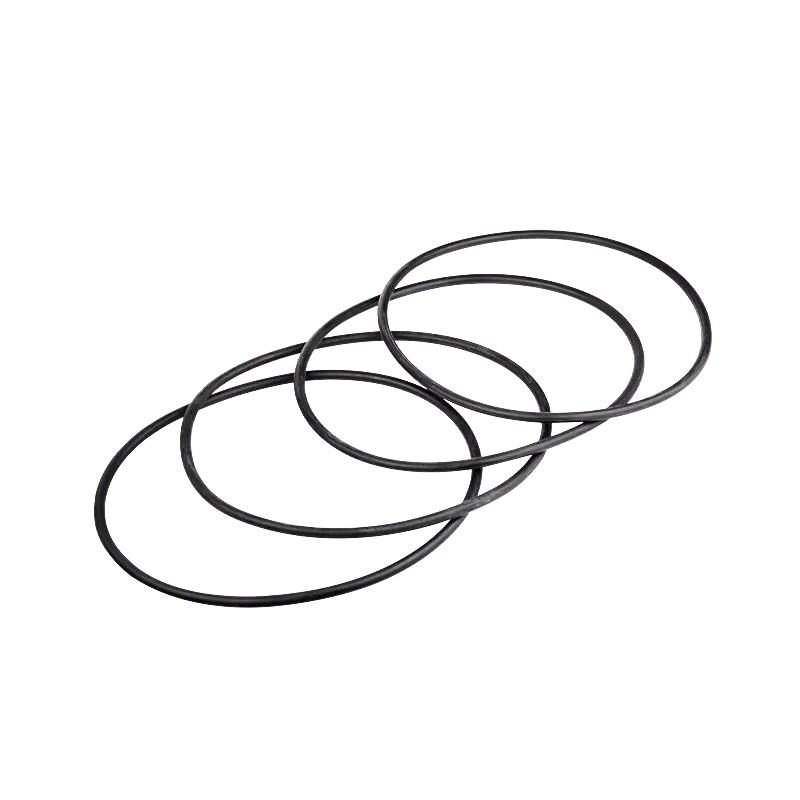
The glove port sealing ring is a small component with a disproportionate role. It retains the glove at the port and must match the port geometry, glove cuff, and sealing method. If the ring is distorted, contaminated, or mismatched, the glove can appear correctly installed while the interface remains a leak path. TENCAN's current accessory listing identifies a glove port sealing ring; compatibility with a specific port and glove should be confirmed from the accessory details and enclosure configuration, not assumed from the name. When replacing a glove, inspect the ring and port surface in the same procedure.
Antechamber doors, joints, and feedthroughs
The antechamber is the most exercised door on the system. Its seals compress and release with every transfer, and its inner door is exposed to the enclosure atmosphere. A worn door seal may not produce an obvious pressure failure; it may simply allow a small, continuous exchange. Split joints and feedthroughs behave similarly. A feedthrough must seal around the conductor, not only at the flange. A vacuum or gas line passing through the wall adds another boundary.
Seal inspection should follow the system's actual construction. The supplier should identify which seals are user-serviceable, which require controlled compression, and which should be replaced after a defined number of cycles or a specific event. A leak detector, pressure-decay test, or tracer-gas method depends on the enclosure design and must follow the manufacturer's procedure. A pressure reading alone does not prove a seal is leak-free for water and oxygen, because the relevant leak rate may be much smaller than the rate that produces an obvious pressure change.
Read the Right Evidence: Pressure, Leak Rate, O2, and H2O Are Different Numbers
Diagnosis improves when each measurement is kept in its own category. The following table is a guide to what common readings can and cannot tell you. It does not replace calibration records or the manufacturer's acceptance criteria.
| Reading or observation | What it mainly indicates | What it does not establish |
|---|---|---|
| Enclosure working pressure | Whether the box is being held near its intended pressure condition and whether the pressure control is responding | The oxygen or moisture concentration, or the size of a small leak |
| Antechamber vacuum | How completely the antechamber gas was removed during that cycle | The purity of the main enclosure or the condition of the purification columns |
| Pump ultimate vacuum | The pump's capability under a defined test condition | The leak rate of the enclosure, or the atmosphere recovery time |
| Leak rate | The rate of unintended gas exchange under the test conditions | The concentration at the working position, or the effect of outgassing samples |
| Oxygen analyzer reading | The oxygen level at the sample point at that time | The moisture level, the whole-chamber average, or the source of contamination |
| Moisture analyzer reading | The water concentration at the sample point at that time | The oxygen level, the condition of the oxygen removal material, or the leak location |
| Purification column status | Whether the columns are within their usable service condition according to the control system | Whether circulation is reaching every part of the enclosure |
The most important distinction is between a measurement and a guarantee. A displayed value is a point measurement under current conditions. A specification may describe a capability under defined test conditions. Neither should be stretched into a promise that every transfer, every sample, and every working position will immediately return to the same value. When a data sheet or page contains a number whose unit, object, or test condition is unclear, treat it as unconfirmed rather than filling the gap by assumption.
A Practical Recovery Check After Sample Transfer
When recovery is slower than expected, a structured check is more useful than adjusting the purifier first. The order below moves from the event itself toward the less accessible parts of the system.
- Record the event. Note the time, antechamber cycle, items transferred, materials involved, door-open duration, and active stations.
- Confirm the analyzer is representative. Check the sample point, filter, sample line, flow, and calibration. Compare with a second point only if the system provides one.
- Review the antechamber procedure. Verify evacuation and purge cycles, vacuum level, purge volume, and whether the inner door opened too early. Check for containers that trap air or moisture.
- Inspect the disturbed interfaces. Look at gloves, port rings, antechamber door seals, feedthroughs, and nearby joints. A glove can be snagged or contaminated during transfer.
- Check circulation and flow. Confirm the blower or valve state, that the return path is not blocked, and that the analyzer is not in a dead zone. Compare recovery with the working area empty.
- Evaluate purification status. Follow the control system and manufacturer's procedure for column service or regeneration. Establish that the columns are limiting before changing material.
- Look for persistent ingress or outgassing. If the reading never settles or drifts upward with the antechamber idle, examine door seals, split joints, feedthroughs, and recently introduced materials.
This sequence does not diagnose a specific failure from a distance. It prevents a common error: treating a slow reading as proof of a faulty purifier when the actual cause is a wet container, a worn glove, or a sample line that no longer responds correctly.
Configuration Questions Before Purchase or Retrofit
The four-station single-sided split-type configuration is a good starting point for a shared working atmosphere, but the details determine whether it fits a particular laboratory. The following questions should be answered with the current product documentation and a description of the intended work. They are also the questions that make a supplier's proposal comparable.
- Station use: How many people will work at once, and will all four stations be active during transfer? What tools or fixtures will occupy the working area?
- Antechamber duty: What containers will be transferred, how often, and what is the largest surface area or trapped volume? Is a second transfer path needed?
- Split construction: Where are the split lines, how are they sealed, and are they included in routine leak checks? Can the joints be inspected without dismantling the enclosure?
- Purification architecture: Is there one purification loop or more than one? What is the circulation path, and where are the supply, return, and analyzer sample points?
- Monitoring: Which variables are displayed, where are the sensors, how are they calibrated, and what is the sample-system response time?
- Sealing and accessories: Which glove material and port ring are specified? Which seals are user-replaceable, and what inspection method is recommended?
- Service and regeneration: What indications show that purification material needs service, what procedure is permitted, and what utilities are required?
- Material compatibility: Are samples, solvents, and cleaning agents compatible with gloves, seals, and internal surfaces? Has outgassing been considered?
The product page for the four-station single-sided split-type glove box with gas purification system is the correct starting point for the current configuration and available views. Use it to establish what is actually offered, then ask for the general arrangement, piping diagram, utility requirements, and operating procedure for the exact unit. Those documents answer questions that a model name cannot.
A final check is to define what “recovered” means for the application. Is it a return to the pre-transfer reading at the analyzer, a return at a specific working position, or simply a reading low enough for the next sample? These are different criteria. Recording the criterion, transfer conditions, and recovery time turns a vague complaint into useful evidence. It also shows whether the enclosure, its split construction, its sealing, and its purification system are working together as intended—or whether one part of the chain needs attention.
