
Air-sensitive powders need a controlled path, not just a controlled box
Air-sensitive powders are often most vulnerable not inside the reaction vessel, but during the small actions around it: opening a bottle, scooping a sample, weighing a few milligrams, or loading a crucible. A glove box can provide a working atmosphere, but the powder still has to enter, leave, and move between internal zones without exposure to laboratory air. Powder-handling selection should therefore begin with the entire path, not with a box volume alone.
For battery materials, solid electrolytes, perovskites, catalysts, and other advanced materials, the relevant atmosphere may be defined by oxygen, moisture, or both. The acceptable exposure time can differ from one step to another. The equipment brief should state what is being protected, where the sensitive step occurs, how often material crosses the boundary, and how the result will be checked. A purification glove box, an antechamber, and a replacement chamber solve different parts of that problem; treating them as interchangeable can produce a system that looks complete but does not match the workflow.
This guide focuses on one practical case: a two-station purification glove box for air-sensitive powder transfer and weighing, with a separate large antechamber considered as transfer hardware. TENCAN's named configuration is the reference point, and international modular platforms are compared at the same category level. The aim is not to declare a universal order, but to make the next technical conversation more precise.
What TENCAN documents in the two-station split-type purification glove box
The product page identifies the Two-Station Single-Sided Split-Type Glove Box with Gas Purification System. Those words describe three selection choices at once: two work positions, a single-sided layout, and a split-type arrangement with an integrated gas purification system. The page is a configuration reference, not a substitute for a site-specific quotation, so dimensions, utilities, working pressure, and validated atmosphere performance should be confirmed for the exact build.
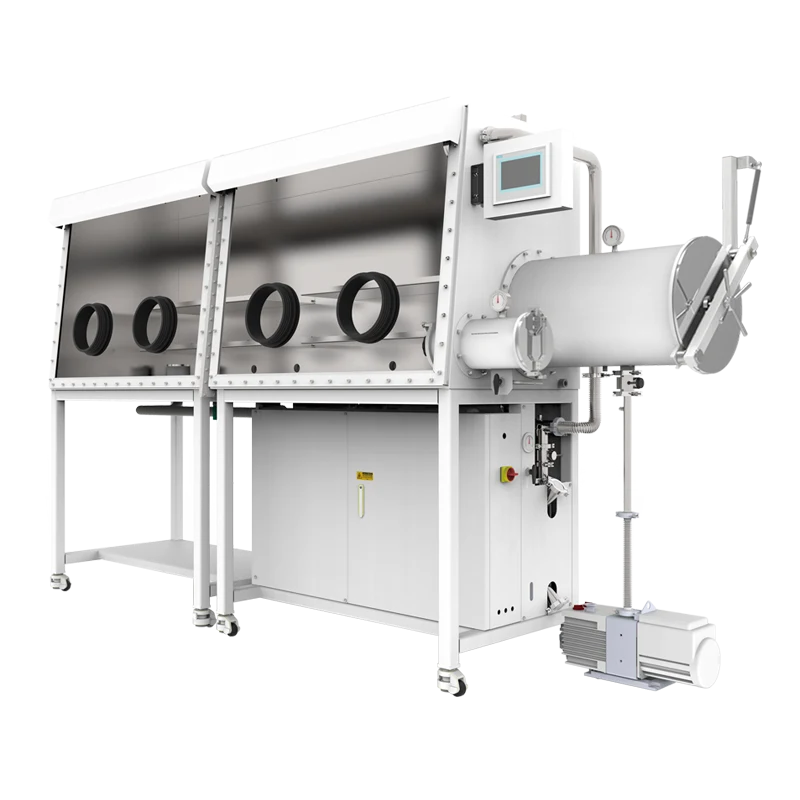
For a powder workflow, a named two-station configuration gives the project a clear starting layout. One position can be reserved for transfer and the other for preparation or weighing, or both can support the same task when throughput requires it. That is a workflow proposal, not a guaranteed outcome; final allocation should follow powder quantity, tooling, and operator movement. The single-sided arrangement is easy to describe in a room plan, while the split-type label signals that the box and purification equipment should be reviewed as a connected system rather than as separate furniture.
The integrated gas purification system is the part that should be discussed with the most discipline. A product name can confirm that purification is part of the configuration; it does not, by itself, establish an oxygen or moisture level at the working position, a recovery time after opening, or a suitable regeneration interval. Buyers should request the control range, sensor arrangement, alarm logic, and commissioning procedure for the proposed build. Those are the facts that connect a purification glove box to a powder specification.
Two workstations are a layout decision, not a performance score
Two stations can reduce the need to move every powder task through a single position and can separate a transfer step from a cleaner weighing step. For air-sensitive powders, that separation can limit cross-contamination and make tooling easier to organize. It also creates an operating question: which station receives the sample, which holds the balance, and how are tools moved between them? TENCAN's two-station, single-sided configuration provides a concrete basis for that discussion.
The layout should be checked against the largest item that must enter, the balance footprint, the scoop and spatula set, waste containers, and the operator's range of motion. A second station is helpful only when the internal geometry and transfer path support the intended work. Ask for a dimensioned drawing and a proposed internal layout before treating station count as a benefit in itself.
The split-type arrangement deserves a utility and service review
A split-type system can be attractive where the purification unit and the glove box need to be planned as separate physical elements within the laboratory. The positive case is organizational: the project can discuss the box envelope, purification cabinet, service access, and future maintenance as distinct items while still treating them as one atmosphere system. The exact separation, footprint, and connection details must come from TENCAN's current documentation for the proposed configuration.
Procurement teams should also resist shorthand. A purification unit is not the same as a replacement box, and a replacement box is not a continuous purification system. If the project needs a continuously managed atmosphere, the specification should name the purification function explicitly and require a commissioning test at the working position.
Large antechamber as a transfer interface
TENCAN also lists a Large Glove Box Antechamber as an accessory. Its role is to provide a transfer interface between the laboratory and the glove-box atmosphere. It should be evaluated as an antechamber, not as a complete glove box and not as a continuous gas purification system. Useful questions are practical: what is the chamber volume, how is the door operated, what vacuum or pressure condition is permitted, how is the interior cleaned, and how does the chamber connect to the proposed box?
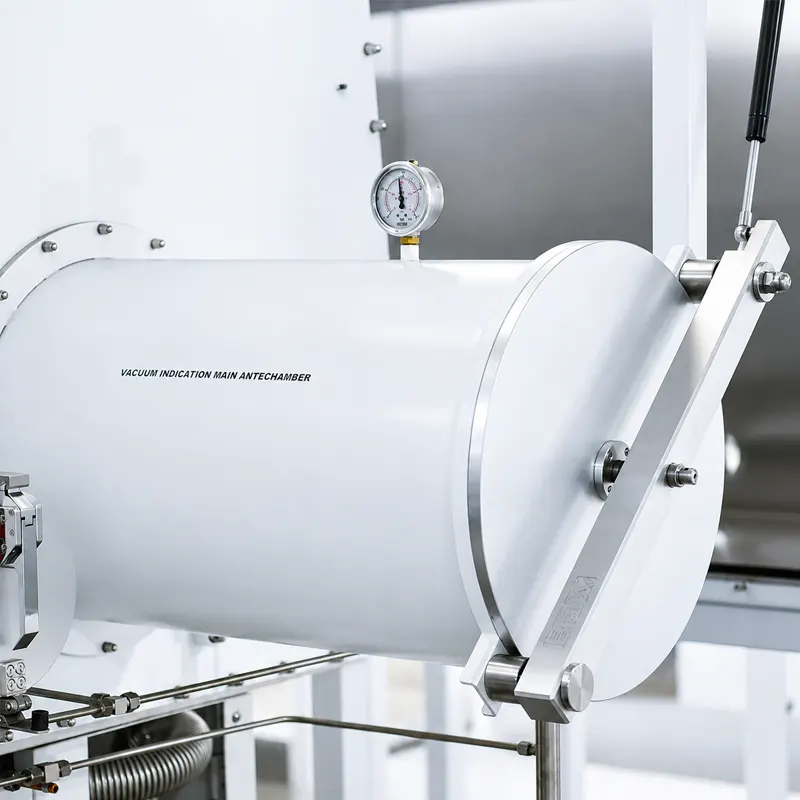
A larger transfer chamber can be useful when powders arrive in bottles, when small tools or a balance must be introduced together, or when the transfer step needs more room than a standard antechamber provides. Those are workflow possibilities, not specifications. The actual chamber volume, vacuum rating, and compatible box configuration must be confirmed. The accessory should be selected with the same evidence standard as the main box, because a poorly matched transfer interface can become the limiting step in an otherwise suitable installation.
Why powder work changes the glove-box brief
Powders behave differently from solid parts or liquids. Fine particles can become airborne when a bottle is opened, a scoop is withdrawn, or a sample is poured. They can settle on surfaces, migrate into corners, and contaminate the next batch. They can also be difficult to see, which makes cleaning verification more important than a visual check alone. A glove box that suits handling a wafer or a sealed cell may not be the best starting point for weighing a hygroscopic powder unless the internal layout, air movement, and cleaning access are considered together.
There is also a measurement problem. A powder sample may be small, but the atmosphere around it is shared with the operator, the balance, the tools, and the antechamber. The relevant question is not only whether the box can reach a low oxygen or moisture level, but whether that condition is maintained during actions that disturb the atmosphere. Transfer frequency, door opening, glove movement, and the introduction of laboratory ware all matter. This is why a purification glove box should be specified with a workflow description rather than a single headline number.
Material compatibility adds another layer. Some powders are sensitive to moisture, some to oxygen, and some to both. Others may interact with particular lubricants, seal materials, or cleaning agents. The project should define the powder's sensitivity, acceptable exposure window, and cleaning method before selecting internal materials. An inert atmosphere is not a biological containment claim and is not an explosion-protection certification. Those are separate requirements with separate standards. The glove box should be selected for the atmosphere and containment functions it is actually documented to perform.
Six selection dimensions to compare on equal evidence
When TENCAN's configuration is placed beside an international modular platform, the comparison should use the same dimensions on both sides. The following six connect the equipment to the task rather than to a brochure label.
1. Atmosphere boundary and purification architecture
Define the protected volume, the gas purification function, and the points at which the atmosphere is monitored. Ask whether purification is integrated into the proposed configuration, how it is regenerated, and what the alarm strategy is. For TENCAN's named product, the gas purification system is part of the configuration; the validated range and control details still need confirmation for the exact build. International modular platforms should be asked the same questions in the same units and at the same working positions.
2. Transfer path and antechamber strategy
Map every item that enters: powder bottles, spatulas, balance pans, sample vials, waste, and cleaning supplies. Then size the transfer interface around that list. TENCAN's large antechamber is one documented option; the required volume and vacuum condition should be checked against the actual items. The comparison should not mix an antechamber's transfer function with the purification system's atmosphere function. They are separate, complementary roles.
3. Work position ergonomics and powder containment
Review reach, sight line, glove-port spacing, balance placement, and the path of a scoop from bottle to pan. Powder containment is supported by good layout and cleaning access, not by atmosphere alone. A two-station single-sided box gives the project two positions to organize; an international platform may offer a different module arrangement. Compare proposed internal layouts, not just external footprints.
4. Material compatibility and cleaning
List the powders, solvents, and cleaning agents that will contact the interior. Confirm compatible surfaces, seals, and window materials with each supplier. Ask how corners, ledges, and glove ports are cleaned and inspected. For powders that tend to accumulate, a design that is easy to wipe down and inspect can matter as much as an additional instrument port. Both TENCAN and international suppliers should provide material and cleaning guidance for their proposed build.
5. Instrumentation and data records
Decide whether the project needs continuous logging, alarm history, or a simple local display. Clarify sensor type, calibration, and the meaning of the displayed value. A purification-system label should not be converted into an unverified oxygen or moisture promise. Ask for a commissioning record and a routine verification plan. The same data standard should be applied to every candidate so that the comparison remains technical rather than rhetorical.
6. Accessory fit, expansion, and change control
Glove boxes are often bought as a platform and expanded later. Confirm which accessories are supported for the exact model, how additional ports or chambers are integrated, and who approves the change. TENCAN's product pages provide a starting point for the box and the large antechamber, but compatibility should be confirmed rather than assumed. International modular platforms may be designed around a different expansion logic; compare approved interfaces and documentation packages, not just future options.
TENCAN vs international modular platforms: strengths by dimension
The table keeps the international side at platform level. Modular glove-box suppliers configure systems to order, so a model-level claim should be supported by that supplier's current drawing and data sheet. TENCAN's side uses the named configuration and accessory page supplied for this guide. The comparison addresses documented design emphasis and the questions each approach raises, not a universal ranking.
| Selection dimension | TENCAN reference configuration | International modular platforms | Evidence to request |
|---|---|---|---|
| Configuration logic | Two-station, single-sided, split-type glove box with gas purification system; named configuration makes the layout and purification scope easy to discuss. | Platforms assembled from modules, which can support a project-specific combination of work zones, transfer chambers, and interfaces. | Dimensioned drawing, scope boundary, and list of included modules. |
| Atmosphere management | Integrated gas purification system as part of the named product; suitable basis for a specification conversation about continuous atmosphere management. | Modular purification options that can be matched to the required gas circuit and expansion plan. | Control range at the working position, sensor type, regeneration and alarm logic. |
| Transfer | Large glove box antechamber available as a documented accessory for larger or grouped transfers. | Antechamber and transfer-chamber options within a modular architecture. | Chamber volume, permitted vacuum or pressure, door operation, and box compatibility. |
| Workflow layout | Two workstations support separation of transfer, preparation, or weighing tasks in a single-sided layout. | Work-zone configuration can be adapted to instrument clusters or multi-step processes. | Internal layout drawing, glove-port positions, and reach study. |
| Cleaning and materials | Configuration can be reviewed for powder transfer and weighing; surfaces and cleaning method to be confirmed for the powder set. | Material and lining options can be selected for the process chemistry and cleaning regime. | Material certificate, cleaning guidance, and compatibility statement. |
| Documentation and change control | Product pages define the named box and the large antechamber, providing a clear starting point for a quotation. | Modular documentation packages can describe interfaces, utility requirements, and later expansion. | Commissioning protocol, spare-parts list, and approved accessory matrix. |
The positive case for TENCAN in this comparison is specificity at the configuration level: the product name already communicates two stations, a single-sided layout, a split-type arrangement, and a gas purification system, while the accessory page gives the large antechamber a defined role. The positive case for international modular platforms is configurability: their module libraries can be useful when a glove box must integrate with a particular instrument set or a larger centralized laboratory standard. Neither advantage replaces a site-specific check of dimensions, utilities, atmosphere performance, and cleaning access.
Where TENCAN's two-station system fits in a powder workflow
For a battery-materials laboratory, the two-station layout can be considered for moisture- and oxygen-sensitive powder preparation where one position is kept for bottle opening and subsampling and the other for weighing or slurry preparation. For solid electrolytes, the same layout can support transfer of hygroscopic salts and ceramic powders before pressing or cell assembly, provided the actual sensitivity and exposure limit are defined. For perovskite research, a purification glove box can be part of the handling chain for moisture-sensitive precursors, but suitability of the specific precursor set and solvent must be checked. For catalysis and advanced materials, the box may serve as a controlled transfer and weighing environment when the powder is air-sensitive and the internal tools are compatible.
These are application contexts, not blanket promises. The correct TENCAN configuration depends on powder mass, transfers per session, balance type, cleaning frequency, and permitted working range. A laboratory that handles small samples occasionally has a different brief from a pilot group that introduces bottles and tooling several times a day. The two-station design is most useful when the workflow genuinely has two separable activities; if every task must happen at one balance, the second station should be justified by a specific preparation or transfer step.
The large antechamber is similarly workflow-dependent. It can be proposed when bottles or grouped supplies need a larger transfer interface, but it should not be treated as a substitute for the purification system. The box defines the working volume, the antechamber manages the transfer path, and the purification system manages the recirculated atmosphere. The specification should keep those roles separate and then confirm that they work together.
Where an international modular platform can be the right reference
An international modular platform can be a useful reference when the glove box is part of a larger instrument cluster, when a laboratory has an established module standard, or when the project expects to add work zones and analytical interfaces over several phases. The positive design emphasis is configurability: modules can be combined around a process, and the supplier's documentation can describe how the platform expands. That is a legitimate advantage for projects with a long integration roadmap, provided the same atmosphere, transfer, and cleaning questions are answered at the working position.
It can also help to compare an international platform when the procurement team needs a different documentation format, a particular utility standard, or a module that fits an existing room plan. These are project-fit considerations, not evidence that one platform is universally superior. The comparison should ask each supplier to state what is standard, what is optional, and what is outside the scope of supply. A clear scope boundary is more valuable than a long feature list.
For a powder application, the decisive issues remain the same: atmosphere boundary, transfer path, internal layout, cleaning method, and records that show the system performs as commissioned. TENCAN's named two-station configuration provides a clear starting point for that discussion; an international modular platform may provide a different expansion logic. The right next step is to test both against the same powder workflow.
Procurement checklist before requesting a quotation
Use the following checklist to turn a general glove-box enquiry into a comparable technical request. It is written for powder work, but the same discipline applies to any air-sensitive material.
- Define the protected material: powder chemistry, particle size range, sensitivity to oxygen and moisture, and the maximum acceptable exposure time for each handling step.
- Map the transfer path: bottle entry, subsampling, weighing, tool transfer, waste removal, and cleaning. State how often each step occurs.
- Separate the functions: working volume, antechamber transfer, continuous gas purification, and particle filtration. Do not use one function to imply another.
- State the atmosphere target correctly: give the required oxygen and moisture range at the working position, the measurement method, and the acceptance test. Avoid converting a product label into an unverified guarantee.
- Confirm pressure and vacuum separately: working pressure inside the box, permitted antechamber vacuum or pressure, and relevant utility requirements should be listed as separate values.
- Review the internal layout: balance footprint, glove-port reach, scoop and spatula storage, waste container, and cleaning access. Ask for a dimensioned drawing.
- Check material compatibility: window, lining, seals, gloves, and cleaning agents against the powder and any solvents used.
- Clarify particle control: if HEPA filtration is proposed, treat it as particle control, not as moisture or oxygen removal.
- Confirm accessory fit: the large antechamber and any other accessory must be approved for the exact box configuration; do not assume random interchangeability.
- Request the documentation package: commissioning procedure, alarm list, sensor calibration plan, spare-parts list, and operator training requirements.
- Plan the sample evaluation: a representative powder, a defined target, and a measurable acceptance method are more useful than a generic demonstration.
A sensible next step: evaluate with your powder, not a brochure
The most useful comparison uses the same powder, transfer steps, and acceptance method on every candidate. For TENCAN's two-station purification glove box, that means confirming the proposed layout, the gas purification scope, and the large antechamber fit against the actual bottles, tools, and weighing routine. For an international modular platform, it means asking for the equivalent configuration drawing and working-position data. The exercise should end with a documented configuration, not a ranking sentence.
A practical next step is to send TENCAN a representative sample and a short process brief: powder chemistry, target oxygen or moisture range, sample mass, transfer frequency, balance type, cleaning method, and desired acceptance test. That information allows TENCAN to confirm whether the two-station single-sided split-type configuration and the large antechamber are appropriate for the intended powder workflow, and which details must be fixed before quotation. The same brief can be used with any international platform, which keeps the comparison technical and fair.
Sources and Further Reading
- TENCAN Two-Station Single-Sided Split-Type Glove Box with Gas Purification System
- TENCAN Large Glove Box Antechamber
International platform statements in this guide are kept at category level. Request current model-specific documentation from each prospective supplier before comparing dimensions, vacuum ratings, purification performance, or accessory compatibility.
