
An antechamber is the sealed transfer volume between the laboratory and the controlled atmosphere of a glove box. It normally has an outer door, an inner door, and a means of removing or diluting the air that enters when the outer door is opened. The Large Glove Box Antechamber is offered as a glove box accessory for this transfer function. Its practical value depends less on the adjective large than on whether its usable opening, internal geometry, sealing arrangement, and evacuation or purge connections match the host box and the objects that must pass through it.
That distinction matters during procurement. A chamber can be large enough on paper and still be awkward in use if the door opening is too small for a loaded tray, if the inner door cannot swing clear of a fixture, or if the pump and purge connections do not match the available services. Conversely, an unnecessarily large chamber can consume more gas and take longer to cycle than the workflow requires. The right choice balances transfer capacity against atmosphere disturbance; it is not a simple preference for more volume.
The antechamber's job: protect the main atmosphere during transfer
A glove box antechamber isolates the main chamber from room air during loading. The operator opens the outer door, places material inside, closes and seals the outer door, adjusts the chamber atmosphere, and then opens the inner door. The main glove ports and the main atmosphere therefore remain protected from the full exchange that would occur if a sample were passed through a directly opened door. This is the basic reason antechambers exist on purifying glove boxes and vacuum glove boxes, although the hardware and cycle logic differ.
The antechamber is not a miniature purifier. It reduces the amount of moisture, oxygen, solvent vapor, or particulate matter that enters with a load, but on a purifying glove box any residual contamination that reaches the box still has to be handled by the box's circulation and purification system, by the operator's procedures, or by both. A large antechamber that is not evacuated or purged effectively can admit a larger absolute quantity of contaminants than a smaller chamber that is operated well. Volume alone is not a performance guarantee.
The accessory also has a workflow role. It provides a staging volume where a tray can be arranged, a small fixture supported, or several items grouped into one transfer. That can reduce the number of times the main chamber is opened. For a busy laboratory, fewer transfers may matter as much as nominal chamber size.
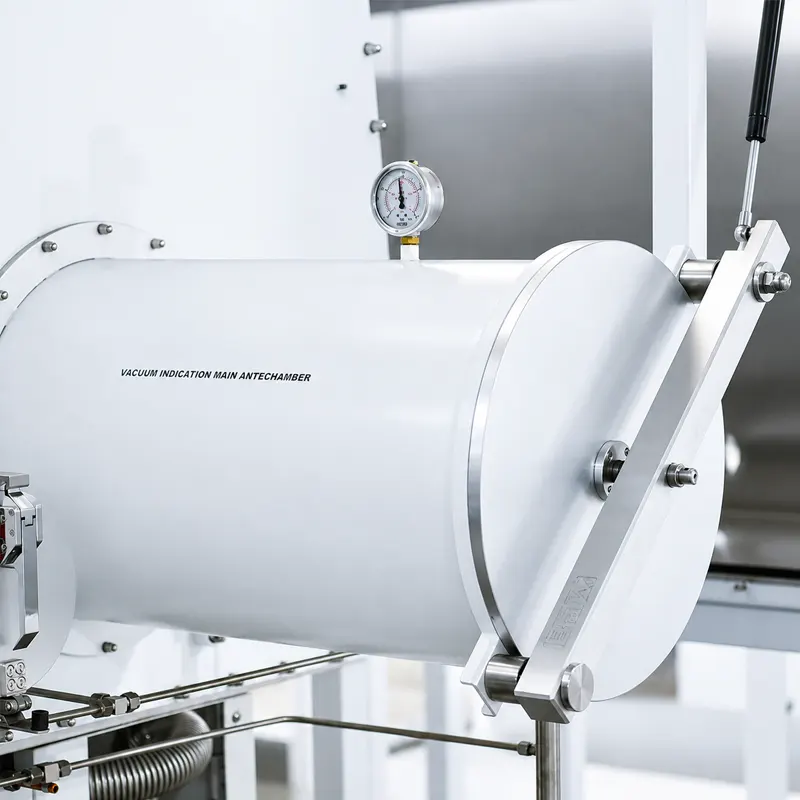
Why a large antechamber can help and where it can hurt
The main argument for a large antechamber is batching. If a standard chamber forces one item through at a time, the operator may open the main box more often, interrupt experiments, and expose the atmosphere to repeated small disturbances. A larger chamber can accept a loaded rack, a group of substrates, a transfer fixture, or a piece of equipment that would otherwise require a different route. The benefit is real when the chamber is used at capacity and the transfer procedure is designed around it.
Fewer cycles can outweigh a longer cycle
It is easy to compare chambers only by how long one cycle takes. A more useful comparison is total time and total gas use for the batch. A large chamber may take longer per cycle, but if it carries four items instead of one, the effective cost per item can be lower. The calculation should include loading, sealing, evacuation, purging, venting, inner-door operation, and the time needed for the box atmosphere to recover. A large chamber that is half empty on every cycle is usually a poor trade.
Volume increases the demand on pumps and gas supply
For the same pump and purge strategy, a larger free volume takes longer to evacuate and needs more inert gas to reach a given dilution. The effect is not linear in every practical system because conductance, leakage, outgassing, and control logic also matter, but the direction is consistent. A large chamber therefore deserves a careful look at pump capacity, purge-flow capacity, valve size, and the time allowed between transfers. If house gas pressure or pump speed is marginal, the large chamber may become the bottleneck it was meant to remove.
Door size changes the human and mechanical interface
A larger door has a longer seal perimeter and a larger area exposed to pressure difference. That does not automatically make it leaky, but it does change the design requirements for hinge stiffness, latch geometry, gasket compression, and door guidance. Operators also have to lift and place loads through a larger opening, sometimes while wearing gloves. A door that is technically adequate but awkward to close squarely will eventually produce inconsistent seals. The accessory should be judged with the same attention to ergonomics as to volume.
Designing the transfer cycle around gas exchange, not just vacuum
Two physical processes are often discussed together: evacuation and purging. They are related but not interchangeable. Evacuation lowers the pressure in the antechamber and removes a proportion of the original atmosphere. Purging fills the chamber with a chosen gas and displaces or dilutes the remaining atmosphere. In many glove box procedures the two are combined, but the correct sequence depends on the chamber's pressure rating, the load, the gas, and the host system.
Evacuation removes bulk gas, not surface contamination
A vacuum pump can remove gas from the free volume, but it does not instantly remove water adsorbed on metal, glass, gasket surfaces, or packaging. It also may not remove gas trapped in porous samples, sealed cavities, or poorly chosen containers quickly enough. The chamber's surfaces and the load itself influence how quickly the pressure falls and how much contamination remains after venting. A vacuum-rated antechamber is therefore not the same as a clean, dry antechamber; the two properties depend on materials, cleaning, and procedure as well as pressure.
Purging depends on flow path and dead zones
An inert-gas purge is only as good as its ability to displace the air in the chamber. If the inlet and outlet are close together, fresh gas can short-circuit across the top of the chamber while stale air remains in a corner. Baffles, a distributed inlet, or a purge path that sweeps the usable volume can matter more than a small increase in flow. The right arrangement should be confirmed with the supplier rather than assumed from the presence of a gas port.
Vacuum plus purge is a strategy, not a universal recipe
For many loads, a vacuum step followed by an inert-gas purge reduces oxygen and moisture more efficiently than purge alone, because the vacuum removes a large fraction of the initial atmosphere before gas is introduced. For other loads, vacuum is inappropriate: sealed cells may be sensitive to pressure change, powders may be disturbed, and some containers may trap gas or collapse. The number and timing of cycles should come from the chamber manufacturer's instructions and from an assessment of the load. They should not be copied blindly from another box.
Do not confuse antechamber vacuum with box purification
An antechamber that can be evacuated does not become a gas purification system. The accessory itself is not a circulating purifier, and it does not continuously remove the water and oxygen that enter the main box. Where the host box has a purifier, that purifier, the circulation path, and the box's leak integrity perform the continuous cleanup. The antechamber simply reduces the size of the disturbance. This distinction matters when comparing specifications: an ultimate vacuum figure for a pump, a working vacuum in the antechamber, a leak rate, and an oxygen or moisture level in the glove box are different measurements with different meanings.
Matching the accessory to the host glove box
An antechamber is an interface component, so compatibility has to be established at the mechanical, pressure, gas, and control boundaries. The fact that two products are listed by the same supplier is not, by itself, a statement that they fit together. The GBV-2 stainless steel vacuum glove box and the Large Glove Box Antechamber are separate product listings; a buyer should ask for the interface drawing and a written compatibility confirmation rather than infer a fit from product names or materials.
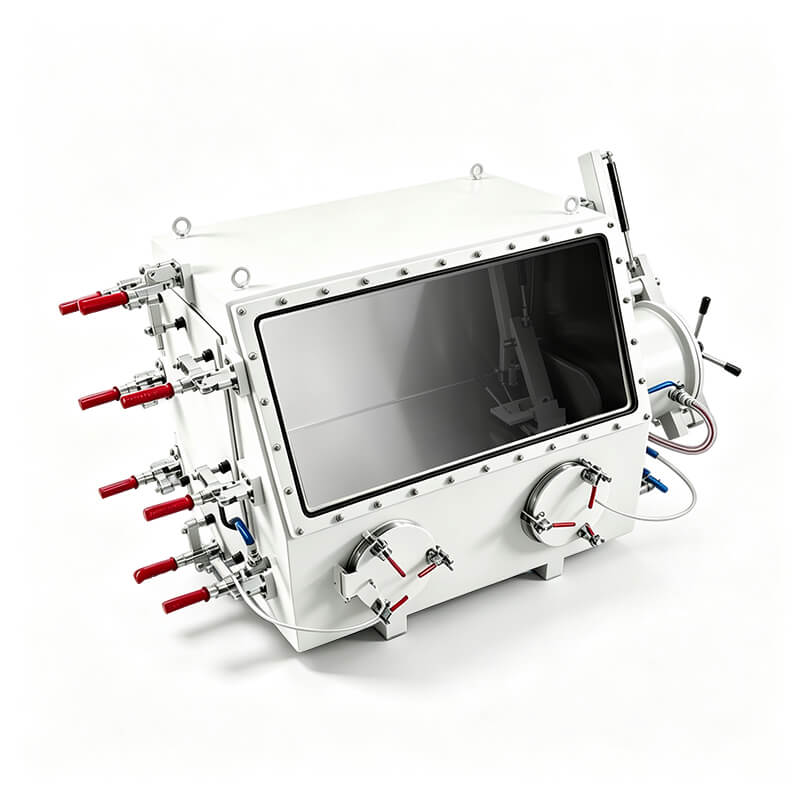
Opening geometry and door interface
The first check is the physical opening in the host box: cutout dimensions, bolt or clamp pattern, flange flatness, wall thickness, and the space available around the door. The antechamber's inner door must clear the box interior, the glove ports, and any internal fixtures. The outer door must have room to swing or lift without interfering with adjacent equipment. Hinge side, latch side, and service access should be agreed before fabrication. If the host box has a curved surface or a nonstandard panel, the adapter detail becomes part of the design.
Pressure loading and structural support
A large antechamber door can present a substantial area to a pressure difference. When the chamber is evacuated, the inner door and its seal may see a different load from the case in which the box is at a slight positive pressure. The support structure and latch must be designed for the worst credible combination, not only for the normal operating state. This is one reason a large chamber should not be treated as a simple cut-and-fit accessory. The host box's working pressure and the antechamber's vacuum rating are separate limits, and neither should be inferred from the other.
Ports, valves, and pump matching
The port schedule should cover evacuation, inert-gas purge, venting, pressure indication, and any sensor or sampling connection that the process requires. Port type and size affect pumping speed and purge distribution. The pump must be matched not only to chamber volume but also to the gas being handled, the expected load, and the exhaust arrangements. A pump with a low ultimate pressure can still be a poor match if its pumping speed at the relevant pressure is low or if the line and valve restrict flow. If the chamber is used with solvents or fine powders, the pump and exhaust strategy need explicit review; a standard pump is not automatically suitable for every vapor or particle load.
Controls, interlocks, and instrumentation
Manual valves and a written sequence can work in a laboratory with trained operators, but a larger chamber with more frequent transfers may justify automated cycles, door-position sensing, or interlocks that prevent an invalid sequence. The presence of an interlock should be confirmed rather than assumed. Instrumentation also needs a defined location. An oxygen analyzer installed in the main box does not necessarily report the antechamber concentration, and a reading at one point does not prove that the whole chamber is uniform. If an analyzer is used for decisions, its range, resolution, accuracy, calibration, and sampling point all matter; resolution alone is not accuracy.
| Interface item | Why it matters | What to confirm |
|---|---|---|
| Usable internal dimensions | Determines whether the real load, tray, and fixtures fit with clearance | Dimensioned drawing, not only a nominal size |
| Door clear opening | Controls loading and unloading access | Opening height and width, seal position, door swing |
| Pressure rating | Defines whether evacuation is permissible and how the door is supported | Rated vacuum or pressure with the applicable conditions |
| Ports and valves | Set purge distribution, pump-down speed, and sensor options | Port type, size, function, and available connections |
| Control sequence | Affects repeatability and operator error | Manual or automatic, door sensing, interlocks, alarms |
| Seal and materials | Affect outgassing, chemical compatibility, and cleaning | Gasket material, wetted surfaces, lubricants |
Sizing around the real transfer envelope
The word large in the product name is not a specification. Sizing should start with the largest routine load and the way it is carried. Measure the item itself, then add the tray, fixture, protective packaging, and the clearance needed for hands or gloves. Consider whether the item must be rotated, tilted, or lifted off a shelf. A chamber that fits the object in a static drawing may still be impossible to load through the inner door.
The largest load is not always the governing load
Frequent small transfers and occasional large transfers create different requirements. If most work is small, a large chamber may impose a gas and time penalty on every cycle for the benefit of an occasional oversized item. If the oversized item is the reason for the system, however, a smaller chamber that cannot accept it is not a solution. The practical answer may be a clear transfer routine, a dedicated tray, or a different loading path, but those choices should be made with the actual dimensions and the host box layout in view.
Weight, support, and handling
The accessory structure must support the load during loading and unloading, not only after the doors are closed. A heavy fixture placed on a shelf or rail can deflect a seal or make the inner door difficult to close. The supplier should know the load weight, the support points, and whether the item is rigid or flexible. If a cart or external lift is used, the approach path and door height become part of the dimensional check.
Access for cleaning and inspection
A large chamber has more surface area, more corners, and often more hardware than a small one. If the process generates particles or uses materials that leave residues, cleaning access should be considered at the design stage. Smooth surfaces and removable trays help, but they do not replace a defined cleaning procedure. The antechamber should not be used as a storage cupboard; material left inside can become a source of outgassing and cross-contamination.
Contamination paths the volume does not solve
Packaging and outgassing
Cardboard, foam, adhesive labels, printed paper, and some plastics can release moisture or organic vapors inside a sealed chamber. A large antechamber may encourage larger packages, which increases the surface area available for outgassing. Whenever possible, outer packaging should be removed before transfer and only the essential carrier should enter. The chamber's purge or vacuum cycle should be matched to the load, not only to the empty chamber.
Seals, lubricants, and solvent compatibility
Gasket materials and lubricants are part of the atmosphere. A seal that is acceptable for dry nitrogen may behave differently with solvent vapor. A lubricant that makes a door easier to close may add a contamination source if it is not compatible with the process. These details should be confirmed with the supplier and, where relevant, with the material safety information. The goal is not simply a seal that holds vacuum; it is a seal that remains appropriate for the chemistry being handled.
Particle filters and gas purification are different functions
A HEPA filter can capture particles. It does not remove water vapor, oxygen, or most solvent vapors. A solvent adsorber can reduce organic vapor but does not replace the water and oxygen removal function of a purifying glove box. An antechamber fitted with a vent filter should not be described as a purified transfer chamber unless the gas path and the measurement support that claim. This distinction matters when a process is sensitive to moisture but the visible contamination problem is particulate.
Verification, acceptance, and the information to send a supplier
Acceptance should be based on the functions the antechamber is expected to perform. Check the delivered dimensions against the approved drawing, operate both doors through their full travel, inspect seal compression and alignment, verify that every port is labeled and connected as specified, and confirm the control sequence. If the chamber is vacuum-rated, the supplier should state the test method and the conditions behind any leak or pressure-hold figure. A bare number without units, test gas, pressure range, and duration is not enough to compare offers.
Atmosphere recovery should be checked with a baseline, not with a single reading after a complicated transfer. Establish the box's normal oxygen and moisture readings, perform a representative transfer, and observe how the readings respond. A slow recovery can come from the load, the purifier condition, the circulation path, the sensor location, or the transfer procedure. It is not proof by itself that the antechamber is faulty. Record what was transferred, how long the chamber was evacuated or purged, and where the readings were taken, so that the result can be interpreted rather than guessed.
Before ordering, provide the supplier with the host glove box model and a dimensioned interface drawing, the largest and heaviest routine loads, the required transfer frequency, the gas and vacuum services available, the intended or existing pump, the control and interlock expectations, and any solvent or particle exposure. Ask for a drawing that shows the usable internal volume, door clear opening, seal arrangement, port schedule, mounting detail, and pressure or vacuum limits with their conditions. For the TENCAN Large Glove Box Antechamber, start from the published product page and confirm the available configuration; do not assume that large means a particular volume or that every option shown in a photograph is included.
The appropriate large antechamber is not the biggest one that can be fitted. It is the smallest chamber that reliably passes the largest routine load with acceptable handling, while keeping gas use, pump-down time, and atmosphere disturbance within the host system's capability. Confirm dimensions, door geometry, pressure limits, port functions, and control logic as a package. A large antechamber improves a glove box only when those interfaces are treated as one design problem.
