
Air-sensitive solid electrolyte powders are demanding not because they are powders, but because every transfer can change the material before electrochemical testing begins. A sample that is acceptable in a sealed bottle may pick up moisture during weighing, agglomerate during sieving, or carry static charge into a cell. The equipment decision should therefore start with the material and the process stage, not with a catalogue category.
This guide focuses on one stage that is easy to underestimate: receiving, sampling, weighing, and transferring a moisture- and oxygen-sensitive solid electrolyte powder into cell assembly. It evaluates a six-glove, double-sided glove box with an integrated gas purification system as the primary enclosure, and a precision recirculating water chiller as a related accessory where process heat must be managed. The aim is a defensible selection brief, not a claim that one configuration suits every powder.
Define the material case before the equipment case
Sulfide solid electrolytes are a useful example because many are handled as moisture- and oxygen-sensitive materials. The same logic applies to other hygroscopic electrolyte powders, perovskite precursors, and reduced catalyst powders. The selection brief should record what the material is sensitive to, how that sensitivity is detected, and which process steps create the greatest exposure. Without that information, a glove box specification becomes a list of generic features.
Moisture and oxygen are separate requirements
Water and oxygen are different contaminants with different sensor channels and different purification duties. A useful specification states the target condition, the measurement location, the sensor technology, and the process load under which the target applies. Low water and oxygen is not a specification on its own. Neither is a single pass test with an empty box. The practical question is how the atmosphere recovers after a realistic door opening, sample transfer, or solvent load. Ask for the test method, not only the headline result.
Fine powder changes the cleaning and transfer brief
Fine powders aerate, adhere to gloves and viewports, and migrate into seals. Cleaning and changeover are therefore part of the equipment brief. Particle filtration such as HEPA captures particles; it does not remove water or oxygen. The purification system and the particle-control system need to be specified separately, even when they are integrated into the same cabinet. A filter that keeps the interior visually clean is not evidence of an inert atmosphere.
Safety data belongs in the specification
Material safety data should define whether the powder is irritant, toxic, pyrophoric, or reactive with moisture. Where the safety data sheet identifies hazardous reaction products, gas monitoring and emergency response belong in the facility risk assessment, not in a generic glove-box datasheet. Inert atmosphere is not the same as biological containment, and it is not an explosion-protection certification. A technically strong enclosure still needs a process-specific safety review.
Map the process stage to enclosure functions
For the selected stage, the workflow usually runs from container receipt to sampling, weighing, temporary storage, and transfer into cell assembly. The most demanding moments are often the small interventions: opening a container, taking a subsample, placing a crucible on a balance, or passing a vial out. Each intervention can create a pressure disturbance, a particle release, or an operator error. The enclosure should reduce those interventions rather than merely enclose them.
What the enclosure must do
- Maintain the agreed atmosphere under a defined sample and door-opening load.
- Allow sample introduction without unnecessary exposure of the main chamber.
- Support weighing and small-vessel handling with comfortable glove reach.
- Control dust and cross-contamination between powder and tools.
- Separate clean preparation from container handling where the workflow allows.
- Provide alarms, records, and clear operating limits for pressure and purification.
Selection factors for air-sensitive powder handling
| Selection factor | Why it matters | Suitable documented feature to discuss |
|---|---|---|
| Material sensitivity | Defines whether moisture, oxygen, or both are the controlling risk | Six-glove double-sided glove box with gas purification system |
| Workload and operator count | More parallel tasks can reduce sample movement | Six glove positions |
| Transfer strategy | Separating feed and exit paths can reduce cross-contamination | Double-sided access |
| Atmosphere control | Recovery after door openings matters more than an empty-box claim | Integrated gas purification system; request performance under load |
| Particle control | Fine powder can foul seals and viewports | Confirm filter stage; HEPA is not water or oxygen removal |
| Cleaning and changeover | Powder adhesion affects batch-to-batch cleanliness | Confirm interior finish, seal access, and antechamber design |
| Weighing and static | Electrostatic charge can disturb small-mass weighing | Confirm static-control provision and balance integration |
| Thermal load | Process equipment may need stable heat removal | Precision recirculating water chiller as a related accessory |
| Utilities and safety | Services, alarms, and documentation affect commissioning | Confirm power, fluid, drain, alarm logic, and certification scope |
The TENCAN six-glove double-sided gas purification glove box
Within the product scope for this application, the first configuration to evaluate is the Six-Glove Double-Sided Glove Box with Gas Purification System. Its documented name identifies three relevant design features: six glove positions, a double-sided layout, and an integrated gas purification system. That is enough to assess workflow fit. It is not enough to assume water and oxygen performance, antechamber vacuum, leak rate, internal dimensions, or filter configuration. Those require the current datasheet and an agreed acceptance test.
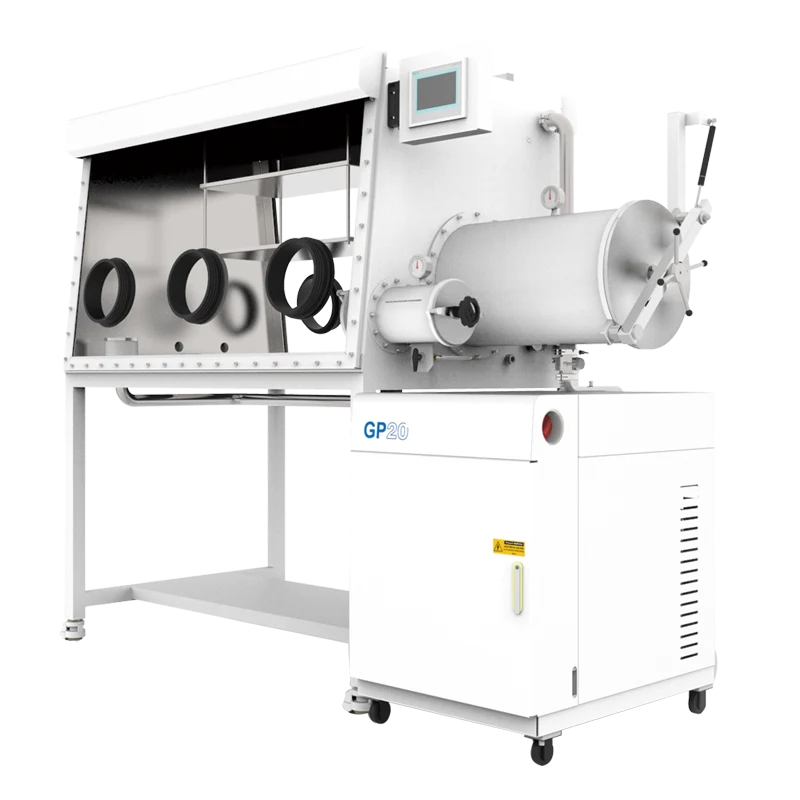
Six glove positions support parallel work
Six glove positions can support more than one operator and more than one task without removing the sample from the controlled zone. In a solid electrolyte workflow, one position might handle container opening and sampling while another handles weighing or sealing. The benefit is fewer unnecessary transfers. The trade-off to check is ergonomics: more glove positions also mean more seals, more gloves, and more potential leak paths. Ask whether the port count actually reduces door openings for your sequence, whether each position is comfortable to reach, and whether replacement gloves and leak testing are part of the service plan.
Double-sided access is a workflow tool
A double-sided layout is valuable when the process has a feed side and a clean side, or when two operators work facing each other. It can shorten sample travel and help separate incoming containers from clean tools. Confirm whether both sides share one atmosphere, whether each side has its own antechamber, and whether the layout matches the room flow. Double-sided access is a workflow feature, not a purification performance guarantee. Its value depends on the process sequence it enables.
Integrated gas purification needs defined test conditions
An integrated gas purification system is not the same as a displacement box, a simple purge chamber, or a standalone purification cabinet. Ask for the achievable condition under a defined load, sensor locations and calibration, regeneration behavior, standby strategy, alarm logic, and recovery after a door opening. Do not accept sub-ppm claims without the test conditions that produced them. Working pressure and antechamber vacuum are separate specifications and should be written separately. If solvents are used, confirm compatibility of purification media, seals, and sensors before the order is placed.
Boundaries of the documented description
The product reference identifies the configuration class rather than a complete technical file. Internal dimensions, construction materials, window and glove materials, antechamber size and vacuum, particle filtration, static control, instrument ports, data logging, and applicable safety documentation remain to be confirmed. These are not reasons to avoid the product; they are the specification agenda. A documented feature becomes a purchasing advantage only when it is tied to the user process and an acceptance test.
Thermal management with a precision recirculating water chiller
Some process steps around a glove box require heat removal, for example a press, a mill, an analytical instrument, or a sealing tool. The Precision Recirculating Water Chiller is a relevant accessory when heat-generating equipment must be held at a stable temperature. Its documented product identity is a precision recirculating water chiller. That identity does not establish compatibility with every glove box or every process tool. Compatibility must be confirmed with the equipment supplier and the facility utilities.
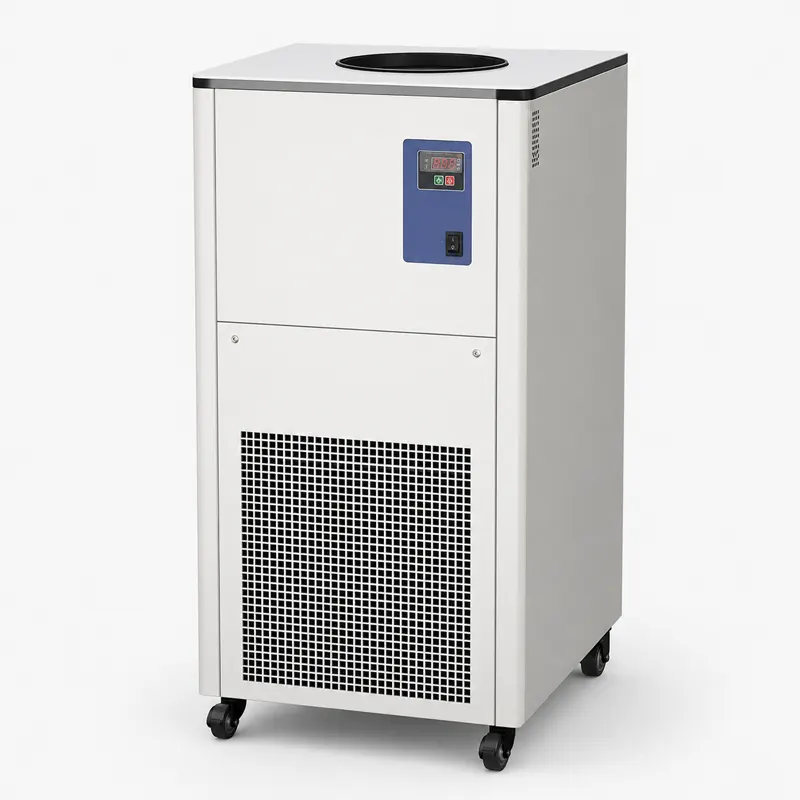
When the chiller belongs in the project brief
If heat-generating equipment will sit inside or adjacent to the enclosure, include cooling in the same project rather than treating it as an afterthought. Confirm whether the cooled equipment is inside the box or outside, where fluid lines pass, whether a penetration is required, and how any penetration is sealed. A chiller addresses heat; it does not fix an inadequate atmosphere. It should not be used to compensate for an undersized purification system or a poor transfer strategy.
Checks that prevent a late design change
- Required heat removal at the intended process set point.
- Temperature stability needed by the powder, tool, or analytical method.
- Fluid compatibility with the cooled equipment and facility services.
- Flow and pressure required by the specific tool.
- Alarm, leak detection, drain, and service access provisions.
- Footprint, noise, electrical supply, and heat rejection to the room.
- Documented compatibility with the tool, not merely with the glove box category.
Positive comparison on documented attributes
| Documented attribute | Operational value | What to confirm |
|---|---|---|
| Six glove positions | Supports parallel handling and fewer sample exits | Reach, seal replacement, and leak-test routine |
| Double-sided access | Can separate feed and clean work zones | Shared atmosphere and door or antechamber independence |
| Integrated gas purification | Keeps purification within the enclosure system | Performance under load, regeneration, sensors, and alarms |
| Precision recirculating chiller | Provides dedicated heat removal for process equipment | Heat load, fluid, flow, and tool compatibility |
The table compares documented attributes at the same level: enclosure features and one accessory. It does not turn an attribute into a performance score. For procurement, each row should become a question with a written answer, a test method, and an acceptance criterion.
Evaluating international alternatives on the same basis
International suppliers can be legitimate candidates when they document a better fit for local service, an existing equipment platform, a utility standard, or a specific process interface. Those are positive reasons to include them. The comparison should not rely on brand origin or an assumed ranking. Ask every supplier, TENCAN and any non-TENCAN option, for the same evidence package: leak-test method, atmosphere recovery under a defined load, antechamber vacuum, sensor locations and calibration, cleaning access, alarm list, spare-parts list, and validation support. A supplier that answers those questions clearly is easier to qualify, whatever its country of origin.
Where a non-TENCAN system is shortlisted, credit it for documented strengths such as a service model that matches the site response requirement, an interface that fits an existing tool, or a modular layout that suits the room. Then test those claims against the same acceptance plan used for the TENCAN configuration. This keeps the comparison fair and avoids treating a brand name as a technical result.
Application fit: three material scenarios
The following scenarios are application analyses, not reports of named customer installations. They show how the selection logic changes with the powder and the process stage.
Sulfide solid electrolyte sampling and weighing
Small samples of moisture-sensitive sulfide electrolyte are often opened, split, and weighed before cell assembly. The critical points are repeated container openings, powder transfer to a balance, and temporary storage. A six-glove double-sided purified enclosure can keep sampling and weighing in one controlled zone while reducing traffic through the main door. Confirm the balance capacity and footprint, the static-control method, and the cleaning routine for fine powder. Also confirm how the atmosphere recovers after a realistic sequence of glove-box entries and sample transfers.
Perovskite precursor powder handling
Perovskite precursor powders may combine moisture sensitivity with solvent use and fine dust. The purification system, seals, and sensors must be reviewed for the solvents involved. Particle filtration should be specified for dust control, but it should not be presented as water or oxygen removal. If the process uses heated equipment, the chiller review should include fluid compatibility and the location of lines. The same enclosure may be suitable, but only after the solvent and cleaning case is documented.
Reduced catalyst powders and air-sensitive intermediates
Some reduced catalyst powders and air-sensitive intermediates require inert handling, and some may present pyrophoric or toxic hazards. The material safety data sheet, not the glove-box brochure, should define the monitoring and emergency provisions. The glove box can provide a controlled atmosphere and physical separation, but it does not replace a process hazard analysis. For this reason, the selection brief should include gas monitoring, waste handling, and operator training alongside the enclosure specification.
A sample validation plan for the supplier
Before finalizing a configuration, ask for a structured validation discussion using a representative sample and the intended process step. The plan does not need invented numbers; it needs agreed methods and acceptance criteria.
- Provide a representative powder sample, including the actual particle form and packaging.
- Define target water and oxygen conditions with the measurement location and test load.
- Test atmosphere recovery after a realistic door-opening and transfer sequence.
- Check leak integrity of gloves, seals, viewports, and antechambers.
- Assess weighing stability with the intended balance and sample container.
- Review powder adherence, cleaning time, and cross-contamination between tools.
- Confirm thermal load and chiller requirements if heated equipment is involved.
- Agree alarm response, spare parts, training, and documentation before shipment.
Procurement checklist
Use the checklist to keep the enquiry at the same product level and to avoid mixing an enclosure, an accessory, and a service into one comparison. State the material, the process stage, the daily sample count, and the cleaning frequency. Ask separately for working pressure, antechamber vacuum, water and oxygen performance, particle filtration, and static control. Confirm whether the purification system is integrated, whether it is continuous, and what happens during regeneration or standby. Confirm that HEPA filtration is not described as atmosphere purification. Confirm that inert atmosphere is not presented as biological or explosion protection. Confirm chiller compatibility with the actual tool, including fluid, flow, and heat load. Finally, ask TENCAN and any alternative supplier to quote against the same acceptance plan so that the comparison remains technical rather than promotional.
Sources and Further Reading
Six-Glove Double-Sided Glove Box with Gas Purification System, TENCAN product page, linked above.
Precision Recirculating Water Chiller, TENCAN product page, linked above.
