
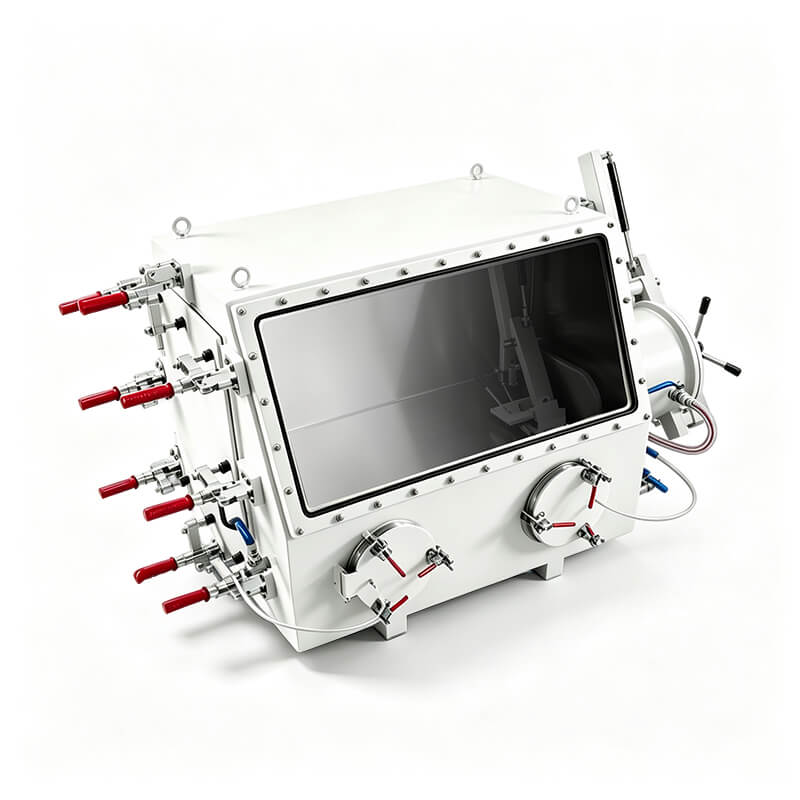
Not every oxygen- or moisture-sensitive task needs the same kind of glove box. A laboratory that opens a chamber once a shift, pumps a small volume, and handles a few grams of air-sensitive powder has a different requirement from a process that needs a continuously low oxygen and moisture level while samples move in and out. The GBV-3 stainless steel vacuum glove box sits in the first family: TENCAN lists it as a stainless steel vacuum glove box, a design in which the protected atmosphere is established and renewed by vacuum and inert-gas exchange rather than by continuous circulation through a purification column.
The useful question is not whether vacuum is “better” than purification in general. It is whether the mechanism matches the sample, the transfer frequency, and the level of atmosphere control that must be demonstrated. A box that is excellent for a sealed batch experiment may be a poor match for a workflow that opens several times an hour. The decision therefore turns on what the GBV-3’s vacuum-replace approach does well, where it needs supporting equipment, and which details belong in the specification.
What the GBV-3 Is—and What It Is Not
The GBV-3’s product identity is specific but limited: it is a stainless steel vacuum glove box. That tells a buyer the enclosure family and the basic working principle, but it does not, by itself, establish a continuous purifier, a particular oxygen or moisture guarantee, a defined transfer-chamber volume, or a specific analyzer package. Those are configuration facts and should be read from the current product page, drawing, and quotation rather than inferred from the model name.
In a vacuum glove box, the chamber is sealed, evacuated, and refilled with an inert gas. One or more cycles reduce the fraction of air; the remaining atmosphere is a mixture of the refill gas and whatever air, moisture, or solvent vapor is left in dead spaces or released from surfaces. This is a batch, dilution-based approach. It is different from a purified glove box, where a blower circulates the internal atmosphere through a purification column, monitors oxygen and moisture, and regenerates the purifying material on a defined schedule. A purifier can maintain a condition continuously while the box is in use; a vacuum-replace box establishes a condition and then depends on the seal, the gas supply, and the operator’s transfer discipline to preserve it.
That distinction matters commercially. Do not assume that a stainless steel enclosure automatically includes a purification loop, and do not treat the presence of a vacuum pump as evidence of continuous water and oxygen removal. The GBV-3 should be evaluated as a vacuum-replace system unless the supplied configuration explicitly states otherwise. The same rule applies to performance: a single “achievable” reading on a page is not a guarantee across the working volume, the glove ports, the transfer path, or a full day of use.
Stainless steel is often selected for durability, cleanability, and resistance to the knocks and solvent exposure of daily laboratory work. It is not a performance guarantee by itself. Seals, gloves, windows, feedthroughs, weld quality, surface finish, and the condition of the door or transfer chamber all influence how long the atmosphere holds. Buyers should ask for the materials of construction and the sealing arrangement for the exact build, not just the shell material.
How Vacuum-Replace Control Actually Works
A vacuum-replace cycle has a simple sequence: close and seal the box, evacuate it, refill with inert gas, and repeat if the target atmosphere requires it. The practical outcome depends on how far the chamber is evacuated, how much gas remains in dead volumes, the purity of the refill gas, the final filling pressure, and the time allowed for mixing. A second or third cycle can improve dilution, but it also adds time, consumes gas, and puts more mechanical cycles on seals and gloves.
The atmosphere should be assessed after the refill has mixed, not at the instant the gas valve opens. Sensors have locations and response times; a reading near the inlet may not represent a corner of the chamber or the space around a sample. If an oxygen or moisture analyzer is part of the build, its range, resolution, accuracy, calibration, and sample point belong in the acceptance discussion. An analyzer measures the atmosphere. It does not purify it, and its display should not be used as a substitute for a defined leak and purge procedure.
Vacuum also does not remove everything that can later raise the moisture reading. Water can be adsorbed on stainless surfaces, glove material, seals, tooling, and the sample itself. Pumping removes gas-phase molecules, but a surface layer may desorb slowly after the box is refilled. The result can look contradictory: the pressure gauge shows that the pump has done its job, yet the moisture reading remains elevated or recovers slowly. That is often a mass-transfer and surface-condition issue, not necessarily a pump failure. Wet samples, solvent residues, humid refill gas, and inaccessible dead volumes can produce the same pattern.
Why a fast pump-down can still leave a wet atmosphere
Consider a chamber that reaches a low pressure quickly. Most of the free air has been removed, but the surfaces are still covered with adsorbed water and the gloves may hold moisture or solvent from previous handling. When the chamber is refilled, that material begins to enter the gas phase. The final moisture level is therefore a balance between the purity of the incoming gas, the leak rate, and the rate of desorption from everything inside. A fast pump-down is useful, but it is not the same as a dry, low-outgassing system.
For that reason, a short “pump and fill” step should not be treated as equivalent to a validated purge protocol. The protocol needs to define how many cycles are used, how long the chamber is held under vacuum, how the refill gas is introduced, whether the box is left at a slight positive pressure, and how the result is checked. Those choices belong in the method and should be confirmed with the equipment supplier for the actual GBV-3 build.
Pump and Exhaust Choices That Protect the Process
The vacuum source is part of the atmosphere-control system, not an isolated utility. Oil-sealed rotary-vane pumps are common in glove-box service because they can produce a useful vacuum at moderate cost, but they are not the only option. Dry pumps avoid oil in the pump body but have their own gas-compatibility and cost considerations. The right choice depends on chamber volume, required vacuum, duty cycle, condensable load, and whether corrosive or solvent vapors will be present. The GBV-3 should be matched to a pump specified for the actual chamber and process, not selected from a generic horsepower or ultimate-pressure claim.
Where an oil-sealed pump is used, exhaust protection deserves attention. A vacuum pump oil mist filter is fitted to the pump exhaust to capture oil mist that would otherwise be carried into the laboratory air or downstream exhaust surfaces. It belongs on the exhaust side of the pump. It is not an inline purifier for the glove-box atmosphere, it does not remove oxygen or water, and it does not replace a solvent trap or a purification column. Its value is in keeping oil mist out of the working environment and in protecting the exhaust path from oily deposits.
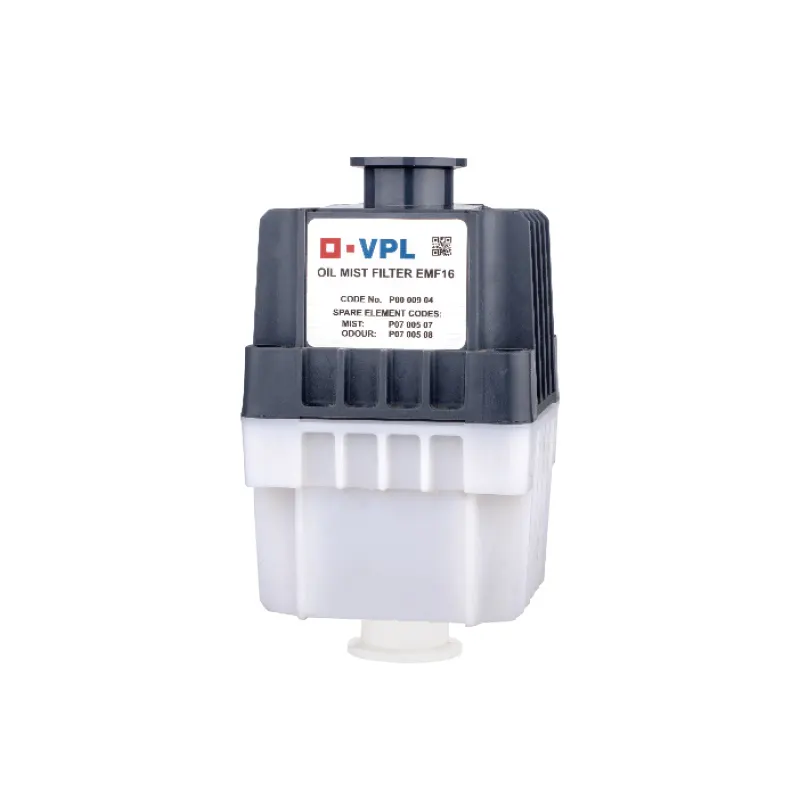
Compatibility has to be checked rather than assumed. The filter must match the pump’s exhaust connection, flow, oil type, and expected mist load. A filter sized for a small pump may create unacceptable back pressure on a larger one; a filter element that is saturated or damaged may pass mist or restrict exhaust. The pump manufacturer’s instructions and the filter supplier’s specification should agree. If the pump is dry-running, or if the exhaust arrangement is different, the oil-mist filter may not be applicable at all.
Condensable vapors are a separate problem. Solvent vapor that reaches an oil-sealed pump can dilute or degrade the oil, raise ultimate pressure, and contaminate the exhaust. A cold trap, condenser, or suitable solvent-management device may be needed, depending on the process. None of those devices should be confused with water and oxygen purification. HEPA filtration, where it is used, addresses particles; it does not remove moisture or oxygen. Solvent adsorption protects the pump and the atmosphere from solvent vapor; it does not replace the water and oxygen control function of a purifier.
Where the GBV-3 Fits—and Where It Does Not
A vacuum-replace box is often a sensible fit for batch work: loading a set of air-sensitive samples, establishing an inert atmosphere, performing a transfer or a short procedure, and then removing the samples. It can suit materials research where the protected step is discrete rather than continuous, and where the operator can work within a defined cycle. Stainless steel construction is useful where repeated cleaning and resistance to laboratory wear matter. The box can also serve as a controlled enclosure for vacuum-compatible fixtures and small tools, provided the chamber and feedthroughs are configured for them.
The fit is weaker when the process needs a continuously maintained low oxygen and moisture level over long periods, very frequent transfers, or a steady purge while open. In those cases, a purified glove box with circulation, monitoring, and regeneration is usually the more appropriate architecture. The vacuum box can still be part of the workflow, but it should not be described as delivering purifier-level continuous control unless the actual supplied system includes that capability.
Sample form also matters. Fine powders can become airborne during pump-down or refill and can migrate into seals, transfer ports, and pump lines. Hygroscopic salts may release water slowly after the chamber is closed. Solvent-heavy processes can load the pump and the exhaust path. None of these issues makes the GBV-3 unsuitable in every case, but each changes the pump choice, the trapping strategy, the cleaning procedure, and the time needed between cycles. “Inert” is not a universal property of every gas for every sample, and a glove box is not a sterile enclosure, a cleanroom classification, or a biological containment device unless it has been specified and validated for that purpose.
| Decision point | Vacuum-replace box (GBV-3 category) | Continuous purification box | What to confirm |
|---|---|---|---|
| Atmosphere target | Established by evacuation and inert-gas refill; condition depends on cycles, seal, and gas purity | Circulated through a purification column with monitoring and regeneration | Target oxygen/moisture, measurement location, and acceptance method |
| Transfer pattern | Batch loading; each opening or transfer can disturb the atmosphere | Designed for more frequent transfer with continuous cleanup | Transfer-chamber size, door arrangement, and recovery procedure |
| Solvent and powder load | Requires pump protection and cleaning discipline | Requires compatible purification and solvent-management strategy | Vapor load, particulate control, and materials compatibility |
| Verification | Leak check, cycle definition, and post-fill readings | Continuous analyzer readings plus regeneration records | Calibration, resolution versus accuracy, and documented test conditions |
The table is a decision aid, not a claim that one column is superior. The correct architecture is the one whose control mechanism matches the work and whose performance can be demonstrated under the user’s conditions.
Configuration Details to Confirm Before Purchase
The GBV-3’s published identity is not a complete specification. Before treating it as the right enclosure, ask for the current configuration drawing and a line-by-line quotation. The chamber size, number and position of glove ports, window material, door or transfer arrangement, vacuum connections, feedthroughs, and instrument ports all affect usability. A large chamber with one working position is not equivalent to a smaller chamber with better access, and a transfer chamber that is too small for the carrier can force the main door open more often than planned.
Ask whether the supplied build includes a transfer chamber, and if so, what its usable volume and door clearances are. Confirm the glove material, thickness, and attachment method, because gloves are both a barrier and a source of permeability and outgassing. Confirm the seal materials against the solvents and cleaning agents that will be used. If electrical or signal feedthroughs are required, confirm their vacuum rating and sealing method rather than assuming that a generic port will do. If an oxygen or moisture analyzer is quoted, confirm its range, calibration approach, and sample point. If particle filtration is needed, confirm whether HEPA filtration is included and recognize that it addresses particles, not water or oxygen.
Numbers that cannot be substituted for one another
Glove-box discussions often mix several different quantities. Chamber working pressure, transfer-chamber vacuum, pump ultimate vacuum, leak rate, oxygen concentration, and moisture concentration are not interchangeable. A pump’s ultimate vacuum describes the pump under a defined test condition, not the chamber atmosphere under gas load. A transfer chamber’s vacuum rating does not establish the main chamber’s working pressure. A displayed oxygen value at one sensor location is not a guarantee for the whole volume, and a moisture reading’s resolution is not the same as its accuracy.
When a value is missing, unit-ambiguous, or inconsistent with another part of the specification, leave it out of the selection decision until the supplier confirms it. Preserve the original units and the item they refer to. This is especially important for “achievable” figures: a value obtained on a clean, empty, well-baked system may not be sustained after a sample load, a glove change, or a solvent procedure. The right question is not “What is the lowest number on the page?” but “What condition is guaranteed, at what location, under what operating cycle, and with what verification method?”
Gloves, seals, and exhaust parts are part of the specification
Accessories should be selected for the function they perform, not as a generic upgrade list. The oil mist filter already discussed is an exhaust-protection item for an oil-sealed pump. It does not improve the vacuum level inside the box, and it is not a substitute for a leak repair. Its element should be inspected and replaced according to the supplier’s guidance; a restricted or damaged filter can affect exhaust flow and pump performance. Confirm the filter model against the actual pump before ordering.
Gloves are another component where “compatible” needs a definition. Size and hand fit affect dexterity, but material and thickness affect permeability, chemical resistance, and the force needed to manipulate tools. A glove that is comfortable for fine work may not be the best barrier for a particular solvent, and a heavier glove may reduce the risk of puncture while making small transfers harder. Change intervals should be based on inspection and use, not on a claim that a glove is permanently impermeable.
Seals, transfer-chamber doors, and feedthroughs are wear items or interfaces whose condition changes over time. A seal that is compatible with one cleaning agent may swell or harden with another. A feedthrough that is mechanically sound may still leak if its connector is strained. Keep the as-built configuration documented, including the pump model, filter type, glove material, and instrument connections, so that maintenance does not silently change the atmosphere performance.
Verification, Recovery, and Troubleshooting Without Guesswork
A new or reconfigured box should be commissioned with a defined baseline. Record the leak-check method, the pump-down behavior, the refill procedure, the indicated oxygen and moisture after a standard cycle, and the recovery after a representative transfer. Use the same sample point and the same waiting time each time; otherwise the numbers are not comparable. The purpose is not to produce a single impressive reading, but to establish whether the box can return to its working condition after the way it will actually be used.
If recovery is slower than expected, diagnose before concluding that the equipment is faulty. A rise in oxygen after glove movement can point to glove permeability, a loose glove port, or a leaking seal. A moisture reading that stays high after refill can come from adsorbed water on surfaces, a wet sample, humid gas, or a leak that admits room air. A problem that appears only after solvent use may involve outgassing from the sample or tooling, contamination of the pump oil, or a saturated exhaust filter. A pump that takes longer than usual may have a clogged line, a worn seal, condensed vapor, or an exhaust restriction. Each pattern has different evidence and different corrective actions.
Analyzer calibration belongs in the maintenance plan. A sensor that has drifted, or that is sampling a dead zone, can make a sound atmosphere look bad or a poor atmosphere look acceptable. Do not use the analyzer as the only evidence if the process is sensitive; pair it with a leak check, a defined purge cycle, and a visual and mechanical inspection of gloves, doors, seals, and connections. Where the supplier’s manual gives a specific procedure, follow it rather than a generic internet checklist.
A Practical Handoff Checklist
When requesting a GBV-3 configuration, give the supplier the application facts rather than a vague request for a “glove box.” Useful inputs include the target oxygen and moisture level and where it must be demonstrated; the sample form, mass, and sensitivity; the solvents, acids, or powders involved; the required vacuum and the fixtures that must fit; the size and frequency of transfers; the number of operators and glove ports needed; the pump and exhaust arrangement; the instrument, feedthrough, and filtration requirements; and the cleaning and validation procedure. Ask for the current GBV-3 product page, a configuration drawing, and a clear list of what is and is not included.
- Define the atmosphere target and the acceptance test, including the measurement point.
- Confirm whether the system is vacuum-replace only or includes a purification loop.
- Match the pump to the chamber, vapor load, and required vacuum; specify exhaust protection.
- Confirm transfer-chamber dimensions, glove ports, window, seals, and feedthroughs.
- List solvents, powders, and cleaning agents so that materials and traps can be checked.
- Agree on spare gloves, seals, filter elements, and the maintenance schedule.
- Require original units and the conditions attached to every performance figure.
The GBV-3 can be a practical stainless steel vacuum glove box for batch work that suits vacuum-replace control. It should not be sold or bought as a continuous purification system unless the supplied configuration proves that capability. The defensible choice is the one whose atmosphere mechanism, transfer path, pump protection, and verification method match the actual samples and protocol. Confirm those details before the equipment order, and the glove box becomes a controlled part of the method rather than an assumed condition.
