
Air-sensitive powders rarely announce a handling error when it happens. A hygroscopic precursor may pick up water during weighing, a solid electrolyte may change before the sample reaches a cell, or a catalyst may lose surface area after a short ambient exposure. The shift often appears later as poor reproducibility or a failed control. A defined small-zone environment and a documented transfer routine reduce that ambiguity. The TENCAN GBT Series acrylic glove box is one option for that zone. This guide evaluates it against other containment approaches without unsupported rankings or invented specifications.
The starting point is a one-page material brief: powder chemistry, the sensitivity that matters, acceptable exposure time, batch size, particle-size range, cleaning solvents, and the analytical method that will judge success. A moisture-sensitive powder needs a different verification plan from an oxygen-sensitive one, and a fine, statically charged powder needs a different routine from a coarse granule. The brief turns a vague request for a glove box into testable requirements.
Why the powder, not the enclosure, should set the brief
Start with chemistry. Battery precursors, solid electrolytes, perovskite powders, and catalyst supports are often called air-sensitive, but the label covers a wide range of behaviour. Some tolerate a short transfer in dry air; others need a maintained low-oxygen or low-water environment throughout weighing. The enclosure cannot make that decision for the user. It provides a controlled zone, a transfer path, and a record of the conditions actually used.
Record the physical task as well. Will the powder be weighed into vials, split into containers, mixed with a binder, pressed into a pellet, or mounted for microscopy? Each operation changes the required working depth, the balance footprint, the risk of dust migration, and the cleaning method. A box that is large enough for the sample but too small for the balance and the operator's hands is not a good selection, even if its atmosphere specification looks impressive.
Transparency helps, but it is not an atmosphere specification. A clear enclosure improves visibility during weighing and transfer, which can reduce clumsy movements and spills. It does not by itself remove moisture or oxygen from the working volume. Those functions depend on the gas supply, purge procedure, purification equipment if specified, sealing, and monitoring. Keeping them separate prevents a common error: treating a visible box as a verified low-ppm system.
Define the safety boundary too. A glove box for air-sensitive powders is not automatically a fume hood, a biological safety cabinet, or an explosion-proof enclosure. If the powder is toxic, radioactive, pyrophoric, or capable of forming a flammable atmosphere, the project needs the appropriate risk assessment and specialist equipment. Acrylic also has chemical-compatibility limits. These are reasons to state the duty clearly before a configuration is quoted.
The TENCAN GBT Series in a documented powder workflow
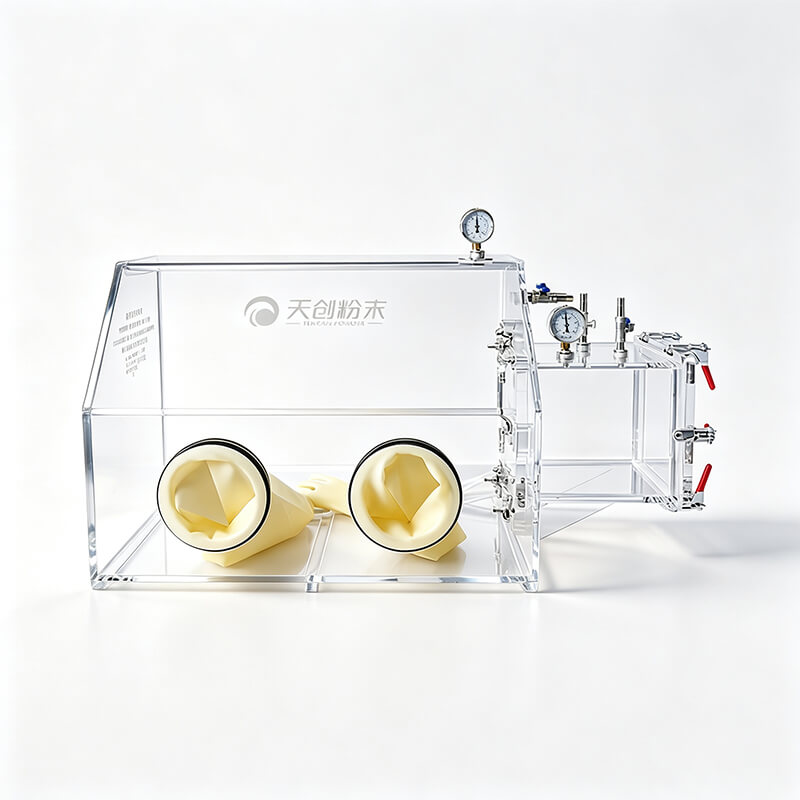
The TENCAN GBT Series Acrylic Glove Box is an acrylic glove box for controlled-atmosphere work where visibility and direct manual access are useful. The product page is the authoritative source for current chamber dimensions, glove-port arrangement, transfer-chamber options, and accessories. Confirm those details on the quotation drawing rather than assuming them from a generic photograph. This matters in powder work, where the balance, containers, and cleaning access compete for the same space.
Acrylic construction gives a wide view of the working zone. For weighing and transferring small quantities, that visibility makes it easier to see spills, keep containers upright, and check that a sample is fully transferred. It also helps during training, because a supervisor can observe a procedure without opening the enclosure. These are practical advantages, not a claim that acrylic suits every chemical or pressure regime.
The material also defines the operating envelope. Acrylic is not the right choice for every solvent, cleaning agent, or high-vacuum duty. Users should provide a solvent list, a cleaning protocol, and any expected temperature excursions so compatibility can be reviewed before the unit is built. If the process involves aggressive chemistry, a different enclosure material may deserve the conversation. The GBT case is strongest when the task needs clear visibility, moderate working volumes, and a documented procedure.
Evaluate the GBT as a system, not as a transparent box. The enclosure, gas supply, transfer path, monitoring, and any thermal support all contribute to the result. Some boundaries are worth stating explicitly:
- An inert-gas purge is not a continuous purification system. For a maintained oxygen or water level, ask for the purification and monitoring configuration and the acceptance-test method.
- A transfer chamber is a transfer device, not a substitute for continuous atmosphere control. Its volume, purge routine, and pressure or vacuum rating should be stated separately.
- Particle filtration, where fitted, addresses particles. It does not remove water vapour or oxygen.
The practical question is whether the configured GBT can hold the required atmosphere during the planned weighing and transfer routine, and whether the enclosure material is compatible with the powder, solvent, and cleaning method. That is a configuration question, answered with a drawing and a test plan.
Six criteria to apply equally to every supplier
A fair comparison uses the same questions for every candidate. These six criteria can be answered from drawings, test methods, and a trial with a representative powder.
1. Atmosphere target and proof
State oxygen and water targets separately, along with recovery time after a transfer, transfers per session, and alarm philosophy. Ask where the sensors sit, how they are calibrated, and whether acceptance is a spot reading or a logged recovery test. A single low reading after a long purge is weaker evidence than a recovery profile under a realistic transfer load. The right target depends on the material, not on a marketing number.
2. Acrylic compatibility and cleaning
List every solvent, acid, base, and cleaning agent that might contact the enclosure, gloves, or internal surfaces. Acrylic has compatibility limits, and some common laboratory solvents can cause crazing or clouding. Ask for a material-compatibility review and a cleaning method that does not scratch the viewing surfaces. If the process needs frequent aggressive cleaning, a different material may be the better design choice.
3. Transfer strategy, pressure and vacuum
Describe how powders and containers enter and leave. A transfer chamber with a defined purge cycle may be appropriate, but its working pressure, vacuum rating, and cycle time should be stated separately from the main chamber. Do not assume a chamber rated for vacuum is also rated for a particular gas-supply pressure, or that a fast purge suits a static-sensitive powder. Write down and practise the transfer routine before production samples are introduced.
4. Ergonomics, balance and sample size
Measure the balance, the largest sample container, and the tools that must remain inside. Check working depth, glove-port spacing, and viewing angle with the people who will do the task. A box comfortable for a five-minute transfer may be tiring for a two-hour weighing campaign. Consider where the balance sits, how the sample is presented, and whether the operator can reach the back of the chamber without contaminating the gloves. Resolve these details on a drawing.
5. Powder containment, static and cleaning
Fine powders can migrate into corners, cling to gloves, and become airborne during transfer. Ask how internal surfaces are finished, how corners are cleaned, and whether an antistatic strategy is needed for the specific powder. Static is material- and humidity-dependent, so test it with the real powder rather than assuming. A routine that works for a coarse granule may be inadequate for a sub-micron powder. The goal is a repeatable transfer with a known cleaning endpoint.
6. Thermal support, documentation and acceptance
Some powder processes involve heat from a hotplate, a press, or a nearby instrument. Where thermal support is required, the utility plan should include heat load, fluid, tubing, and control integration. The TENCAN Precision Recirculating Water Chiller is listed among glove box accessories; its suitability for a particular GBT configuration should be confirmed rather than assumed. Documentation should include the general arrangement drawing, utility requirements, operating manual, spare-parts list, and the agreed acceptance test. Training and service belong in the same conversation.
Positive comparison: where each containment approach fits
The table compares equipment approaches, not brand rankings. It shows where the GBT acrylic box has a clear application fit and where another approach may be the more natural place to start. Apply the same evidence standard to every row.
| Approach | Typical positive fit | Visibility | Atmosphere control | Chemical compatibility | Scale and next check |
|---|---|---|---|---|---|
| TENCAN GBT acrylic glove box | Powder weighing, transfer, and small-scale assembly where clear viewing and direct manual access help. | High, because the acrylic chamber is transparent. | Depends on the gas, purge, purification if specified, sealing, and monitoring configuration. | Confirm the solvent and cleaning list; acrylic has limits. | Confirm chamber size and footprint on the drawing; request a compatibility and acceptance-test review. |
| Stainless-steel glove box | Processes that need a durable metal enclosure or a particular vacuum duty where specified. | Viewing depends on window design and size. | Depends on the purifier, sensors, and transfer routine. | Metal grade and internal finish should be matched to the chemistry. | Confirm pressure and vacuum ratings, cleaning access, and service plan. |
| Glove bag | Short, portable operations where a small working volume is sufficient. | Good, because the film is usually clear. | Limited to the purge method and the integrity of the bag. | Film compatibility must be checked for the powder and solvent. | Confirm film type, leak test, and one-use or reuse policy. |
The GBT row is first because it is the subject of this guide, not because the table proves an overall winner. A stainless-steel box may be the better conversation for aggressive chemistry or a demanding vacuum duty. A glove bag may be sufficient for a short, low-risk transfer. The useful decision is the one that matches the powder, the exposure limit, and the cleaning routine.
Where the GBT acrylic box fits in powder projects
The strongest fit is usually a workflow that values visibility and manual dexterity, uses materials compatible with acrylic, and can define a transfer and monitoring routine.
Weighing and dispensing
Weighing is often the first place where an air-sensitive powder is exposed. A clear chamber allows the operator to see the balance pan, the vial, and the powder stream, which can reduce spills and repeated opening. The balance footprint, vibration sensitivity, and static behaviour of the powder should be checked before the layout is fixed. If the balance is too large for comfortable access, the workflow will be awkward regardless of the atmosphere specification.
Transfer and short-term holding
Powders may need to move from storage to a vial, from a vial to a press, or from a glove box to an analytical instrument. Each transfer adds an exposure step. The GBT can provide a visible working zone for opening, sub-sampling, and closing containers, provided the transfer path and purge routine are defined. The number of transfers per session matters: a procedure that works for one vial may not work for twenty. Ask for a recovery test that reflects the real transfer load.
Small-scale assembly and sample preparation
Some powder projects involve pellet pressing, slurry preparation, or mounting a sample for microscopy. These tasks need space for tools and a cleaning routine between samples. Acrylic visibility can help with alignment and inspection, but the enclosure must be compatible with the solvents and temperatures involved. If a process generates heat or requires a press with a large frame, review the layout early. A glove box is a controlled zone with a defined working envelope, not a universal workshop.
Battery, solid electrolyte, perovskite and catalyst research
These material families are often described as air-sensitive, but the specific sensitivity varies widely. A cathode precursor, a sulfide solid electrolyte, a perovskite powder, and a supported catalyst may each need a different exposure limit and analytical control. Evaluate the GBT with a representative sample and a stated test method, not with a generic claim that it suits every material in the family. A successful trial might measure weight change, phase stability, or a functional property after a defined handling routine.
When another approach deserves the conversation
If the chemistry attacks acrylic, if the process needs a high-vacuum duty beyond the confirmed rating, or if the powder presents a toxicity or flammability hazard that requires a different containment strategy, another enclosure type may be more appropriate. This is not a criticism of the GBT; it is a normal part of matching equipment to duty. The same applies when the sample volume is very small and a short, portable glove bag is sufficient.
How to compare TENCAN with an international supplier fairly
A brand-level comparison is only as good as the published data behind it. If one supplier provides a drawing, a sensor calibration method, and a recovery test, while another provides only a brochure, the comparison is measuring documentation, not equipment. That does not mean the less-documented supplier has a worse product; it means the buyer needs more information. Send the same material brief and the same six criteria to every candidate.
For TENCAN, the positive case is built around a documented acrylic glove box and a defined accessory path. The GBT provides a visible working chamber, and the product page is the reference for current configuration options. The precision recirculating water chiller is listed among the glove box accessories for projects that need thermal support. These are concrete starting points for a technical discussion, not a claim that every powder process is a match.
International suppliers may bring different standard configurations, documentation sets, or service models. Those differences are not defects; they are reasons to compare like with like. Ask each supplier for the same chamber drawing, atmosphere test method, material-compatibility statement, and list of excluded operating conditions. If a data point is missing, record it as missing and keep it out of the scoring. Do not turn an absent number into either an advantage or a disadvantage.
Procurement checklist for a powder glove box
Use this checklist to keep the evaluation grounded in the powder task. It can be applied to the GBT and to any alternative under consideration.
- Define the powder chemistry, particle size, and the sensitivity that matters.
- State the acceptable exposure time and the maximum number of transfers per session.
- Set separate oxygen and water targets, with a recovery-time requirement.
- List all solvents, cleaning agents, and expected temperatures.
- Measure the balance, sample containers, tools, and required working depth.
- Describe the transfer path and the expected transfer-chamber cycle.
- Confirm the pressure and vacuum ratings as separate values.
- Ask how the atmosphere sensors are calibrated and alarmed.
- Review the acrylic compatibility and the cleaning method.
- Check the internal finish, corners, and static-control plan for the powder.
- Request the general arrangement drawing, utility list, and acceptance test.
- Agree on training, spares, and the service response path before purchase.
A sample evaluation is the most useful next step. Provide TENCAN with a representative powder, the target oxygen and water levels, the planned weighing and transfer routine, the solvent list, and the acceptance method. Ask for a configuration review against those inputs. If the review shows that acrylic is not the right material, or that a different transfer strategy is needed, that is a valuable result rather than a lost sale. The aim is a documented match between the enclosure and the powder workflow.
Sources and Further Reading
- TENCAN, GBT Series Acrylic Glove Box: https://www.gloveboxs.com/products/acrylic-glove-box/gbt-acrylic-glove-box.html
- TENCAN, Precision Recirculating Water Chiller: https://www.gloveboxs.com/products/glove-box-accessories/precision-recirculating-water-chiller.html
Product images are from the TENCAN product pages listed above.
