
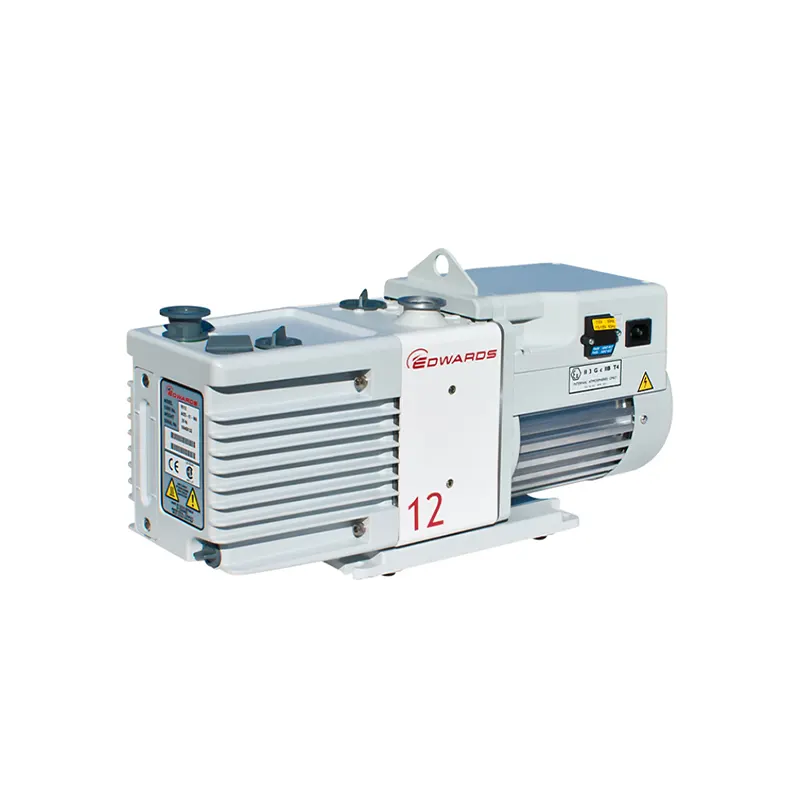
The vacuum pump is easy to overlook because it sits outside the glove box and runs only during transfer. Yet in many glove box workflows, it is the component that decides how much air enters the antechamber, how long a transfer takes, and how hard the gas purification system must work afterward. TENCAN lists a Glove Box Vacuum Pump as a glove box accessory. Its value is not that it creates a protective atmosphere; it removes the bulk atmosphere from a sealed transfer volume before that volume is opened to the inert working space.
That distinction matters. A pump can lower the pressure in an antechamber, but it cannot remove trace oxygen and water from a circulating atmosphere, regenerate a purifier, or compensate for a leaking glove. Those jobs belong to the gas purification system, the purifier column, the circulation loop, and the monitoring chain. A well-chosen pump reduces the load on those systems by limiting the air that reaches them. A poorly matched pump can create a different set of problems: slow transfers, solvent-contaminated oil, backstreaming, seal wear, or a vacuum gauge that reports a number the process cannot use.
The Vacuum Pump's Job Is Transfer, Not Atmosphere Generation
In a typical glove box, the antechamber, also called the transfer chamber or airlock, is the buffer between laboratory air and the inert workspace. A sample, tool, or small device is placed in the antechamber, the outer door is closed, and the chamber is evacuated. The pump pulls air out of that volume. The chamber is then refilled with the working gas, usually nitrogen or argon, and the inner door is opened to the glove box. The cycle may be repeated. Each evacuation lowers the amount of air that can enter the box when the inner door opens.
The pump is therefore a batch device. It does not maintain the glove box atmosphere between transfers. It does not circulate gas through the purifier. It does not measure oxygen or water. Its performance is judged by how quickly and reliably it can evacuate the antechamber to the pressure the procedure requires, and by how well it tolerates the gases and vapors it sees.
Evacuation and backfill as a batch cycle
A transfer cycle usually has four stages: load, evacuate, backfill, and equalize. The pump works mainly during evacuation. The refill step may use working gas from the glove box or from a supply line; the pressure equalization step protects the inner door and the gloves from an abrupt pressure difference. The exact sequence, valve arrangement, and control logic depend on the glove box design. The important point is that the pump is part of a sequence, not a standalone atmosphere solution. If the valve timing is wrong, if the inner door is opened before the pressure is equalized, or if the outer door seal is worn, the pump may perform correctly and the transfer will still be poor.
Pump selection should therefore start with the transfer chamber and the procedure, not with a catalog page. A small antechamber used occasionally has different demands from a larger chamber used dozens of times per shift. A pump with a high pumping speed can shorten evacuation, but only if the line, valve, and chamber conductance allow the gas to reach the pump. A pump with a very low ultimate pressure may be unnecessary if the procedure only requires rough evacuation before backfill. Conversely, a pump that is adequate on a clean, dry chamber may struggle when solvent vapors, dust, or condensable materials are present.
Why the pump influences purifier load
Every transfer brings a small amount of air into the glove box unless the antechamber is evacuated effectively. Oxygen and water in that air must be removed by the gas purification system. The purifier columns have a finite capacity, and they regenerate on a schedule or on a condition-based trigger. A pump that leaves more air in the antechamber, or a cycle that skips a proper evacuation step, increases the load on the columns and can make oxygen or moisture readings recover more slowly. The pump is not the cause of every slow recovery, but it is part of the mass balance.
Operators may see a moisture reading rise after a transfer and assume the purifier is failing. The more useful question is whether the transfer introduced more moisture than usual: Was the antechamber evacuated to the normal pressure? Was the outer door sealed? Was a wet sample or a solvent-soaked item placed inside? Was the purge time shortened? Was the pump actually pulling on the chamber, or was a valve closed? A pump cannot fix a wet sample, and a purifier cannot compensate indefinitely for a procedure that repeatedly admits air.
Where a Glove Box Vacuum Pump Sits in the System
The TENCAN Glove Box Vacuum Pump is listed as a glove box accessory, which is the right way to think about it: as one element in a vacuum path that includes the antechamber, the isolation valve, the hose or piping, the gauge or switch, and the exhaust. The pump inlet is not connected directly to the working space in normal operation. It is connected to the volume being evacuated, through a valve that isolates the pump when the chamber is backfilled. The exhaust must be directed to a safe location, especially when the pump may see solvents or other vapors.
Pump, valve, chamber, and gauge form one vacuum path
The pump's catalog performance is measured at its inlet. The chamber sees something different. A long, narrow hose, a partially closed valve, a clogged filter, or a poor flange connection can reduce effective pumping speed and extend pumpdown time. These losses are called conductance losses. They are common in retrofit installations because the pump is added after the glove box is in service, and the shortest path is not always the best path. A large pump connected through a restrictive line may perform no better than a smaller pump with a clean, short connection.
The gauge is part of the path too. A vacuum gauge at the pump inlet reads the pump's condition; a gauge at the chamber reads the chamber's condition. If the two disagree, the difference may be a real pressure drop across the line, or it may be a gauge that is not suitable for the pressure range. A gauge with fine resolution is not necessarily accurate. Resolution is the smallest displayed change; accuracy is how close the reading is to the true pressure. For transfer control, a switch or sensor that reliably indicates an evacuated condition is often more useful than a high-resolution display that is not calibrated.
What the pump does not do
A glove box vacuum pump does not remove oxygen and water from a circulating gas stream. It does not replace the purifier column, the circulation blower, or the oxygen and moisture analyzers. It does not create a sterile environment, a cleanroom classification, or a biological safety barrier. It does not make every gas inert for every sample. It also does not guarantee that a vacuum glove box or a purification glove box is suitable for a particular process. Those are system-level questions that depend on the box design, the purifier, the gloves, the seals, the sample, and the procedure.
It is equally important not to confuse evacuation with purging. Evacuation removes gas from a sealed volume; purging displaces one gas with another. Some transfer sequences use both: a vacuum cycle followed by a gas refill, repeated several times. Each step has a different purpose. A pump is essential to the evacuation step, but it does not perform the purging step by itself. If a procedure relies on dilution rather than evacuation, the pump's role may be smaller than expected, and the gas consumption may be larger.
Why a General-Purpose Pump Can Be a Poor Match
A vacuum pump that works well on a clean, dry laboratory chamber is not automatically suitable for glove box service. The glove box pump sees a specific combination of conditions: short, frequent cycles; possible solvent vapors; possible fine powders; a need for reliable automatic control; and an exhaust that may be inside a laboratory. The pump must be matched to those conditions, not only to a target pressure.
Chemical vapors and oil backstreaming
Oil-sealed rotary vane pumps are common in laboratory vacuum service because they are widely available and can reach low pressures. In a glove box accessory role, their main vulnerability is the oil. Solvent vapors can dissolve into the oil, dilute it, and raise its vapor pressure. Water can emulsify or corrode internal parts. If the pump is not protected by a cold trap, sorbent trap, or other suitable means, vapors can migrate toward the pump and, under some conditions, oil vapor can migrate back toward the chamber. Backstreaming is not a reason to reject every oil-sealed pump, but it is a reason to ask how the pump will be protected and how the oil will be monitored.
Dry pumps avoid oil in the swept volume, which can be an advantage when solvent exposure is expected or when oil changes are difficult. They are not automatically better for every application. Dry pump designs differ in their achievable vacuum, tolerance to condensable vapors, heat rejection, noise, and cost. Some dry pumps are intended for clean, dry gas and may require inlet filtration or a purge. The correct choice depends on the vapor load and the cycle, not on the label dry alone.
Whatever the pump type, the exhaust path deserves attention. A pump that compresses solvent-laden gas may discharge that gas into the laboratory. Local exhaust ventilation, an exhaust line to a safe location, or a suitable trap may be needed. The specific requirement depends on the substances used and the site's safety assessment. A glove box pump should not be treated as a sealed, emission-free device.
Duty cycle and connection losses
Glove box transfers are often short and repetitive. A pump may run for a few minutes, stop, and start again after the next sample. That pattern places different demands on the motor, bearings, seals, and valves than continuous operation does. The pump's duty cycle, allowable starting frequency, and thermal limits should be checked against the expected transfer rate. A pump that is oversized for the chamber but undersized for the cycle may still overheat if it is started too often or if its cooling is inadequate.
Control integration is another selection factor. The pump may need to start and stop under the glove box's programmable logic controller, or it may be controlled by a manual switch. The interface may be a contact, a relay, a 24 V signal, or a communication protocol. The antechamber valve may be pneumatic or manual. The pump may need a run-status signal, a fault signal, or an interlock that prevents the inner door from opening unless the chamber is at the correct pressure. These details determine whether the transfer sequence is repeatable.
When a transfer is slow, the pump is often blamed first. The cause may be a collapsed hose, a swollen seal, a closed valve, a clogged inlet filter, or a leak in the antechamber door. A hose that is too narrow for the pumping speed can dominate the pumpdown time. A hose that is too long, or that has a sharp bend, can do the same. A quick-connect fitting that was not fully engaged can leak. A filter that was installed to protect the pump can become blocked with dust or condensed material. These are normal maintenance and installation issues, not evidence that the pump is defective.
Selection Criteria for a Glove Box Vacuum Pump
The right pump is the one that satisfies the transfer procedure with an acceptable margin, tolerates the process chemistry, and fits the available space, utilities, and controls. Model-specific values should be confirmed from the current TENCAN datasheet and the glove box documentation; they should not be inferred from a product name or a photograph.
Target pressure, chamber volume, and pumpdown time
Start with the pressure the procedure actually needs. Vacuum is not a single condition. A rough vacuum suitable for removing bulk air before backfill is different from a low pressure needed for a leak test or a vacuum-drying step. The pump's ultimate pressure is only one input. The working pressure, the chamber volume, the starting pressure, the allowable pumpdown time, and the conductance of the line all matter. A larger chamber or a longer line requires more pumping capacity or more time. A pump with a low ultimate pressure but a small pumping speed may take too long to reach the working pressure.
Pumpdown time also depends on outgassing. The internal surfaces of the antechamber, the gloves, and the load can release water or solvent vapor as the pressure falls. A clean, dry, empty chamber will pump down faster than a chamber that has just held a solvent-soaked sample. If the process involves solvents, the pump must be selected for that vapor load, and the pumpdown procedure may need a purge or a trap. A pump that meets the empty-chamber specification may not meet the production cycle.
Wetted materials and solvent exposure
Ask what the pump's wetted materials are and whether they are compatible with the substances that may enter the antechamber. This includes the pump's seals, valves, diaphragm or piston materials, and any internal coatings. It also includes the hose, the inlet filter, and the trap. Compatibility is not only about corrosion; it is also about swelling, hardening, and permeation. A material that is chemically resistant to a liquid may still absorb vapor and release it later.
Solvent vapor can affect the pump in several ways. It can dilute lubricating oil, raise oil vapor pressure, attack elastomers, or condense in the line. A cold trap or sorbent trap can reduce the vapor load, but a trap adds maintenance and can itself become a source of contamination if it is not changed. A filter that removes particles does not remove solvent vapor. HEPA filtration is for particles, not for water or organic vapors. These distinctions matter when specifying the accessory chain.
Connection, control, and service access
The pump inlet must connect to the glove box's vacuum port in a way that is vacuum-tight, mechanically stable, and compatible with the required conductance. Common connection types include KF flanges, threaded fittings, and hose barbs. The right choice depends on the port on the glove box, the pump inlet, and the expected frequency of disconnection. A hose barb and flexible hose are convenient, but a flexible line can collapse under vacuum if it is not rated for the duty. A KF connection is more rigid and easier to seal, but it requires the correct centering ring and clamp.
The isolation valve is part of the connection. It must be suitable for the pressure range and the gas, and it must close reliably before the chamber is backfilled. If the valve leaks, the pump may continue to pull on the chamber during backfill, wasting gas and disturbing the pressure balance. If the valve is manual, the procedure depends on the operator's timing. If it is automatic, the control sequence must be defined and tested. The pump should not be used as the isolation valve.
Every pump needs maintenance. Oil-sealed pumps need oil checks and changes; dry pumps need inlet filters, seals, and sometimes bearing service. The maintenance interval depends on the duty cycle and the process. A pump that is mounted in a cramped space, behind a panel, or above a shelf may be difficult to service. Service access should be planned before installation, not after the first failure. Noise and vibration are practical factors in a laboratory, especially if the pump shares a room with a balance, a microscope, or a sensitive analytical instrument.
Matching the Pump to a Two-Station Split-Type Glove Box
The reference glove box for this discussion is the Two-Station Single-Sided Split-Type Glove Box with Gas Purification System. Its name identifies three configuration facts: two workstations, a single-sided arrangement, and a split-type enclosure with a gas purification system. Those facts affect how the box is used, but they do not by themselves specify the pump. The transfer chamber volume, the valve arrangement, the required vacuum level, and the expected transfer frequency still need to be confirmed.
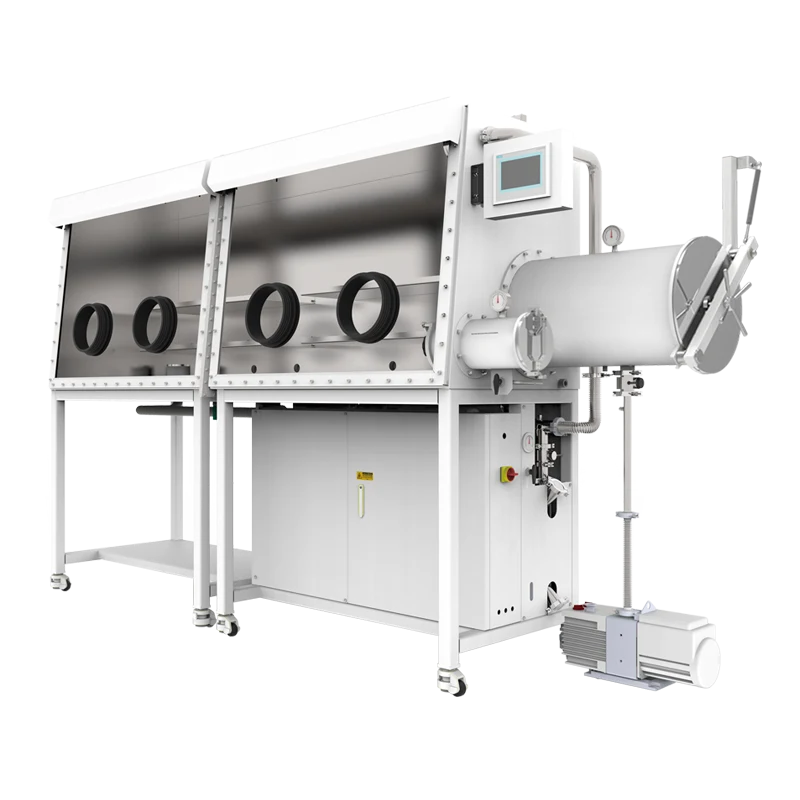
A two-station box can serve two operators or two related tasks. That may increase the number of transfers per shift, especially if each station introduces samples through the same antechamber. A higher transfer rate can affect pump duty cycle and purifier load. It does not automatically mean that a larger pump is required; the correct response may be a larger antechamber, a different valve sequence, a second transfer chamber, or a procedure change. The pump should be sized for the actual cycle, not for the number of gloves.
What to confirm with TENCAN
Before selecting the TENCAN Glove Box Vacuum Pump for a specific glove box, confirm the following with the supplier: the antechamber volume and port size; the intended working pressure and pumpdown time; the valve type and control interface; the expected gas and vapor exposure; the exhaust requirements; the electrical supply; and the available space. Also confirm whether the pump is supplied with a trap, filter, hose, flange, or switch, and whether those items are compatible with the glove box. Do not assume that an accessory listed for glove box service is a direct fit for every model.
This is especially important when the pump is added to an existing box. The existing antechamber may have a port that is smaller than the pump inlet, or a manual valve that was designed for a different pump. The existing gauge may not cover the intended pressure range. The existing control system may not have a spare output for a pump run signal. A short compatibility review can prevent a long installation delay.
Verification, Symptoms, and Ordering Checklist
The following observations are not fault codes. They are starting points for a structured check. In each case, the pump may be involved, but the chamber, valve, line, gauge, or procedure may be equally responsible. Do not replace the pump until the vacuum path has been checked.
Slow pumpdown
Slow pumpdown can come from a restricted inlet, a collapsing hose, a clogged filter, a leaking door seal, a leaking valve, or a pump that is worn. It can also come from outgassing of a wet or solvent-laden load. Compare the pumpdown curve with a baseline taken when the chamber was clean and empty. If the baseline is also slow, check the line and pump. If only the loaded condition is slow, review the load and the purge procedure. If the pump's blank-off pressure is poor, the pump may need service, but confirm the gauge and the test method first.
Oxygen or moisture spike after transfer
A spike after transfer suggests that air or moisture entered the box. The antechamber may not have been evacuated to the usual pressure, the inner door may have been opened too early, the outer door seal may be worn, or the sample may be releasing moisture. The pump could be weak, but it could also be isolated by a closed valve or a control fault. Check the transfer sequence, the valve positions, the door seals, and the purifier status. A single spike after a deliberate transfer is different from a persistent rise with no transfers; the latter points toward a leak or a purifier issue.
Oil mist, noise, or overheating
Oil mist at the exhaust or in the chamber is a serious signal. Stop the pump and inspect the exhaust, the oil level, the oil condition, and any trap. Oil mist can indicate overpressure, a blocked exhaust, a worn seal, or the wrong oil. Noise and overheating can indicate a worn bearing, a cooling problem, a wrong voltage, or a duty cycle that exceeds the pump's rating. These conditions should be checked by qualified service personnel. Do not continue to run a pump that is overheating or discharging oil into the workspace.
A gauge can show a good vacuum while the process still sees moisture. The gauge measures total pressure, not water partial pressure. A chamber can be at a low total pressure and still have enough water vapor to affect a sensitive sample. If the process is moisture-sensitive, check the transfer procedure and the purifier performance, not only the pump. The pump's job is to remove bulk gas; the purifier's job is to remove trace water and oxygen from the circulating atmosphere.
| Information to define | Why it matters |
|---|---|
| Antechamber volume and dimensions | Sets the amount of gas to be removed and the practical pumpdown time. |
| Required working pressure and allowable pumpdown time | Connects the pump's performance to the transfer procedure, not just to a catalog ultimate pressure. |
| Gas used for backfill and any process gases | Affects gauge choice, seal compatibility, and exhaust routing. |
| Solvents, acids, powders, or condensable materials | Determines the need for a trap, filter, dry pump, or special wetted materials. |
| Transfers per shift and cycle pattern | Defines duty cycle, starting frequency, and maintenance interval. |
| Port size, flange type, and line length | Determines conductance and the fittings required for a leak-tight connection. |
| Valve and control interface | Ensures the pump can be interlocked with the antechamber sequence. |
| Electrical supply and environment | Matches voltage, phase, cooling, noise, and service access. |
| Exhaust location and ventilation | Addresses solvent vapor and discharge in the laboratory. |
| Documentation and spare parts | Supports commissioning, maintenance, and future service. |
For a TENCAN glove box project, the most useful application information is specific: the model or configuration of the glove box, the antechamber size, the target pressure, the sample types, the solvents used, the number of transfers per day, the available utilities, and the control requirements. With that information, the pump can be selected as part of the vacuum path rather than as an isolated catalog item. The same information helps confirm whether the TENCAN Glove Box Vacuum Pump is the right accessory for the box, or whether a different configuration, trap, or valve arrangement is needed.
The central point is simple: a glove box vacuum pump is a transfer accessory, not an atmosphere generator. Its performance depends on the chamber, the line, the valve, the gauge, and the procedure as much as on the pump itself. Select it for the real cycle, protect it from the real chemistry, and verify the whole path. That approach supports the gas purification system instead of asking it to compensate for avoidable air ingress.
