
The name of this system encodes three engineering decisions: a two-station layout, a single working face, and a split-type build. Each is defensible on its own; together they decide how the box behaves day to day — how many people can work at once, how quickly the atmosphere recovers after a transfer, how the unit travels through a building, and how it is serviced years later. This article works through those interactions, using the two-station single-sided split-type glove box with gas purification system as the reference configuration, and sets out what to confirm with a supplier before an order is placed.
It assumes a reader who already treats a glove box as a controlled atmosphere system rather than a sealed enclosure with sleeves. That distinction is what makes configuration choices consequential: most of the complaints heard in materials laboratories — readings that recover slowly, results that differ between two operators on the same box — trace back to specification and operating practice rather than to one failed component.
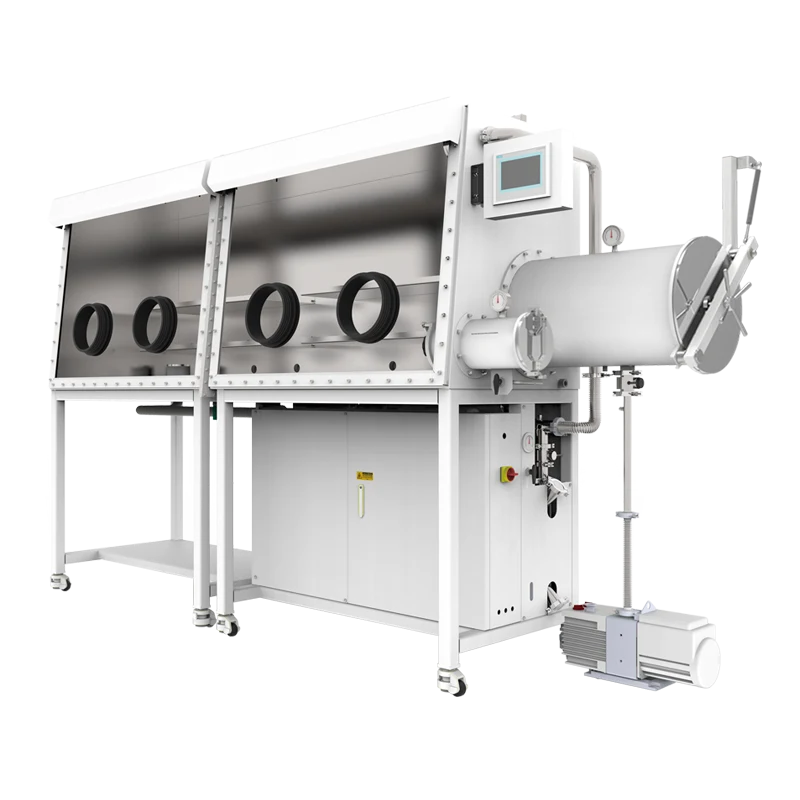
Reading the Name: Two Stations, One Face, Split Construction
The three descriptors in the name affect different things. Station count affects throughput and internal volume, sidedness affects workflow and reach, and split construction affects logistics, installation and service. Separating them is the first step toward a specification that matches real work rather than a brochure list.
What Two Stations Actually Buy You
A two-station box provides two glove port positions along the same working face. That supports two operators working in parallel or, more commonly in research laboratories, one operator alternating between set-ups without dismantling anything. The second case is often the more valuable one: a sample that must stay under inert atmosphere can remain at station two while station one is used for weighing, cutting, assembly or mounting. The cost is internal volume. A larger enclosure holds more gas, presents more internal surface and offers more places for outgassing to begin, so the same purification capacity takes longer to restore the working level after an air ingress event. Station count and volume are not interchangeable specifications: a two-station enclosure with a small purifier behaves differently from a single-station enclosure with the same purifier.
What Single-Sided Construction Changes
Single-sided, or single-face, designs place all glove ports, the viewing window and usually the antechamber on one side of the enclosure. The workflow becomes linear: material enters through the transfer chamber, is processed along the face, and leaves by the same route. Gas movement inside the box is easier to organise because the working zone is not divided into two facing halves, and the rear wall stays free for feedthroughs, gas lines, solvent traps and the connection to the purification module. Reach is the limitation. Operators work through gloves fixed to one plane, so heavy or bulky equipment must sit where it can genuinely be manipulated — near the front window, on a low shelf, or on a cart that can be moved into place. Single-sided construction also rules out the face-to-face collaboration of double-sided designs, which matters in training and in processes that need two people on opposite sides of one sample.
What Split-Type Construction Means for Delivery and Service
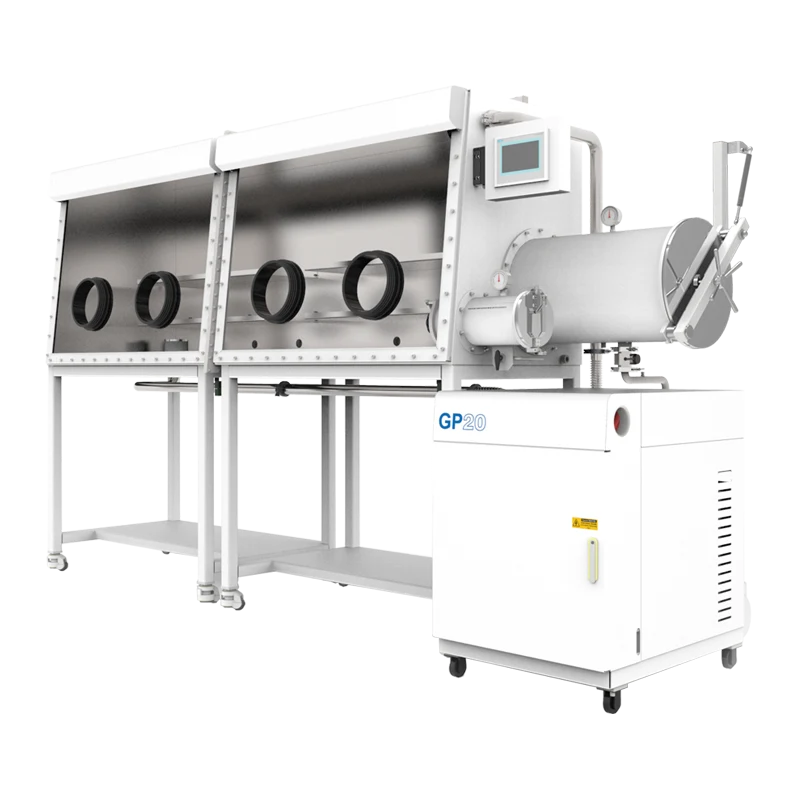
Split-type describes a system built from separate structural units rather than one welded monolith. The consequences are logistical before they are technical: a split enclosure and its purification and control assembly can normally be moved through standard laboratory doors, corridors and lifts, and positioned with lighter handling equipment. Each split, however, introduces joints — gas connections, electrical interconnections, sealing faces — and those joints become commissioning items. Ask where the split boundary sits, whether the sections are tested as a matched set before shipment or only after on-site assembly, and who carries responsibility for connecting, leak-testing and documenting the result.
How the Gas Purification Loop Sets the Ceiling on Performance
In a purification glove box the enclosure is only half of the system. The other half is the closed loop that continuously moves atmosphere out of the box, through purification columns and back again. That loop determines how low impurity levels can be held, how quickly the box recovers after a disturbance, and how much operating time is consumed by regeneration and consumables.
Circulation, Not Flushing
A purification box is a closed-loop system: gas is drawn from the enclosure, passed through purifying material and returned. It does not rely on continuously venting fresh inert gas to hold impurity levels down. That keeps inert gas consumption modest during normal operation and makes atmosphere quality largely independent of day-to-day variation in the site gas supply — provided the loop is running, the columns are active and the enclosure is tight. Purge-only boxes are simpler and cheaper, but their atmosphere is tied directly to purge rate and gas purity: every transfer dilutes the working zone, and the only remedy is more gas. Knowing which architecture is being quoted matters more than any single impurity figure on a brochure.
Purification and Regeneration Are Two Different States
The columns contain materials that bind water and oxygen. Over time those materials saturate, and the loop's ability to hold a low impurity level falls away — often gradually, without an obvious alarm, until readings begin to drift upward. Regeneration reverses saturation by heating the columns and sweeping them with a regeneration gas before cooling them back into service. The composition of that gas, its flow rate, the temperature profile and the duration of each step belong to the unit's manual and should never be inferred from generic guidance or from another manufacturer's procedure. Two operational points follow. Regeneration is scheduled maintenance, not a response to a contamination event. And a box that is regenerating is not purifying at that moment, so campaign planning has to accommodate it. Laboratories running near-continuous work on air-sensitive materials should clarify the expected regeneration interval and whether a standby column set is available, because that determines whether the box runs through a weekend or stops.
What Analyzers Tell You — And What They Do Not
Water and oxygen analyzers sample the atmosphere at a defined point and report a value. That value is useful for trend monitoring, for confirming that a transfer is complete and for showing that the loop is doing its job. It is not a map of the enclosure. A sensor may sit on the return line near the purifier while moisture accumulates in a corner beside a porous sample. Resolution — the smallest change a display can show — is not accuracy, and neither figure is a guarantee for the box as a whole. When comparing quotations, ask where each sensor is mounted, how often it is calibrated, against what reference, and whether the system logs readings during transfers as well as at rest. A number taken at the wrong moment answers the wrong question.
Where Atmosphere Is Lost: Transfers, Gloves and the Vacuum Pump
Impurity levels rise during disturbances, not during quiet operation, and the disturbances are predictable: material entering and leaving, gloves in use and being replaced, doors opening, and equipment inside the box releasing trapped air or solvent vapour.
The Antechamber Cycle Is a Dilution Process
An antechamber — also called an airlock or transfer chamber — reduces the amount of air carried into the working volume, but it cannot remove all of it. Each evacuation and refill cycle dilutes the residual air by a fixed fraction. Because dilution is geometric, several short cycles generally achieve more than one long evacuation, and the number of cycles, the vacuum level reached and the refill pressure all influence the result. Under-evacuating to save a few minutes is the most common way a laboratory quietly undoes the benefit of an otherwise well-specified box. The inner door should be opened only after the chamber has been refilled to the box's working pressure, since opening early creates a pressure surge that disturbs the whole atmosphere and stresses the gloves.
Why Pump Selection Matters More Than Pump Price
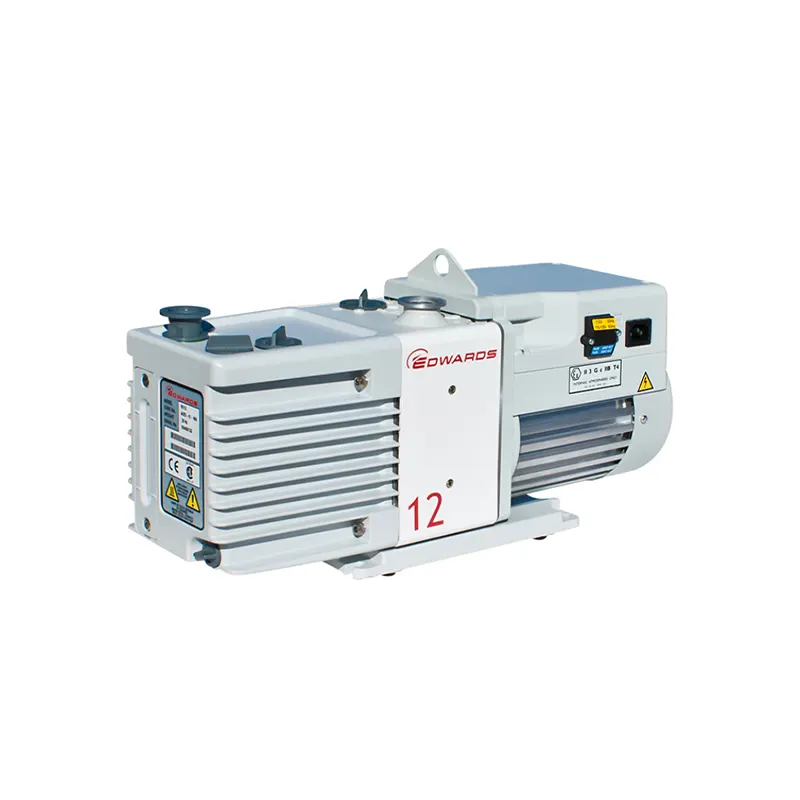
The vacuum pump makes routine transfer possible. Its job is not to reach the deepest vacuum on the market but to evacuate the antechamber, and any other evacuated volume, reliably and repeatedly in the presence of the gases and vapours a particular laboratory uses. Selection follows from that duty: pumping speed matched to chamber volume, an ultimate vacuum consistent with the cycle time required, and material compatibility where condensable solvent vapours are involved, which may call for a cold trap or a chemically resistant pump. If the same pump also serves a mini antechamber, a vacuum oven or a sample transfer vessel, the duty cycle changes and the sizing has to change with it. Because chamber volumes and duties differ between configurations, pump specification should be confirmed against your own box rather than assumed; the glove box vacuum pump page describes the accessory in its own terms, and suitability still has to be checked against the box it will serve.
Gloves Are a Barrier With a Service Life
Gloves are the most frequently replaced part of the system and one of the most common routes for moisture and oxygen to enter. Permeation depends on glove material, thickness, the solvents in use and handling practice; a glove repeatedly stretched over a sharp edge degrades faster than one used for light handling. Selection therefore balances dexterity, size, mechanical durability and chemical compatibility, and inspection belongs on a routine schedule rather than on a hunch. The same applies to ports, O-rings and door gaskets: a box is only as tight as its weakest seal, and seals age in ways that stay invisible until readings drift.
Slow Recovery After a Transfer: A Diagnostic Sequence
When readings recover more slowly than expected, a sequence is more useful than a diagnosis. Work through four groups. First, internal sources: samples, cardboard, paper, plastic bags, solvent residues and uncleaned tools all release moisture or oxygen, and their effect scales with the surface area introduced. Second, transfer practice: too few antechamber cycles, a chamber not fully evacuated, an inner door opened early. Third, loop status: whether circulation is running, whether the columns are due for regeneration, whether flow is restricted. Fourth, integrity and measurement: gloves, seals, feedthroughs and door gaskets on one hand, sensor location and calibration on the other. Only the first two groups are usually within the operator's immediate control, and only the last typically requires a service call. Naming the group first prevents the most expensive mistake — replacing parts to solve a practice problem.
Workflow Design for a Two-Station Single-Sided Box
Decide Whether the Second Station Serves a Person or a Process
There are two reasons to choose two stations, and they lead to different layouts. If the second station is for a second operator, port spacing, lighting and the position of shared instruments matter most, and the working face must be wide enough that two people do not obstruct each other. If it is for a process — a sample that must stay under atmosphere while another task proceeds — the priority shifts to keeping the idle station uncluttered, reserving it for a dedicated holder, balance or assembly fixture. In battery, perovskite, semiconductor and air-sensitive chemistry programmes, this second pattern is common: one station stays devoted to a partially assembled device while the other absorbs short, dirty operations. Answering this question first simplifies the remaining layout decisions, including the choice of antechamber size.
Keep the Rear Wall for Services and the Front for Hands
In a single-sided box the rear wall is the natural home for everything that should not move: power and signal feedthroughs, gas connections, loop supply and return lines, a solvent trap, and any analyser sampling point. Placing services there keeps the working face clear and reduces the chance of a cable being dragged across the gloves. Permanent instruments such as a small balance or a microscope should sit where controls remain reachable and the window is not blocked. Anything heavy belongs low and close to the front plane, because lifting force through a glove is limited and awkward.
Compare the Layout Options Honestly
| Configuration | Main advantage | Main trade-off | Typical fit |
|---|---|---|---|
| Single station, single-sided | Smallest volume, fastest recovery, lowest cost | One task at a time | Method development, low throughput |
| Two stations, single-sided | Two parallel tasks, or one process left undisturbed | Larger volume and more internal surface to manage | Most materials, battery and thin-film laboratories |
| Two or more stations, double-sided | Face-to-face collaboration, longer process lines | More seals, more volume, larger footprint, higher cost | Pilot-scale and production-like operations |
The table is a starting point, not a ranking. A two-station single-sided box with a well-matched purifier will hold a stable atmosphere more easily than an oversized double-sided box of the same purification capacity, because there is less volume and less seal perimeter to defend. The right answer depends on whether your bottleneck is space, throughput, collaboration or atmosphere stability.
Split-Type Construction: Site, Service and Integration
Check the Route Before the Specification
Walk the delivery path before finalising the purchase: door widths, corridor turns, lift dimensions, floor loading and any steps. A split-type system exists partly to make that route feasible, but the sub-assemblies still have to pass through the building, and the largest one sets the constraint. Photographs with a tape measure in the frame are more useful to a supplier than a description.
Plan Feedthroughs and Utilities Early
Feedthroughs are easier to specify with the enclosure than to retrofit. Electrical and signal feedthroughs for instruments, KF flanged ports for gas and vacuum lines, and probe access all require openings that must be sealed and documented. Every penetration is a potential leak path, so the aim is the smallest number of openings that supports the intended work, positioned where cables will not cross the working zone. In a split system, agree in advance which section carries which service so that interconnection work on site is unambiguous.
Plan for Service Access and Later Upgrades
Purification columns, blowers, valves and analyzers all need access for maintenance. A split configuration makes that easier if the purification and control module can be reached without moving the enclosure — but only when the layout was planned that way. Ask how the columns are removed, what clearance is required, and whether a second station, an additional antechamber or a larger purifier can be added later without rebuilding the system. If a laboratory expects to grow from two stations to more, the enclosure and the purification capacity should be chosen together rather than in sequence. The reference configuration, the two-station single-sided split-type purification glove box, is one point on that scale; confirm with the supplier which elements can be extended.
Matching a Vacuum Pump and Other Accessories to the Box
Start From the Duty, Not the Catalogue
Accessories should be chosen from the function they perform. The vacuum pump serves evacuation of the antechamber and of any other evacuated volume; what matters is the chamber volume it must empty, the cycle time the workflow requires, the gases and vapours it will see, and whether it will be shared with other equipment. An analyzer serves measurement, so its range, resolution, accuracy and calibration routine matter, and it must be placed where the sample is representative. A feedthrough serves connection and sealing, so conductor count or tube size, flange standard and leak-tightness requirement dominate. Gloves serve as the operator interface, so size, thickness, permeation behaviour and chemical compatibility dominate. Reading specifications through the function they perform prevents the common error of paying for performance in one area while leaving a bottleneck in another.
Do Not Let One Component Stand In for Another
Several functions in a glove box are easy to confuse, and the confusion produces unrealistic expectations. HEPA filtration removes particles; it does not remove water, oxygen or solvent vapour, and it is not a substitute for purification. Solvent adsorption protects the purification columns from organic vapours, but it is not water and oxygen purification. An analyzer measures the atmosphere; it does not change it. Evacuation and inert gas refilling dilute contaminants; they do not remove the last traces the way a continuously circulating purification loop does. Keeping these roles distinct makes problems easier to explain, because each symptom maps to a specific subsystem rather than to "the glove box" as a whole.
Verify Before You Commit
Because accessories interact with the box rather than standing alone, compatibility should be confirmed against the actual configuration: antechamber volume, port sizes, flange standards, available electrical supply, and the maximum acceptable vapour load. A pump well matched to a small transfer chamber may be under-sized for a larger one, and an analyzer calibrated for a narrow range may be unsuitable for the excursions seen during commissioning. Written confirmation of the mechanical, electrical and gas interfaces is cheap at the quotation stage and expensive afterwards.
Configuration Checklist and Data to Send a Supplier
The most efficient way to get an accurate proposal is to describe the work rather than the equipment. A supplier sizing a two-station single-sided split-type purification box needs the following.
- Sample types and their sensitivity: which materials must never see air or moisture, and how long they remain inside the box.
- Process steps performed inside: weighing, cutting, mixing, coating, cell assembly, microscopy, heating, or storage only.
- Number of simultaneous operators, and whether the second station serves a person or a process.
- Transfer frequency and typical item size, which together set antechamber volume and cycle requirements.
- Solvents used and their quantities, since these decide whether solvent adsorption and vapour-compatible pumping are needed.
- Required electrical and signal connections inside the box, and the instruments that will use them.
- Site constraints: door and lift dimensions, floor loading, available height, and the planned position of the purification module.
- Utilities available: power supply, the purity and pressure of the inert gas supply, and any additional services.
- Service expectations: who performs regeneration, how often, and whether downtime must be scheduled around campaigns.
- Documentation required at handover: leak test records, analyzer calibration records and the commissioning procedure.
A set of verification points belongs in the acceptance plan rather than in a folder. Confirm that the enclosure and the purification module have been leak-tested after final assembly, that the analyzer has been calibrated with its sampling point documented, that the antechamber reaches the vacuum level the intended cycle requires, and that the regeneration procedure is written down for the specific unit. Ask for the box to be demonstrated under a realistic disturbance — a transfer of the largest item you expect to handle — so that recovery behaviour is observed rather than assumed. A steady reading on a quiet box says very little; how the system behaves after a door closes says almost everything.
Treat the specification as a description of a working system rather than a list of parts. The two-station layout, the single face and the split build all exist to serve the work done inside the enclosure, while the purification loop sets the limit on what that work can reliably achieve. When station count, sidedness, construction and purification capacity are chosen together, the box stops being a source of variability in experimental results and becomes what it was bought to be: a stable, predictable atmosphere that supports the science rather than competing with it.
