
Air-sensitive work becomes easier to specify once the question is framed correctly. A glove box is not simply a sealed box filled with inert gas. It is a set of barriers, transfer steps, gas-handling functions, and monitoring choices. The GBV-1 Stainless Steel Vacuum Glove Box uses a stainless steel enclosure and vacuum–inert gas exchange to create a controlled environment. That architecture is useful for many tasks, but it is not the same as a glove box with a continuously circulating purification system. The difference affects how the box is used, how atmosphere readings behave, and which specifications matter at purchase.
The practical question is not whether a vacuum box is better than a purified box in general. It is what atmosphere must be held, for how long, and under what ingress. A researcher handling a few air-sensitive samples once a week has a different problem from a laboratory running a continuous campaign with frequent transfers and solvent-bearing materials. Both may need inert gas, but they do not need the same gas-control architecture.
What the GBV-1 is and is not
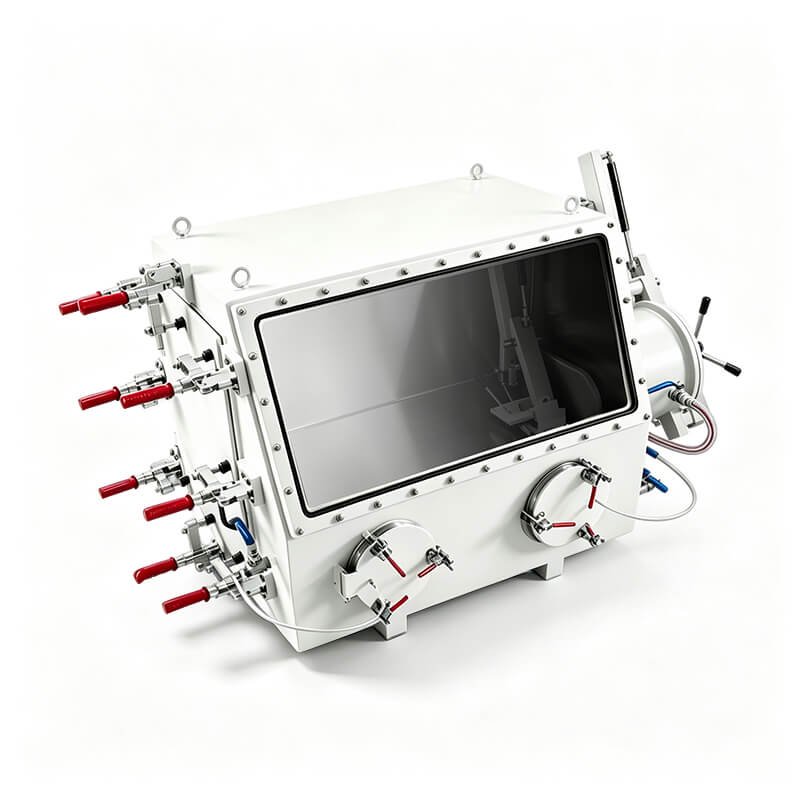
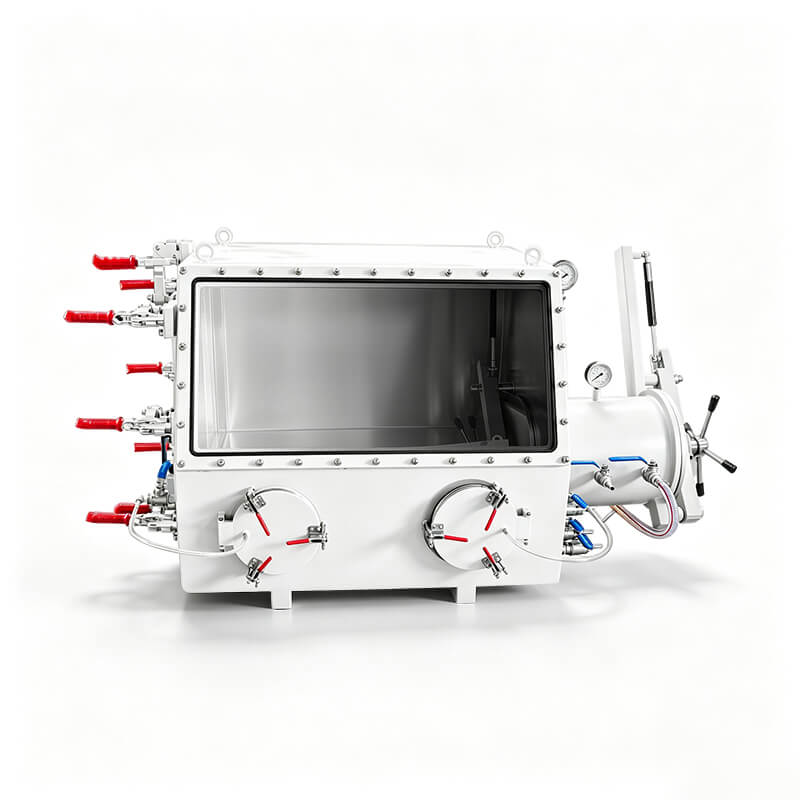
GBV-1 is a stainless steel vacuum glove box. Its working principle is straightforward: the chamber is sealed, air is removed by vacuum, and inert gas is admitted to replace it. Repeating the evacuation and refill sequence reduces oxygen and moisture by dilution. The operator works through gloves in a controlled inner atmosphere. Stainless steel construction provides a durable enclosure, but the material alone does not define atmosphere quality. The result depends on the complete system: seals, gloves, valves, vacuum pump, gas supply, transfer method, and operating procedure.
The GBV-1 is presented as a vacuum glove box, not as a continuously purified glove box. That boundary matters. A vacuum box can provide a reduced-oxygen environment for appropriate work, but it does not automatically include a purification column, a closed-loop circulator, or continuous water and oxygen removal. It should not be described as delivering sub-ppm oxygen or moisture for every process. It should not be selected for an application that requires continuous removal of contaminants released by samples, solvents, or repeated transfers unless the full system has been designed and verified for that duty. Buyers should confirm the exact configuration instead of inferring capabilities from the category name.
Seen from the outside, one vacuum glove box can look much like another. The meaningful differences are in the pressure boundary and the gas path: how the chamber is sealed, how the vacuum is applied, how the refill gas is distributed, how the gloves and ports are arranged, and how the atmosphere is checked. A stainless steel box with a good pump can still perform poorly if the gloves are permeable, the door seal is damaged, or the refill procedure leaves air in a pocket. Conversely, a modest vacuum box can perform well for a batch process when the procedure and maintenance are disciplined.
Vacuum–gas replacement: what it can and cannot do
Vacuum replacement is a dilution process. Each cycle removes a fraction of the existing atmosphere and replaces it with inert gas. The final oxygen and moisture levels depend on the starting concentration, the vacuum level reached, the number of cycles, the purity of the refill gas, and the amount of gas trapped in dead spaces. They also depend on how much air enters during transfers and how much water or oxygen is released by chamber walls, gloves, tools, and samples. A box that measures low oxygen immediately after a fill can drift upward as these sources release gas. That is not necessarily a fault. It is the difference between a batch exchange and continuous purification.
Vacuum also does more than remove oxygen. It removes the mobile gas phase, which is why vacuum–refill cycles can reduce both oxygen and moisture. But vacuum does not selectively destroy water molecules or oxygen. It removes what the pump can reach. Blind pockets, rough surfaces, porous samples, and poor gas flow can slow the exchange. A vacuum gauge reading is a pressure measurement, not a certificate of oxygen or water content. The two must be verified with suitable instruments if the process requires a quantified atmosphere.
This is why evacuate and refill is not a complete specification. The useful details are the evacuation target at the chamber, the allowed time, the number of refill cycles, the inert gas purity, and the point at which the atmosphere is sampled. A procedure that works for a small, clean, dry load may be inadequate for a large load with high surface area, a solvent-wet sample, or frequently opened ports. The same box can produce different results under different loads, and that is normal for a batch-exchange system.
A vacuum box is not a purifier, and a purifier is not a vacuum box. Vacuum replacement lowers the amount of unwanted gas present at the start of a campaign. Continuous purification removes unwanted gas that enters or outgasses during the campaign. If the process needs a stable setpoint for hours while the box is in use, vacuum replacement alone may not be the right architecture. If the process is a short, sealed batch and the starting atmosphere is the main concern, vacuum replacement can be a practical approach.
Consider two boxes with the same chamber volume and the same pump. One is loaded with a few small, dry samples. The other is loaded with a large, porous part, a solvent-wet tray, and tools that were stored in room air. The first may reach a useful atmosphere in a short sequence; the second may need more cycles or may never hold a stable low reading without additional controls. This is not a contradiction in the product data. It is the load dependence of a batch process. A specification should therefore be tied to a representative load and a defined test procedure.
When vacuum replacement is the right engineering choice
Vacuum replacement is often a good fit when the work is batch-like and the atmosphere requirement is moderate, or when the box can remain closed for the duration of a campaign. Examples include temporary storage of air-sensitive samples, preparation of materials that need protection during handling rather than continuous gas flow, and operations where the main concern is excluding bulk air rather than holding an ultra-low setpoint through frequent openings. It can also suit laboratories that want a robust stainless steel enclosure with a clear vacuum–purge procedure and do not need the additional subsystems of a purifier.
Typical research contexts include air-sensitive chemistry, lithium metal and solid-state battery sample handling, perovskite and OLED materials, and general advanced materials work. Each of these is a broad category, not a guarantee. The correct choice depends on the sample’s sensitivity, the acceptable exposure time, the amount of solvent or powder involved, and whether the process produces gases or vapors. A vacuum box is not automatically suitable for every oxygen-sensitive material. It is also not a sterile, cleanroom-grade, or biological-containment environment unless those properties have been separately designed and verified.
From a workflow standpoint, vacuum replacement encourages disciplined batch operation. The user prepares material outside, transfers it with minimal air ingress, closes the box, evacuates, refills, and verifies. If the box is opened frequently, the atmosphere is disturbed frequently, and recovery time becomes part of the process cycle. A vacuum box can still be the right tool in that setting, but the procedure must account for recovery time. The alternative is not simply a more expensive box. It is a different architecture with continuous circulation and purification.
There is also a maintenance trade-off. A vacuum-replacement box avoids purification-media regeneration and the associated control logic, but it still needs vacuum-pump maintenance, seal inspection, glove replacement, and gas-supply checks. A purified box adds purification media, circulation equipment, sensors, and regeneration procedures. Neither architecture removes the need for routine attention. The question is which maintenance tasks and failure modes the laboratory can manage reliably.
Continuous purification changes the operating model
A continuously purified glove box uses a closed gas loop. Gas is circulated through purification material that removes water and oxygen, and the cleaned gas returns to the box. The system also needs monitoring, regeneration, and replacement of saturated purification media. In a well-designed system, the purifier can maintain a target atmosphere while the box is in use, provided the ingress and outgassing load remain within its capacity. This is a continuous function, not a single evacuation step.
Several functions should be kept separate. Gas replacement, continuous purification, measurement, and particulate filtration are not interchangeable. A HEPA filter removes particles; it does not remove water or oxygen. A solvent adsorber captures organic vapors; it does not replace the water and oxygen purification bed. An oxygen or moisture analyzer measures the atmosphere; it does not improve it. A vacuum pump creates reduced pressure; it does not create a purified atmosphere by itself. When these functions are conflated, a specification can look better than the actual system.
Continuous purification is usually considered when a process must hold a low oxygen or moisture setpoint through frequent access, long campaigns, or ongoing outgassing from samples. It is also relevant when a failed batch is costly and the required atmosphere must be demonstrated with continuous records. It is not a universal upgrade. Purification media have capacity, regeneration needs, and compatibility limits. The box, transfer chambers, gloves, and gas distribution all affect performance. A purifier can maintain a clean atmosphere only if the enclosure and transfer practices keep the load within the system’s design.
Regeneration is another distinction. In a purifier, the removal medium eventually becomes loaded and must be regenerated or replaced according to the manufacturer’s procedure. That procedure is part of the operating schedule and can affect gas consumption, heat load, and availability. A vacuum-replacement box does not have this regeneration step, but it consumes inert gas for each refill and depends on the vacuum pump to remove the previous atmosphere. The operating cost and downtime profiles are therefore different even before purchase price is considered. The technical choice should be based on the atmosphere requirement, not on a single consumable comparison.
For the GBV-1 specifically, the product information does not present it as a continuous purification system. If an application requires continuous removal of water and oxygen, the correct step is to specify a purifier-equipped glove box or a separate compatible purification solution after confirming the engineering interface. It is not correct to assume that a vacuum glove box includes a purification loop, or that adding a purifier to any enclosure will automatically produce a low-ppm environment. The enclosure, transfer path, and purification capacity have to be designed as a system.
Reading the right numbers before comparing systems
Specifications for vacuum boxes and purified boxes are often compared as if they were the same kind of number. They are not. The following distinctions are a practical checklist.
| Metric | What it describes | What it does not establish |
|---|---|---|
| Chamber working pressure | The pressure condition at which the glove box chamber is intended to operate | The oxygen or moisture content at the sample, or the performance of the transfer path |
| Transfer-chamber vacuum | The evacuation level reached in a transfer volume, where one is fitted | The vacuum or atmosphere quality of the main chamber |
| Pump ultimate vacuum | The lowest pressure a pump can approach under defined test conditions | The pressure at the glove ports, the leak rate of the box, or the achievable moisture level |
| Leak rate | Ingress under a specified pressure test and acceptance method | Outgassing from gloves, samples, or solvents, or ingress caused by operating technique |
| Oxygen or moisture reading | The concentration indicated at the sensor location under stated conditions | The worst-case concentration at the sample or the recovery time after a transfer |
| Analyzer resolution and accuracy | The display increment and the measurement uncertainty of the instrument | Resolution alone does not equal accuracy; accuracy does not equal atmosphere control |
An oxygen analyzer with a fine display resolution can still have a larger measurement uncertainty. A moisture sensor can be calibrated for a dry-gas range and behave differently near its limit. A chamber vacuum reading can be excellent while a glove port or transfer door leaks during use. A leak-rate test performed at one pressure does not automatically predict behavior at another pressure or with a different gas. For these reasons, a responsible specification states the object being measured, the conditions, and the acceptance method. If a data sheet contains a number without those conditions, treat it as a prompt for clarification, not as a guaranteed outcome.
Pressure units also deserve care. A gauge may read in pascals, millibar, torr, or another unit, and the same numerical value can mean very different things if the unit is misread. When a specification uses units without a clear reference, ask for the conversion and the measurement location. Keep the original units in the purchase record and in the acceptance test. Do not translate a pressure claim into an oxygen claim. The two belong to different parts of the system.
For the GBV-1, the useful questions are: What vacuum level is specified at the chamber, and over what evacuation time? How is the refill sequence defined? What final oxygen and moisture levels have been demonstrated, with which analyzer, at which location, and after how many cycles? What is the leak-rate acceptance criterion? Which gloves and seals are supplied? What gas connections and port types are present? What is the maximum allowable working pressure? The answers define the usable envelope. They are more informative than a single low-oxygen claim.
Sealing and transfer hardware: the small parts that decide the result
Atmosphere control is often limited by connections rather than chamber volume. A vacuum glove box has a pressure boundary made of doors, gloves, glove ports, valves, feedthroughs, and gas lines. Each joint is a potential path for air or moisture. The goal is not to add as many ports as possible. It is to make every port necessary, sealable, and compatible with the intended gas and vacuum duty.
KF connections are one way to join vacuum components. A KF Vacuum Clamp holds two flanged faces together against a gasket. The clamp itself does not create vacuum and does not replace the gasket; it provides the mechanical compression that allows the seal to work. Selection therefore depends on the flange size, the gasket material, the line diameter, the pressure regime, and the available space. The wrong clamp size, a damaged gasket, or an unevenly tightened assembly can produce a leak that looks like a purge or purification problem.
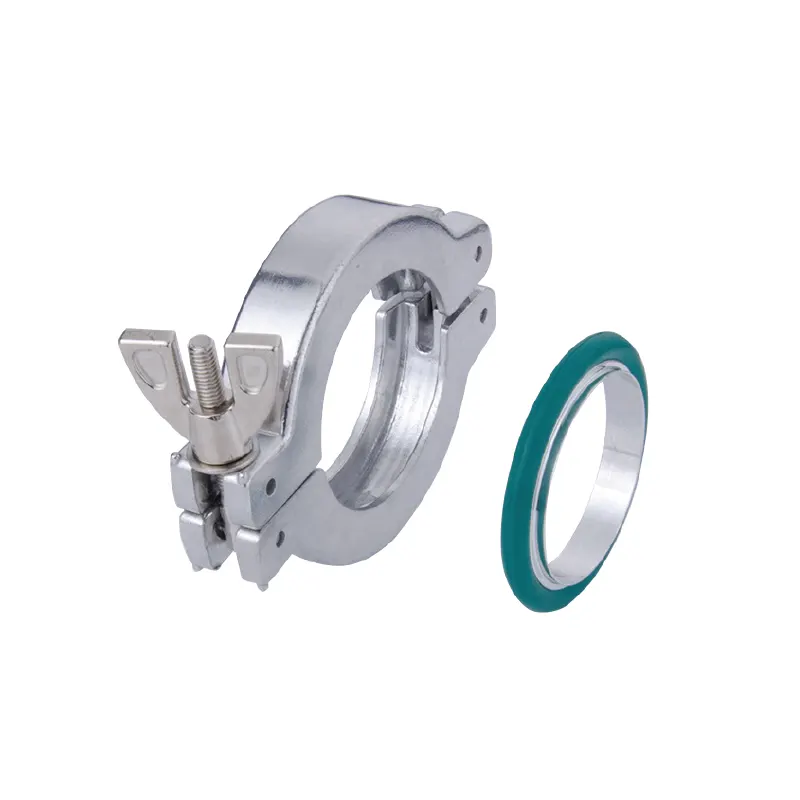
Because the GBV-1 is a vacuum glove box, the quality of its vacuum connections matters to the evacuation and refill cycle. Where KF connections are used, confirm the KF size and the intended gasket before ordering clamps. Avoid mixing incompatible flange standards. Tighten for uniform compression rather than forcing the clamp. Inspect gaskets for cuts, hardening, or contamination. If a vacuum line will be disconnected frequently, choose a clamping method that supports repeatable assembly. If it will remain under vacuum, verify that the clamp and gasket are appropriate for the duty. These are general vacuum-practice points, but they are often the difference between a stable atmosphere and a slow leak that is misattributed to the box.
Transfer hardware deserves the same attention. Every time a sample enters, some air enters with it unless the transfer path is evacuated or purged. The volume of the transfer chamber, the number of evacuation cycles, and the way the inner door is opened all influence the atmosphere disturbance. A large transfer chamber may be convenient for equipment, but it presents a larger volume to evacuate and refill. A small transfer chamber reduces the disturbance per transfer but may limit what can pass through. The right choice depends on the size and frequency of transfers, not on a single ideal configuration.
Gloves are another controlled interface. They must fit the operator, suit the materials being handled, and remain compatible with the atmosphere and cleaning agents. Glove material, thickness, and permeation behavior affect both dexterity and moisture ingress. A glove that is comfortable but highly permeable to water vapor can make a dry atmosphere harder to hold. Glove ports and O-rings should be inspected as part of routine maintenance. A box with excellent initial evacuation but worn gloves will show poor recovery after use. If solvents are used, a cold trap or solvent adsorber may be needed to protect the vacuum pump and reduce vapor load, but it is not a substitute for water and oxygen purification.
A practical configuration checklist for GBV-1 and purifier decisions
Before requesting a quotation or a performance estimate, prepare a short application brief. It should include the following items.
- Sample and chemistry: what the material is, its approximate mass and surface area, and whether it releases solvents, vapors, or reactive gases.
- Atmosphere requirement: the maximum acceptable oxygen and moisture levels for the process, the gas type and purity, and the allowed recovery time after a transfer.
- Operating pattern: how long the atmosphere must hold, how often the box is opened, and whether the work is a single batch, a repeating batch, or a continuous campaign.
- Transfer load: the size, shape, and frequency of items entering the box, and whether a transfer chamber or another controlled path is required.
- Vacuum duty: the required chamber vacuum, the pump type, the line size, the port standard, and the location of pressure gauges.
- Materials compatibility: glove material, seal material, window material, and resistance to the solvents and cleaning agents in use.
- Accessories: gloves, glove ports, seals, KF clamps and gaskets, feedthroughs, HEPA filtration, solvent trapping, and analysis instruments. Each item should be selected against the actual connection and duty, not by appearance alone.
- Verification: the acceptance test, leak test, analyzer calibration method, and the operating procedure that will be used after installation.
Two questions are especially useful when comparing the GBV-1 with a purifier-equipped glove box. First, what atmosphere must be maintained during the period when the box is open or being used, not only after a long evacuation? Second, what is the demonstrated recovery time after a realistic transfer? A system that reaches a good number overnight but takes a long time to recover after each sample transfer may still be unsuitable for a busy workflow. A system that recovers quickly but has limited purification capacity may be unsuitable for a high-outgassing load.
Use a short acceptance protocol rather than a single spot check. Record the starting condition, the evacuation time, the number of refill cycles, the gas pressure, the analyzer reading at the working location, and the recovery after a representative transfer. Repeat the test with the actual tools and sample containers. This produces a baseline that can be compared later. If the baseline changes, the cause may be a worn glove, a gasket, a pump, a valve, or a change in the load. A documented baseline makes diagnosis faster and prevents a routine seal issue from being mistaken for a fundamental limitation of the box.
Distinguish also between the atmosphere at the sensor and the atmosphere at the sample. A clean reading at the analyzer does not prove that a powder in a vial, a solvent-wet substrate, or a poorly purged transfer box is at the same condition. Allow recovery time after transfers, place the sensor where it represents the working volume, and verify the actual process with the actual materials. The GBV-1 can be a practical stainless steel vacuum glove box when its batch-exchange architecture matches the work. It should not be asked to perform as a continuously purified system unless that capability has been explicitly engineered and demonstrated.
Before ordering, provide the supplier with the material list, required atmosphere, operating cycle, transfer volume, solvent exposure, vacuum connections, and acceptance method. Ask for the current GBV-1 configuration and for any limits that apply to the intended process. That information allows a technical comparison between vacuum replacement and continuous purification without relying on a single headline number.
