
A three-station, single-sided, split-type glove box with a gas purification system is not simply a bigger version of a one-port enclosure. The number of glove stations, the number of accessible faces and the separation between the working box and the purification cabinet each change how the atmosphere behaves, how operators organize their work, and which figures actually describe the system's capability. Buyers who treat these as layout details often approve a system that meets an oxygen and moisture target on paper yet feels awkward for the chemistry it was bought to protect. The sections below unpack each decision, then follow the atmosphere through a transfer event and look at the parts — purification loop, antechamber, gloves, analyzers and traps — that decide whether the target survives real work.
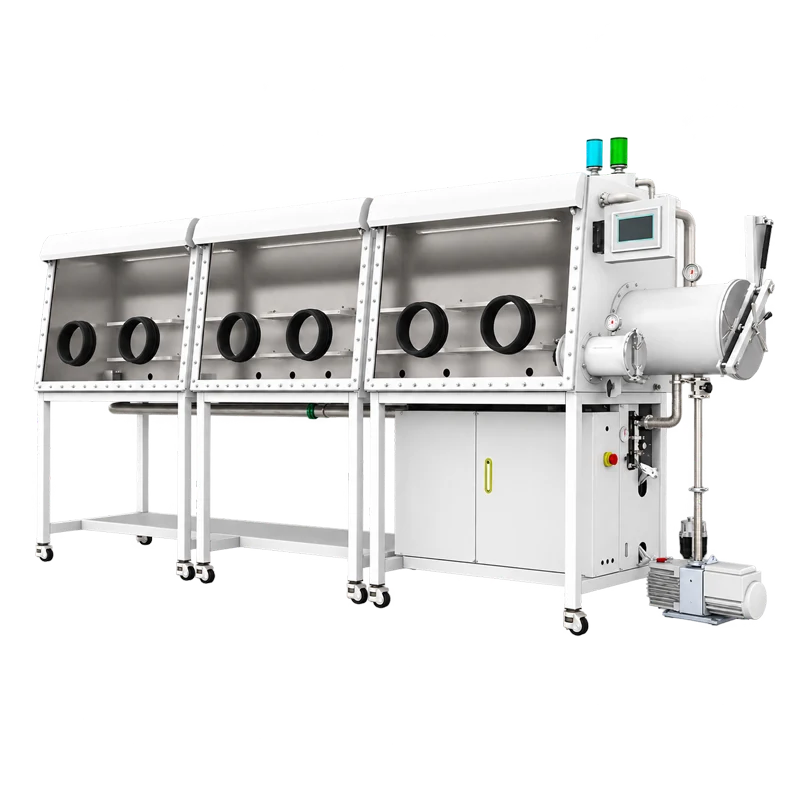
What the Three-Station, Single-Sided, Split-Type Designation Actually Decides
Names in this product category are dense because three separate engineering decisions are compressed into one line. "Three-station" describes how many glove ports are built into the front panel. "Single-sided" says the working space is reached from one face only. "Split-type" means the working enclosure and the gas purification unit are separate cabinets joined by circulation piping instead of a single integrated frame. Each choice has consequences that last for the life of the box, long after the quotation has been signed. A representative example of this configuration is the three-station single-sided split-type glove box with gas purification system.
Three stations, one shared atmosphere
Three stations allow two or three operators — or one operator moving through sequential steps — to work at the same time inside a single atmosphere. Where a process has several hand-off points, such as weighing and dispensing, assembling or stacking components, sealing a finished device and inspecting the result, that parallelism removes the serial rhythm of a single-port box, in which every task waits for the previous one to clear the gloves. The trade-off is that the atmosphere is common property. A solvent opened at one station, a powder poured at another, or a heated sample at a third all release material into the same gas volume the purification loop is trying to keep dry and oxygen-free. Three stations therefore raise the value of work discipline: assign tasks to stations rather than sharing them freely, keep containers closed between uses, and decide in advance where the messiest operation sits relative to the return path to the purification unit.
Single-sided access: what one face gains and costs
A single-sided box is reached only from the front. That reduces the number of large sealed openings on the enclosure, which simplifies sealing geometry and leak-checking, and it allows the box to stand against a wall in a compact bay with the operator side free. Operators at three stations face the same direction, which makes coordination easier than calling across a two-sided tunnel. The rear and end walls then become available for what cannot be handled through gloves anyway: electrical and signal feedthroughs, KF ports for gas lines, instrument mounts and cooling lines. The cost is transfer flexibility: with no rear access, everything enters through the antechamber, and oversized items must be planned into the design rather than slid in from behind.
Split-type architecture: separating enclosure from purification
When the purification unit sits in its own cabinet, it can be placed where there is actually room for it — beside rather than above the box, outside a crowded bay, or in a position a service technician can reach without disturbing the working enclosure. The separation also moves the heat and vibration associated with regeneration away from sensitive measurements. What the split arrangement adds is piping. The circulation loop between the two cabinets is longer, and every additional joint, valve and flexible section is a possible leak path and a source of pressure drop. A split system should therefore be judged on how those connections are made and where the isolation valves sit, not only on the catalogued capacity of the purification cabinet. Confirm which components — antechamber, vacuum pump, control cabinet, analyzer — belong on the box side and which on the purification side, because that determines installation, service access and where the atmosphere is sampled.
How the Atmosphere Responds When a Sample Goes In
The moment a sample, tool or container crosses from room air into the box, the atmosphere the purification loop has been holding starts to drift. Understanding the path of that drift — and the difference between the several pressure and purity figures involved — is the key to reading the monitors sensibly.
Three different jobs that are often confused
Gas replacement, or purging, uses a flow of working gas to push air out of a volume. Evacuation lowers the pressure so that less residual air is left to dilute. Circulation purification continuously passes box gas through purification material that removes moisture and oxygen. These are separate mechanisms with separate specifications. An antechamber that is evacuated and refilled reaches some vacuum and leaves some residual contamination per cycle; a circulation loop turns the box volume over at some rate; neither figure tells you the other. Confusing them leads to two common mistakes: expecting one antechamber cycle to deliver the box's full working atmosphere right at the transfer port, and expecting a purge-only enclosure to behave like a box with continuous purification and recirculation.
Why the water and oxygen readings recover slowly after a transfer
A rise in the moisture reading after loading is normal. The interesting question is the shape of the decay. The fast part of recovery is the loop mixing the gas volume: introduced moisture is diluted and carried to the purification material. The slow part happens at surfaces. Moisture adsorbs on the inside of the enclosure walls, on the gloves, on tools, racks and containers, and on the sample itself, then desorbs over hours or days. That reservoir effect means a reading can fall quickly at first and then plateau above its previous level even though the purification material is working normally. A porous, hygroscopic or heavily insulated sample extends the plateau considerably, and so does a large antechamber that admits a bigger slug of air per cycle.
Other contributors have less to do with physics than with condition. A glove with a pinhole or a damaged cuff seal admits a small continuous stream of room air, so the loop fights a standing load instead of a one-off event. A valve left partly open between antechamber and box does the same. Long piping runs in a split layout add residence time and surface area where moisture can linger. A purification column close to saturation, or one that has only just returned from regeneration, will not pull the reading down as quickly as a freshly regenerated column. Before concluding that something is faulty, check the recent transfer history, the state of gloves and seals, and the position of every valve between box, antechamber and purification cabinet.
Regeneration is a separate cycle, not a stronger purification mode
Purification material eventually loads up with the water and oxygen it has captured, and regeneration restores it: the column is taken out of the loop, heated and swept with a regeneration gas stream to drive off the captured species, then cooled and returned to service. During that window the box is running without full purification capacity, and readings behave differently from normal circulation — which is exactly why regeneration scheduling belongs in the operating plan and should be coordinated with sensitive work. Regeneration gas composition, temperatures and cycle times are defined by the manufacturer for each system and should be followed as written rather than inferred from general practice. Likewise, the fact that a system includes regeneration tells you nothing on its own about the levels the box will hold during ordinary operation.
Configuring Three Stations Around a Real Workflow
Port count is usually chosen before task allocation, which is the wrong order. A three-station box supports very different workflows depending on what happens at each glove port, and the layout that suits cell assembly does not suit a laboratory that runs several short experiments a day.
| Design choice | What it changes | Where it fits | What to confirm |
|---|---|---|---|
| Number of stations | Parallel work positions on one shared atmosphere | Multi-step processes and teams working simultaneously | Port spacing, reach per station, zoning plan |
| Single-sided access | One sealed working face; walls free for feedthroughs | Box placed against a wall; instrument-heavy interiors | Transfer route for large items; antechamber size |
| Split-type layout | Working box and purification cabinet separated by piping | Limited ceiling height or restricted service access | Piping route, joints, isolation valves, sampling point |
Assign tasks to stations instead of sharing them
Write down the operations that will be performed inside the box and group them by what they release. Powder handling, weighing and sample loading release particles. Solvent work releases organic vapor. Heating and sealing release both heat and, sometimes, decomposition products. Powder work is best placed where local particulate removal is available and away from open solvent containers. Solvent work belongs downstream of whatever solvent adsorption the system includes and as far as practical from the return path to the purification material, because organic vapor that reaches purification material can degrade its capacity. Heaters and hot plates should sit away from the gloves and from anything temperature-sensitive. These are not rules about one particular model; they are the questions the layout should answer before the enclosure is built.
Antechamber sizing sets the size of each disturbance
The antechamber is where atmosphere control is repeatedly interrupted, so its volume relative to the box volume matters. A large antechamber on a modest enclosure does not cause a leak, but it does make every transfer a bigger event: more air admitted, more moisture and oxygen to remove, longer recovery. A common arrangement is one small chamber for frequent small parts and one larger chamber for tools, consumables and fixtures, so the daily disturbance stays small. If the box has a single chamber sized for the largest item, expect a slower return after each cycle of that chamber and plan sensitive work around those moments rather than immediately after them.
Build the equipment into the design, not into the gloves
Anything that must live inside the box — a balance, a sealing tool, a microscope, a heater, a fixture for stacking cells — should be defined before the enclosure is ordered, because feedthroughs, mounting plates, power and signal connections, and cooling lines all have to pass through a wall. A single-sided, three-station box offers a long rear wall for that purpose, which is one reason this layout appears in instrument-heavy laboratories.
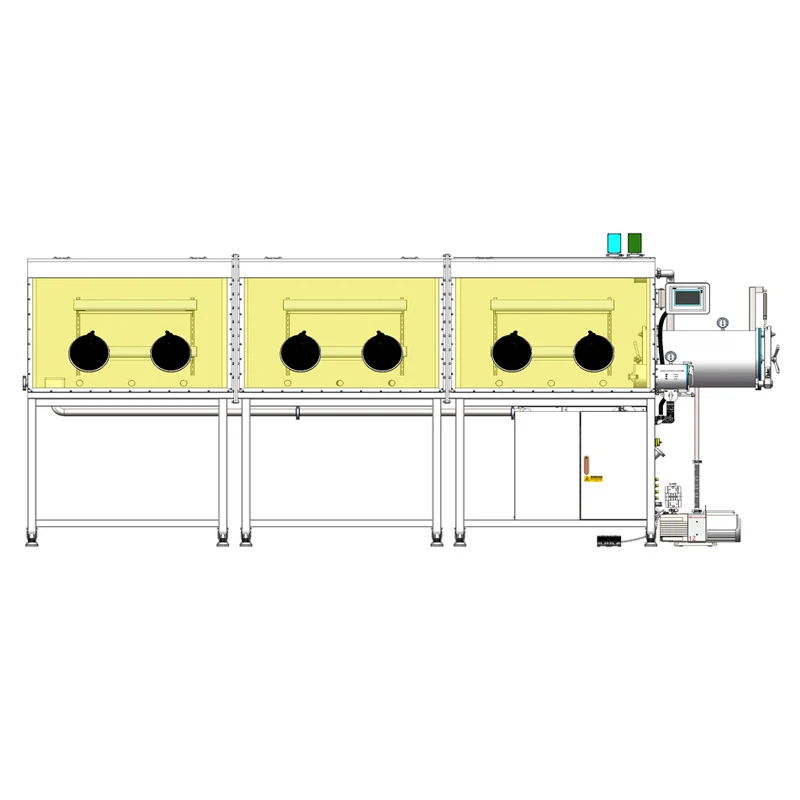
It is also worth checking reach: if the third station is used mainly for a fixture that never moves, a slightly different port spacing may serve better than an evenly divided front panel. Finally, remember that powered equipment inside the box adds heat to the atmosphere, and heat drives desorption from surfaces.
Gloves Are Part of the Barrier, Not Just a Consumable
The gloves are the thinnest, most continuously flexed part of the enclosure boundary and the only part an operator touches all day. Material choice therefore affects the steady infiltration of moisture and oxygen into the box, and in a three-station system three pairs of gloves are in play at once. A glove decision that would be secondary in a small enclosure becomes a first-order question in one where several people work in parallel.
Why butyl rubber appears in moisture-sensitive work
Butyl rubber is known for low permeability to water vapor and gases, which is why it is frequently chosen where an enclosure has to hold low moisture levels, and it also tolerates many polar media. The same chemistry that makes it a good moisture barrier makes it a poor match for aliphatic and aromatic hydrocarbons and halogenated solvents, where it swells and ages quickly; it is also less resilient than some alternatives, so dexterity and wrist fatigue deserve an honest trial before a lab commits to it across three stations. A laboratory running both low-moisture chemistry and aromatic solvent work may need more than one glove type and a routine for changing them between task blocks, rather than one compromise glove fitted permanently. Storage matters too: rubber ages in light, heat and ozone, so spares kept near a window or a motor are not really spares. The butyl rubber gloves offered for glove box use are one option to evaluate against that list.

What to confirm before ordering gloves for a three-station box
- Port diameter and cuff design: gloves are matched to the glove port and its retaining ring or clamp, and they are not interchangeable across port geometries.
- Length and thickness: thicker material is more durable and less permeable but harder to work in, and at three stations fatigue accumulates over a shift.
- Chemical compatibility with the actual list of solvents, not with a general category such as "solvents".
- Whether a pinhole check and a replacement interval are part of routine maintenance, since a small defect is a permanent load on the purification loop.
- Whether a glove can be changed while the box is kept under working atmosphere, which affects how the change is sequenced and how long the atmosphere takes to settle afterwards.
Assigning One Job to Each Accessory
Accessories are frequently discussed as a single group, as though adding more of them improves atmosphere control. In practice each item has one job, and buying one to do another's work is how systems end up disappointing.
Analyzers measure; they do not purify
Oxygen and moisture analyzers are sensors. Their range, resolution, accuracy and calibration state define what their numbers mean, and resolution is not accuracy: a display that moves in fine steps can still be consistently wrong. Placement matters as much as specification, because the reading that governs the work is the one taken where the work happens rather than in the return line alone. During and just after a transfer, a sensor near the port will show a local excursion that the rest of the box does not share. Calibration against a reference gas needs a place in the maintenance schedule, since a drifting sensor and a drifting atmosphere look identical if only one number is watched.
Particle filters and solvent traps solve different problems
HEPA filtration removes particles. It does not remove moisture, oxygen or solvent vapor, and it is not a substitute for the purification loop in any of those roles. Solvent adsorption targets organic vapor before it can reach purification material or the operators; it cannot replace water and oxygen removal either. In a box where powders are handled — cathode and anode materials, perovskites, metal powders — particulate control is worth having for cross-contamination reasons, and it is a separate objective from keeping moisture low. Where solvent use is planned, the question to ask is where the vapor goes first, because organic compounds that reach purification material can reduce its working capacity and shorten the interval between regenerations.
Pumps, valves and seals
The vacuum pump serves the antechamber and any evacuation step; its selection depends on the gas being handled, the volume to be evacuated and the duty cycle, and its ultimate vacuum is a pump figure rather than a statement about the box atmosphere. Valves isolate the antechamber, direct gas during regeneration and allow sections to be tested separately; their positions belong in a written operating procedure so that a partly open valve is spotted as a procedure error rather than a mystery. Seals and O-rings are wear items. Together with the gloves, they are the usual explanation for a slow upward drift in readings that no change in work pattern accounts for.
A Configuration Checklist Before You Request a Quotation
Most specification problems are information problems. A supplier can size purification capacity, antechamber volume and circulation routing properly only if the application is described in operational terms. Send the following:
- The materials and chemicals to be handled, including every solvent, and whether any of them are known to attack purification material.
- How moisture- and oxygen-sensitive the work is, and the level the process actually needs to hold during operation rather than the lowest number a brochure can show.
- The tasks assigned to each station and how many operators will work at once.
- The largest and heaviest item that must pass through the antechamber, and how often transfers occur.
- Whether powders, solvent vapor or both will be present, and whether local extraction or adsorption is expected.
- Equipment to be installed inside the box, with its power, signal, cooling and mounting requirements.
- Available floor area, ceiling height and access route, and whether the purification cabinet must be separate from the enclosure.
- Site services available, including the supply intended for regeneration.
- Where atmosphere readings need to be taken, and how they will be recorded and calibrated.
- How routine maintenance — glove changes, seal replacement and regeneration — will be performed without compromising ongoing work.
None of these items is exotic, and none of them substitutes for the manufacturer's own documentation for a specific model. What they do is connect the three design decisions in the product name — three stations, single-sided access, split-type layout — to the daily reality of the work. A three-station box with gas purification buys parallel working capacity and continuous atmosphere management; it does not buy immunity from solvent vapor, glove permeation or the moisture that rides in on surfaces. The sensible sequence is to define the work, then the atmosphere requirement, then the configuration, and only then the equipment list. Every quoted figure should be tied to a stated configuration and a stated condition, because a value that is not attached to those two things cannot be compared with anything.
