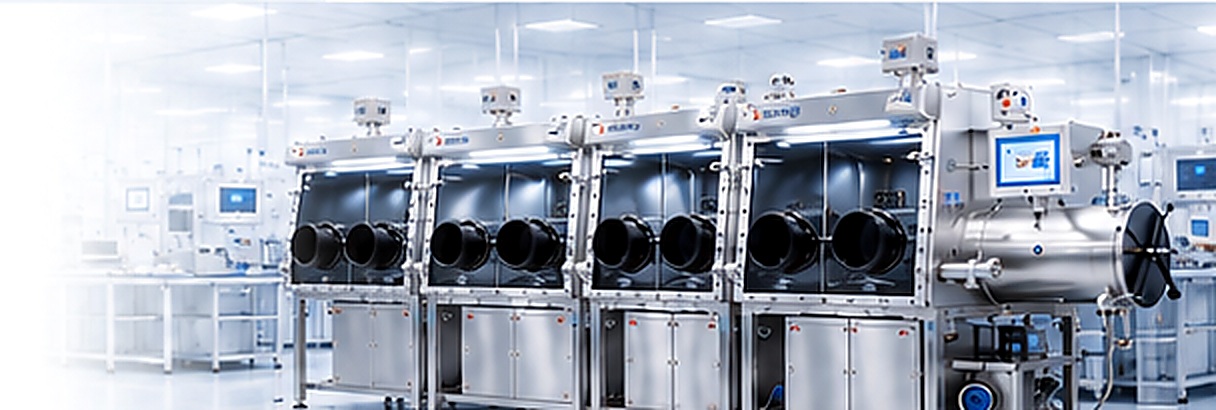
A glove box is a barrier first and a workspace second. Its atmosphere quality depends on every opening in the enclosure wall, and glove ports are deliberate openings. On a single-station box, both ports normally carry gloves, so the question of what to do with an unused port rarely comes up. On larger installations the arithmetic changes. A four-station box has four working positions, and a double-sided arrangement adds a second face. Shifts, projects and staffing rarely fill all of them at once, and a port without a glove is simply a hole.
That is where a Glove Box Port Cover becomes relevant. The part itself is unglamorous: a cover that closes a glove port opening. Its consequences are less trivial, because it sits on the boundary between a controlled inert atmosphere and the laboratory air around it.
This article treats the port cover as a system component rather than a catalogue line. It covers what the part actually closes, how an idle port affects water and oxygen behaviour, the geometry and material questions that decide whether a cover suits your box, and the checks worth running before a purchase order goes out. Nothing here assumes that a given cover fits a given enclosure; that has to be confirmed against the port ring on the machine in front of you.
What a Glove Box Port Cover Actually Closes
A glove port is an engineered opening, not merely a hole in a panel. It usually consists of a rigid ring or flange set into the front window or wall, a seat where the glove cuff or band is clamped, and a sealing surface that keeps the glove-to-ring joint airtight. When a glove is mounted and clamped, that joint is the boundary. When no glove is mounted, the boundary is missing entirely, and the ring becomes a free path between the internal atmosphere and the room.
A port cover is designed to occupy that position instead. Depending on the design, it may be a plate fastened over the ring, a cap that seats in the ring groove, or a cover with its own gasket pressed against the ring face. The functional requirement is the same in every case: close the aperture and provide a seal at the interface.
Closing a port is not the same as sealing it
These two things get conflated in purchase discussions. A loose plate laid over a port reduces gross exchange by blocking bulk flow, but it does nothing about the perimeter. Air can still move along the gap between plate and ring, and water vapour can still diffuse through that gap and through the cover material itself. A sealing cover closes the gap with a gasket or an interference fit, and ideally uses a retention method that keeps the seal loaded. Ask which of the two you are buying, because it determines whether the part is a dust cap or an atmosphere control element.
What the cover does not do
Expectations often run ahead of function, so the boundaries are worth stating plainly:
- It does not allow manipulation. With a port covered, that station is out of service for hands-in work.
- It does not transfer anything. Sample movement is an antechamber function.
- It does not purify. Removing water and oxygen is the job of the purification loop and its regenerable media.
- It does not filter particles or adsorb solvent vapour. Those are separate accessory functions.
- It does not repair a worn ring, a hardened gasket, or a leaking glove elsewhere on the box.
- Unless it has been specifically designed and rated for the duty, it should not be treated as a pressure or vacuum boundary.
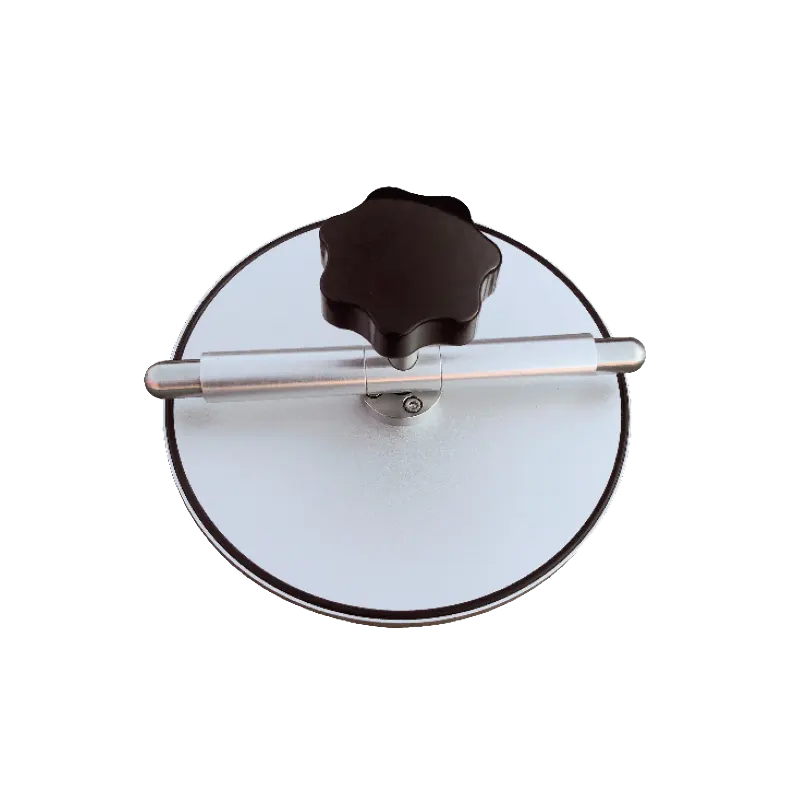
In short, a port cover restores a missing part of the enclosure boundary. Everything else it appears to do follows from that single function, and is limited by it.
How an Unused Port Influences Atmosphere Control
Two different ingress mechanisms
Exchange through an open port happens in two regimes. When the box interior sits at a lower pressure than the surrounding room, which is typical of a box running with a slight negative offset or one that has just been evacuated and refilled, air is drawn in through the aperture. That is bulk flow, and it is fast. When pressures equalise, bulk flow stops, but concentration gradients do not: oxygen and water vapour diffuse from the room into the box, and exchange continues at a slower rate.
Fitting a cover changes the second regime and largely removes the first. The remaining paths are the seal interface, any fastener holes or clearances, and the cover material itself. That last path matters more than people expect. Every polymer transmits some water vapour and some oxygen; the rate depends on polymer chemistry, wall thickness, temperature and the humidity gradient across it. A thin polymer cover is not an absolute barrier.
Static seals behave better than moving ones
A glove is a moving seal. Each time an operator reaches in, the glove flexes at the cuff, the band works against the ring, and the joint sees mechanical cycling. A covered port is a static joint with no flexing and no working load, which is why a well-matched cover with a compressed gasket usually holds up better than a glove band does. The catch is that static seals still need compression. If a cover rests on a ring without being loaded against it, the joint will not behave as a seal regardless of the material chosen.
What you actually observe in the data
Port covers do not produce step changes in water and oxygen readings. What they change is the slope. With a port open, the reading climbs faster after any disturbance and takes longer to come back down. With the port closed, the curve is flatter and recovery is quicker, assuming the purification loop and the rest of the box are in good order.
That qualifier matters. Recovery time is a function of several variables at once: enclosure volume, the total leak rate of the system, the capacity and condition of the purification media, the amount of water adsorbed on internal surfaces, and where the sensor is mounted. Attributing a slow recovery to the port alone, or to the cover alone, is a guess until the other factors are ruled out.
Where a Port Cover Fits in Everyday Box Operation
Boxes with more ports than operators
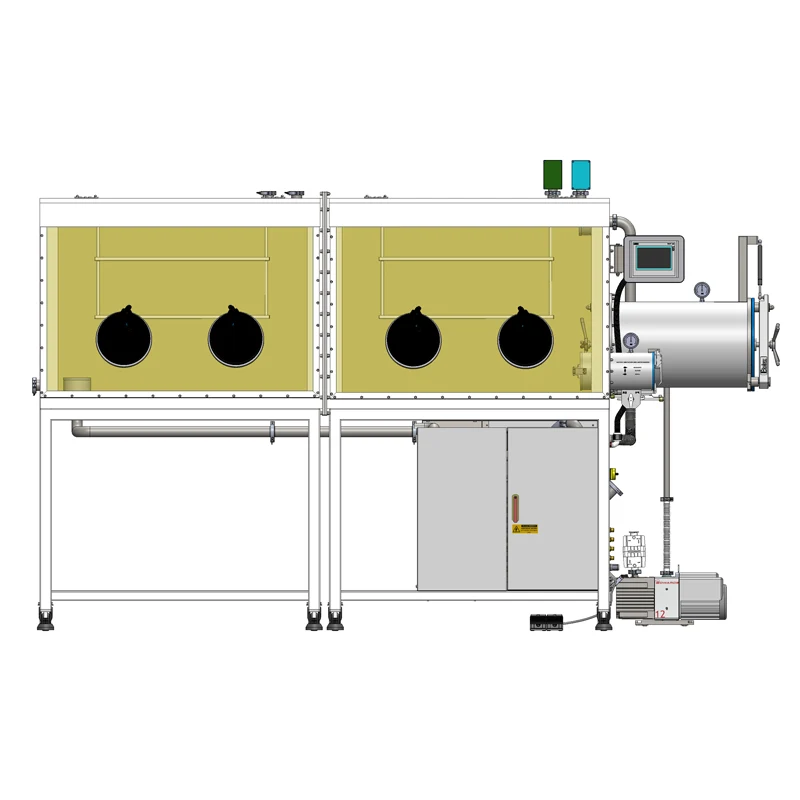
Multi-station boxes are the clearest case. A four-station, double-sided, split-type configuration, such as the Four-Station Double-Sided Split-Type Glove Box with Gas Purification System, offers four working positions across two faces. On a normal working day, two or three people may be present, and the remaining ports sit idle.
Leaving those ports open means the box is permanently exchanging with the room through apertures that are doing no work. Covering them is a low-cost way to reduce that exchange. Whether a particular cover suits a particular model is a separate question, and it should be answered from the port ring dimensions and seal design of that model, not from the fact that both items appear on the same website.
Maintenance and glove replacement windows
When a glove is removed for replacement, inspection or cleaning, the port stays open for the duration of the work. Fitting a cover during that window keeps the aperture closed while the replacement glove is being prepared, and gives the technician a defined working position instead of an open hole.
Operating one side of a double-sided box
For double-sided designs, a project may need only the front face for a period. Covering the rear ports keeps the boundary closed while those stations are unused, and removes the temptation to leave gloves hanging loose on the far side, where cracks and contamination are harder to spot during a walk-through.
Where the limits of the part show up
Covers are also used to shut down a station that handled a particular material class during a campaign. Be precise about what this achieves. A port cover closes an aperture; it does not partition the interior of a single chamber. Two stations in the same enclosure share one atmosphere, so a cover on one port does not isolate one working position from another. What it does is stop room air from entering through that port while the station is idle. Compatibility of the cover's own materials with residues at that station still has to be checked separately.
Port Geometry and Material Compatibility: The Two Deciding Questions
Geometry: what to measure
Port rings are not standardised across manufacturers, and they are not always standardised within one manufacturer's range. Before ordering, measure and record the following:
- Inner diameter of the port opening.
- Outer diameter and width of the mounting ring or flange.
- Ring thickness, and whether the face is flat, grooved or threaded.
- How the glove is retained: band, O-ring in a groove, clamp ring, or threaded collar.
- Whether the surrounding panel is flat or curved, and how much flat area is available for a cover to seat on.
- Clearance to adjacent ports, to the antechamber door, and to equipment mounted inside the box near that port.
Also ask whether the cover is fitted from outside or from inside, and how it is retained. A cover that relies on friction alone may be adequate on a small port and inadequate on a large one.
Materials: body and seal are separate decisions
The cover body and its sealing element do different jobs and should be assessed separately. Metal bodies are dimensionally stable and tolerate higher temperatures, but they are heavier and need a properly designed sealing face or gasket. Polymer and elastomer bodies are lighter and can be moulded to a specific ring profile, at the cost of higher water vapour and oxygen permeation through the wall.
Seal materials follow their own rules:
- Nitrile (NBR) — good general oil and fuel resistance, moderate temperature range.
- EPDM — strong water, steam, ozone and weather resistance; poor resistance to many hydrocarbons and aromatic solvents.
- Silicone — wide temperature range and good flexibility, but swells in some non-polar solvents and has comparatively high gas permeability.
- FKM / fluoroelastomer — broad chemical resistance and higher temperature tolerance, but still not a zero-permeation material.
- PTFE or PTFE-faced seals — excellent chemical inertness and low outgassing, but they cold-flow and need careful compression design.
Operating conditions that change the answer
Three conditions usually drive the material choice. The first is the box atmosphere: nitrogen or argon, whether any reactive species is present in trace amounts, and how humid the room air is on the outside of the cover. The second is what has been handled at that station, since solvent, acid, base or reactive powder residues migrate into elastomers over time. The third is temperature, whether from the box itself or from a hotplate or lamp operating near that window. A cover that seals at room temperature can lose compression or deform when the surrounding panel warms.
Handling and weight
Large port covers on glass or acrylic panels add weight and handling risk. A heavy cover set down carelessly or leaned against a window can damage the panel or deform the seal. Where the port is large, lighter construction and a defined storage position are worth more than a marginal gain in material rigidity.
Port Cover Versus Other Accessories: What Each Component Solves
Accessory selection goes wrong when one part is expected to do another part's job. The table below sets out the main functions and the metric worth checking for each.
| Component | Primary function | What to check | What it does not do |
|---|---|---|---|
| Glove box port cover | Closes an unused glove port and seals the interface | Ring geometry, seal material, retention method | Does not purify, filter, or allow manipulation |
| Antechamber / transfer port | Moves samples in and out with limited atmosphere exchange | Chamber volume, door sealing, purge or vacuum cycles | Does not remove water and oxygen from the main chamber |
| Oxygen / moisture analyzer | Measures the state of the atmosphere | Range, resolution, accuracy, calibration interval, sensor location | Does not change the atmosphere; resolution is not accuracy |
| Vacuum pump | Evacuates an antechamber or compatible enclosure | Gas compatibility, pumping speed against the load, ultimate vacuum | Does not create a purified atmosphere on its own |
| Electrical / signal feedthrough | Brings power and data through the wall | Pin count, ratings, sealing method at the flange | Does not seal any other opening on the box |
| Solvent adsorbent | Captures solvent vapour from the internal atmosphere | Capacity, breakthrough behaviour, replacement procedure | Is not a substitute for water and oxygen removal |
| HEPA or particle filter | Removes particulate from circulated gas | Filtration class, pressure drop, replacement interval | Does not remove water, oxygen or solvent vapour |
| Purification column and loop | Removes water and oxygen from the circulated working gas | Media capacity, regeneration conditions, circulation flow | Does not cover mechanical openings such as ports |
Read the table as a division of labour. The port cover is a passive mechanical barrier. It changes the rate at which the atmosphere is challenged; it does not change the atmosphere itself. Analyzers report, pumps move gas, purification media absorb, and filters trap particles. Keeping those roles separate is what makes fault-finding possible later.
Verifying the Seal and Reading the Atmosphere Data
Tests that isolate the port
If the goal is to confirm that a covered port is actually sealed, the test has to separate that port from the rest of the system. Three approaches are common in laboratories. A pressure decay test applies a small differential across the cover and observes whether the pressure holds over a defined interval. A tracer gas test sprays helium around the ring joint while a sniffer probes the interior side. A comparative observation measures the water and oxygen trend with the port open, then covered, under otherwise identical conditions with circulation and purge settings unchanged.
The comparative approach is the easiest and the least conclusive. It shows a difference, not the cause of that difference. A short window with the analyzer sampling from a different part of the box can produce a flattering result that has nothing to do with the cover. Keep sampling location, box volume, internal load and ambient humidity the same across both runs, or the comparison means very little.
When readings recover slowly after fitting a cover
A slow recovery is not evidence that the new cover leaks. Other explanations are more common:
- Water adsorbed on internal surfaces, gloves and fixtures desorbs slowly and keeps readings elevated after the external path is closed.
- The purification loop may be near the end of its media capacity, or due for regeneration, so its removal rate is lower than expected.
- The sensor may sit far from the port, so local ingress is diluted before it reaches the measurement point.
- Calibration drift and sensor response time both affect how quickly a change is displayed.
- A different leak path, such as an antechamber door seal, a feedthrough flange or a glove on another port, may dominate the total leak rate.
Work through that list before drawing conclusions about the cover. The order matters: rule out the largest suspected leak paths first, then media condition, then instrumentation.
Keeping the quantities straight
Numbers in glove box discussions get mixed up easily, and mixing them up leads to wrong expectations. Box working pressure, antechamber vacuum, pump ultimate vacuum, system leak rate, oxygen concentration and water concentration are six different quantities with six different units and six different meanings. A value quoted as achievable on one machine under one set of conditions is not a guaranteed continuous value for every unit in a range. Where a specification is ambiguous, the sensible move is to keep the number out of the decision and ask the supplier what conditions it applies to. Likewise, a display resolution of a fraction of a ppm does not mean the instrument is accurate to that fraction.
Configuration Checklist: What to Confirm Before You Order
Most port cover problems trace back to a piece of information missing at the enquiry stage. The list below covers what a supplier needs in order to confirm a match, and what you should verify on receipt.
- Box model and configuration identifier, including whether it is single-station, multi-station, single-sided or double-sided, integrated or split-type.
- Port ring inner diameter, flange outer diameter, ring width and thickness, and whether the sealing face is flat, grooved or threaded.
- Glove retention method currently used at that port.
- Working gas, and whether the box runs at ambient, slightly positive or slightly negative pressure.
- Whether the covered port will ever see vacuum or a pressure differential, and at what level.
- Materials previously handled at that station, so seal compatibility can be assessed.
- Operating temperature at the window, including any local heat sources.
- Number of covers required, plus spares for maintenance windows.
On receipt, check the cover against the ring before installing it: fit, seal compression, and whether the retention method holds the seal under load. Then record a baseline, whether a leak rate or an atmosphere trend under known conditions, so later changes can be compared against something rather than against memory.
A port cover is a small part with a defined job: it closes an opening that should not be open. Matched to the ring, made from materials compatible with the chemistry at that station, and verified rather than assumed, it removes one variable from atmosphere control. Used as a substitute for purification, transfer discipline or maintenance, it adds one instead.