
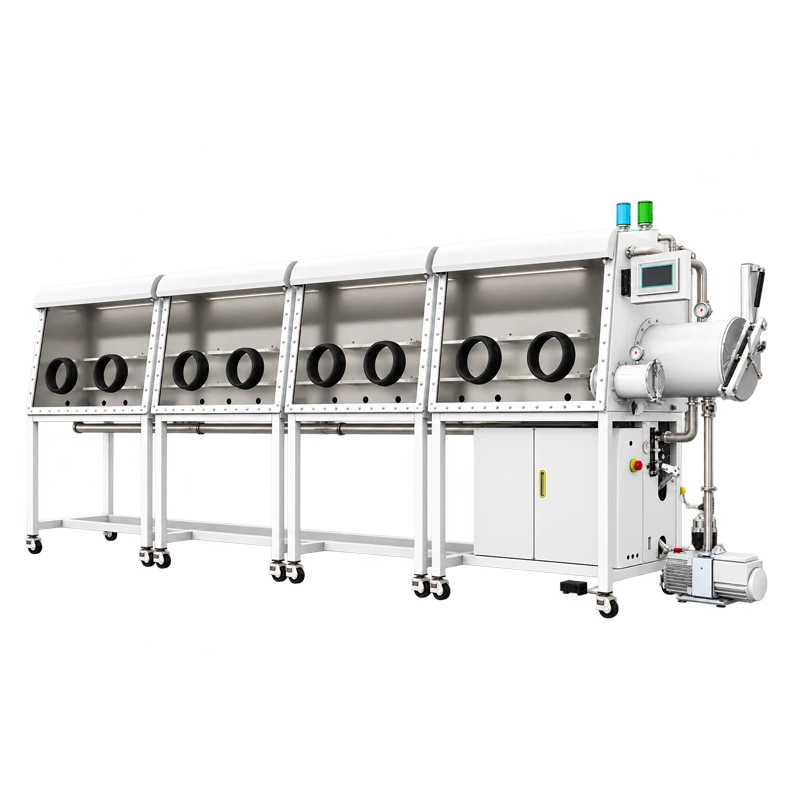
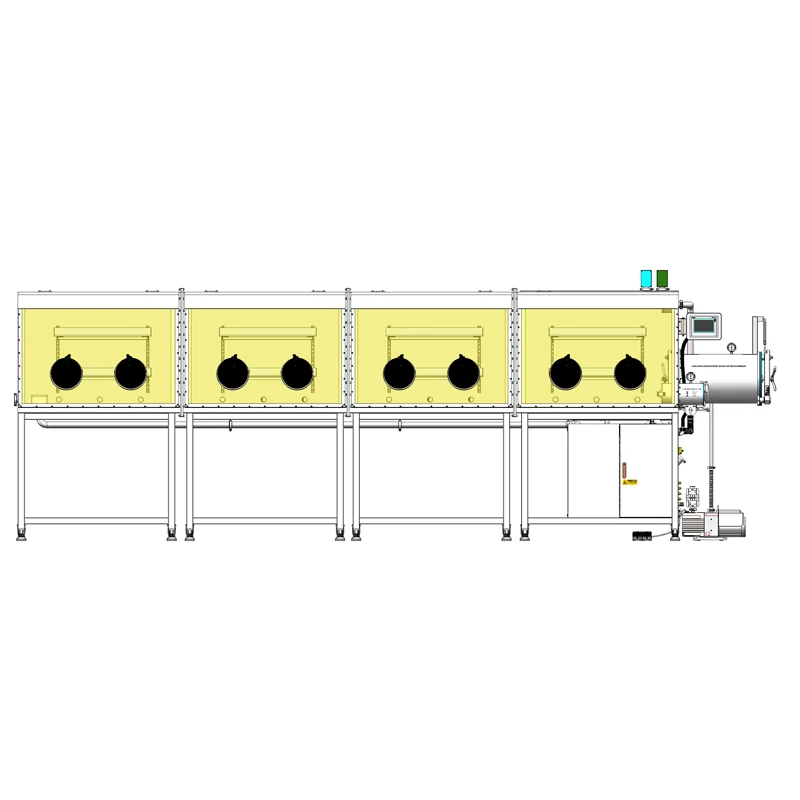
A single-sided, split-type glove box with four work stations is normally specified when a lab wants several people, or several parallel experiments, sharing one inert atmosphere without committing to one very long continuous enclosure. The four-station single-sided split-type glove box with gas purification system is a clear example of that compromise: every operator works from one face, the enclosure is built in sections rather than as a single shell, and one purification loop serves the whole volume. The engineering question worth time is not the station count. It is how the split, the antechambers and the purification loop behave once samples actually start moving in and out.
What follows is the general physics and configuration logic of atmosphere control. Where a value matters, such as recirculation flow, achievable moisture and oxygen levels, antechamber volume, regeneration interval or purge gas consumption, the valid source is the documentation for the specific unit, and it should be confirmed in writing before an order is placed.
What four stations on one face actually change
One atmosphere, four working positions
Inside a recirculating glove box there is only one gas volume, and all four positions receive whatever the purification loop delivers. That is the feature, not a flaw: it is what lets four benches rely on the same moisture and oxygen level. It also makes contamination a shared resource. A solvent-wet container opened at one station releases vapour that migrates, adsorbs on walls, gloves and equipment, and eventually reaches the purification column, which then needs regeneration sooner. Designing a workflow around a shared atmosphere is largely about deciding which processes are compatible with one another.
Operating pressure is the second shared variable. The box is held slightly above room pressure so that leakage moves outward rather than inward, with an automatic valve or bubbler releasing the excess. Too high a setpoint balloons gloves and stresses seals; too low allows room air to work its way in. With four ports in use and several operators inserting hands at different times, each movement displaces gas and flexes gloves, so the pressure control has to absorb more disturbance than a single-station box would present.
Why split the enclosure instead of building one shell
A split design assembles the box from modules joined into one working volume. The reasons are usually practical: a long shell may not pass through a doorway or into a lift, installation may be staged as a lab is commissioned, and rear service access is easier when the structure comes apart. Some configurations allow a section to be isolated for maintenance or for a process that should not disturb the rest. Whether isolation is provided, and how it is valved, is a question for the supplier rather than an assumption.
The cost of the split is interfaces. Every joint between modules adds a sealing surface to leak-test and maintain, and each is a candidate for the slow leak that raises a baseline months after commissioning. Modular construction also adds internal surface area, including walls, shelves, windows and gloves, and every surface adsorbs water. More volume means more gas to circulate and to consume during initial purging, and the circulation path must be balanced so the module furthest from the blower is not stagnant. Where the loop returns matters more in a four-station split box than in a compact enclosure.
Purification and purge solve different problems
What a closed purification loop does
A purification glove box is a closed circuit. A blower draws gas from the enclosure, pushes it through a purifying column, normally a desiccant that takes up water plus a regenerable medium that takes up oxygen, and returns it to the box. Analyzers sample the circulating stream and report moisture and oxygen, usually in parts per million. In steady state the loop is not fighting the room; it replaces what enters through leaks and what desorbs from internal surfaces, and that balance sets the readings an operator sees.
Because the circuit is closed, working gas consumption during steady operation is low compared with an open flow of inert gas. That is one reason purification boxes suit argon or long experiments: the cost and logistics of continuously venting gas disappear. The trade is complexity, since blower, column, regeneration system, sensors and control all need maintenance.
Where purge still belongs
Purge is dilution, and dilution remains the right tool for several jobs: filling the box initially, cycling an antechamber, removing air introduced with a tool or a large object, and clearing the interior after maintenance. Dilution lowers concentration quickly at high contaminant levels and slowly at low ones, since each additional volume of gas removes a smaller fraction of what is left. Reaching trace levels by dilution alone demands very large gas volumes, and the result depends on gas purity, leak rate and the water held on internal surfaces.
Removal mechanisms are frequently confused in specifications, so keep them separate. A HEPA stage removes particles only; it does not remove water, oxygen or solvent vapour. A solvent trap removes organic vapour, not water. A desiccant removes water, not oxygen. The oxygen medium removes oxygen, not solvent. An analyzer measures the atmosphere; it does not change it. Boxes designed for evacuation and refill rather than continuous recirculation are a different class of equipment and should be expected to perform differently.
Regeneration is a scheduled interruption
The media have finite capacity, so the column is regenerated periodically: heated while a flow of the specified regenerating gas passes through, driving off water and restoring the oxygen-removing medium. The loop is normally isolated or bypassed during that window, and sensitive work pauses. How often regeneration is needed depends on how much water and oxygen enter the box, so the interval is a symptom as much as a schedule. The gas mixture, temperatures and durations belong to the manufacturer's manual for that unit; guessing them can damage the media.
Sample transfer is the largest routine disturbance
What an antechamber cycle really removes
An antechamber is a small sealed chamber with an inner door into the box, an outer door to the lab, and connections to a vacuum pump and the working gas. A typical cycle closes the inner door, evacuates, refills with working gas, and may repeat before the inner door opens. Each cycle removes a fraction of the air, and the fractions compound: the first evacuation removes most of it, the second removes most of what remained, and the curve flattens quickly. Vacuum cycling is not automatically best for every sample, however; liquids, volatile components, loose powders and delicate structures can be affected by rapid evacuation, and a purge-only cycle may suit them better.
Why readings climb after a transfer and take time to return
When the inner door opens, several things happen at once. Residual atmosphere in the antechamber mixes into the box. The transferred object begins releasing the water it carried in, and paper, cardboard, plastic bags, porous substrates and high-surface-area powders hold a great deal, releasing it over hours. The pressure balance shifts as gas moves and the controller responds. And every hand movement through a glove displaces gas and flexes a polymer surface that is permeable to water vapour by nature.
The readings then decay back toward baseline, and the shape of that decay is informative. Recovery rate depends on how many times per hour the blower moves the box volume through the column, how much water can desorb from internal surfaces, how much enters through leaks, and how much capacity the media have left. Water usually recovers more slowly than oxygen for a simple reason: water sticks. It adsorbs on metal, glass, polymer and dust, and it comes off gradually.
Sensor behaviour shapes what an operator sees as well. An analyzer reads the gas where its sampling point sits, and its own response time adds lag to the displayed curve. A sensor in a stagnant corner, or one due for calibration, can make recovery look slower or faster than it is. Separating the instrument from the atmosphere is worth doing before blaming the box.
None of this diagnoses a specific installation. If a baseline drifts upward and does not return, investigate cheapest first: inspect gloves for pin holes, check door seals and feedthrough fittings, run a pressure-decay leak test, confirm regeneration history, and verify analyzer calibration against the supplier's procedure. A leak, a saturated column and a drifting sensor produce similar symptoms and very different fixes.
Moisture, oxygen, solvent vapour and heat are separate problems
Solvent vapour needs its own removal path
Solvent molecules are larger and more chemically varied than water, and a desiccant is not designed to hold them. Without a dedicated trap, solvent vapour travels the loop, occupies sites on media that would otherwise take up water or oxygen, and can be released again later, including during regeneration when the column is heated. In practice this appears as a box that drifts upward or never quite returns to a previous baseline after solvent-heavy work. A solvent trap ahead of the purification media, sized and replaced on schedule, reduces the load. For repeated solvent work the more robust answer may be a separate enclosure or a dedicated station, rather than sharing one volume with four benches that all need clean conditions.
Heat, process cooling and the recirculating chiller
Some processes put heat into a box: curing and drying stages, heated sample stages, coating tools, lamp or laser-driven experiments, and test fixtures that run for hours. Heat in a closed atmosphere has three consequences. It raises the temperature of internal surfaces, increasing the rate at which water desorbs from walls, gloves and fixtures, so the loop works harder for the same sample load. It creates gradients that move vapour from warm zones to cool ones. And it stresses the materials nearest the source, gloves and seals included.
Where a process must stay inside the enclosure, the practical approach is usually to remove heat at the source rather than cool the whole volume. A precision recirculating water chiller circulates coolant through a closed circuit to the equipment that generates the heat and rejects that heat outside the enclosure. Selection is a heat-transfer exercise: heat load at the intended operating temperature, the temperature stability the process actually needs, setpoint range, coolant chemistry and material compatibility, flow rate against the pressure drop of hoses and fittings, filtration, reservoir monitoring and alarms. If coolant lines enter the box, they pass through a sealed fluid feedthrough, which adds a leak-checking obligation and a routing question, because careless internal tubing disturbs circulation.
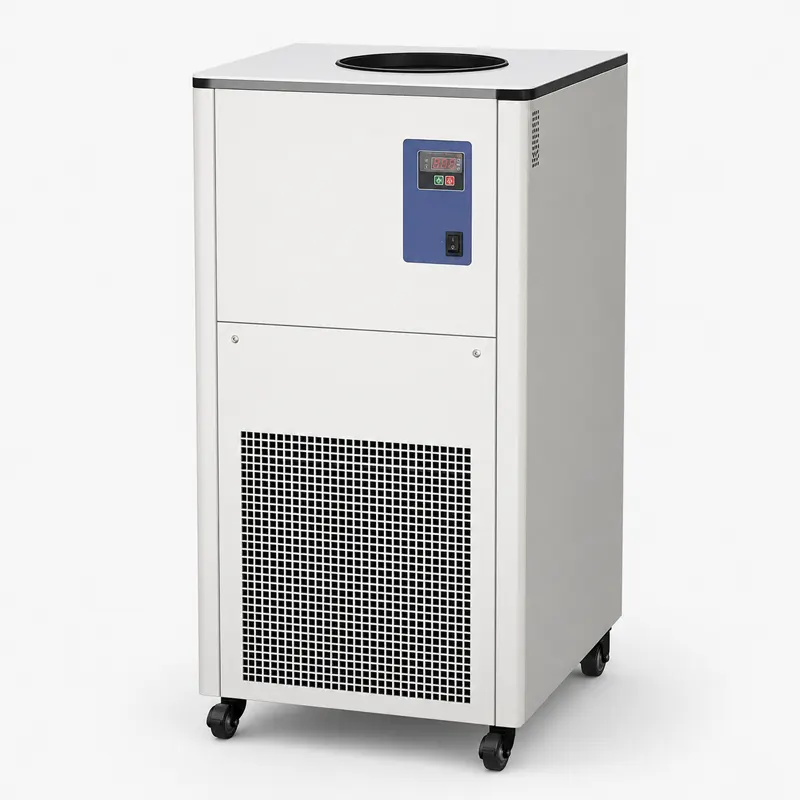
Two cautions are worth stating plainly. A chiller is an accessory, not a purification device: it does not lower moisture or oxygen. And not every chiller suits every enclosure; heat load, coolant choice and plumbing should be agreed with the box supplier. Cold exposed lines in a humid lab can also condense water on their outer surfaces.
Gloves, seals and feedthroughs decide whether the atmosphere holds
Gloves are the largest polymer surface in the box
Gloves deserve more attention than they usually receive. They are the biggest continuous polymer area in contact with the atmosphere, they flex thousands of times, and they are permeable to water vapour and oxygen to some degree whatever they are made of. Material choice trades permeation rate against resistance to the solvents and acids in use, flexibility and cost; thickness affects both barrier behaviour and dexterity; port diameter and glove size must match the box so the glove seats correctly and does not balloon under pressure. A pin hole is among the most common and least expensive causes of a rising baseline.
Seals, doors and feedthroughs
The rest of the barrier is elastomer and metal. Door seals, O-rings and gaskets must be compatible with the chemicals in use, and the vacuum grease specified for the box should be the one the manufacturer recommends. Electrical feedthroughs are convenient and often numerous, but each is a sealed interface with its own torque and seal, and each provides a thermal path that carries heat out through conductors. Fluid feedthroughs must be rated for the coolant and for line pressure. On a split box, module joints belong on the same inspection list as the doors. Recording a leak-rate baseline after commissioning turns later changes into evidence rather than a mystery.
Regeneration and maintenance planning
Signals worth investigating
- A steady-state baseline drifting upward with no transfer taking place.
- Recovery after each transfer taking noticeably longer than before.
- Regeneration being triggered more often than the historical pattern suggests.
- A step change after maintenance, a glove change or new equipment was installed.
Each of these can come from a leak, a glove, outgassing from something new inside the box, spent medium, or a sensor needing calibration. Listing them keeps the diagnosis ordered: a box that never returns to its previous baseline is saying something different from a box that returns slowly, and those two observations should not be treated as the same problem.
Spares, consumables and records
- Gloves and glove seating rings, plus seals and O-rings for every door and module joint.
- Filters and solvent trap media, replaced on a schedule rather than on failure.
- Calibration gas and a written calibration procedure for the analyzers.
- Spare fittings and seals for feedthroughs, and the recorded leak-test baseline.
- A log of dates, transfers, readings, regeneration events, maintenance, and anything new placed in the box.
That log is the most valuable maintenance document a lab can keep, because atmosphere problems are almost always trend problems. A single reading means little; a reading compared with the same measurement last month means a great deal.
A configuration checklist before you specify
A purification box is configured around the work, not the other way round. The table below groups the decisions that most often change the outcome, and the questions that should be answered in writing before purchase.
| Configuration choice | What it changes | What to confirm |
|---|---|---|
| Number and arrangement of stations | How many people can work at once, and how close together | Simultaneous users, shift patterns, and whether their processes can share one atmosphere |
| Single-sided or double-sided | Access, footprint, separation between clean and contaminated work | Whether a second face is needed for a separate task or for service |
| Split or one-piece shell | Transport, installation staging, service access | Whether sections can be isolated, and how each joint is leak-tested |
| Antechamber size and cycle type | Transfer volume, transfer time, disturbance to the atmosphere | Whether vacuum cycling is acceptable for your samples, and how the chamber is purged |
| Purification loop and media | Steady-state readings and recovery speed | Media type, regeneration method and interval, and the conditions attached to quoted values |
| Analyzers | What you can see, not what you can remove | Range, resolution, accuracy, calibration method and sampling point |
| Gloves and ports | Permeation, dexterity, chemical resistance | Material compatibility, thickness, size, port diameter and spare availability |
| Feedthroughs and filters | Connectivity and protection of the media | Types and counts, spare capacity, sealing method, solvent trap and HEPA stage (particles only) |
| Heat management | Atmosphere stability and material life | Process heat load, cooling inside the box or through a closed coolant loop, chiller selection and plumbing |
Information to give a supplier
- Sample types, their sensitivity to moisture and oxygen, and whether any are solvents, powders or porous materials.
- The contaminant you are actually defending against: water, oxygen, solvent vapour, particles, or a combination.
- Process heat load, operating temperature, and whether the process must run inside the enclosure.
- How many operators work simultaneously, on how many shifts, and how much of the time the box is open.
- How samples and tools enter and leave, including bottle sizes, substrate carriers, bulky tools, and whether vacuum cycling is acceptable for them.
- Chemical compatibility requirements for gloves, seals and grease.
- Feedthrough needs for electrical, signal and fluid lines, with counts and spare capacity for future work.
- Whether any part of the box must be isolatable for maintenance or for a process that could affect the others.
- Site constraints: floor space, doorway and lift dimensions, ceiling height, and available services.
A four-station single-sided split purification box earns its place when the work is parallel, collaborative and space-constrained, and when the materials being handled are compatible with sharing one atmosphere. It is the wrong choice when one process would compromise all four stations, or when nobody has the time to look after joints, gloves and a regeneration schedule. Ask for detail about the loop, the antechambers and the sealing interfaces, because those are what determine whether a four-station box is still holding its baseline a year after commissioning.
