
Glove box performance is usually discussed through two numbers: oxygen and water. Purification columns, regeneration cycles, analyser calibration and leak testing dominate the conversation, and for moisture-sensitive or air-sensitive materials that focus is justified, because a few parts per million of either species is often enough to change a result. There is a third variable, however, that rarely appears on a specification sheet and still decides whether certain processes work: particulate contamination.
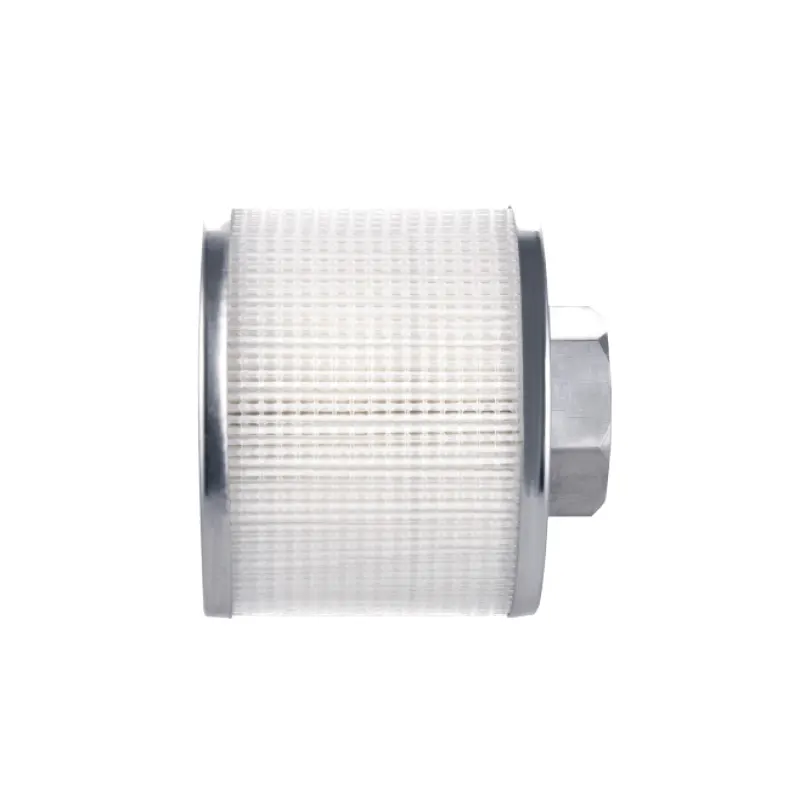
The HEPA filter cartridge is the component that addresses that third variable. It is a small, replaceable element, and its job is deliberately narrow: remove airborne particles from a gas stream without changing the chemical composition of that stream. Knowing where such a cartridge belongs, what it can and cannot accomplish, and how to specify it is the difference between a filter that quietly protects a blower, a pump or a sample, and one that only adds pressure drop, joints and false confidence to a system.
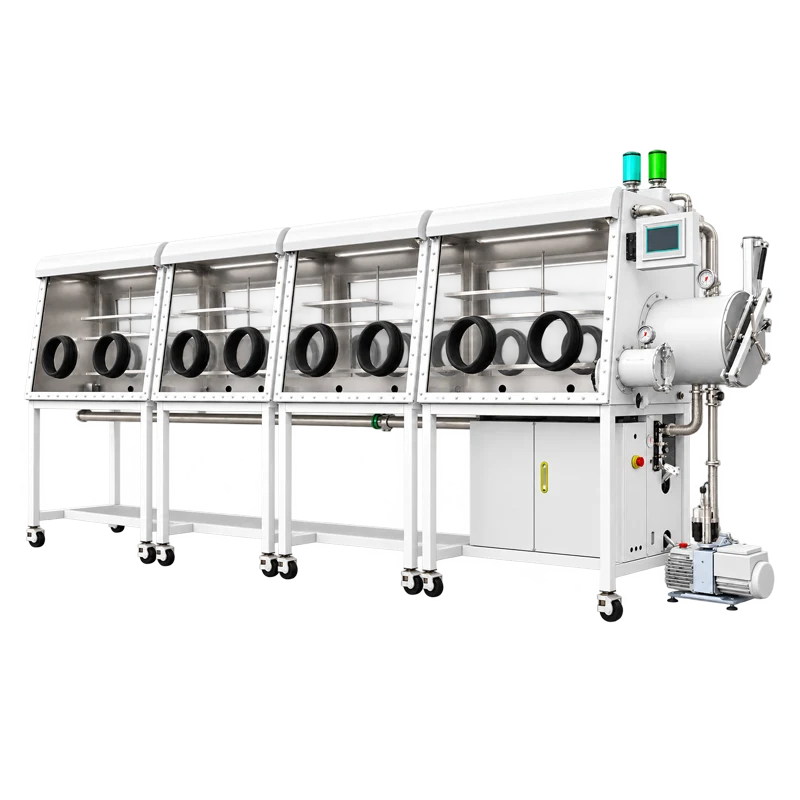
This article focuses on the accessory itself: how particulate filtration fits into glove box atmosphere control, which locations it can serve, how to read a filter specification, and which compatibility questions should be answered before ordering. The eight-station double-sided split-type glove box with gas purification system appears here only as an example of a larger system in which those questions become more demanding; whether a particular cartridge suits that or any other box has to be confirmed against the actual gas circuit, ducting and flow.
A HEPA Cartridge Is a Particle Device, Not an Atmosphere Device
The most persistent misunderstanding about a glove box HEPA filter is the assumption that it improves atmosphere quality in the same way the purification column does. The two components sit in the same system and are often discussed in the same sentence, but they act on entirely different things. A purification column contains reactive and adsorbent media that bind oxygen and water, and it is the reason a sealed box can hold a low moisture and oxygen level while gas circulates through it. A HEPA cartridge contains a pleated fibrous medium that intercepts particles. It has no capacity for oxygen, no capacity for water, and no meaningful capacity for solvent vapour.
What the cartridge actually removes
The particles that appear inside a working box are ordinary ones: fine dust released when a powder is weighed, sieved or ground in the working volume; fibres shed by wipes, gloves and paper; skin flakes; and sub-micron debris from cutting, coating or preparation of feedstock for additive manufacturing. Most of it is invisible. A fibrous medium captures such material through a combination of interception, inertial impaction and diffusion, with electrostatic attraction playing a minor role in some media. This is why the widely used definition of a HEPA filter refers to a particle size rather than to a chemical: capture of at least 99.97% of particles around 0.3 µm, a size selected because it sits near the most penetrating particle size for many fibrous media. Smaller particles move fast enough for diffusion to help, larger ones are caught by impaction, and the region between is the hardest to hold.
What the cartridge does not do
It does not lower water or oxygen. If a moisture reading is drifting upward, the answer lies in the purification column, its regeneration state, the glove ports, the antechamber seals or the overall leak rate, not in the particle filter. It does not remove solvent vapour: solvent adsorbers based on activated carbon handle that duty, and a HEPA element passes solvent molecules with no measurable effect. It does not make a box sterile or cleanroom-classified, because particle removal and biological control are separate claims with separate test methods. And it does not compensate for a leak. A filter is an addition to the atmosphere system, never a replacement for the parts that define the atmosphere.
Recognising that a particle problem exists is part of the exercise. Signs include a visible film on the inner surface of the window, dust observed on sample surfaces under a microscope, a gradual loss of loop flow with no change in valve settings, and unusual noise from a blower or vacuum pump. None of these alone proves that a filter has failed; a film on the window may be condensation residue, and flow loss may come from a partly closed valve or a loaded column. The point of listing them is to separate particle-related symptoms from atmosphere-related ones, because the two are investigated with different tools.
Keeping the roles separate prevents most specification mistakes:
| Requirement | Component that addresses it | Does a HEPA cartridge address it? |
|---|---|---|
| Oxygen removal | Purification column media | No |
| Moisture removal | Purification column and molecular sieve | No |
| Solvent vapour | Solvent adsorber | No |
| Airborne particles | HEPA filter cartridge | Yes |
| Gas circulation | Blower and loop ducting | No |
Where a Cartridge Sits in a Glove Box Circuit
A filter matters only if gas actually flows through it, so the first question about a cartridge is not how efficient it is but where it is installed and what flow and pressure that position sees. In glove box practice there are three common positions, and they place very different demands on the element.
In the circulation loop
In a purified box, gas is moved continuously through the purification column and back into the working volume. A particulate element is often placed on this loop, at the blower inlet or immediately upstream of the column. The reason is mechanical: particles that reach a blower impeller erode and unbalance it over time, and particles that settle into a packed column bed raise its resistance, which the loop must then overcome. Protecting those two components is the usual justification for a cartridge in a purified system. Because this position sees continuous flow, its pressure drop becomes a permanent operating cost for the loop, and the element is exposed to whatever the box atmosphere carries.
On vent, vacuum and transfer paths
The second position lies on the paths that move gas in and out of the box rather than circulating it. When an antechamber is evacuated and refilled, gas leaves and enters through valves and tubing. A filter on the vent path keeps particles from the surrounding laboratory out of the box, and a filter on the exhaust side keeps particles from the box out of the vacuum pump. The pump often benefits most: a rotary vane or dry pump that ingests abrasive dust loses performance and eventually fails, and a cartridge costs far less than a pump rebuild. Elements here see intermittent flow and, depending on the layout, a pressure differential rather than near-atmospheric conditions — a detail to check against the housing rating rather than assume.
Inside the working volume
Some installations use a filter inside the box, either to clean a local recirculation stream or to protect a specific workstation such as a coating or powder-handling area. This can work well, but it consumes workspace and alters internal airflow; a filter that is too restrictive in a small volume can leave stagnant zones where moisture lingers. A filter placed inside the box also becomes part of the working environment rather than part of the utility equipment, so it must be compatible with everything else present, including gloves, solvents and samples.
Reading the Specification: Efficiency, Pressure Drop and Airflow
Two cartridges can look identical and behave completely differently, because the numbers that decide performance are not visible from the outside. Four properties matter when comparing accessories: efficiency class and the method behind it, pressure drop at the working flow, media and housing materials, and the connection and sealing arrangement.
Efficiency classes and what they mean in practice
EN 1822 and ISO 29463 assign classes from H13 upward for HEPA filters and U15 upward for ULPA filters, based on the most penetrating particle size and on both the overall filter and the local efficiency of the medium. In North American practice the familiar figure is 99.97% at 0.3 µm, while MERV ratings and other national schemes add further vocabulary. The practical consequence is that a class label is meaningful only together with the standard it refers to. A cartridge described as H13 and one described as 99.97% at 0.3 µm are making related but not identical claims, tested differently, and they should not be treated as interchangeable when quotations are compared. Ask which standard, which test aerosol, and whether the figure applies to the finished filter or only to flat sheet media.
Pressure drop is the number that changes your system
A filter is a resistance in a gas path, and the flow that path can deliver falls as resistance rises. That matters more in a glove box than in a large air-handling system, because the loop already contains a column, tubing, valves and heat exchange, and the blower has a limited curve. A high-efficiency element with a small media area can starve the loop of flow, which often appears as a slower return to a stable reading after a transfer rather than as an obvious failure. A larger pleated area in the same footprint usually lowers resistance at the same class, which is one reason media area is worth asking about explicitly. Pressure drop also increases as the element loads, so the clean value and the end-of-life value are different numbers. The usable figure is pressure drop at the actual operating flow, not a nominal value printed on a data sheet for a different duty point.
Media, housing and connection details
Most glove box HEPA cartridges use pleated glass-fibre or synthetic microfibre media held in a frame, with a gasket sealing the element to its housing. The gasket material — silicone, EPDM or a fluoropolymer such as FKM — determines chemical compatibility with the box atmosphere. Housings are commonly stainless steel or polymer; polymer versions are lighter and less expensive but have temperature and solvent limits, while stainless versions tolerate vacuum and cleaning better. The connection determines how the cartridge integrates: KF flanges for quick seal-based assembly, threaded ports, or hose barbs for flexible tubing. Every joint is a possible leak path, and in a sealed atmosphere system each added connection is another opportunity for air ingress. Fewer, well-matched joints are usually better than an excellent filter behind an improvised adapter.
Compatibility Boundaries and Common Failure Modes
Once efficiency and flow figures are settled, the remaining questions concern exposure and installation. Most disappointing filter performance in glove box service comes not from a wrong class but from a media, seal or handling decision that was never checked.
What the media tolerates
Glass-fibre media is stable over a wide temperature range and is not damaged by moisture, but a wet element has a higher pressure drop, and if the separator or housing is metallic, prolonged moisture exposure can promote corrosion. Solvent vapour passes through a HEPA element without being retained, and over time it attacks gaskets and potting compounds rather than the medium itself. This is why a solvent adsorber and a particle filter are complementary rather than alternative: the adsorber handles vapour, the filter handles particles, and neither performs the other's job. Where a process generates both, as spray coating inside a box can, both stages should be designed deliberately rather than added one at a time.
Leak paths, seals and pressure direction
Every filter adds at least two joints to a system whose performance is measured in parts per million. Gasket material, compression and surface finish all influence whether those joints stay tight, and an O-ring that outgasses or hardens changes both the leak rate and the atmosphere. Pressure direction deserves separate attention: a cartridge installed on an exhaust or vacuum line may see a differential across the medium that a cartridge intended for a circulation loop was never designed for. Housings and media have structural limits, and a collapse inside a duct is difficult to diagnose from the outside. Confirm the pressure each position develops and match the element to it instead of assuming one cartridge can serve every location.
One element or a staged arrangement
Some systems are best served by a single element at the point where protection matters most, while others benefit from a staged arrangement: a coarser pre-filter that takes the bulk of the load and a HEPA stage behind it that provides the final efficiency. Staging costs an extra connection and an extra pressure drop, but it extends the life of the more expensive element and makes replacement less frequent, which matters when every filter change interrupts the atmosphere. The decision depends on how much particulate material the process actually produces. A box used to handle pre-formed, clean samples may need little particle control; a box used for grinding, sieving or powder transfer may justify the extra stage.
Replacement follows loading, not the calendar
A HEPA element is a consumable, and its life ends when pressure drop becomes unacceptable for the flow it serves, not on a fixed schedule. Loading depends on what is handled inside the box, how often material is transferred, and whether powders are used. Trend is the useful indicator: a slow rise in loop resistance, or a slower recovery after transfers, is the signal to inspect. Replacement also means opening a sealed system, which requires planning — bring the box to a defined state, protect the atmosphere as far as the design allows, then purge and monitor afterwards. A spare element stored in laboratory air should be treated as a potential contamination source rather than a clean part, and keeping the correct part number on the shelf prevents a filter from becoming a whole-system availability problem.
Configuration Questions in Multi-Station and Split-Type Systems
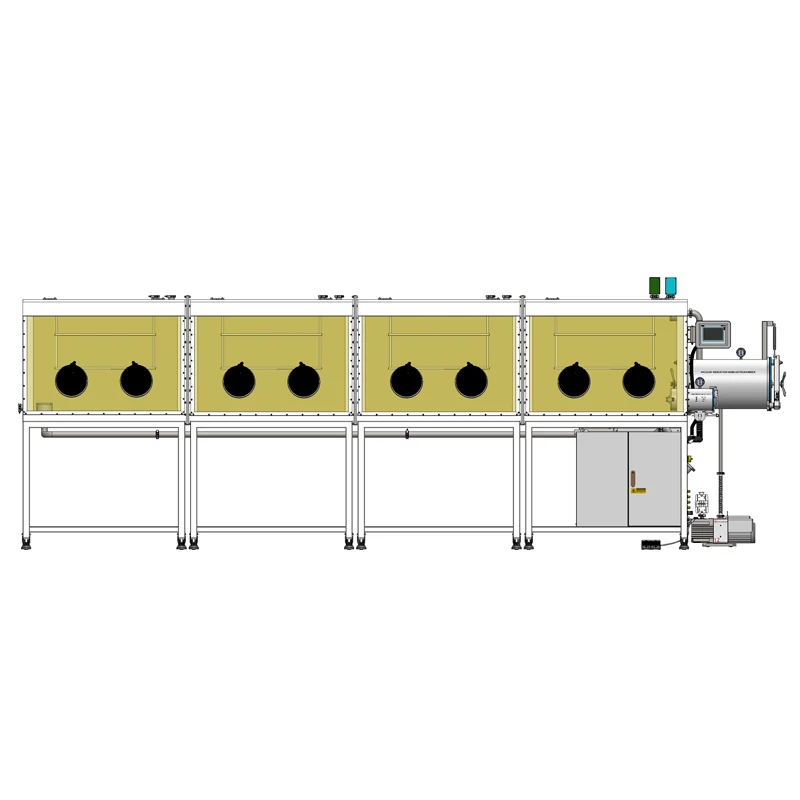
In a single-station box, one small cartridge is usually sufficient and selection is quick. As systems grow, the accessory question becomes an airflow question. The eight-station double-sided split-type glove box with gas purification system illustrates the scale at which this happens: multiple stations, two working faces, and a purification unit arranged separately from the box rather than integrated into it.
Airflow and volume scale together
A larger working volume holds more gas, presents more internal surface for adsorption and desorption, and is opened more often because more operators use it. Each transfer and each glove movement displaces gas and stirs particles that had settled. The circulation loop must therefore move a larger volume of gas per unit time to keep the atmosphere uniform, and any resistance added to that loop, including a particle filter, has a proportionally larger effect on flow. Filter sizing should be reconsidered whenever a system expands rather than carried over from a smaller box on the assumption that an efficient element is efficient everywhere.
Split-type layouts and where filtration belongs
In a split-type arrangement the purification unit and the box are separate assemblies joined by ducting, which changes where a filter can go: on the box-side duct, on the purifier-side inlet, or on the interconnecting line, each with different access, service and pressure conditions. Duct length adds its own resistance and volume as well. None of this can be settled from a catalogue description alone. A cartridge listed as a glove box accessory has defined dimensions, media area, connections and pressure limits; whether it fits a specific multi-station system depends on the actual duct diameter, flange standard, required flow and the pressure each position develops. Those details should be confirmed with the supplier before the accessory is treated as compatible with a given machine.
What to Send the Supplier Before Choosing a Cartridge
Filter selection moves faster when the application is described rather than only the model number. The following information is usually enough to narrow the choice and avoid a mismatch:
- Working gas and any reactive species present, such as argon, nitrogen, dry air or a hydrogen mixture.
- Intended installation point: circulation loop, vent path, pump exhaust, antechamber line or inside the box.
- Required flow at that position and the pressure drop the loop can tolerate.
- Particle sources inside the box, including powders, cutting or grinding, fibre shedding and coating processes.
- Solvent or vapour exposure, and whether a separate adsorber stage already exists.
- Connection type and flange standard at the installation point, for example the KF size, plus available space.
- Operating temperature and whether vacuum or a pressure differential appears at that point.
- Preferred gasket and housing materials based on chemical compatibility.
- Expected service interval, and whether the element can be changed without dismantling ducting.
- Any documentation or cleanliness requirement the laboratory has to meet.
A HEPA filter cartridge is one of the least expensive components in a glove box and one of the easiest to specify badly. Treated as an atmosphere device, it invites the wrong expectations: oxygen and moisture readings will not move, and the real problem will be sought in the wrong place. Treated as what it is — a particle barrier in a defined gas path, with a defined resistance and defined chemical limits — it protects blowers, pumps, columns and samples without disturbing the atmosphere control the purification system provides. The useful questions are positional and quantitative: where does the gas flow, how much of it, at what pressure, and what does it carry. Answering those four questions first turns an accessory into a decision with a clear technical basis.
