
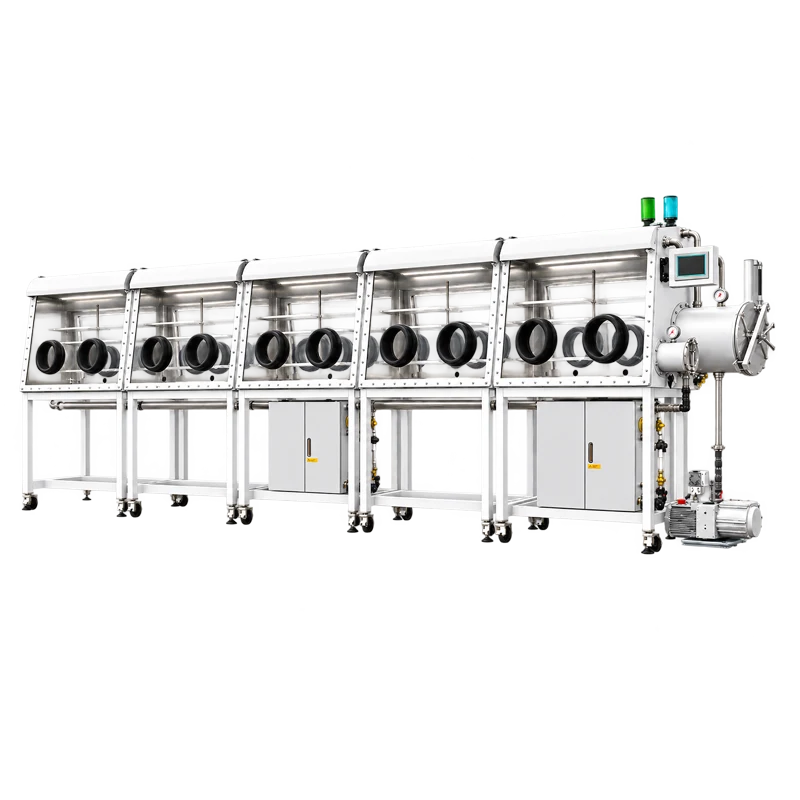
Ten glove stations, two working faces, and a purification loop look like a scale-up of a smaller box. Operationally, they create a shared atmosphere problem. Every transfer, glove movement, tool operation, and service event adds a small load; the purification system has to manage the sum while the people at each station expect stable conditions. The TENCAN ten-station double-sided split-type glove box with gas purification system is the reference product for this discussion. The supplied listing identifies the configuration and the presence of gas purification. It does not provide numerical water, oxygen, leak, or recovery ratings, so the useful questions are about layout, purification architecture, transfer discipline, and verification.
Why Station Count Is an Atmosphere-Control Decision
A station is not just a pair of gloves. It is an access point where the enclosure is handled, loaded, cleaned, and observed. Ten stations increase the number of simultaneous small disturbances and the number of people who need the same procedure. They also increase the number of gloves, ports, and seals that can wear. A leak that would be a minor nuisance on a two-station box can become a persistent load on a ten-station box because it competes with purification alongside normal transfers.
The product name indicates ten operating stations, but it does not define whether every station is a full work position, how many are on each side, or whether the split sections are independently controlled. Those details belong on the current drawing and gas schematic. They matter because a shared atmosphere behaves as one system only to the extent that it is actually connected. If isolation valves divide the box into zones, a local problem may be contained. If not, a pressure change or an outgassing event at one end can influence the whole enclosure.
This is why station count should be discussed with the process map, not only with the floor plan. Two operators working at adjacent stations on a shared loop are not equivalent to two separate boxes. They can share gas, monitoring, and purification capacity, which is efficient, but they also share consequences. The design question is how much independence is worth paying for in valves, controls, and additional purification hardware.
Purification capacity has to be matched to the duty cycle, not the empty volume. A ten-station box may sit quiet for hours and then see several transfers in a short period. The purifier sees a transient load; the analyzer sees the result after mixing and transport delays. A capacity figure without a defined load and recovery condition is therefore difficult to interpret. Ask for the basis: enclosure volume, gas circulation, expected ingress, material load, and the acceptable time to return to the working range.
The same logic applies to redundancy. A single purification loop may be adequate if the work can pause for service and if transfers are controlled. A laboratory that runs sensitive processes across multiple stations may prefer isolation or a backup purification path. That is a workflow decision as much as an equipment decision. Finally, count the people, not only the ports. Ten stations can support a larger team, but each additional operator adds a protocol to train, a set of gloves to inspect, and a habit to align. Atmosphere control in a multi-user box is partly a human-factors problem.
What the Double-Sided Split Layout Changes
Double-sided access can shorten material paths. One side can receive a sample or a tool while the other side performs the process; two operators can work face to face on a long part; inspection can happen without carrying an item around the enclosure. In a ten-station box, that can reduce congestion and the temptation to open a main door during a sensitive step. The benefit is real, but it depends on a workflow that actually uses both sides.
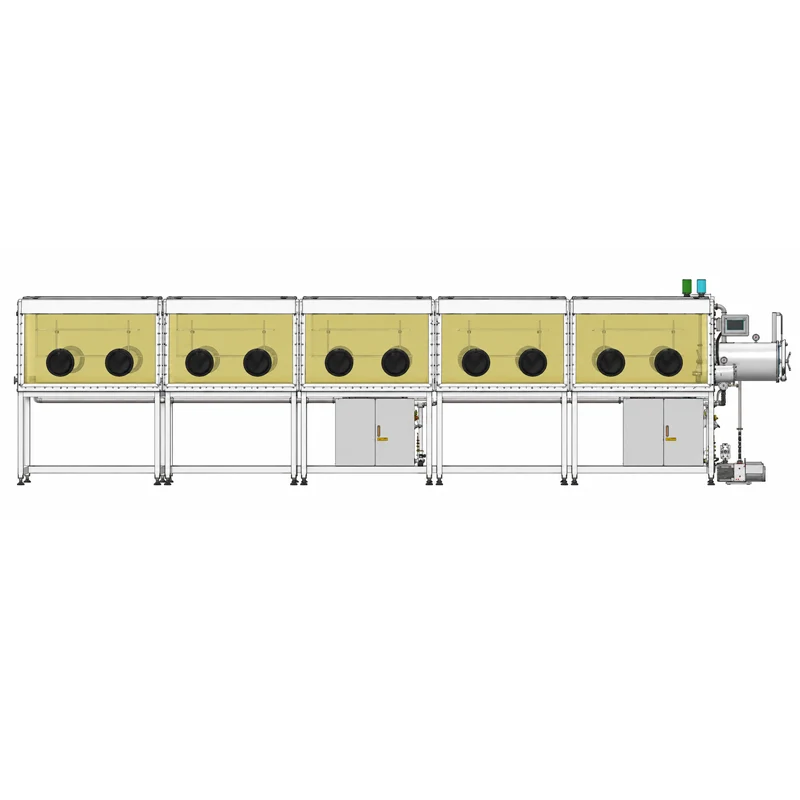
The split-type construction matters just as much. A split enclosure may be easier to transport, install, and service, and it may allow process zones to be separated. It can also add flanges, connections, and dead volume. The critical question is whether the split is only a mechanical division or also an atmospheric one. Are there isolation valves? Can one section be serviced while another stays under inert gas? Does each section have its own purification, or do they share a loop? The product listing does not answer these questions, and they should not be inferred from the name.
Double-sided operation also changes monitoring. A sensor at one end of a long enclosure may not represent the atmosphere at a glove port at the other end. Circulation patterns, obstruction by equipment, and local outgassing can create differences. A single reading is useful for trend control, but it is not a map of the working volume. For a ten-station box, ask where the sample is taken, whether there are multiple sample points, and how the reading responds when a station is used.
| Layout question | Why it matters | What to confirm |
|---|---|---|
| Are all stations on one gas circuit? | Local disturbances may affect the shared atmosphere; purifier load is aggregated. | Gas schematic, isolation valves, loop routing. |
| Does double-sided access share one volume? | Pressure coupling and operator coordination change with layout. | Cross-section drawing, pressure-control points. |
| What does split-type separate? | Service access and process zoning depend on real isolation. | Module boundaries, flange locations, purifier arrangement. |
| Where are analyzers sampled? | A single point may not represent every station. | Sample points, calibration ports, trend logging. |
The table is a specification aid, not a diagnosis. If a supplier cannot show the gas path, the isolation philosophy, and the sensor locations, the layout discussion is incomplete. Those three documents explain more than a list of dimensions.
How the Purification Loop Serves a Multi-Station Box
A gas purification system for this product category is a closed-loop atmosphere-management system. Gas is circulated from the enclosure through purification material that removes water and oxygen, then returned. A blower maintains circulation, sensors monitor the atmosphere, and controls manage alarms, setpoints, and regeneration. The purifier is not a particle filter. A HEPA filter addresses particles, not water or oxygen. Solvent adsorption addresses solvent vapor, not water and oxygen removal. These functions can coexist, but they should not be conflated.
In a ten-station box, the purification loop has to handle continuous ingress plus transient events. Continuous ingress includes small leaks, glove permeation, and outgassing from materials stored inside. Transient events include a pass-through cycle, a glove change, a new sample, or a process that releases moisture. The purifier's removal rate must exceed the total ingress rate if the atmosphere is to recover. During a heavy transfer, it may not; the question is how far the reading moves and how quickly it returns under a defined procedure.
Working gas, control gas, and regeneration gas are different roles. The working gas is the atmosphere in the enclosure. Control gas may actuate valves or instruments. Regeneration gas restores the purifying material. They may come from the same supply, but they are not interchangeable in function. A multi-station laboratory should know which gas is used for which purpose and what happens to atmosphere control during regeneration. Specific temperatures, gas mixtures, and sequences must come from the manufacturer's instructions for the actual model; they are not generic settings.
The split layout raises a capacity and redundancy question. If the sections share one purifier, a regeneration or service event can affect every station. If they have separate purification, one section can continue while the other is maintained, but the system is more complex and may require more monitoring. Neither arrangement is automatically better. The choice depends on whether the work can pause, whether any process is continuous, and how much atmosphere independence the laboratory needs.
Control strategy is part of capacity. A system that only alarms when a limit is crossed gives the operator little warning. Trend logging, service reminders, and clear status indicators help a multi-user laboratory see a slow drift before it becomes a failed batch. The analyzer is a measurement device, not a purification device; it can tell you that the atmosphere is changing, but it cannot remove the load. For specification, ask for the purification architecture, not only the model name: number of columns, circulation path, isolation points, regeneration method, and monitoring locations. If those details are not available in the current material, they need to be confirmed for the actual project.
Transfer, Pressure, and the Real Cost of Atmosphere Disturbance
Most atmosphere disturbance enters through a transfer. A pass-through or antechamber lets an item move in or out without opening the main enclosure to room air. The transfer uses evacuation and inert-gas backfill, or a purge cycle, and then equalizes with the box. If the procedure is rushed, if the chamber is overloaded, or if the inner door is opened before the atmosphere has settled, the main box sees a pressure transient and a gas load. In a ten-station box, the same protocol may run many times per shift, so cumulative discipline matters more than a single perfect transfer.
Pressure and composition are related but not the same. A pressure-control system may add inert gas to maintain a slight positive pressure, while the purifier handles water and oxygen. If pressure rises, gas may escape outward; if it falls, room air may enter. The correct pressure strategy depends on the design and must be confirmed. Operators should know which instrument controls pressure and which measures water or oxygen. A pressure gauge is not an oxygen analyzer.
Leak rate, purge rate, and purification rate are separate quantities. A high purge rate can dilute ingress, but it consumes gas and may disturb the process. A low leak rate is preferable to a high purge rate when stable atmosphere is the goal. Gloves are a common leak path because they flex, wear, and are handled constantly. Ten stations mean more gloves and more glove ports. Inspection should be based on use and observed condition, not only on a calendar interval. Door seals, pass-through seals, and feedthrough seals deserve the same attention.
Transfer strategy also determines how much the layout helps. If every station can receive material directly from the room, there are many potential ingress points. A central pass-through with a written protocol may be more controllable. If double-sided operation lets material enter on one side and leave on the other, crossing is reduced, but the route and the zone status must be tracked. Split sections can separate high-outgassing work only if they are genuinely isolatable; otherwise the separation is procedural.
Where a Gas and Liquid Feedthrough Fits
Some processes need a continuous service inside the enclosure rather than a discrete object transfer. A feedthrough carries gas, liquid, or electrical connections through the glove box wall. TENCAN's gas and liquid feedthrough is listed as an accessory for this purpose. It is not a replacement for a pass-through, and it should not be selected from a product name alone. The media, pressure and temperature conditions, wetted materials, sealing method, electrical requirements if any, and available port on the box all matter. Compatibility between a particular feedthrough and a particular ten-station split-type glove box must be checked against the box drawing and the feedthrough specification; both products being listed by the same supplier is not, by itself, proof of compatibility.
What the Analyzers Can and Cannot Tell You
An oxygen or moisture analyzer measures the atmosphere at its sampling point. It does not measure the remaining capacity of the purifying material, and it does not prove that every station in a ten-station box is at the same condition. In a long or split enclosure, flow patterns, dead zones, and sensor placement can create differences. A sensor in the return line may represent the gas leaving the enclosure; a sensor near a working station may reveal a local event. Both readings can be valid, but they answer different questions.
Resolution, accuracy, range, response time, and calibration are distinct specifications. A display with more decimal places is not automatically more accurate. If the documentation does not state the measurement conditions, a displayed value should not be converted into a process guarantee. Ask where the sample is drawn, how long the sample path is, whether it is filtered, and how calibration is performed. For a multi-station box, the sampling map is part of the atmosphere-control design.
Slow recovery after a transfer is a common observation with several possible causes: a large air load, a leak, a saturated purifier, insufficient circulation, a closed isolation valve, a slow sensor, or a local dead zone. The right response is to gather evidence, not to assume the purifier has failed. Record the transfer size and duration, the pressure trend, glove condition, purifier status, valve positions, and the analyzer's response to a known challenge. Service decisions should follow the model-specific manual and the alarm history.
A Configuration Checklist Before You Specify Ten Stations
The specification should start with the process, not the station count. A ten-station box is justified when the workflow genuinely needs parallel access, double-sided handling, or separated process zones. If the work can be done at four stations with a controlled transfer protocol, a larger box adds volume, connections, and monitoring burden without adding value. The following checklist organizes the information a supplier needs.
- Process map: which operations happen at each station, expected duration, tools, heat, motion, and operator count.
- Material list: powders, solvents, reactive materials, substrates, and any process that releases moisture, oxygen, particles, or solvent vapor.
- Atmosphere requirement: working gas, acceptable water and oxygen ranges, and how those ranges are verified. State whether the values are steady-state targets or recovery targets.
- Load profile: number of transfers per shift, largest load, frequency of door or pass-through opening, and planned idle periods.
- Layout: single or double-sided access, number of stations per side, split module boundaries, pass-through locations, storage, and service access.
- Purification: shared or independent purifier, redundancy, regeneration plan, monitoring points, and alarm strategy.
- Utilities and interfaces: gas supply, liquid lines, vacuum, electrical feedthroughs, exhaust, solvent adsorption, and HEPA filtration where particles are the concern.
- Site services: power, inert gas supply, exhaust, floor loading, and clearance for service.
- Acceptance and documentation: leak test method, atmosphere test conditions, calibration records, spare parts, and operating instructions.
Do not accept a single atmosphere number without its conditions. Ask whether it applies to an empty box, a defined load, a specific purge procedure, or a steady state after a defined recovery period. Ask whether it is typical or guaranteed, which sensor was used, and where the sample was taken. In a ten-station system, one point is not a map. A verification procedure with defined sample points is more useful than a headline value.
Compatibility is separate from product category. A gas and liquid feedthrough, a glove, a pass-through, or an analyzer may appear in an accessory list, but the specific item must match the port, sealing system, and service conditions. The same caution applies to purification. The product name confirms that a gas purification system is part of the configuration; it does not confirm that a particular setpoint will be reached in every installation.
For a ten-station double-sided split-type system, the central decision is how much atmosphere independence the work requires. A shared loop with good circulation and disciplined transfers may suit a coordinated research program. Isolated sections or separate purification may suit work that cannot pause for service or that produces high transient loads. The trade-off is complexity: more valves, more monitoring points, more procedures, and more commissioning. Neither choice is universally right; the process and maintenance plan should decide.
Before requesting a quotation, prepare a station-by-station workflow, a material and solvent list, a transfer-frequency estimate, and the utilities needed inside the enclosure. Ask for the gas schematic, the isolation philosophy, the sensor locations, and the conditions behind any atmosphere claim. Those documents will explain more than a single number. The TENCAN ten-station double-sided split-type glove box with gas purification system product page is the place to confirm the current configuration, while the feedthrough page can start a separate compatibility check for gas or liquid services.
