
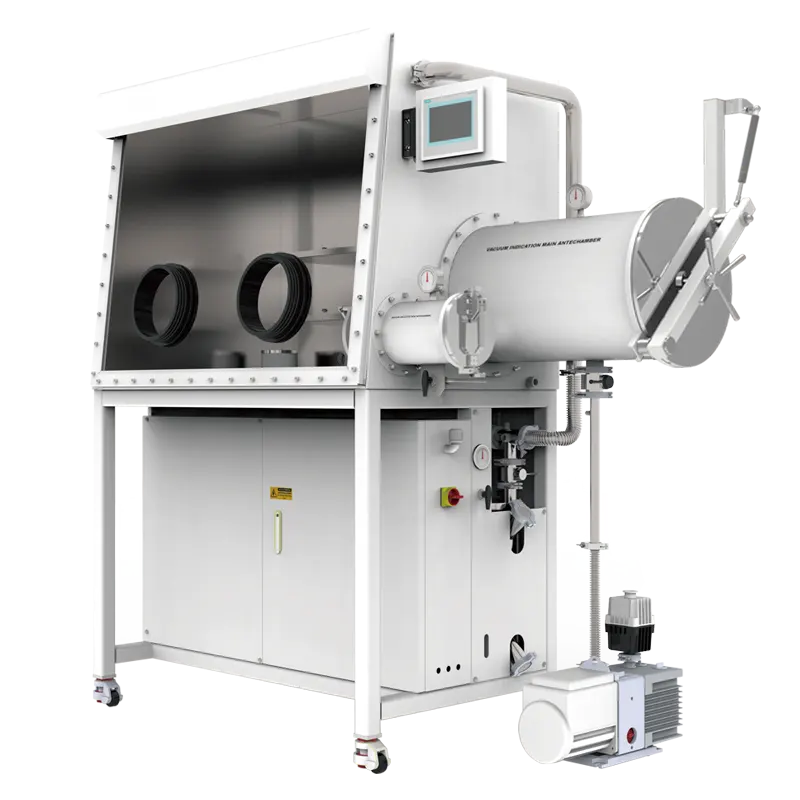
A single-station, single-sided glove box with gas purification is often selected when one operator needs a compact, controlled inert atmosphere for air- or moisture-sensitive work. The configuration sounds simple, but the phrase combines two separate engineering functions: the physical enclosure that isolates the operator from the process, and the gas purification system that continuously manages the atmosphere inside that enclosure. A single-station, single-sided layout reduces footprint and is intended for one working position, which can improve access and reduce the volume that must be controlled. It also means there is less internal buffer space for equipment, solvents, and samples. Every transfer, glove change, spill, or leak affects one shared atmosphere.
The practical question is not whether the box can be filled with argon or nitrogen. It is whether the atmosphere can be maintained at the required oxygen and water levels throughout a process, including after doors are opened, samples are transferred, and materials release trapped moisture or solvent. Gas replacement alone cannot provide that ongoing control. A purification system can, provided it is correctly sized, correctly installed, and maintained. The reference product in this category, the Single-Station Single-Sided Glove Box with Gas Purification System, is an example of a compact box in which purification is part of the design rather than an afterthought.
This guide takes a selection and troubleshooting perspective. It explains what the single-station, single-sided format changes, how purification differs from inert gas replacement, what the closed-loop hardware does, when an organic solvent vapor adsorption accessory is relevant, and why water and oxygen readings may take time to recover after a disturbance. It also lists the information to confirm before purchase so that the box is matched to the process rather than to a generic specification.
What the Single-Station, Single-Sided Layout Changes
In a single-station, single-sided glove box, the working space is normally arranged around one operator position and one side of glove access. This is different from a multi-station or double-sided box, where two or more people can work simultaneously or where processes can be separated across zones. The single-station format is well suited to small-scale research, sample preparation, battery material handling, and processes that do not require parallel work. Because the internal volume is limited, the purification loop has less gas to condition, and the atmosphere may respond quickly to changes when the system is functioning correctly. The same small volume can also be a disadvantage: a spilled solvent, a large outgassing sample, or a poorly purged antechamber can disturb the entire atmosphere more quickly than in a larger box.
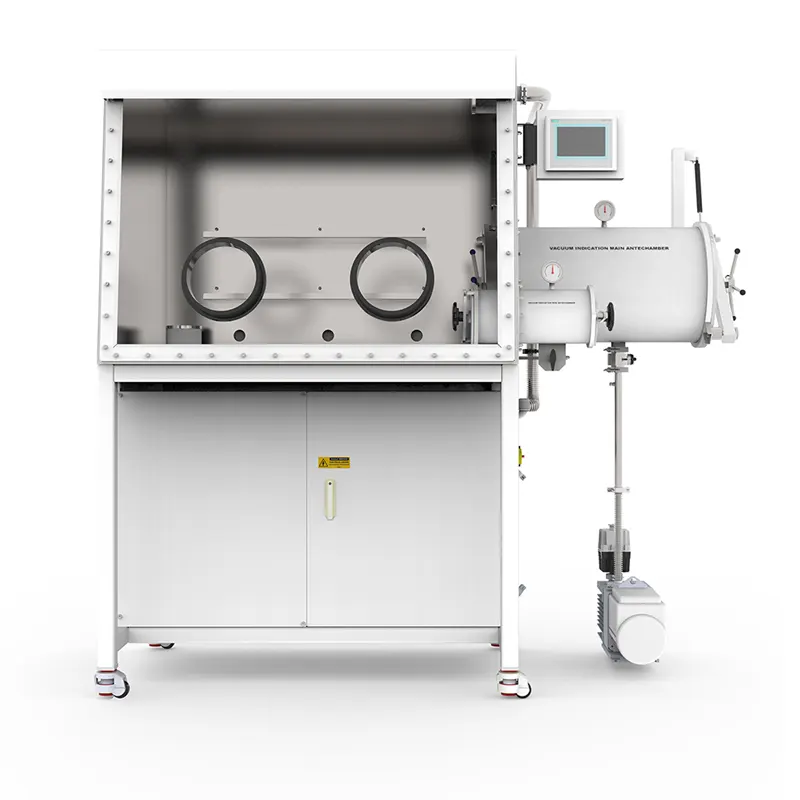
Single-sided access also affects ergonomics and equipment layout. The operator reaches through gloves on one face, so the usable depth and height of the work area matter. Analytical instruments, hot plates, balance, or small processing tools must fit without blocking the circulation path. If the box is configured with a single antechamber, every item must pass through that one transfer path, which can become a bottleneck. If the process requires frequent transfers of large items or multiple sample batches, the antechamber volume and cycle time become important selection criteria. The product page should be checked for the actual antechamber arrangement, glove port count, internal dimensions, and whether the box is delivered with a stand or is intended for bench placement.
Why Inert Gas Replacement Is Not the Same as Purification
Inert gas replacement, often called purging or inerting, removes oxygen and water by diluting the existing atmosphere with dry nitrogen or argon. A typical sequence may involve vacuum and refill cycles, a flow purge, or both. Replacement is essential when a box is first commissioned or after it has been opened to air. It reduces the bulk concentration of oxygen and moisture, but it does not continuously remove the small amounts that enter through gloves, seals, and materials. Once the purge stops, oxygen and water can rise again.
Gas purification is a continuous process. The box atmosphere is circulated through a closed loop that contains material designed to remove oxygen and water. Oxygen is typically removed by a catalyst that reacts with oxygen, while water is removed by an adsorbent such as molecular sieve. The loop operates while the box is in use, so it can compensate for low-level ingress and outgassing. This is the key difference: replacement establishes a starting atmosphere; purification maintains it. Both are necessary. A purification system without a proper initial purge will take much longer to reach a low level, and a box without purification will drift after every transfer.
| Aspect | Inert gas replacement | Closed-loop purification |
|---|---|---|
| Purpose | Reduce bulk O2/H2O at start or after opening | Maintain low O2/H2O during work |
| Driving force | Dilution and displacement | Circulation through reactive or adsorbent media |
| Continuous? | No, batch or flow event | Yes, while blower and columns operate |
| Consumables | Gas supply | Purification media, regeneration gas, power, filters |
| Limit | Cannot remove trace ingress indefinitely | Capacity, regeneration, leak rate, outgassing |
| Typical use | Commissioning, antechamber cycles, emergency purge | Routine operation with sensitive materials |
Inside a Closed-Loop Gas Purification System
A closed-loop purification system is not a single component. It is an assembly that includes a circulation blower, one or more purification columns, valves, piping, a control system, and sensors for oxygen and water. In many designs, the box atmosphere is drawn from the working volume, passed through the purification column, and returned to the box. The loop may also include a heat exchanger or cooler to manage temperature, and filters to protect the blower and columns from particles. The exact arrangement depends on the manufacturer and the model. The Single-Station Single-Sided Glove Box with Gas Purification System should be reviewed with its actual piping and instrument diagram rather than assumed.
It is useful to distinguish working gas, control gas, and regeneration gas. Working gas is the inert atmosphere inside the box. Control gas may operate valves or actuators, and regeneration gas is used to restore the purification media. These streams may have different purity, pressure, and flow requirements. Confusing them can lead to poor regeneration or unnecessary gas consumption. The supplier should provide a gas schematic and identify each connection.
Purification Column and Regeneration
The purification column contains media that remove oxygen and water. Oxygen removal is often based on a copper catalyst that converts oxygen to copper oxide; water removal uses an adsorbent such as molecular sieve. Over time the media become saturated. Regeneration restores them by heating and exposing them to a suitable gas. Oxygen catalyst regeneration typically requires a reducing gas mixture, while water adsorbent regeneration uses heat and a dry purge or vacuum. Regeneration is not the same as normal circulation, and it must not be confused with box purging. The control system should make the mode clear, and the operator should know which gas is used for working atmosphere, which is used for control or actuation, and which is used for regeneration.
Circulation, Analyzers, and Pressure Control
Circulation flow rate affects how quickly the box atmosphere passes through the purification media. A higher flow can improve mixing and recovery speed, but it must be compatible with the column design and the pressure balance of the box. Oxygen and water analyzers measure the atmosphere; they do not purify it. Their location matters. A sensor near the return line may read differently from a sensor near the gloves or antechamber. Analyzer range, resolution, accuracy, calibration, and response time are separate specifications, and a displayed resolution does not automatically mean measurement accuracy. Pressure control is also separate from purification. The box may operate at a slight positive pressure, while the antechamber may be evacuated and refilled. The working pressure, antechamber vacuum, pump ultimate vacuum, and leak rate are different values and should not be mixed.
What Purification Cannot Fix
A purification system cannot compensate for a large, continuous leak, a glove with the wrong material or a poor seal, a saturated column that has not been regenerated, or a process that releases large amounts of solvent or water vapor. It also cannot make an incompatible material safe. If a sample outgasses heavily, the purification loop may be overwhelmed, and the oxygen or water reading will remain high until the source is removed. In that situation, increasing circulation or running longer may not solve the problem. The cause must be identified. This is why selection begins with the material, process, and transfer frequency, not with the purification column alone.
When a Single-Station Purification Box Is the Right Fit and When It Is Not
Workflow, Ergonomics, and Integration
A single-station, single-sided purification box is a good fit when one operator performs intermittent or continuous work that requires a controlled atmosphere and the process does not need multiple simultaneous users. It is also suitable when floor space is limited and when the box can be placed near supporting equipment such as a vacuum pump, gas supply, and analyzer. The compact format can reduce the time and gas required for initial inerting, and it can make it easier to observe the entire working area. However, it is not the right choice when two operators must work at the same time, when large equipment must be installed inside, or when several sample-transfer paths are needed to avoid cross-contamination. In those cases, a multi-station or double-sided configuration may be more appropriate, but it also increases internal volume and the amount of gas that must be purified.
Scalability also matters. A single-station box may be adequate for early experiments, but if the process moves to larger samples or multiple parallel runs, the transfer frequency and internal equipment load may exceed the practical capacity of the compact format. Planning for the next stage can prevent a premature upgrade. The decision should consider not only the current sample size but also the number of transfers per day and the maximum time the box can be open.
Materials, Solvents, and Process Risk
Material compatibility is more important than box size. The gloves must resist the solvents, acids, or particles used in the process. Seals, windows, and internal surfaces must also be considered. The purification media may be sensitive to certain vapors, and some solvents can compete with water adsorption or produce deposits. If the process uses organic solvents, the question is not simply whether the box is inert; it is whether the solvent vapor is managed so that it does not degrade the atmosphere or the purification loop. The process temperature, sample mass, and exposure time also affect how much vapor or moisture is released. A small sample may have little effect, while a large solvent reservoir or a heated process can release enough vapor to change the atmosphere for hours.
Solvent Vapor Control: Where the Organic Solvent Vapor Adsorption System Fits
Organic solvents are common in glove box work, including cleaning, casting, electrolyte preparation, and chemical reactions. Even when the box atmosphere is inert, solvent vapor can affect the process, the analyzers, and the purification media. An Organic Solvent Vapor Adsorption System is an accessory intended to capture organic solvent vapors before they accumulate or reach sensitive parts of the system. It is not a replacement for water and oxygen purification. It also does not remove oxygen or water, and it should not be expected to solve a leak or an outgassing problem. Its role is complementary: it addresses a different contaminant class.
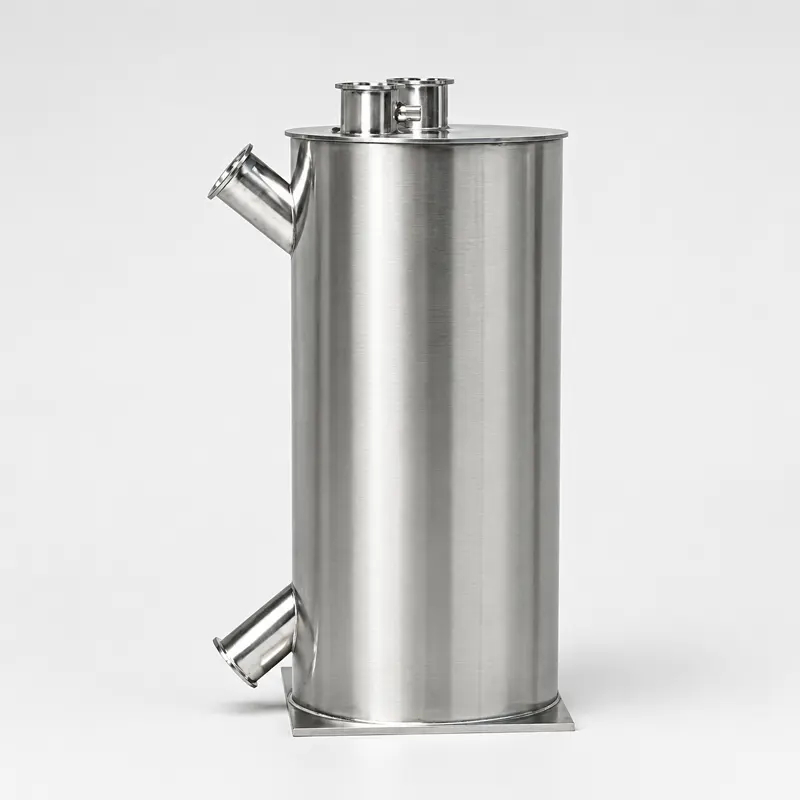
Compatibility must be confirmed. The adsorption system must be suitable for the specific solvents used, the expected vapor concentration, and the box circulation path. The connection point, pressure drop, and service interval matter. If the accessory is added after the box is installed, the supplier should confirm that the purification loop can tolerate the additional flow resistance and that the control system can monitor the relevant conditions. The product page provides the starting point for that discussion. The decision should be based on the solvent list, the process duration, and the required atmosphere, not on a general assumption that any adsorption canister will work with any purification system.
Monitoring solvent vapor is not the same as monitoring oxygen and water. If solvent vapors are part of the process, the system may need additional monitoring or a defined service interval for the adsorption medium. The absence of an oxygen or water rise does not prove that solvent vapor is under control, because different contaminants affect different parts of the system. A solvent that is not removed can condense on surfaces, alter analyzer readings, or gradually reduce the capacity of the water adsorbent.
Why Water and Oxygen Readings Recover Slowly
Slow recovery after a transfer or an opening is a common observation. The reading rises, and then takes longer than expected to return. This does not automatically mean the purification system is faulty. Recovery is a race between the rate at which oxygen and water enter the box and the rate at which the purification loop removes them. If the ingress rate is high, or the removal rate is low, the reading will remain elevated. The first step is to separate a temporary disturbance from a persistent source.
Likely Causes to Separate
- Large or wet item transferred through antechamber without adequate purge.
- Antechamber door seal, glove port, or glove itself passing air.
- Glove material with high permeability for water or oxygen.
- Outgassing from samples, containers, tape, labels, or internal equipment.
- Solvent vapor loading or coating on purification media.
- Purification column saturated or not regenerated.
- Circulation blower or valve not operating at the intended flow.
- Analyzer calibration drift or sensor located in a stagnant zone.
- Box pressure set too low, allowing ingress.
- Leak in piping, fittings, or welded joints.
What to Check Before Concluding a Fault
A logical check sequence helps. Confirm the event that preceded the rise. If the reading rose after a transfer, review the antechamber cycle and the item surface area and moisture content. If it rose without an obvious event, check gloves, seals, and fittings. Confirm that the purification loop is actually running and that the column is not in regeneration or standby. Compare the reading with a second analyzer if available. Look for solvent use or new materials in the box. Review the pressure and flow indicators. If the system has a regeneration cycle, verify that it completed and that the valves returned to the operating position. Only after these checks should the purification media or the analyzer be suspected. Even then, the manufacturer service procedure should be followed.
Recovery Time Is Not a Single Specification
Recovery time depends on the starting concentration, the final target, the volume, the circulation flow, the number and condition of purification columns, the leak rate, and the material load. Two boxes with the same nominal volume can behave differently if one has a higher leak rate or a larger antechamber. For this reason, a recovery time quoted without conditions is of limited value. It is more useful to define a test: close the box, introduce a known disturbance, and record the time to return to the target under a defined circulation and regeneration state. The supplier can then confirm whether the specified performance matches the process requirement.
Configuration Checklist for a Single-Station Purification Box
- Internal dimensions and single-sided glove port layout.
- Number and size of antechambers; vacuum and refill cycle.
- Purification system type and number of columns; whether both oxygen and water removal are included.
- Regeneration method and required gases.
- Circulation flow and pressure control range.
- Oxygen and water analyzer range, resolution, accuracy, calibration method, and sensor locations.
- Leak rate specification and test method.
- Glove material, thickness, and compatibility with process chemicals.
- Solvent vapor adsorption provisions if organic solvents are used.
- Vacuum pump compatibility with antechamber volume and gas load.
- Electrical and signal feedthroughs required for equipment.
- HEPA filtration needs for particles, if any.
- Alarm, data logging, and remote monitoring options.
- Service access and consumable replacement intervals.
Provide the supplier with the process description, the materials and solvents used, the required oxygen and water levels, the transfer frequency, the largest item to be transferred, the number of operators, the available floor space, and the utilities available. This information allows the supplier to recommend a configuration rather than just a model. The Single-Station Single-Sided Glove Box with Gas Purification System can be evaluated against these criteria.
A single-station, single-sided purification glove box is a focused tool. It performs as intended when the process is well defined, the transfer path is controlled, and the purification loop is maintained. It struggles when it is expected to compensate for an open transfer path, incompatible materials, or a solvent load that the purification media were not designed to handle. The selection decision should therefore be based on the actual atmosphere requirement, the contaminants present, and the workflow. When those are clear, the box and its accessories can be matched to the task instead of being adjusted after problems appear.
