
Why a Transfer Rarely Ends When the Door Closes
Most glove box problems are noticed at the same moment. Someone opens the antechamber, moves a sample or a small fixture inside, closes the door, and watches the analyzer display. The oxygen figure steps up, the moisture figure climbs further than expected, and neither returns to its earlier baseline within the few minutes the schedule allows. An hour later the numbers are still drifting downward. Nothing has obviously failed, yet the work has stopped.
That pattern, a fast disturbance followed by a slow return, is one of the most common questions raised about purification glove boxes, and it deserves a better answer than "the box must be leaking." Recovery time is a property of the whole system: the volume that has to be exchanged, the surfaces that release water, the number of joints and glove ports in the circuit, the condition of the purification columns, and the rate at which gas is circulated through them. A four-station single-sided split-type box with a separate gas purification system makes several of those factors easier to reason about, because the workspace, the transfer chamber and the purification unit are physically distinct elements rather than one integrated cabinet.
This article examines what actually happens during and after a transfer, why water and oxygen do not recover at the same speed, which parts of a split four-station layout shape the curve, and which measurements help you judge whether you are seeing normal behaviour or a genuine fault. It deliberately avoids quoting target values, because a target is only meaningful together with its unit, its sampling point and the condition under which it is supposed to hold.
Four Jobs That Get Confused: Replacement, Evacuation, Circulation and Regeneration
Before blaming hardware, it helps to name the operation. A controlled atmosphere is maintained by four distinct functions that are frequently compressed into the single word "purge," and that compression is where most confusion begins.
- Gas replacement removes the air that entered with the sample. It is a one-off, volume-based operation, performed in the antechamber or by flooding the box.
- Evacuation removes bulk gas by lowering pressure, then the chamber is refilled with working gas. It reduces oxygen and moisture load mechanically rather than chemically.
- Circulation is continuous: gas is drawn from the box, passed through purification media, and returned. This is what actually holds a baseline over hours and days.
- Regeneration restores the purification media. During regeneration the columns are taken offline, heated and swept, so purification capacity is temporarily unavailable.
Gas replacement is not purification
A generous purge of the antechamber will push bulk air out and drop both readings quickly. It does not remove the water that has adsorbed onto the chamber walls, the door seal, the gloves and the tools carried in. That water desorbs gradually and is carried into the main box when the inner door opens. This is why a transfer can look successful for ten minutes and then produce a long, shallow moisture tail that the purifier has to absorb. Treating that tail as a purifier failure leads to unnecessary service calls; treating it as a leak leads to unnecessary seal replacement.
Why moisture recovers more slowly than oxygen
Oxygen is mostly a gas-phase problem. Once fresh air is diluted or displaced, the oxygen reading falls at a rate set mainly by circulation flow and column capacity. Water has a second reservoir: surfaces. Polymers, gloves, glass, anodised aluminium, tapes, powders and hygroscopic samples all hold moisture that exchanges slowly with the surrounding gas. A box can show a clean oxygen reading while the moisture channel continues to climb for another half hour, because the box is not filling with air, it is drying out its own interior.
| Transfer strategy | What it does well | Where it falls short | Effect on recovery |
|---|---|---|---|
| Direct flow purge of the antechamber | Simple, no vacuum pump needed, removes bulk air | Consumes working gas; leaves adsorbed water on chamber surfaces | Fast bulk drop, then a pronounced moisture tail |
| Repeated vacuum and refill cycles | Removes bulk air efficiently with less gas | Requires a vacuum-capable chamber and a matched pump | Effective on the bulk load; surfaces still need drying |
| Evacuate, refill, then circulate before opening | Lets the loop support the box while the chamber is still closed | Adds time to every transfer | Smallest disturbance if the inner door only opens after equilibration |
| Passing items through the main gloves with no antechamber discipline | Nothing measurable | Uncontrolled air ingress at every movement | Longest recovery and the largest moisture excursion |
How a Four-Station Single-Sided Split Purification Box Is Organised
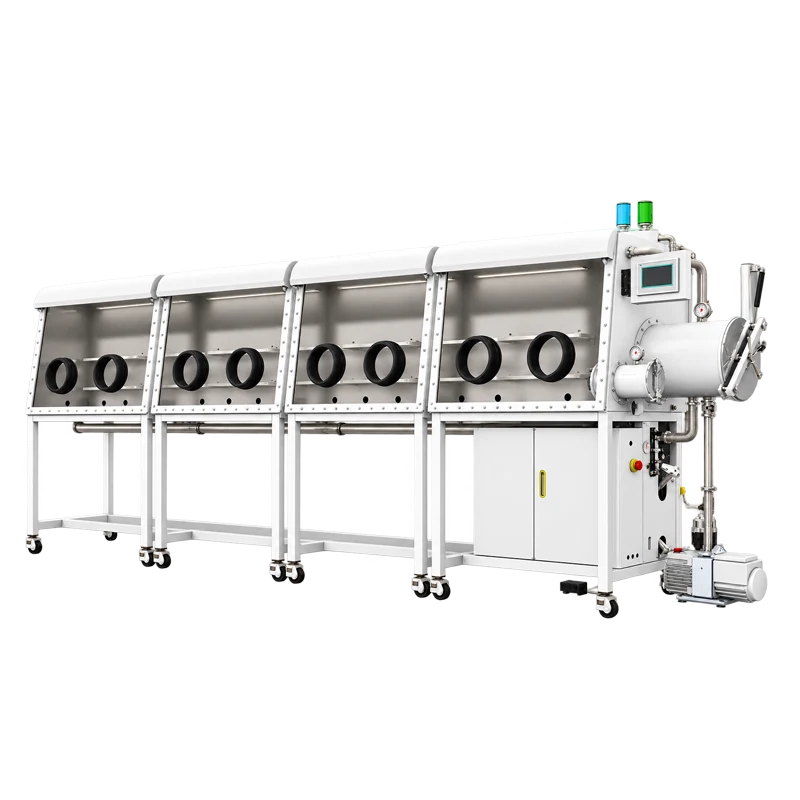
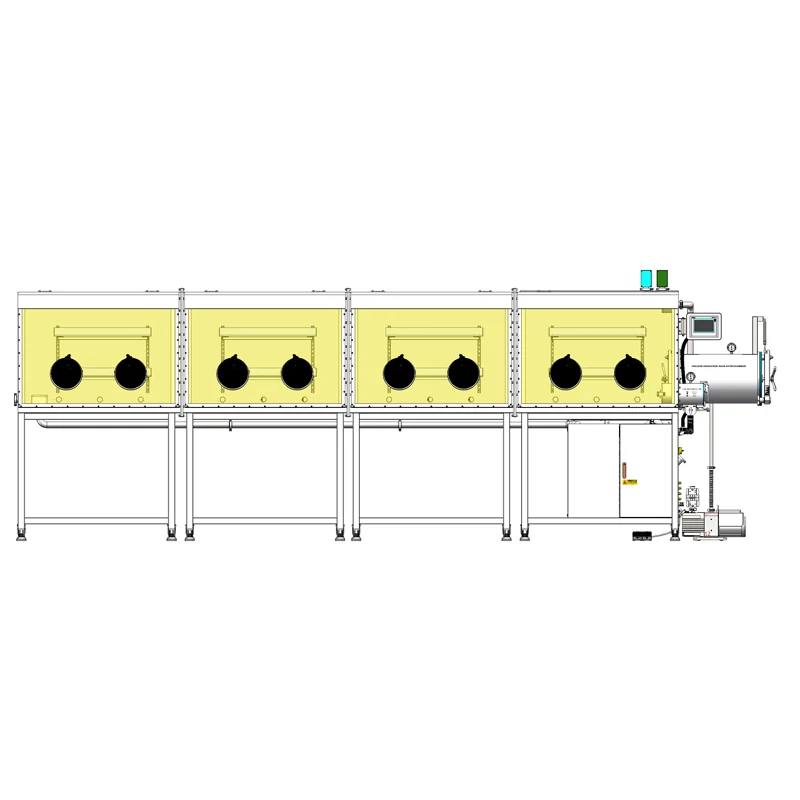
For the four-station single-sided split-type glove box with gas purification system, the nominal description already tells you a great deal about how it behaves. Four stations sit on one side; the structure is split, so the purification unit is a separate body connected to the workspace by pipework rather than sharing a frame.
The split structure
Separating the purification system from the working box has practical advantages. The pump, blower and columns can be placed where they are easiest to service, and their heat and vibration stay away from the bench area where sensitive weighing or assembly happens. The trade-off is pipework. Every additional metre of tubing adds internal surface area that can adsorb and later release moisture, adds joints that could leak, and adds pressure drop that the circulator has to overcome. A split layout is therefore most comfortable when the runs are short and the joints are few and well made.
Four stations, one shared atmosphere
Four glove ports on a single side means four operators, or two operators working in parallel, share one gas volume. There is no zoning: if one person carries a solvent-heavy sample through a port, everyone's reading moves. This is not a design flaw, it is the definition of a single-atmosphere box, but it changes how you plan work. Group incompatible activities in time rather than in space, keep solvent work short and covered, and avoid opening a port simply to pass a message.
The purification loop and its columns
The loop consists of a circulator, media that remove water and oxygen, a regeneration path, and sensors. The media are finite: they hold a certain amount of each contaminant and must be regenerated periodically. Recovery is therefore not only about the box, it is about how much unused capacity is left in the columns at the moment the sample goes in. A box that recovers slowly on a Friday afternoon, after a week of dense transfers, may simply be closer to its regeneration point than it was on Monday. That condition is invisible unless someone tracks the trend rather than the instantaneous reading.
What the instruments actually measure
Analyzers measure the atmosphere; they do not purify it, and they do not measure each other's variable. A moisture analyzer responds to water vapour at its sampling point, which may sit in the return line rather than in the working zone, so a reading can look better than the gas a sample actually sees. Oxygen and moisture channels also differ in response speed. Before drawing conclusions from a recovery curve, confirm where each sensor samples, how often it updates, and whether the displayed figure is a live value or a filtered average.
Reading the Recovery Curve: Plausible Causes and How to Separate Them
A slow return has several possible explanations, and they produce different signatures. None of them should be diagnosed from a single data point.
Exchange volume rather than box volume
The volume that matters is not the box, it is what the antechamber and the open door exchange. A large transfer chamber that is repeatedly purged without evacuation holds a lot of residual air; a small chamber cycled properly disturbs far less. If recovery time grew after the chamber was loaded with bulky items, exchange volume is the first thing to check.
Leak paths and permeation
Leaks are usually distributed rather than dramatic: a seal that has taken a compression set, a feedthrough that was reseated, a valve left slightly open, a glove with a pinhole near the cuff. Glove material also permeates, particularly against moisture, so the gloves themselves form part of the background load. A useful test is to hold the box at its normal slight overpressure with circulation running and no transfers, and observe whether the readings fall and then stay flat. A baseline that never settles points outward, toward leaks and permeation, rather than toward the purifier.
Column condition and regeneration state
If recovery has been getting steadily slower over weeks, with no change in workflow, the media are a reasonable suspect. If instead a single event produced a sudden step, look at what entered the box. Regeneration events themselves cause temporary excursions, which is why transfers are best scheduled away from them.
Volatile loads that do not belong to the water or oxygen channels
Solvent vapour is a separate problem from water and oxygen. A solvent adsorber reduces the organic load in the loop, but it does not replace water and oxygen purification, and it does not remove moisture. A box that smells of solvent, or whose readings drift upward after solvent work, needs an adsorbent question answered, not a purifier service.
Circulation rate and dead zones
Recovery speed scales with how quickly box gas reaches the media. Obstructions, closed valves, kinked tubing, a filter loaded with particulate, or a sensor placed in a slow-moving corner all stretch the curve without any contaminant entering the box.
Pressure Is a Separate Variable, and a Useful One
Box working pressure, antechamber vacuum, pump ultimate vacuum, leak rate, oxygen content and moisture content are six different quantities. Mixing them is a reliable way to misdiagnose a system. In particular, a pressure reading does not tell you how clean the atmosphere is, and a clean atmosphere does not prove the box is sealed.
What pressure does give you is a fast, continuous signal about the mechanical state of the enclosure. A slight positive pressure relative to ambient discourages room air from being drawn in through small imperfections, and the stability of that pressure over hours says something about the integrity of the seals, gloves and joints that no analyzer will show you directly. A pressure channel is also the clearest way to confirm that an antechamber cycle completed as intended before the inner door is opened.
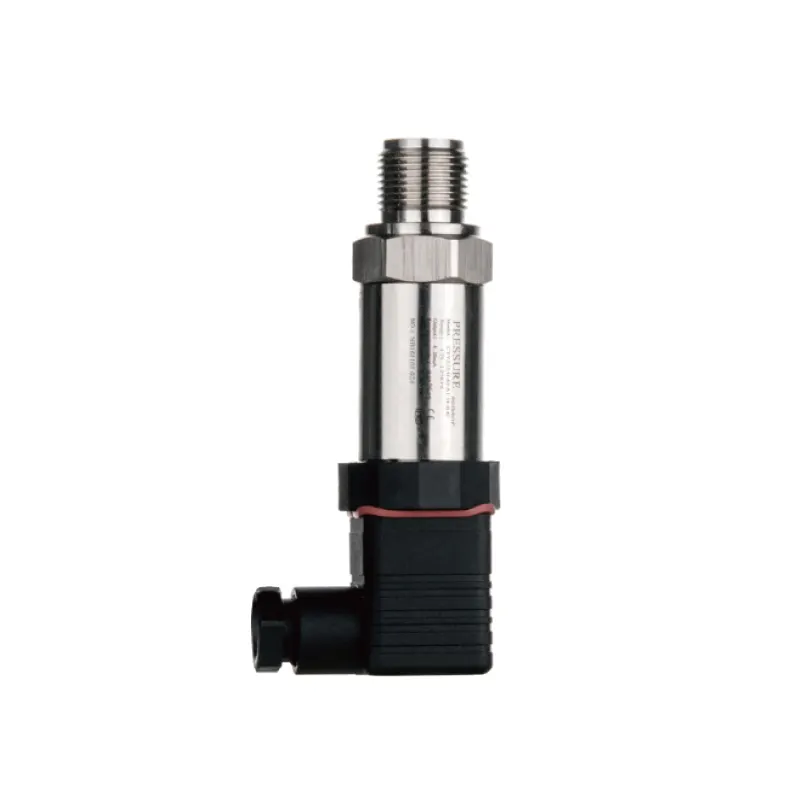
A high precision pressure transmitter is one of the accessory options used for exactly this role. When evaluating one for a glove box, the useful questions are practical rather than promotional: what range covers your working pressure and your evacuation cycles without over-ranging, what accuracy and long-term stability matter for the trend you want to see, what output signal your data system expects, what wetted materials are compatible with your working gas and any solvent traces, and how the transmitter is connected and sealed to the box. Resolution is not the same as accuracy, and a display with many decimal places can still be the wrong instrument. Whether a given transmitter fits a specific box depends on port type, range and signal interface, so compatibility should be confirmed with the supplier rather than assumed from the product name.
Configuration Choices That Change Recovery Time
When a split purification box is specified, several decisions have a direct effect on how the system behaves during transfers.
Station count and single versus double sided
Four stations on one side suit a workflow where a small team works facing the same direction and where the room layout favours a single bench line. A double-sided arrangement is usually chosen when two areas must be connected, or when services and instruments need to sit behind the box. More stations mean more glove ports, more potential permeation paths and higher traffic, which is why an identical purification system can perform differently in a two-station and a four-station installation.
Antechamber design
Chamber volume, door sealing, whether the chamber is vacuum-rated, and how the pump is matched to the chamber all shape the disturbance. A chamber that is comfortably larger than the largest item you actually transfer is not automatically better; every extra litre is gas that has to be replaced and surface that has to be dried.
Loop sizing and sensor placement
The purification package should be sized against the total volume it serves, including the workspace, the antechamber and the pipework of a split layout. Sensor placement should reflect where you need the truth: near the working zone if you care about what the sample sees, in the return line if you care about what the media are removing.
Information to Prepare Before Requesting a Configuration
Recovery behaviour cannot be specified in a single number, so the fastest way to a well-matched system is to describe the work rather than the wish. Prepare the following before discussing a configuration:
- The materials and sample forms you handle, including powders, and whether any are hygroscopic or oxygen sensitive.
- Whether solvents, acids or reactive chemistries enter the box, and in what quantity and frequency.
- How many transfers per day, of what size, and whether the antechamber must be vacuum-capable.
- How many operators work simultaneously and whether the layout should be single-sided or double-sided.
- The target atmosphere you need, stated with units, plus the sampling point and whether it is a steady-state or a recovery-time requirement.
- The working pressure range you intend to use, and whether you need continuous pressure logging.
- Available working gas, regeneration gas and utilities, and the space available for a split purification unit.
- Any feedthrough, instrument or accessory needs: signals, KF ports, filtration, solvent adsorption or cooling.
Slow recovery after a transfer is rarely a single broken part. It is the sum of exchange volume, surface moisture, leak paths, column capacity and circulation efficiency, and a four-station single-sided split purification box exposes each of those contributions clearly enough to be investigated one at a time. Measuring the right variable, in the right place, with the right unit, is what turns a puzzling curve into a decision: adjust the transfer routine, regenerate the media, inspect the seals, or specify a different configuration.
