
The GBV-3 Stainless Steel Vacuum Glove Box is a sealed stainless steel enclosure that lets an operator handle air- or moisture-sensitive materials through gloves while the internal atmosphere is controlled by evacuation and inert gas replacement. It sits in the laboratory workflow wherever a sample must be weighed, mixed, assembled, or transferred without prolonged exposure to ambient air, but where a continuously regenerating purification loop is not the chosen method of atmosphere control.
What the GBV-3 Does and How It Works
A vacuum glove box works in cycles. The chamber is sealed, evacuated, and then refilled with an inert gas such as nitrogen or argon. Repeating this sequence reduces the concentration of ambient air inside the chamber. The operator then works through the glove ports, using the gloves as a flexible barrier between the controlled interior and the outside environment. The stainless steel construction provides a rigid, cleanable enclosure that can tolerate repeated evacuation and refilling without the structural limitations of softer materials.
The key point is that the atmosphere is established and maintained by gas replacement, not by continuous circulation through a purification column. That distinction matters. A purification glove box continuously circulates the internal gas through columns that remove oxygen and moisture, and it usually includes monitoring to keep those levels under control. A vacuum glove box relies on the initial evacuation and purge cycles, plus the quality of its seals, gloves, and gas supply, to hold a protective atmosphere. It is therefore a different tool with different strengths and different limits.
For the GBV-3, the practical work sequence is defined by the enclosure itself: load or transfer material through the available port or antechamber configuration, close the chamber, evacuate, refill with inert gas, and repeat as needed for the target application. The operator should verify the actual port layout, chamber volume, and vacuum compatibility of the delivered configuration rather than assuming these details from the product category alone.
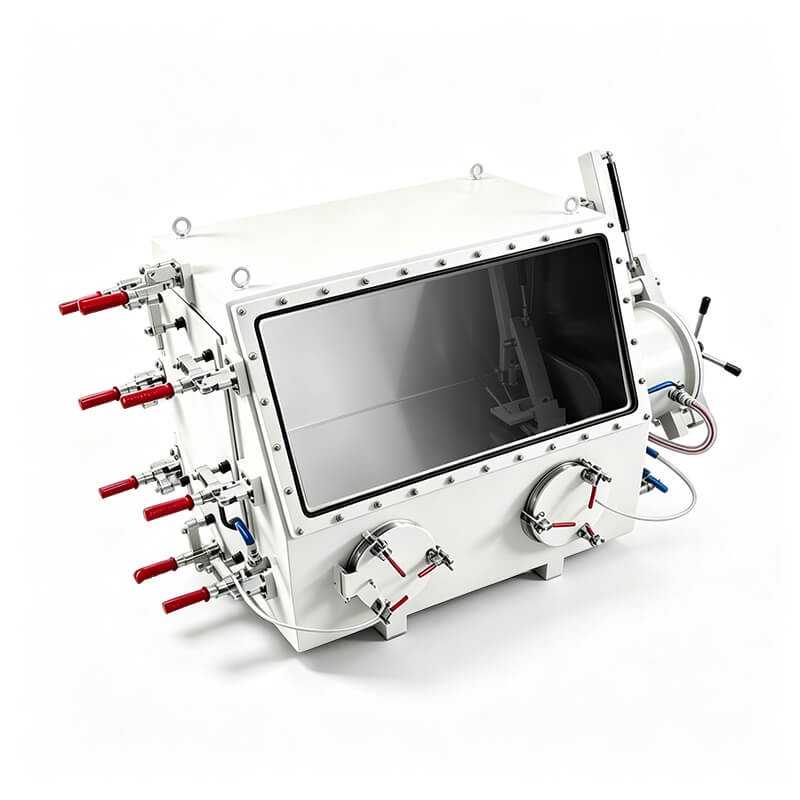
Where a Vacuum Glove Box Sits in an Atmosphere-Control Strategy
Atmosphere control in sensitive-material work is not a single technology. It ranges from simple glove bags and desiccators to vacuum glove boxes, purification glove boxes, and integrated gas purification systems. The GBV-3 belongs to the vacuum-replacement family. Its main advantage is a straightforward mechanism: if the chamber is sealed and the gas replacement is done carefully, the interior can be kept under an inert gas blanket for the duration of a task. It does not require a purification column, a circulation blower, or regeneration gas, so it can be simpler to install and operate in laboratories that do not need continuous trace-level control.
The trade-off is that a vacuum glove box cannot be assumed to hold sub-ppm oxygen and moisture indefinitely. Each time the chamber is opened or a transfer occurs, the atmosphere is disturbed, and the recovery depends on another evacuation and purge cycle. The achievable oxygen and water levels are configuration-dependent: they depend on the number of purge cycles, the purity and flow of the inert gas, the leak rate of the enclosure, the permeability of the gloves, and the condition of seals and valves. Without measured data for the specific setup, no responsible claim can be made about continuous ppm-level performance.
This makes the vacuum glove box a good fit for applications where a dry, oxygen-reduced environment is useful for the duration of a procedure, and where the operator can tolerate a batch-style atmosphere reset. It is not a substitute for a continuously purifying glove box when the process requires stable low-level oxygen and moisture for days or weeks without interruption.
Key Configurations and Components to Verify
Because the GBV-3 is supplied as a stainless steel vacuum glove box, the most important configuration questions are about the chamber, the transfer interface, the gloves, and the vacuum and gas connections. The product page should be checked for the exact options that are available, and the quotation should confirm what is included.
Chamber and Port Layout
The chamber volume and shape determine how much work can be done inside, how many samples can be handled at once, and whether larger fixtures or instruments fit. Stainless steel chambers are typically chosen for durability, chemical resistance, and the ability to be cleaned. Port layout matters as much as volume: feedthroughs, gas inlets, vacuum ports, and sensor ports all compete for space. If a pressure transmitter, oxygen analyzer, or other instrument is planned, the chamber must have a compatible port or be ordered with one.
Antechamber and Transfer
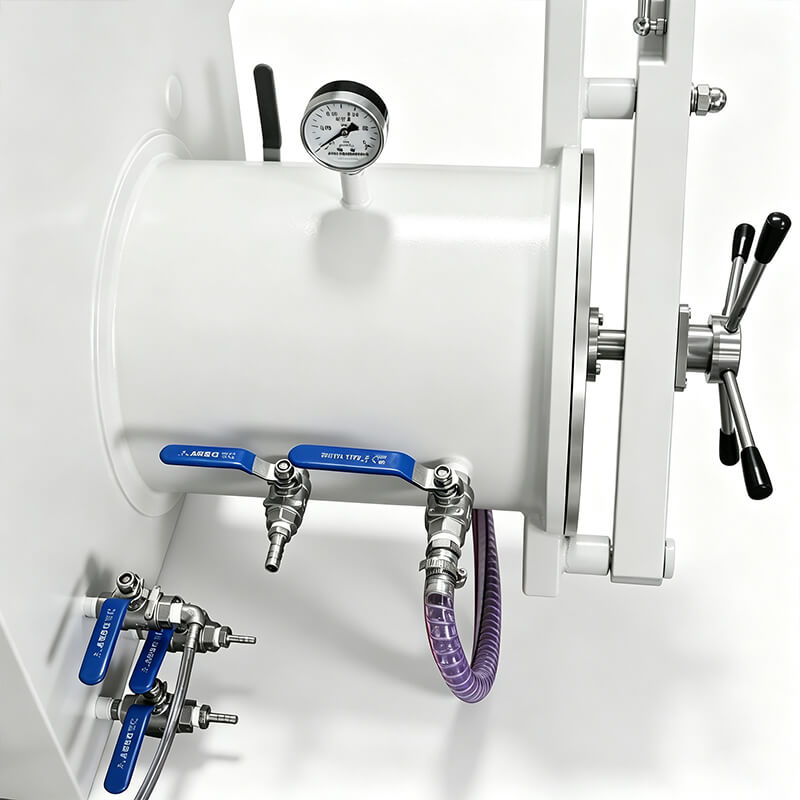
If the delivered configuration includes an antechamber, it becomes the main route for introducing and removing samples without opening the entire glove chamber to air. The antechamber’s internal volume, door design, and vacuum capability determine how quickly a sample can be transferred and how much air is introduced with it. If no antechamber is present, transfers must be planned around the main chamber opening, which changes both the atmosphere recovery time and the workflow. This is a configuration detail that should be confirmed rather than assumed.
Glove Ports and Gloves
Gloves are the operator’s physical interface with the controlled atmosphere. The glove material affects chemical compatibility, moisture and oxygen permeation, mechanical durability, and dexterity. Common choices include butyl, nitrile, neoprene, and laminated gloves, but the correct selection depends on the solvents, acids, or reactive materials used. Glove port size and glove length must match the chamber and the operator’s reach. A poorly fitted glove can leak or tear, and it can also make precise work difficult, which in turn increases the chance of accidental exposure.
Vacuum and Gas Connections
A vacuum glove box needs a vacuum source and a gas supply that match the chamber’s volume and the intended cycle. The vacuum pump should be selected for the required vacuum level and for compatibility with the gases and potential vapors in the system. The inert gas supply should be dry and of suitable purity, with a regulator and plumbing that do not introduce contamination. Connections, valves, and seals should be checked for leak integrity before the box is put into regular use.
Monitoring and Instrumentation
Instrumentation does not create a protective atmosphere, but it helps verify that the atmosphere is what it is supposed to be. A pressure transmitter can be used to monitor pressure or vacuum in a chamber or antechamber, provided its measurement range, accuracy, output signal, and process connection match the system. For example, the High Precision Pressure Transmitter is a component intended for pressure measurement; before integrating it, confirm that the GBV-3 configuration offers a suitable port, that the wetted materials are compatible with the gas, and that the electrical signal is compatible with the readout or control system. A pressure transmitter does not remove oxygen or moisture, and it should not be described as doing so.
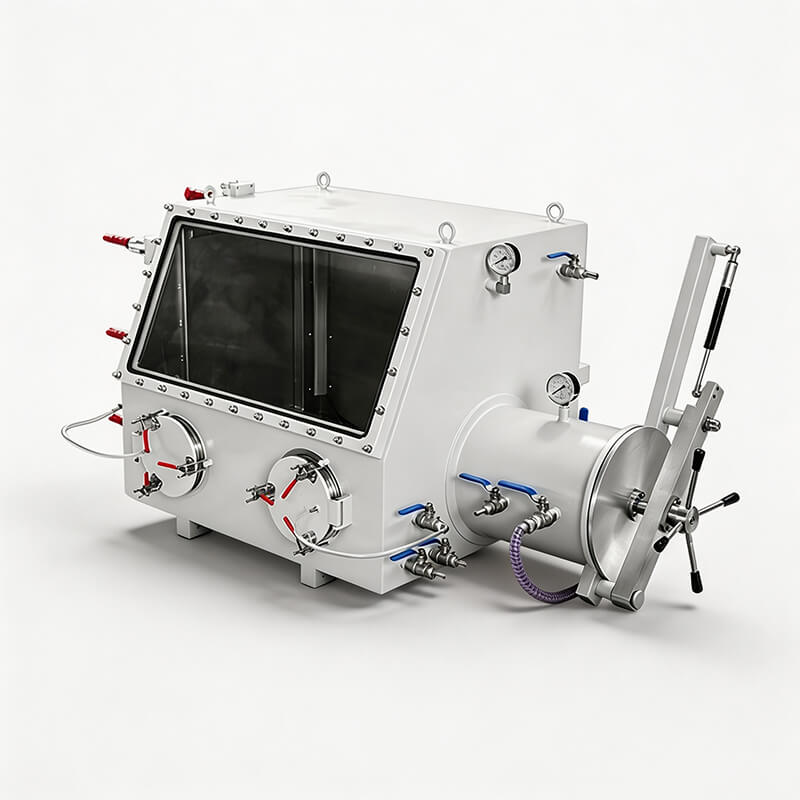
Specifications That Matter—and Units That Must Not Be Confused
Technical discussions about glove boxes often mix together values that describe very different things. For a vacuum glove box, the following are separate specifications, and each applies to a specific component or condition:
- Chamber working pressure: the pressure range the sealed chamber is designed to withstand during normal operation.
- Antechamber vacuum: the vacuum level the transfer chamber can reach, if an antechamber is included.
- Pump ultimate vacuum: the lowest pressure the vacuum pump can achieve under specified conditions, not the pressure of the whole glove box.
- Leak rate: the rate at which air or gas enters the enclosure, usually expressed under defined test conditions.
- Oxygen and water content: the measured concentration inside the working chamber, which depends on purge cycles, gas purity, seals, gloves, and load.
These values are not interchangeable. A pump with a low ultimate vacuum does not guarantee a low-oxygen atmosphere inside the box. A leak rate measured on an empty chamber does not predict performance with a loaded chamber and frequent transfers. A measurement resolution is not the same as measurement accuracy. When a product page or quotation gives a value, check the unit, the test condition, and the component the value refers to. If any of these are unclear, the value should be treated as provisional and confirmed with the supplier.
Suitable Applications and Real Limits
The GBV-3 is relevant to work with materials that are sensitive to air or moisture but that do not require a continuously purifying atmosphere. Typical fields include lithium and solid-state battery research, perovskite and OLED materials, semiconductor and electronic materials, air-sensitive chemistry, advanced materials, additive manufacturing pre- and post-processing, and general laboratory research where an inert gas blanket is useful.
The limits are just as important as the applications. A vacuum glove box is not a sterile environment, and it does not establish a cleanroom classification, a biological safety level, or a hazardous-material containment certification. It uses an inert gas, but not every gas is inert to every sample; some materials react with nitrogen, and some processes require argon. A vacuum glove box also does not make a sample immune to contamination from gloves, tools, or residual solvent. If the process requires continuous trace-level oxygen and moisture control, a purification glove box or a gas purification system is the appropriate category, not a vacuum glove box alone.
How to Select or Integrate a GBV-3
Selection starts with the sample and the procedure, not with the model number. Ask what the material needs: a short period of inert protection, a dry environment during weighing, protection during transfer, or a stable atmosphere for a multi-step assembly. Then match those needs to the chamber size, port layout, transfer method, glove type, and monitoring options available for the GBV-3.
For integration, confirm the utility requirements: vacuum pump compatibility, gas supply purity and pressure, electrical service for instruments, and the physical footprint of the box in the laboratory. If a pressure transmitter is added, verify the pressure range, process connection, output signal, and material compatibility before installation. If an oxygen or moisture analyzer is added, verify its measuring range, calibration method, and sampling interface. If an antechamber is part of the configuration, confirm its volume and vacuum capability against the size and frequency of transfers. These checks prevent a common mistake: buying an instrument or accessory that is technically functional but does not match the glove box interface or the process window.
Frequently Asked Questions
Does the GBV-3 include a continuous gas purification system?
The GBV-3 is a stainless steel vacuum glove box. Its atmosphere control is based on sealing, evacuation, and inert gas replacement. A continuous purification loop with purification columns is a different configuration and should not be assumed. If continuous purification is required, that capability must be confirmed separately with the supplier.
Can a vacuum glove box directly lower oxygen and moisture to sub-ppm levels?
Vacuum and purge cycles can reduce oxygen and moisture, but the final levels depend on the gas purity, number of cycles, leak rate, glove permeability, and load. A vacuum glove box should not be expected to provide the same continuous trace-level control as a purification glove box unless actual measured data for the specific configuration supports that claim.
How do I know whether a pressure transmitter is compatible?
Check the pressure range, accuracy, output signal, process connection, and wetted materials against the glove box port and the gas used. The transmitter measures pressure; it does not purify the atmosphere. Compatibility is a configuration question, not a generic one.
When is a vacuum glove box a better choice than a purification glove box?
A vacuum glove box is often a practical choice when the work is batch-oriented, when the required atmosphere is protective rather than continuously trace-controlled, and when a simpler installation without purification columns and regeneration is preferred. A purification glove box is more appropriate when the process needs stable low oxygen and moisture levels over long periods.
A Practical Starting Point
Start by writing down what the material needs and what the procedure actually involves. Then compare those requirements with the GBV-3 configuration that is available: chamber volume, port layout, antechamber or transfer method, glove type, vacuum source, gas supply, and monitoring options. Use the product page for the exact model details, and confirm any performance value with the supplier in writing, including the test conditions. A vacuum glove box is a capable tool for inert atmosphere work, but it works best when its batch-style atmosphere control is matched to the application rather than treated as a universal replacement for continuous purification.
