
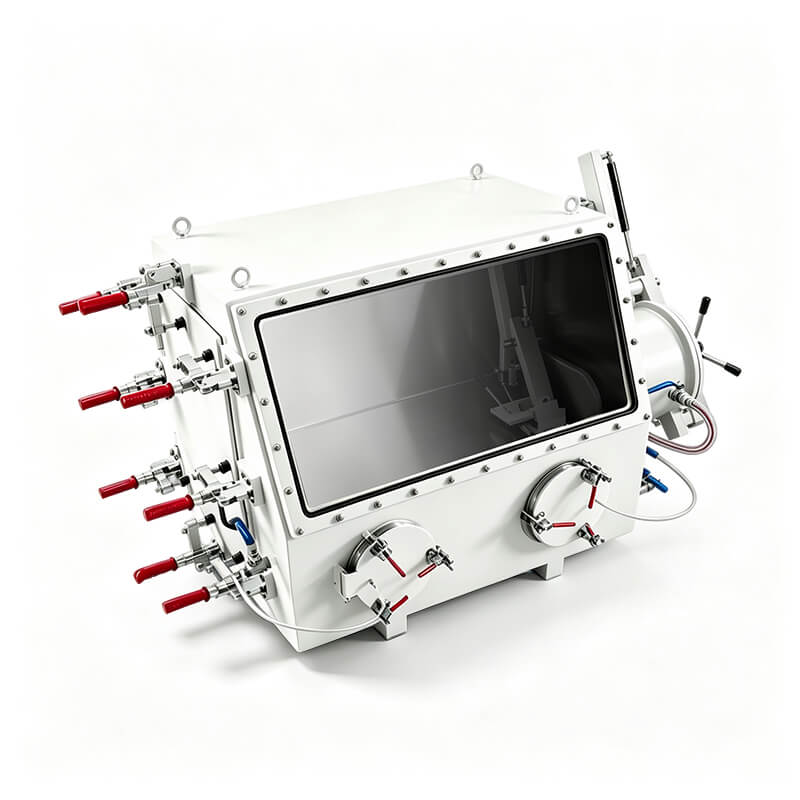
The GBV-2 stainless steel vacuum glove box is a sealed stainless-steel enclosure that lets an operator handle air-sensitive materials through gloves while the workspace remains isolated from the room. It belongs to the vacuum-assisted branch of glove box design: the chamber is evacuated and refilled with inert gas to create a controlled atmosphere. Its practical role is to reduce the oxygen and moisture that a sample sees during transfer, temporary storage, or manual assembly. Vacuum exchange is a batch process, so the GBV-2 should not be treated as a continuously purifying glove box unless a purification loop is explicitly part of the quoted configuration.
What Does the GBV-2 Do in a Glove Box Workflow?
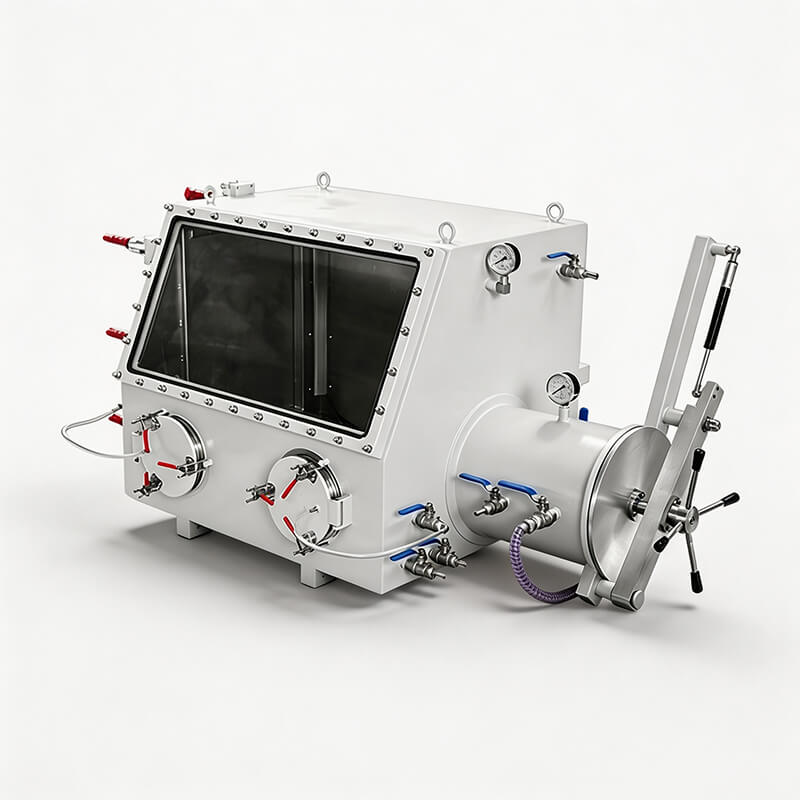
At the most basic level, the GBV-2 provides a physical barrier and a controlled internal environment. The stainless-steel chamber defines the working volume; the glove ports allow manipulation without opening the box; the viewing window, where fitted, lets the operator observe the work. A vacuum connection and inert-gas inlet support the exchange procedure. The box solves a specific problem: many materials change when they meet ambient oxygen or moisture, and a simple bench-level glove bag may not provide enough mechanical protection, repeatability, or vacuum capability.
The GBV-2 is not just a storage cabinet. Its value comes from being part of a workflow: receiving a sample, moving it into the chamber, replacing the atmosphere, performing the task, and removing or sealing the material. Each of those steps has a contamination path. Gloves permeate, seals age, transfer containers carry air, and every opening disturbs the internal atmosphere. A vacuum glove box therefore performs best when the procedure is designed around minimising openings and validating the atmosphere before critical work.
How Vacuum-Assisted Atmosphere Control Works
The working principle is straightforward but often oversimplified. The chamber is sealed, connected to a vacuum pump, and evacuated. It is then refilled with an inert gas such as nitrogen or argon, depending on the process and the material being handled. Repeating the evacuation and refill sequence reduces the residual ambient atmosphere. The result is a workspace with a lower oxygen and moisture burden than the room air, but the final condition is not a fixed property of the model. It depends on chamber volume, seal integrity, the number and depth of exchange cycles, the purity of the supply gas, the starting humidity, and the way the box is loaded.
A vacuum gauge measures total pressure, not oxygen concentration. Reaching a low pressure does not prove that oxygen or water has reached a correspondingly low level; residual gas can remain in dead spaces, on surfaces, and in the pores of samples or fixtures. For the same reason, the pump's ultimate vacuum is not the same as the atmosphere delivered to the work zone. If a process has an oxygen or moisture limit, that limit needs to be verified with a suitable measurement method under the actual operating procedure, not inferred from a pressure reading.
Similarly, a leak test, a pressure-decay check, and a gas-composition measurement answer three different questions. A leak test asks whether the enclosure holds against the surrounding atmosphere. A pressure check asks whether the pump and chamber can reach a certain condition. An oxygen or moisture analyser asks what is present in the gas. None of these should be substituted for another.
Vacuum Exchange and Continuous Purification Are Not the Same
Because both approaches are used to protect sensitive materials, vacuum glove boxes and purified glove boxes are sometimes described as if they were interchangeable. They are not. A purified glove box normally uses a closed circulation loop with purification media to remove oxygen and moisture on a continuing basis; the loop, blower, columns, and monitoring system are central to its function. A vacuum glove box uses evacuation and inert-gas refill to prepare the chamber before work. It may be very effective for batch operations, but it does not continuously remove contaminants that enter during use.
For the GBV-2, the safe planning assumption is that atmosphere control is based on the vacuum glove box configuration. If a project needs a continuously maintained low-oxygen or low-moisture environment during frequent access, long experiments, or multiple sample transfers, the requirement should be discussed as a system-level question. Adding a feedthrough, a gauge, or a larger gas supply does not turn a batch-exchange box into a purifying system. The purification capability would need to come from an integrated or separate purification system designed for that duty.
Which Configuration Details Matter?
Only one core model is identified in the current material: the GBV-2 stainless steel vacuum glove box. Even so, two GBV-2 boxes can differ in practical details, because the usable system is defined by the chamber, glazing, glove ports, seals, ports, and accessories rather than by the model name alone. The current product page should be used to confirm the exact configuration offered.
The chamber and frame determine working volume, reach, and the size of objects that can be handled comfortably. Stainless steel is often selected for structural durability and for cleaning compared with acrylic enclosures, but it is not automatically compatible with every chemical. Chlorides, strong acids, and some solvents can attack stainless steel, and the viewing window, gloves, seals, and any polymer parts may have tighter limits than the metal shell. Material compatibility therefore has to be checked for the whole wetted and exposed set of components, not just the chamber material.
Glove ports and gloves affect ergonomics, leak integrity, and permeation. A thick glove may reduce the transmission of moisture or solvent vapour but make fine work harder; a thin glove may improve dexterity but require more frequent replacement. Port size, glove size, and replacement method should match the operator and the task.
The vacuum and gas connections define how the box is evacuated and refilled. The interface type, hose or tubing size, isolation valves, and gas supply quality all belong in the specification. The same applies to any viewing window, internal shelf, electrical pass-through, or transfer chamber: each added feature changes the working space, the cleaning routine, and the leak boundary. None should be treated as a cosmetic option.
Specifications to Confirm Before Purchase
Specification review should begin with the process requirement, not with a single headline number. Define the material, the allowable exposure time, the size and number of items per session, the required handling dexterity, the cleaning agents, and the gas supply available in the laboratory. Then check how the GBV-2 is configured to meet those conditions.
For the chamber, confirm the internal dimensions and usable volume, the number and position of glove ports, the window size and material, the door or transfer arrangement, and the maximum load that the internal surfaces are intended to support. For the vacuum side, distinguish the chamber working pressure, any transfer chamber vacuum requirement, the pump's ultimate pressure, and the acceptable leak rate. These are different values with different test conditions. A pump chosen only for low ultimate pressure may not have the gas handling capacity or chemical compatibility needed for the process.
For atmosphere control, confirm the supply gas and its specified purity, the number of exchange cycles intended, and the measurement method for oxygen or moisture if a limit is important. If analysers are used, their range, resolution, accuracy, calibration, and sampling point matter. Resolution is not the same as accuracy, and a reading from a sensor in one part of the system does not necessarily describe every corner of the chamber.
Finally, confirm the service and safety boundary. The GBV-2 is a glove box for controlled-atmosphere work; it is not a fume hood, a sterile isolator, a biological safety cabinet, or a certified hazardous-duty enclosure unless a specific configuration has been assessed for that use. Vacuum adds stored energy and the possibility of implosion or sample disturbance, so the chamber, window, and pump arrangement must be appropriate for the intended operation. The product documentation and the final quotation should be the authority for the installed configuration.
Where the GBV-2 Is Suitable, and Where It Is Not
The GBV-2 is a reasonable candidate when the work is batch-oriented and the main need is a sealed, stainless-steel workspace that can be evacuated and refilled before handling. Typical discussions include air-sensitive battery or solid-state battery materials, perovskite and OLED-related samples, semiconductor or electronic materials, air-sensitive reagents, and general advanced-materials research. The common thread is sensitivity to oxygen or moisture during a defined operation, not a demand for continuous purification.
A vacuum glove box can also be useful when a sample must be moved between containers or assembled with components that cannot be exposed to room air. It may support weighing, mixing, sample mounting, sealing, and simple mechanical work, provided the internal space and the glove arrangement are adequate. These are application possibilities, not automatic approvals. Each material still needs a compatibility check, and each atmosphere target still needs a validation method.
The limits are equally important. A vacuum-only exchange routine should not be presented as a guarantee of sub-ppm oxygen or moisture. It is not a substitute for a purification loop when the process requires continuous removal of contaminants during long or frequent access. It does not make a non-sterile chamber sterile, and it does not turn a glove box into a chemical fume hood or a containment device for hazardous dusts or vapours. High-vapour-pressure solvents, reactive gases, and materials that outgas heavily need specific review before they are placed under vacuum. If the sample is damaged by evacuation, or if the process requires a steady trace-oxygen level while the gloves are in use, a different system architecture may be more appropriate.
Adding a Gas and Liquid Feedthrough
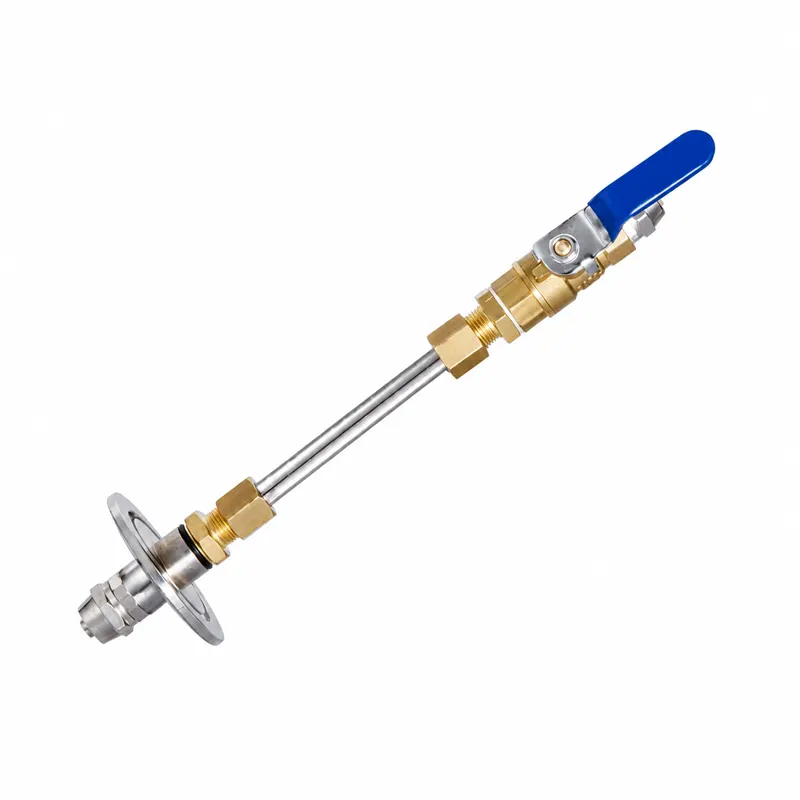
Some work needs a line inside the chamber without breaking the seal on the front window or door. A gas and liquid feedthrough provides that path: it passes a tube or line through the glove box wall while maintaining the enclosure boundary. It is an interface component, not an atmosphere-control device. It does not generate inert gas, remove oxygen, or purify a solvent; it simply lets a gas or liquid reach the interior through a designed connection.
The current accessory is identified as a gas and liquid feedthrough, but a feedthrough is only suitable when its connection, materials, and sealing method match the host box and the process. Before selecting one, confirm the available port or mounting location on the GBV-2, the thread or flange standard, the tubing size, the pressure and vacuum conditions on both sides, the allowed materials for the gas or liquid, and the leak-integrity requirement. The feedthrough becomes part of the leak boundary, so installation quality matters as much as the component itself.
There is also a process distinction between gas and liquid service. A line carrying a gas may need a different internal volume, shutoff arrangement, and purge procedure from a line carrying a liquid. A liquid line may need attention to dead volume, drainage, and cleaning. If the line will be used with a solvent, check the tubing, seals, and feedthrough body against that solvent, and consider how the line will be emptied or flushed. Do not assume that a feedthrough rated for one service is automatically suitable for another.
For a vacuum glove box, the feedthrough should be integrated before the atmosphere is validated. Adding it later changes the leak path and may require a new evacuation and refill routine. If the GBV-2 configuration does not include a suitable port, the correct approach is to confirm a factory or compatible modification rather than to improvise a seal.
Selection and Integration Checklist
- Define the atmosphere target and the method that will prove it under real operating conditions.
- Decide whether the process is a batch exchange or needs continuous purification.
- Size the chamber around the objects, gloves, and access required for the task.
- Confirm vacuum pump, gas supply, connections, and instrumentation as one compatible set.
- Review chamber, window, glove, seal, and feedthrough materials against the sample and cleaning agents.
- Plan transfer, feedthrough, and validation steps before the box is put into routine use.
Common Questions
Does the GBV-2 include continuous gas purification?
Do not assume so. The GBV-2 is identified as a stainless steel vacuum glove box; a continuous purification loop should be confirmed only if it is included in the quoted configuration.
Can vacuum alone lower oxygen to a specific level?
Evacuation and inert-gas refill lower the residual atmosphere, but the achieved level depends on the procedure and must be measured. A pressure reading alone cannot confirm an oxygen or moisture specification.
Is a gas and liquid feedthrough compatible with every GBV-2?
No. Compatibility depends on the available port, mounting standard, line size, materials, and sealing arrangement. Confirm these details before ordering.
When is a purified glove box a better fit?
When the process needs a continuously maintained atmosphere during frequent access, long dwell times, or repeated transfers, a system with an active purification loop is the more direct solution. A vacuum glove box is better suited to batch exchange and tasks that can be planned around a defined cycle.
Is stainless steel always the right chamber material?
Stainless steel offers durability and cleanability, but chemical compatibility still depends on the grade, welds, window, gloves, and seals. Aggressive chlorides or acids may require a different material or a specific wetted-parts review.
The most reliable way to specify the GBV-2 is to start with the sample, the allowed exposure, and the measurement that will prove the atmosphere is acceptable. Then match the chamber, glove arrangement, vacuum and gas connections, and any feedthrough to that procedure. Used within those limits, the GBV-2 is a practical stainless-steel vacuum glove box for batch work with air-sensitive materials; used as if it were a continuously purifying system, it will be asked to do a job it was not specified to perform.
