
A ten-station double-sided split-type glove box with gas purification is a large, shared inert-atmosphere workstation. Ten working positions are arranged across two sides of the enclosure; gloves and transfer chambers isolate the interior from room air; and a closed-loop purification system circulates the internal gas to control moisture and oxygen. The arrangement is intended for coordinated work on air-sensitive materials, not simply for storage. In the TENCAN system described here, the glove box and its purification loop are one specified package, so the layout, transfer chambers, gas circuit, and monitoring must be evaluated together.
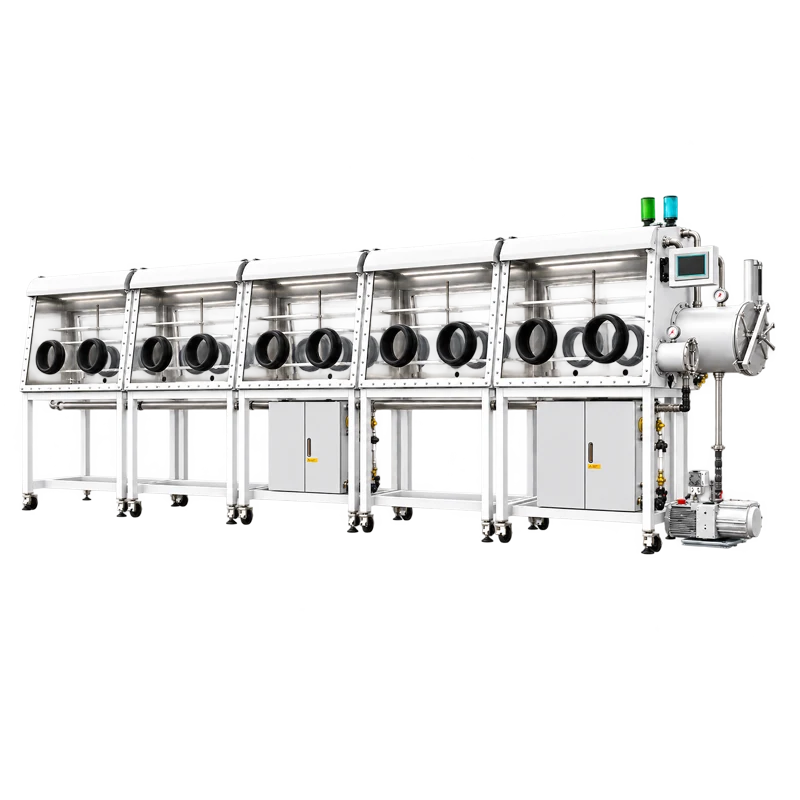
What does a ten-station purification glove box do?
A glove box provides a physical barrier, but the controlled atmosphere is the reason it exists. The enclosure holds a working gas, usually nitrogen or argon depending on the process, at a slight positive pressure relative to the room. Operators use gloves fixed to the front or both sides to manipulate samples without opening the box. Antechambers allow tools, containers, and small equipment to enter or leave through a smaller volume, reducing the amount of room air that reaches the main chamber.
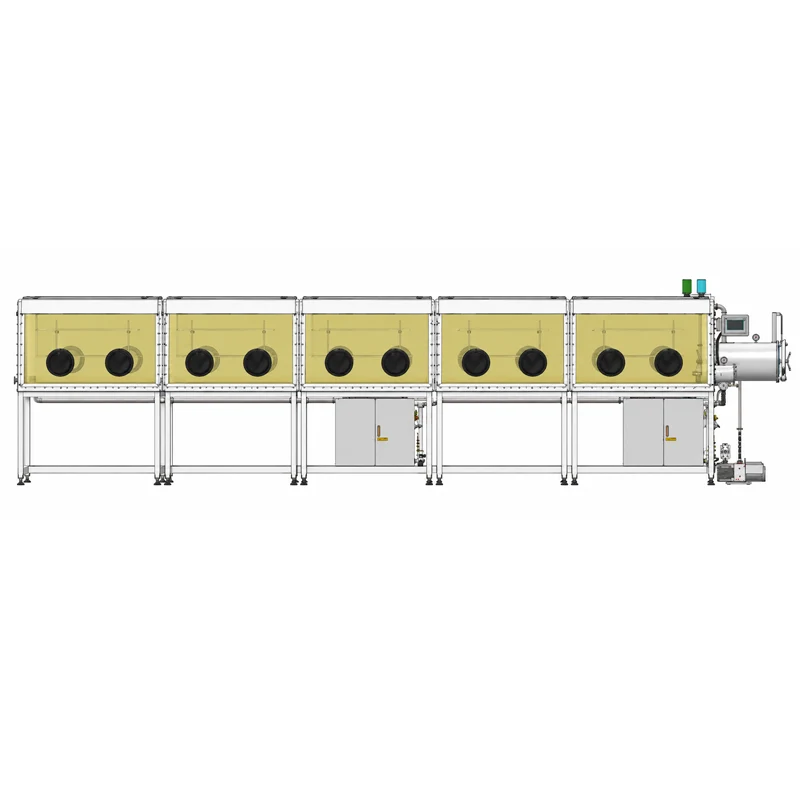
The ten-station configuration extends this basic concept to a larger working envelope. It is suited to workflows in which several people need access at the same time, or in which a process must pass through several preparation and assembly positions without repeated transfers between separate boxes. The exact layout, including station spacing, glove-port positions, antechamber sizes, internal shelving, and feedthrough locations, should be confirmed from the current arrangement drawing. A station count alone does not describe usable bench area or ergonomic reach.
How the gas purification loop works
The purification system is a closed loop connected to the glove box. A blower moves gas from the chamber through purification columns, where moisture and oxygen are removed by adsorbents and catalytic media, and returns treated gas to the enclosure. In many designs, one column is online while another is regenerated; regeneration is a separate operating mode with its own gas supply, heating, and timing. It should never be confused with normal circulation.
The loop also has to manage the gases that enter during transfer, the materials and solvents introduced by users, and small leaks at seals and gloves. A large box with ten stations has more glove ports, doors, joints, and operator activity than a small enclosure, so the purification load and leak-tightness of the whole assembly matter. Where the design uses a working gas, a control gas for valves or instruments, and a regeneration gas for the columns, keep those streams distinct. The working gas is the atmosphere exposed to the sample; the other streams support the equipment and are not interchangeable.
Purification also needs a defined starting point. Bulk air is removed by purging or evacuating an antechamber before it opens to the main chamber; the purification loop maintains the target atmosphere thereafter. It does not instantly clean a box after a large spill or an open door. Recovery time depends on the volume, the purifier capacity, the contaminant load, and the operating procedure.
Purification, filtration, and monitoring are different jobs
A HEPA filter captures particles; it does not remove water vapor or oxygen. A solvent adsorber can reduce organic vapors, but it does not replace the water and oxygen columns and may have its own capacity limits. An oxygen or moisture analyzer measures the atmosphere at its sample point; it does not improve it. These distinctions matter when reviewing a specification, because a list of accessories can look like a list of atmosphere capabilities. The core capability is the integrated purification loop, not any single filter, valve, or sensor.
Why double-sided, split, and ten-station construction matters
The model name carries three design choices, and each has an operational consequence. None is merely a label.
Ten working stations
Ten positions increase potential throughput and allow parallel tasks such as sample preparation, cell assembly, inspection, and packaging. They also create a shared fate: a solvent release, a poorly purged transfer, or a torn glove can affect everyone connected to the same atmosphere. More stations mean more gloves, more ports, more surfaces to clean, and more opportunities for a leak. The useful question is not whether ten is larger than five, but whether the planned work needs continuous access by several operators and whether the layout keeps incompatible activities far enough apart.
Double-sided access
A double-sided box places operators on both faces. This can support a cleaner/dirtier workflow, a two-team process, or equipment that is loaded from one side and observed from the other. It can also reduce reaching across a deep enclosure. The tradeoff is that two sides must be planned as one controlled volume. Local airflow, heat sources, and solvent use on one side can influence sensors and samples on the other.
Split-type construction
A split enclosure is built from sections rather than one indivisible shell. That can make transport, handling, and installation more practical for a long ten-station footprint. It also introduces additional joints that must be sealed, aligned, and commissioned. Before acceptance, confirm how the sections join, how the seals are inspected, and how leak testing covers the complete assembled box rather than only individual modules.
Which specifications should you check?
For a multi-station purification glove box, the specification should describe the assembled system, not just the enclosure or the purifier alone. The following categories are more informative than a single headline oxygen or moisture number.
Physical layout and ergonomics
- Internal and external dimensions, usable bench depth, and internal height
- Number and placement of working stations, glove ports, and viewing panels
- Antechamber locations, door sizes, and internal clearances
- Feedthroughs for power, signals, gas, or analytical connections
- Access for cleaning, maintenance, and replacement of gloves or filters
Check that the ten-station layout supports the actual tools and sample containers. A crowded station is not a productive station, and reach limits can make a large box harder to use than its dimensions suggest.
Atmosphere and purification performance
Ask for the target moisture and oxygen levels, the conditions under which they apply, the purification capacity, and the expected recovery after a transfer or a known load. A value described as achievable should be tied to a test condition: empty or loaded box, door-opening frequency, gas purity, sample and solvent load, and analyzer location. Do not treat a sensor's resolution as the guaranteed atmosphere specification. Resolution is the smallest displayed change; accuracy is how close the reading is to the true value, and the achievable working level also depends on leaks, purging, and purifier condition.
Transfer, sealing, and pressure
The antechamber is part of the atmosphere boundary, not a shelf outside it. Confirm volume, door diameter, vacuum rating, purge method, and the pump or gas supply that supports it. Keep four ideas separate: box working pressure, antechamber vacuum, pump ultimate vacuum, and leak rate. A pump's ultimate vacuum does not by itself establish the glove box's leak-tightness, and an antechamber vacuum rating does not define the main chamber's normal operating pressure.
Monitoring and control
Specify what is measured, where the sample is taken, and how the result is used. For moisture and oxygen instruments, check range, resolution, accuracy, lower detection limit, response time, calibration method, and compatibility with the sample gas. The control system should make alarm conditions, purge status, regeneration status, and sensor health visible. A reading without a clear sample point or calibration status is difficult to interpret.
Materials and process compatibility
Gloves, seals, windows, and internal materials must tolerate the samples, solvents, and cleaning agents in use. Solvent vapors can affect purification media, and reactive compounds can attack components. A solvent adsorber may help with a defined vapor load, but it does not make unlimited solvent use safe and does not replace moisture or oxygen removal. Review material compatibility with the process and the manufacturer before introducing a new chemical.
Where the trace moisture analyzer fits
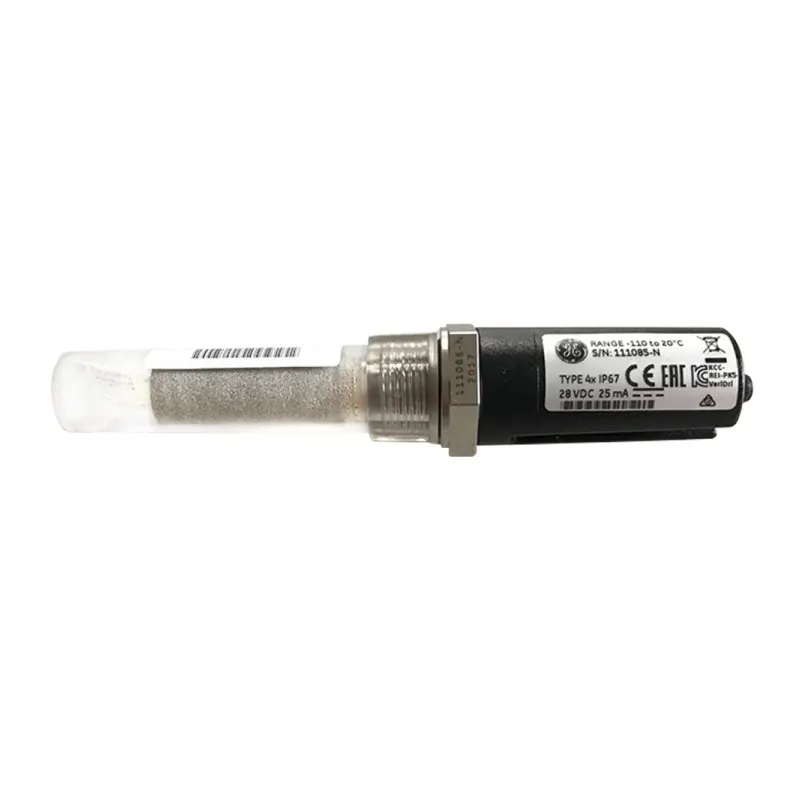
Moisture control is only as good as the measurement used to verify it. A glove box trace moisture analyzer samples gas from a defined point in the system and reports the water content. It can help operators detect a failed purge, a saturated column, a leaking glove, or a wet sample load, provided the sample is representative and the instrument is maintained. The analyzer is not a dryer. It does not lower the moisture level and cannot compensate for an undersized purification loop. Its value comes from making the atmosphere visible and from supporting decisions about transfer, regeneration, and maintenance.
When integrating a trace moisture analyzer, confirm the sampling point, line materials, flow rate, pressure, and temperature at the analyzer. Check the measurement range, resolution, accuracy, response time, and calibration procedure. A display resolution of 0.1 ppm does not mean an accuracy of 0.1 ppm. Also check whether the instrument is intended for the working gas and whether the sample line can be purged and isolated without disturbing the box. The same discipline applies to oxygen measurement: specify the measurement task first, then choose the sensor and its calibration approach.
Where is it suitable, and what are its limits?
A ten-station, double-sided purification box is most useful when a team needs a shared controlled atmosphere and a workflow with several sequential or parallel operations. Typical settings include lithium-metal and solid-state battery assembly, air-sensitive chemical synthesis, perovskite and OLED device work, semiconductor and electronic materials processing, and additive-manufacturing powder handling where the material must be protected from room atmosphere. It can also support analytical sample preparation and encapsulation when the sample mass and solvent load are compatible with the purification system.
The limits are equally important. The enclosure is not a sterile cleanroom, a fume hood, a biological safety cabinet, or a certified hazardous-waste containment system. Inert gas is not automatically inert toward every substance, and a low-oxygen reading does not prove that a particular sample is stable. Powders can contaminate surfaces and seals; solvents can load the purifier; reactive gases can damage sensors or purification media. A shared ten-station volume also means shared contamination risk. If two processes are chemically incompatible, or if one requires frequent opening while another needs long undisturbed periods, separate enclosures or a clearly defined zoning and transfer strategy may be more appropriate. No responsible specification should promise universal zero-oxygen conditions or maintenance-free operation.
How should you select or integrate the system?
Start with a process map rather than a station count. List who needs access, which samples and tools enter the box, how often transfers occur, which solvents and powders are used, and what analytical or electrical connections are required. Then size the enclosure and purification loop around those loads. A ten-station box is justified when parallel work and shared atmosphere improve the workflow; it is not automatically the best choice for a single operator or for processes that need isolation.
Use the TENCAN ten-station double-sided split-type glove box with gas purification system page as the reference point for the current configuration, but verify the assembled layout, antechamber arrangement, purification capacity, utility requirements, and monitoring options with the supplier. Ask for a leak-test and commissioning plan, a purge and regeneration procedure, sensor calibration details, and a maintenance schedule for gloves, seals, filters, and columns. Training should cover what may enter the box, how transfers are performed, and what to do when an alarm occurs. The objective is a documented, repeatable atmosphere, not a box that looks sealed on delivery day. The same review should confirm whether a moisture analyzer is factory-fitted or added as an accessory, and whether its sample point represents the atmosphere at the working stations.
Frequently asked questions
Does this ten-station model include gas purification?
Yes. The referenced product is a glove box with a gas purification system. The purification loop is part of the specified package, but its capacity and configuration must be confirmed for the planned workload.
Can the analyzer lower oxygen or moisture?
No. A trace moisture analyzer measures water content. It supports atmosphere control by providing data; the purification columns and the transfer procedure do the removal.
Can all ten stations maintain the same atmosphere?
They share the enclosure and, in the usual configuration, the same circulating atmosphere. Local conditions can still differ because of heat sources, airflow, open antechambers, solvent use, and sensor placement. Confirm zoning and sample points if uniformity is critical.
Is a split-type box less airtight than a one-piece box?
Not necessarily, but the additional joints must be designed, sealed, and tested correctly. Acceptance testing should cover the complete assembled enclosure, not just individual sections.
What information is needed for a quotation?
Provide the process description, number of users and stations, sample and solvent loads, required antechambers and feedthroughs, gas supply, analytical instruments, utility data, and any documentation or acceptance-test requirements. This lets the supplier match the purification loop and layout to the work rather than to a station count alone.
