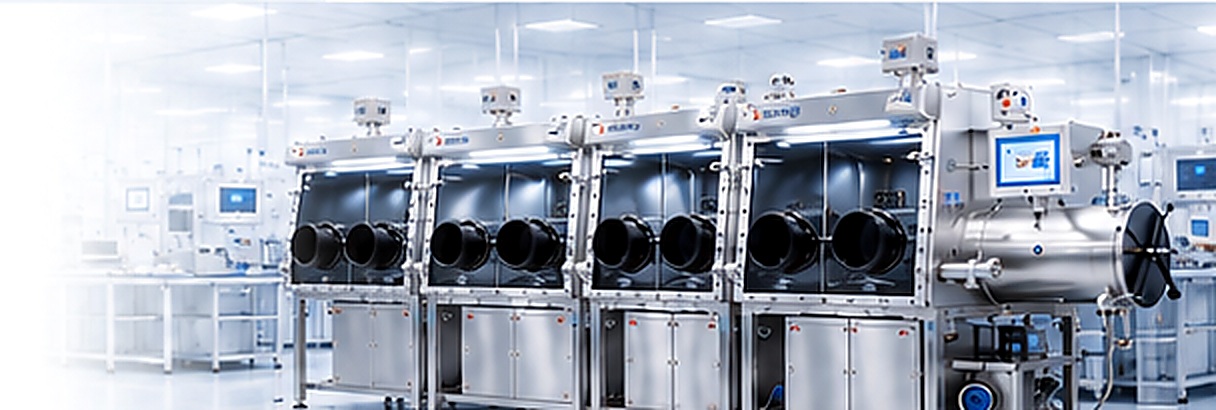
Even brief exposure to ambient air can change an oxygen-sensitive sample. A two-station single-sided glove box with gas purification system addresses that problem by combining a sealed working enclosure with a closed-loop atmosphere treatment system. The enclosure separates the operator from the sample; the purification loop circulates internal gas through media that remove moisture and oxygen. This is not an ordinary bench enclosure with gloves attached. Performance depends on the box, the purifier, the transfer path, the sensors, and the procedure used around them.
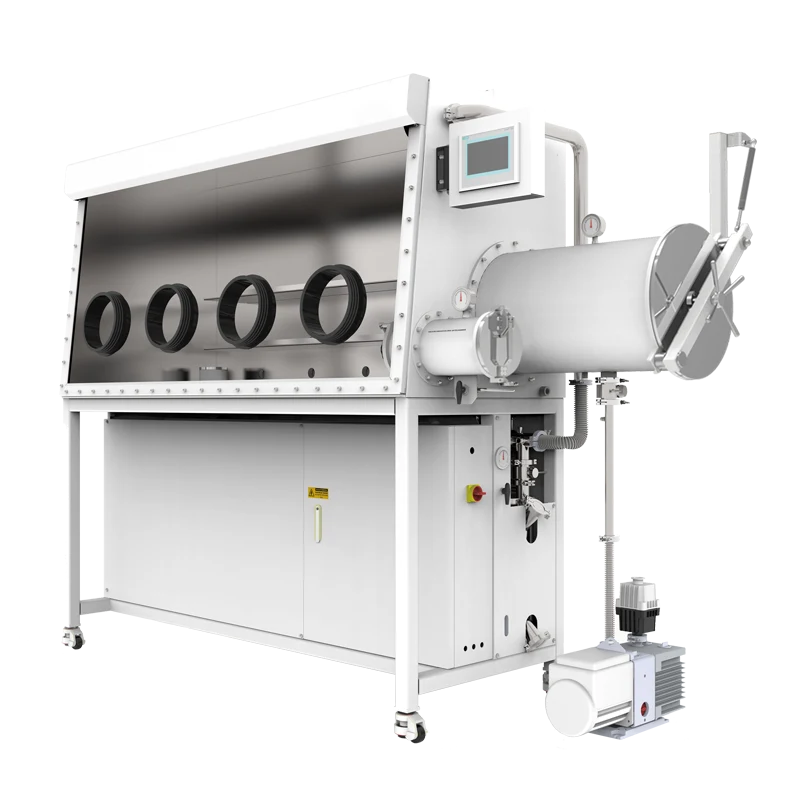
What Does a Two-Station Single-Sided Purification Glove Box Do?
A two-station single-sided box has two operator positions along one working face. Both positions look into the same sealed chamber, so samples, tools, and small equipment can be shared. Single-sided access means the work is performed from one side rather than from opposing faces. This layout suits parallel sample preparation, training, or a sequence in which one person handles material while another prepares a tool or records data. The two stations share one atmosphere; they are not independent controlled environments.
The phrase with gas purification system describes the atmosphere side of the installation. Gas is drawn from the chamber, passed through a purifier, and returned. The purifier is the active element, the circulation path moves gas through it, sensors monitor the atmosphere, and controls manage the cycle. The purification unit may be integrated into the box or arranged as a connected unit, depending on the build. The box and the purifier should not be confused: the box provides the barrier and working volume, while the purification system conditions the gas inside that volume.
How the Gas Purification Loop Works
A closed-loop purification system is best understood as a circuit rather than a container. Gas leaves the working chamber, enters the purification side, passes through one or more purifier columns, and returns to the chamber. Oxygen and moisture are removed by the purifier media, while sensors measure the remaining concentration in the gas stream or chamber.
Purification, Filtration, and Solvent Removal Are Different Jobs
Water and oxygen removal belong to the purifier. Particle filtration, usually associated with HEPA filters, captures airborne particles; it does not remove dissolved moisture or oxygen, and it does not substitute for a purifier. Solvent adsorption is also separate. A solvent trap can reduce organic vapor in the circuit, but it cannot replace the water and oxygen removal step. If a process releases solvents, acids, or other aggressive vapors, the compatibility of the purifier media, seals, gloves, and any adsorption stage must be reviewed together.
Working Gas, Control Gas, and Regeneration Gas
Purification systems may use gas for more than one purpose. The working gas fills and maintains the inert atmosphere. Compressed air or another control medium may operate pneumatic valves and actuators. Regeneration gas is used when the purifier media is refreshed, and that step may involve heat and a specific gas flow. These streams should not be treated as interchangeable. A pneumatic valve that works on shop air is not necessarily suitable for the process gas path, and a regeneration supply is not simply extra working gas.
Measurement Is Not Purification
An oxygen or moisture analyzer reports the condition of the atmosphere. It does not create a low-oxygen or low-moisture atmosphere. Sensor range, resolution, accuracy, calibration method, and sampling point all matter. Resolution is the smallest change the display can show; accuracy is how close the reading is to the true value. A display that resolves a very small change should not be read as a guarantee that the chamber is at that value. For any claimed atmosphere performance, ask how it was measured, where the sample was taken, and what stabilization period was used.
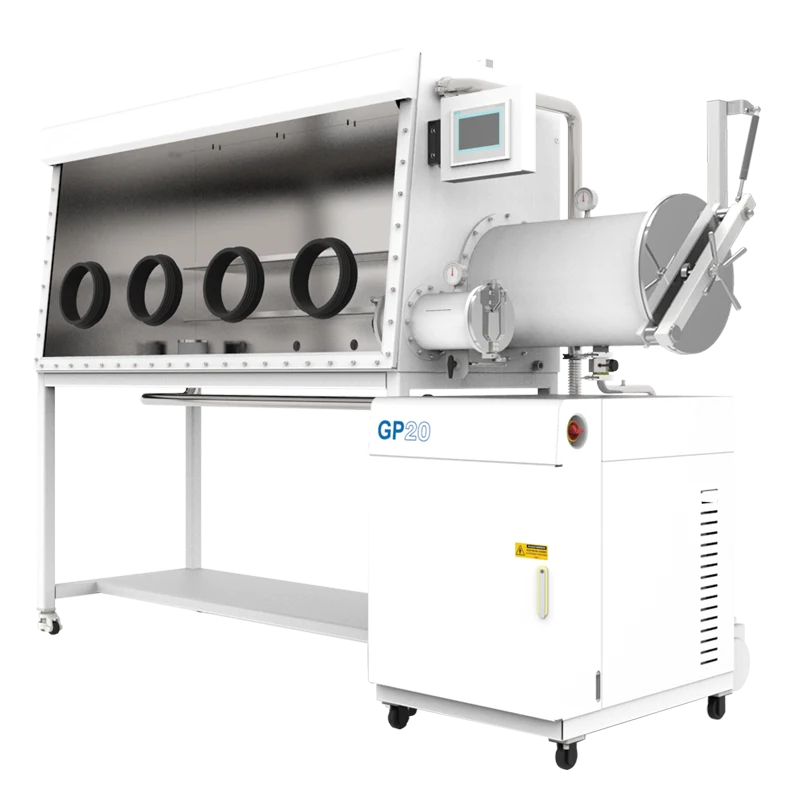
Which Layout and Configuration Choices Matter?
The two-station layout changes more than the number of glove ports. Two operators share one chamber, so internal volume, reach, and equipment placement affect how comfortably the work can be divided. More space is useful only when the workflow actually needs it. Every additional access event, open port, and item placed inside can add to the atmosphere load.
Single-sided access is appropriate when the process can be reached from one face. It leaves the opposite side available for services, supports, or the purification unit, depending on the design. A double-sided or multi-sided box may be preferable for long equipment or opposing workflows, but it is not automatically better for a research bench. Configuration also includes the transfer path. A transfer chamber lets materials enter and leave without opening the main work area directly to room air. Its volume, door arrangement, vacuum capability, and purge procedure affect how much air enters during a transfer.
Panel construction, window material, glove-port arrangement, lighting, and feedthrough positions also influence daily use. A clear view is valuable for small parts, but visibility alone does not define chemical compatibility. Gloves, seals, and window materials must be matched to the samples and cleaning agents. Sharp tools and hot processes can damage gloves or create particles.
Which Specifications Should You Check?
A purification glove box is specified by a set of related but distinct values. Combining them into a single performance claim hides the conditions that matter.
Working Space and Transfer
Confirm internal dimensions, glove-port positions, working height, and usable space after fixtures are installed. A two-station shell can look generous on a drawing but become crowded once a microscope, press, or sample rack is inside. Check the transfer chamber separately; the main chamber size says nothing about the size of the object that can pass through the antechamber.
Atmosphere and Measurement
Ask which oxygen and moisture ranges are quoted, whether they are continuous or best-case values, and where the sensors are located. Confirm the calibration interval and calibration gas. Do not compare an analyzer's resolution with another system's accuracy. Also ask how quickly the system recovers after a transfer, because recovery behavior often matters more than a single stabilized reading.
Leakage, Pressure, and Vacuum Ratings
Chamber working pressure, transfer-chamber vacuum, pump ultimate vacuum, and leak rate are different quantities. A box may tolerate a slight positive working pressure without being rated for high vacuum. A transfer chamber may pull a vacuum without making the whole main chamber a vacuum vessel. The pump's ultimate vacuum describes the pump under specified conditions, not the pressure reached in every connected volume. Keep the original units and the applicable object with each value.
Purification Capacity and Utilities
Ask how much moisture and oxygen the purifier media can take up under the intended duty, what triggers regeneration, and what utilities regeneration requires. The regeneration procedure belongs to the purifier design and should not be improvised from a general article. Also list every connection the process needs: electrical feedthroughs, signal ports, gas lines, cooling lines, vacuum lines, and sensor ports. Each penetration is a potential leak path and must be sealed for the intended atmosphere.
Where Is It Suitable, and What Are Its Limits?
A two-station purification glove box fits work where a shared, controlled atmosphere is more useful than two separate small boxes. Typical settings include lithium and solid-state battery material preparation, perovskite and OLED device work, semiconductor and electronic materials, air-sensitive chemistry, advanced materials research, and selected additive manufacturing preparation or post-processing steps. The box keeps samples away from ambient moisture and oxygen while allowing tools and small equipment to remain inside between steps.
The limits are just as important. Inert atmosphere protection is not sterilization, a cleanroom classification, biological containment, or hazardous-material containment certification. A glove box is not a fume hood, and it should not be used to vent large solvent volumes unless the configuration has been reviewed for that duty. A purification system does not make every gas harmless or every sample stable. Some materials react with the inert gas itself, some release vapors that attack seals or gloves, and some processes generate heat or particles that need separate controls.
How a Pneumatic Vacuum Baffle Valve Fits
A pneumatic vacuum baffle valve is a vacuum valve with a baffle-style closure and a pneumatic actuator. In a glove box installation it may be considered for isolating a vacuum path, such as a pump line or a transfer circuit, where automatic actuation is useful. The valve does not remove water or oxygen, and it does not turn a non-purified box into a purified one. Its contribution is flow isolation: it opens and closes a path under controlled actuation.
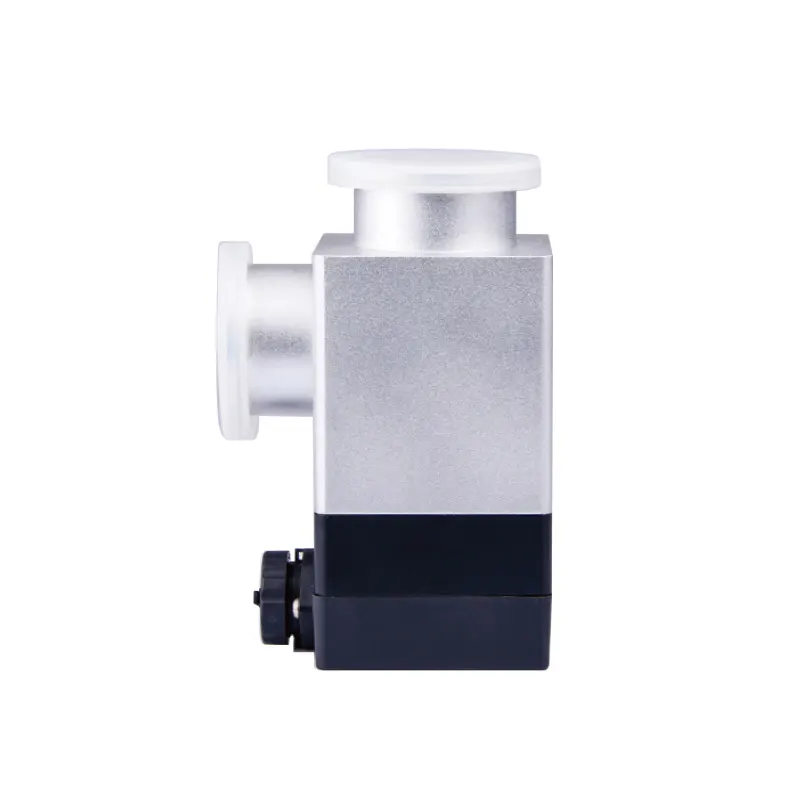
Compatibility should be checked rather than assumed. Confirm the flange or connection standard, seal material, permitted process and control media, vacuum rating, required compressed-air supply, actuation signal, and fail-safe behavior if air or power is lost. A valve that is correct for a rough vacuum line may not be correct for a high-vacuum path, and a seal that suits dry inert gas may not suit solvent vapor. Automatic isolation can make a transfer cycle more repeatable and reduce the chance that a pump line is left open by mistake, but it also adds a control dependency.
Selection and Integration Checklist
Use the following sequence to move from a general requirement to a defensible configuration.
- Define the sample and process. Record material sensitivity, acceptable exposure time, process temperature, and any solvents, acids, or particles released.
- State the atmosphere target and measurement method. Separate required oxygen and moisture levels from the analyzer's display resolution.
- Map the workflow. Count operators, tools, and equipment that must remain inside, and decide whether two stations are needed for parallel work.
- Review the transfer and vacuum path. Check the largest object that must pass through the antechamber and whether vacuum isolation needs manual or automatic actuation.
- Confirm purification, regeneration, and compatibility. Verify purifier capacity, regeneration method, permitted gases, utilities, and the compatibility of gloves, seals, tubing, and valve seats. Use the current product page for supplied dimensions and options, and verify any accessory against its own current details.
Frequently Asked Questions
Does a two-station single-sided glove box always include gas purification?
No. Two-station single-sided describes the enclosure layout. The purification capability comes from the gas purification system named in the configuration. Check the model title and current equipment list rather than inferring a purifier from the enclosure shape.
Can the purification system guarantee a specific oxygen or moisture level?
It should be evaluated against a stated test condition. The achievable level depends on the purifier, box leak rate, transfer frequency, internal load, sensor calibration, and stabilization time. If a number appears without those details, treat it as something to confirm.
Is a pneumatic vacuum baffle valve required on every glove box?
No. It is a vacuum-circuit component, not a standard requirement for every enclosure. It becomes relevant when the design needs automatic isolation of a vacuum path and when its flange, seal, pressure rating, and control supply match the installation.
Can the box be used for solvents or biological work?
Do not assume so. Solvent vapor may require dedicated adsorption and compatible seals, and biological work may require containment or sterilization features that an inert-atmosphere glove box does not provide. Review the intended use against the actual configuration and relevant safety requirements.
A two-station single-sided glove box with gas purification is a workflow tool, not a badge of atmosphere quality. Its value comes from a sealed enclosure, a properly sized purification loop, a controlled transfer path, and operators who understand what the sensors measure. Start with the sample and process, verify the configuration and measurement conditions, and treat accessories as parts of a defined circuit.