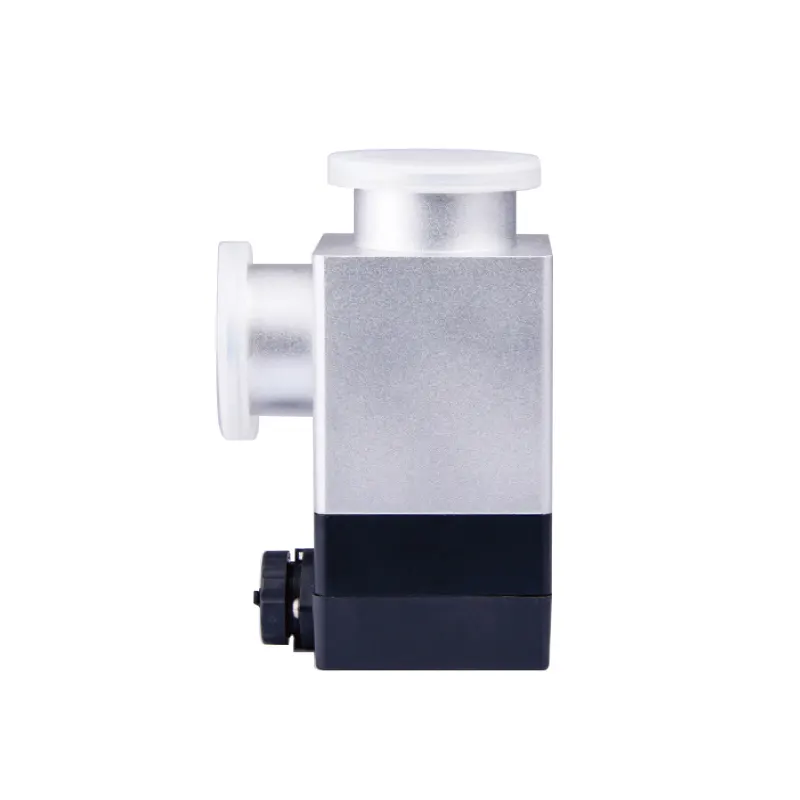
A pneumatic vacuum baffle valve is a remotely actuated on/off valve that isolates a vacuum or gas path connected to a glove box. It is typically mounted between a chamber and a pump, on a transfer-chamber evacuation line, or in a purge and vent manifold, where it opens or closes the path under compressed-air control. Its job is isolation: it does not create vacuum, remove oxygen or moisture, or filter particles, and it does not by itself turn a cabinet into a controlled-atmosphere system.
The TENCAN pneumatic vacuum baffle valve is offered as a glove box accessory. The available product information identifies the item and its product image but does not publish a detailed performance table. For that reason, the useful question is not “what number does this valve achieve?” but “what does this line require, and which valve configuration can meet it?” The answers have to come from the current datasheet, the line conditions, and the cabinet design.
Where the Valve Fits in the System
A glove box contains several distinct gas paths. The main purification loop circulates the working atmosphere through purifier columns; vacuum service lines evacuate the transfer chamber or small antechambers; purge and vent lines add inert gas or carry displaced gas away. These circuits have different pressure, flow, and contamination profiles. A vacuum baffle valve is normally considered for the service side—pump isolation, transfer-chamber evacuation, or a purge/vent branch—rather than inside the working chamber, where it would take up space and interfere with gloves.
Placement changes the duty. A valve near a pump inlet may see continuous vacuum and traces of condensable material. A valve on a transfer chamber may cycle repeatedly as the chamber is evacuated and refilled. A valve in a purge manifold may see positive pressure rather than vacuum. The same size and body style does not make one valve suitable for all three. The line’s gas, pressure direction, cycling rate, and allowable leakage must be defined first.
What Does It Do and How Does It Work?
The functional core is a movable baffle, disc, or plate that seats against a sealing surface. In the open position, gas passes through a relatively direct path; in the closed position, the plate and seat separate the two sides. The pneumatic actuator supplies the force. Compressed air acts on a piston or diaphragm, the moving element is pushed or pulled, and the baffle changes position. A spring, a second air port, or another mechanical arrangement returns the valve, depending on the design.
From Air Pressure to Valve Movement
Pneumatic operation separates the actuator from the process line. That is useful when the valve is behind a panel, under a transfer chamber, or close to a pump where manual access is awkward. It also allows the valve to be driven by a control sequence: opening a path for evacuation, closing it before venting, or isolating a pump before maintenance. However, “pneumatic” describes the motive power, not the control intelligence. A solenoid pilot valve, air tubing, an air-preparation device, and position feedback may all be needed to make the valve work as part of a system.
Isolation, Not Flow Regulation
Most baffle valves are intended for on/off service, not for setting a precise flow rate. Leaving the plate partly open can expose the seat to erosion, chatter, or unstable flow, and the valve’s position is not a calibrated flow setting. If the task requires controlled venting, proportional pressure control, or repeatable gas dosing, a metering valve or mass-flow controller is the appropriate device. A baffle valve should be treated as a gate that is either securely open or securely closed.
Why Use Pneumatic Actuation?
Remote operation and repeatability are the main advantages. In a glove box, reaching a valve by hand may require breaking atmosphere or removing a panel. Pneumatic actuation puts the operating force outside the working area. It can be interlocked with a pump, a transfer chamber, or a pressure switch. It gives a repeatable stroke and can be commanded by a PLC. For a multi-step pump-purge routine, that repeatability is more valuable than a handwheel.
The tradeoff is that the valve needs a reliable air supply. Moisture, oil, or particles in the air can cause sticky movement or actuator wear. The control system must also define what happens when power or air is lost. A normally closed valve may isolate a pump safely but trap gas; a normally open valve may vent a line but leave a pump exposed. Neither state is universally safer. The correct failure state depends on what the line contains and what the rest of the system is doing.
How Baffle Isolation Compares with Other Valve Choices
Valve selection is a system decision. Gate, ball, butterfly, and baffle valves have different space requirements, sealing behavior, and flow paths. The baffle design is often attractive where a compact, direct path and a short stroke are useful. That does not make it the right choice for every vacuum line. A line that needs high conductance may favor a valve with a large open area; a line that must isolate a rough pump may need a different seat and actuator arrangement; a line exposed to solvent vapor may need a seal material that a standard elastomer cannot provide. The comparison should be made using datasheets, not by assuming that all “vacuum valves” are interchangeable.
Which Configurations and Specifications Matter?
The available information describes one product rather than a published family of variants. Rather than invent a model matrix, the practical approach is to identify the configuration choices that must be settled before an order. The table below lists checks that apply to a pneumatic vacuum baffle valve in a glove box installation; the actual values for this product must be obtained from its current datasheet or the supplier.
| Item to confirm | Why it matters | What to ask |
|---|---|---|
| Port or flange | Determines whether the valve can be fitted to the line without adapters. | Standard, size, gasket type, and mating hardware. |
| Actuator action | Defines the valve’s state when air or power is lost. | Normally closed, normally open, or double acting; spring-return details. |
| Air supply | Affects reliability and movement speed. | Supply pressure range, filtration, lubrication, and connection size. |
| Seal material | Controls chemical compatibility and seat life. | Compatibility with process gas, solvents, oxygen, and cleaning agents. |
| Leakage | Determines how well the valve isolates one side from the other. | Test method, test pressure, and acceptable leakage for the duty. |
| Conductance | Affects pump-down time even when the valve is fully open. | Flow path and expected pressure drop at the working conditions. |
| Position feedback | Allows the control system to prove that the valve has moved. | Switch type, signal, and whether an open/closed indication is included. |
| Solenoid and controls | Must match the cabinet’s electrical and automation design. | Coil voltage, power, connector, manual override, and signal type. |
| Installation and service | Affects actuator clearance and long-term maintenance. | Orientation limits, access for seat replacement, and support requirements. |
Two columns deserve particular attention. Leakage and conductance describe different things. A valve can close tightly and still make a pump-down step slow because its open path is restrictive; a valve with a wide-open bore can still leak at the seat. Ask for the test conditions, not only a headline number. Also, the valve’s pressure rating is not the cabinet’s oxygen or moisture performance. The purification system, gloves, seals, transfer chamber, and operating procedure determine the atmosphere. A valve on a vacuum line cannot compensate for a leaking glove port.
Where It Is Suitable, and What It Cannot Do
A pneumatic vacuum baffle valve can be considered for on/off isolation of a transfer-chamber vacuum line, a pump service branch, a small load-lock, or an inert-gas purge/vent line when its materials and ratings match the gas. It is also useful as an automated isolation point in a sequence that must be repeated many times. In each case, the design question is not “add a valve” but “place an isolation element where the process needs one.”
The boundaries are just as important. It is not a vacuum source, a purifier, a moisture trap, a solvent adsorber, a HEPA filter, or an oxygen analyzer. It does not make a non-vacuum-rated acrylic chamber vacuum-tight, and it does not convert a manual glove box into an automated purification system. It should not be used as a throttling device for precise pressure control. It should not be assumed compatible with corrosive, condensable, oxygen-enriched, or solvent-laden streams without checking the wetted materials and seal. And it cannot replace routine leak checks, glove inspection, or maintenance of the purification loop.
How to Select and Integrate It
Map the Circuit
Draw the line from its source to its destination and mark the valve’s state in each mode: evacuation, hold, vent, purge, and maintenance. Record the gas, the pressure direction, the maximum and minimum temperature, and any condensable or particulate load. A valve that is correct for a clean vacuum line may be wrong for a line carrying solvent vapor or fine powder.
Define the Failure State
Decide what should happen if control power or compressed air is lost. The answer depends on whether the priority is protecting the pump, protecting the sample, or preventing an unintended vent. Specify the actuator action and the solenoid arrangement to achieve that state, and include position feedback if the control system must prove that the valve has moved.
Verify Materials and Sealing
Check the body, baffle, stem, and seat materials against the process gas. For oxygen service, cleaning and material compatibility need explicit confirmation; do not assume that a vacuum-tight valve is oxygen-compatible. For solvents, verify the seal elastomer and avoid relying on a generic “chemical resistant” claim. The same caution applies to purge gases: a gas that is inert to a sample may still affect a seal or a lubricant.
Check the Control Chain and Installation
Match the solenoid voltage and signal to the cabinet controls. Provide air of the quality specified by the actuator manufacturer. Leave access for seat replacement and actuator service. Support the valve and its tubing so that the body is not stressed by the connected pipe. After installation, leak-check the joints and the seat using the site’s procedure and a suitable detection method; the valve’s own datasheet cannot confirm the quality of the field installation.
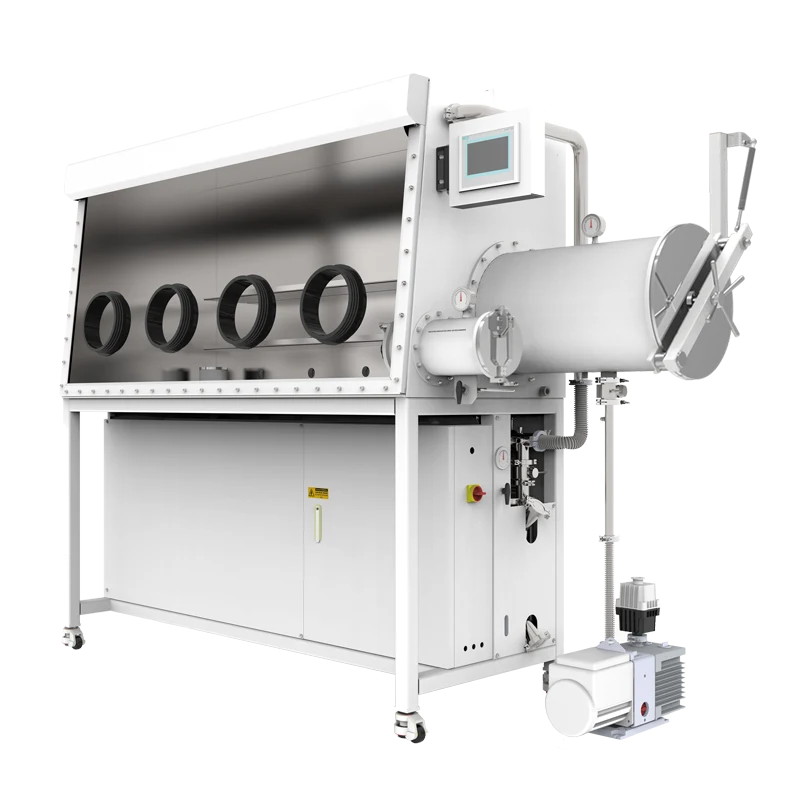
In a larger cabinet, the number of service points grows. The two-station single-sided glove box with gas purification system, for example, combines a work area, a transfer chamber, and a purification loop, so a valve must be assigned to a specific line rather than treated as a generic add-on. The fact that the cabinet and the accessory appear in the same catalog does not prove that they are a drop-in match. Flange, seal, actuator, and control details still need to be checked against the cabinet’s actual drawing.
A Practical Selection Checklist
- Which line will the valve isolate, and in which operating modes?
- What are the gas, pressure, temperature, and contamination conditions?
- Which port or flange standard does the line use?
- Is the required action normally closed, normally open, or double acting?
- What air quality and supply pressure does the actuator need?
- Which seal material is compatible with the process gas and cleaning agents?
- What leakage and conductance are needed for the pump-down step?
- How will the valve be controlled, monitored, and serviced?
- Does the failure state protect the pump, the sample, and the operator?
FAQ
Does a pneumatic vacuum baffle valve generate vacuum?
No. It only opens or closes a path. Vacuum comes from a pump or an ejector, and the reachable pressure depends on the pump, the line conductance, and the leak rate of the whole assembly.
Can the valve lower oxygen or moisture in a glove box?
No. It can isolate a purge or vacuum line, but oxygen and moisture control comes from the purification system, the box integrity, and the operating procedure. A valve is not a purifier, and an analyzer is needed to measure the atmosphere.
Is it normally closed?
That depends on the actuator and control arrangement. Normally closed, normally open, and double-acting versions exist in general, but the available product information does not establish which configuration this particular valve uses. The required failure state should be specified before ordering.
Can it be fitted to any glove box?
Not without checking. The flange or port, seal material, actuator clearance, air supply, and control signal all have to match the cabinet. Compatibility should be confirmed from drawings and the valve datasheet, not inferred from a product name.
When is a baffle valve the wrong choice?
When the job needs metering, proportional flow, particle removal, solvent adsorption, or atmosphere purification. It is also a poor choice if its materials or pressure ratings do not cover the gas, or if the installation cannot provide the required air quality and maintenance access.