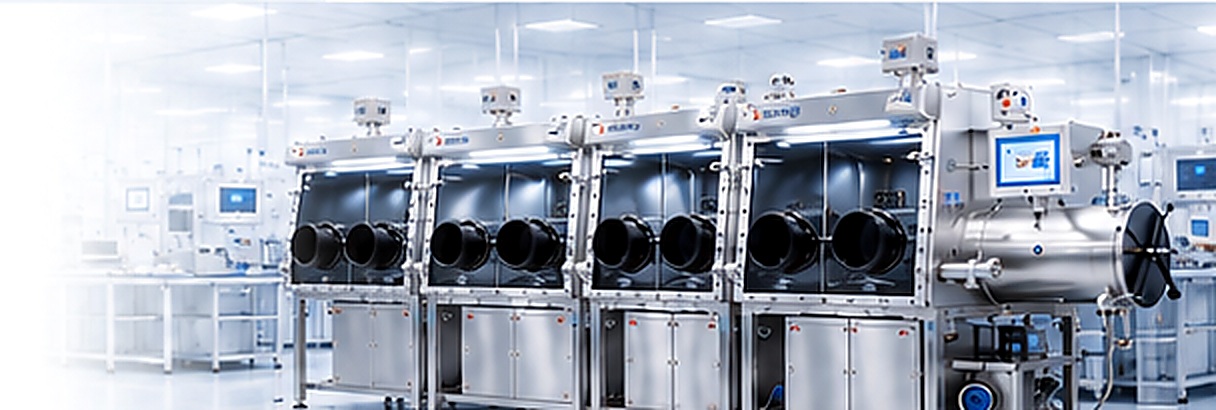
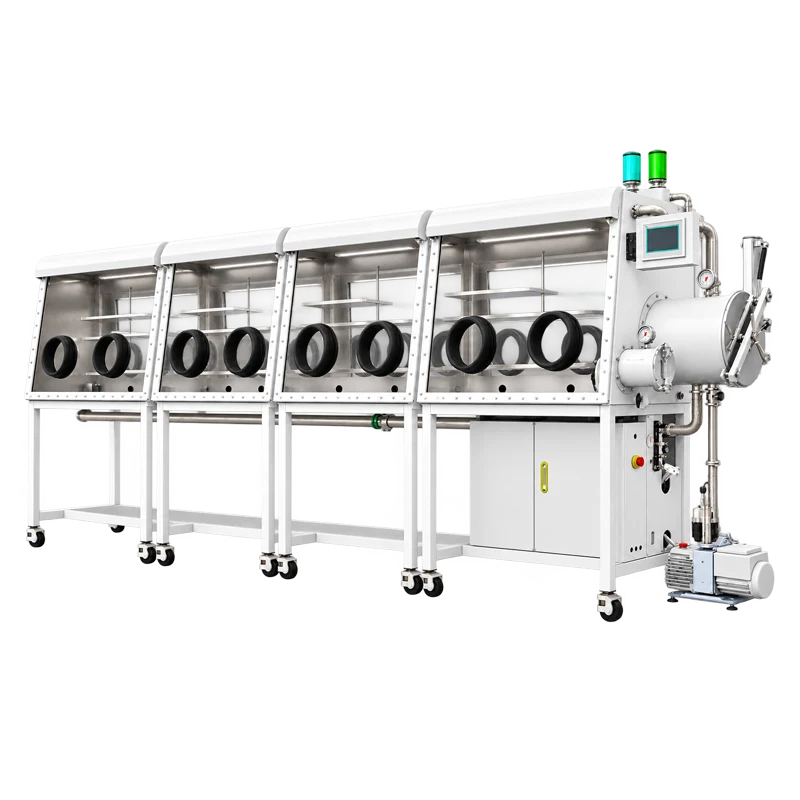
An eight-station double-sided split-type glove box with a gas purification system is a sealed, multi-user enclosure for handling air-sensitive materials under a managed inert atmosphere. The eight-station part of the name identifies eight working positions; double-sided means the enclosure can be accessed from two opposing sides; and split-type generally indicates that the glove box enclosure and the purification or utility section are arranged as separate assemblies rather than one integrated cabinet. The purification system is central to the installation: it circulates the internal atmosphere, removes moisture and oxygen, and supports the measurements used to judge atmosphere quality. A configuration of this size is relevant where several people, processes, or sample-transfer routes share one controlled environment. Exact dimensions, performance figures, and utility requirements should be confirmed in the current product documentation.
What does the system do and how does it work?
A gas-purified glove box maintains a closed working volume that is physically isolated from the surrounding air. Operators use gloves fixed to ports in the enclosure; samples and equipment pass through an antechamber or another transfer device. The purification system draws gas from the box, passes it through purifier material that captures moisture and oxygen, and returns it to the enclosure. Monitors sample the atmosphere so that the operator can see whether conditions remain within the intended range. This is a different function from simply filling a box with nitrogen or argon. Gas replacement can establish an initial inert atmosphere, but a closed purification loop is what counteracts continuing ingress, outgassing from materials, and small leaks during use.
Enclosure and station layout
The eight-station designation matters most in daily use. More stations allow more hands, more samples, or more than one activity to share the enclosure, and a double-sided layout lets teams work from opposite sides or use one side for loading and the other for observation or processing. The trade-off is that all stations normally share one atmosphere. A spill, an open port, or a contaminated sample at one position can affect the whole working volume. It is also not safe to assume that one station can be isolated from the rest; that requires a specific compartment design and should be confirmed before purchase.
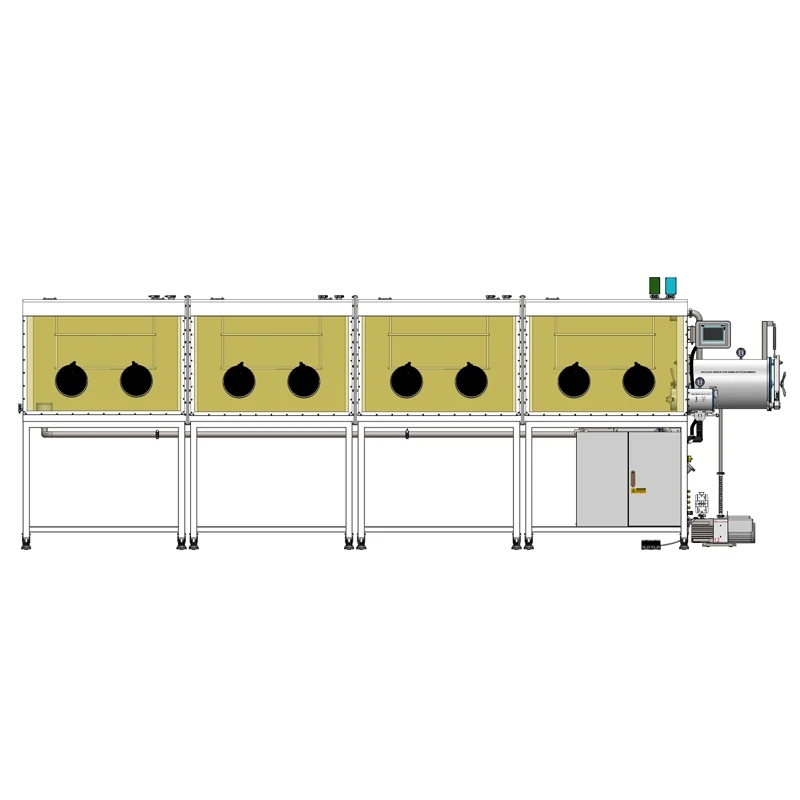
A large enclosure changes ergonomics as well as capacity. Reach, sightlines, glove-port spacing, and the height of the working surface all influence how quickly an operator can work without straining. The split-type arrangement should be reviewed at the layout stage, because separating the enclosure from the purification or utility section affects floor space, service access, and the routing of ducts, cables, and gas lines. Separation can make maintenance easier to organize, but every additional connection is also a potential leak path and must be included in the installation checks.
Purification loop and atmosphere control
The purification loop normally includes a blower or circulation pump, one or more purifier columns, valves, and atmosphere monitors. The purifier is not a particulate filter. HEPA filtration captures particles; it does not remove water vapor, oxygen, or solvent vapor. Solvent adsorption can protect the purifier and reduce organic contamination, but it does not replace water and oxygen removal. Likewise, an oxygen or moisture analyzer measures the atmosphere; it does not improve it. These distinctions matter when specifying a system, because adding an analyzer or a filter does not automatically increase purification capacity.
Purifier material eventually needs regeneration or replacement. Regeneration is a separate operating phase, not part of normal circulation. Gas flows, valve positions, and heating may differ from the normal operating state, and the procedure must follow the manufacturer's instructions for the specific model. The practical interval depends on how often the box is opened, how much moisture or oxygen enters with samples, what materials are processed, and how much solvent vapor reaches the purifier. A system with more purification capacity may recover more quickly after a transfer, but the enclosure volume, leak rate, and operating discipline still determine the actual atmosphere history.
Which configurations and components matter?
For this eight-station platform, the meaningful choices are not arbitrary variations in model number. They are decisions about how the working volume is arranged and how the atmosphere is maintained:
- Station layout: the number and spacing of glove ports, the working height, and access from one or both sides.
- Split versus integrated arrangement: where the purification and utility hardware sits, how it is serviced, and how far gas lines must run.
- Transfer method: antechamber size, number of transfer chambers, pumping arrangement, and the size of items that must pass through.
- Purification and monitoring: purifier capacity, number and location of atmosphere sensors, alarm logic, and calibration access.
- Port interface: glove size, glove material, sealing rings, and the condition of the sealing surfaces.
These items are connected. A larger antechamber may reduce transfer time, but it also changes pump requirements and the amount of air introduced during a cycle. A larger enclosure provides more working space, but it takes more purification effort to restore conditions after a disturbance. The right balance depends on the process, not on the largest available number.
Glove ports, gloves, and sealing rings
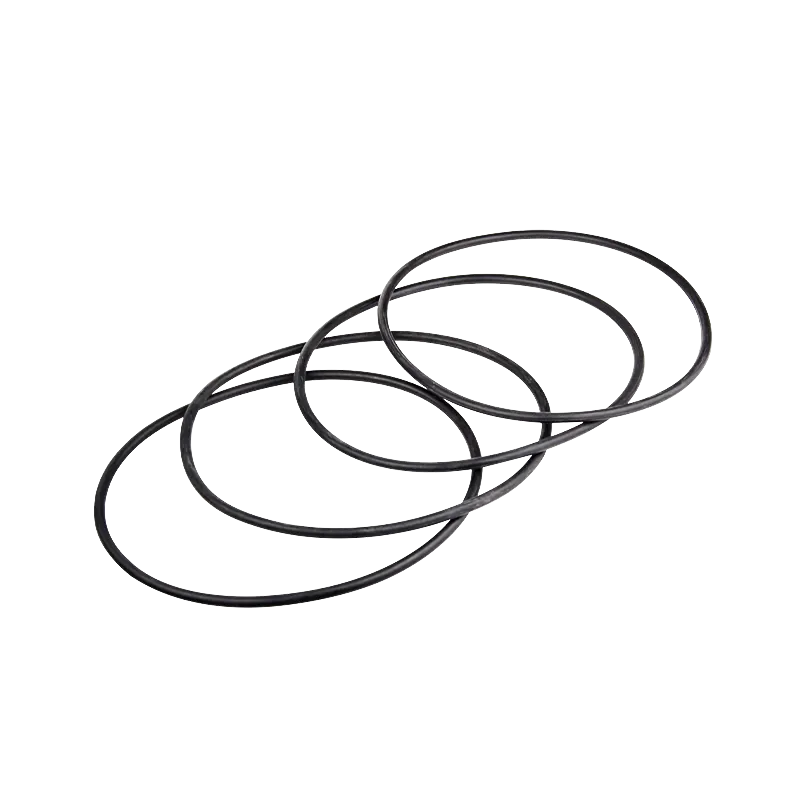
Every glove port is a deliberate opening in an otherwise closed boundary. The glove provides the flexible barrier through which an operator works, and the port sealing ring holds the glove interface tight against the port. A worn, incorrectly sized, or chemically incompatible ring can allow a small leak that is difficult to trace by watching the analyzer alone. On an eight-station box, there are more of these interfaces to inspect, so the sealing arrangement deserves attention during installation and routine maintenance.
The glove port sealing ring is an accessory, not a purification device. It cannot lower oxygen or moisture by itself. Selection should be based on the actual port geometry, glove cuff thickness, elastomer compatibility with the materials handled, and the replacement interval expected in service. The fit should be confirmed against the port and glove specifications rather than assumed from a nominal diameter. A sealing ring that is compatible with the process atmosphere but not with a cleaning agent, for example, may fail prematurely even though it looked correct at installation.
Which specifications should you check?
The product name describes the architecture, not the performance of a particular installation. Before comparing quotations, ask for the conditions behind every atmosphere claim and keep different vacuum and pressure figures separate.
- Atmosphere performance: the measured oxygen and moisture ranges, sensor locations, calibration method, and the conditions under which any achievable value is stated. Resolution is not the same as accuracy, and a display with fine resolution does not guarantee that the whole box stays at that level.
- Leak integrity and pressure control: the leak-test method, acceptable leakage criterion, working-pressure range, and alarm or interlock behavior. Box working pressure, antechamber vacuum, pump ultimate vacuum, and leak rate are different specifications and should not be combined into one number.
- Purification capacity: purifier loading, expected regeneration or replacement interval, and how recovery is defined after a transfer or a period of heavy use.
- Transfer performance: antechamber volume, pump compatibility, cycle procedure, and whether the chamber is intended for vacuum or only for gas exchange.
- Enclosure geometry: internal working dimensions, station spacing, reach, sightlines, feedthrough provisions, and the footprint of the split utility section.
- Utilities and installation: inert-gas supply quality and pressure, exhaust or vent requirements, electrical load, and service clearance around the purification section.
- Port and glove compatibility: port diameter, glove material and thickness, sealing-ring elastomer, and the cleaning agents used in the laboratory.
Ask for values in their original units and for the object they apply to. A purifier specification, a sensor specification, and an enclosure leak specification answer different questions. If a document gives a value without saying whether it is a typical value, a guaranteed value, or a best-case result under a defined test, treat it as incomplete until clarified.
Where is it suitable, and what are its limits?
A large double-sided purification glove box suits shared laboratory work with air-sensitive materials: lithium metal and solid-state battery components, perovskite and OLED materials, semiconductor precursors, air-sensitive catalysts and organometallic chemistry, and advanced materials that must be weighed, mixed, or assembled without exposure to ambient moisture and oxygen. In additive manufacturing workflows, it can support powder handling or post-processing where the material is sensitive, provided the powder-handling equipment and cleaning method are compatible with the enclosure.
The limits are just as important. A glove box is not a sterile environment, a cleanroom classification, a biological safety cabinet, or a substitute for a fume hood. HEPA filtration does not remove solvent vapor or oxygen, and a solvent trap does not replace the water and oxygen purifier. The system also does not make every gas inert for every sample; nitrogen and argon can react with or be absorbed by some materials, and process compatibility must be checked separately. Because all eight stations normally share one atmosphere, cross-contamination between samples is a real operating risk. High occupancy, frequent transfers, wet samples, and poorly maintained gloves all increase the load on the purification system.
How should you select or integrate it?
Start with the process rather than the cabinet size. Define the largest item that must enter, the number of people who work at the same time, the frequency of transfer, the sensitivity of the materials, and whether solvents or powders will be present. Then check the enclosure geometry, transfer arrangement, purification capacity, monitoring, and service access as one system. Confirm how the split-type section will be installed, how gas lines will be routed, and how the atmosphere will be verified after commissioning.
The TENCAN eight-station double-sided split-type glove box with gas purification system is the reference point for the configuration discussed here. Use its current product page to confirm the available layout, equipment scope, and documentation, and ask for the conditions behind any atmosphere or vacuum figure. A final review should also include the glove port sealing rings, spare gloves, and a maintenance plan for the purifier, because these consumables and interfaces determine how well the installed system holds its intended environment over time.
Frequently asked questions
Does this glove box include gas purification?
Yes, gas purification is part of the product name and architecture. The number of purifier columns, the blower arrangement, the monitor set, and the stated performance should still be confirmed in the current configuration documents.
Are the eight stations independent?
Do not assume so. A multi-station purification glove box normally shares one atmosphere across the working volume. If a process requires isolation between stations, that must be addressed by a specific compartment design or a separate enclosure.
Can a glove port sealing ring reduce oxygen or moisture?
No. The ring helps maintain the seal at the glove-to-port interface. It can reduce the risk of leakage, but it does not remove oxygen or moisture and cannot substitute for the purification system.
Can the box be used with solvents?
Only after reviewing solvent compatibility, vapor load, and the appropriate adsorption or exhaust arrangement. A solvent trap protects the purifier and interior, but it does not replace water and oxygen removal. The manufacturer's guidance for the specific configuration should be followed.
What does split-type change?
It changes the physical arrangement of the enclosure and the purification or utility section, which affects footprint, service access, and routing. It does not, by itself, guarantee better atmosphere performance; the installed connections and operating procedure still matter.