
A GP20 gas purification system cabinet is a standalone atmosphere-treatment unit that circulates inert gas through purification media and returns it to a compatible sealed enclosure. It is not a complete glove box: the working space, gloves, antechamber and physical barrier belong to the connected box. The GP20's role is to manage the recirculating atmosphere, typically by removing moisture and oxygen, while the box provides the controlled workspace.
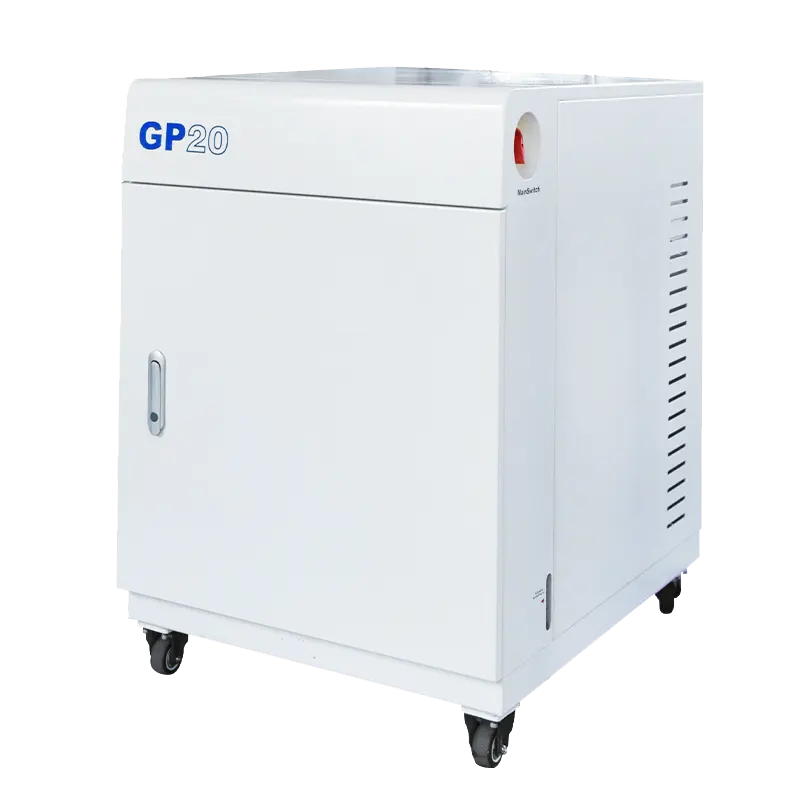
What the GP20 Does in a Closed-Loop Glove Box System
In a closed-loop arrangement, gas leaves the glove box, passes through the purification cabinet, and returns to the box. A purification cabinet of this type normally contains the hardware needed to move the gas, bring it into contact with purification media, and monitor selected atmosphere parameters. The exact flow path, media volume, sensor set and control architecture depend on the final configuration, so the GP20 should be specified against the connected enclosure rather than treated as a universal add-on.
Three gas roles need to be kept separate. The working gas is the inert atmosphere inside the box and loop - commonly nitrogen or argon, subject to material and process compatibility. Control gas operates valves, instruments or other pneumatic functions where applicable. Regeneration gas is used to renew the purification media; it follows a separate procedure and must not be confused with normal working gas. A cabinet that performs regeneration does not purify the box during that step in the same way as it does in normal circulation.
The purification media remove target impurities from the gas stream. In a typical inert-atmosphere glove box, those targets are moisture and oxygen. The media have finite capacity and selectivity; they are not a general scrubber for every solvent vapor, acid gas or particulate. Circulation distributes treated gas through the box, but it cannot compensate for an unresolved leak, outgassing from materials, or a poorly purged antechamber. Monitoring instruments measure the atmosphere; they do not create the purification. This distinction matters when reviewing performance claims, because a sensor reading is evidence of conditions at the sampling point, not proof that the whole box is uniform.
Key Components and Configuration Points
The GP20 is a single cabinet model rather than a family of differently sized cabinets. The useful configuration discussion therefore focuses on the components and interfaces that determine whether the cabinet matches the box and process.
Purification columns and media
The purification column or columns hold the media that remove moisture and oxygen. Their capacity, changeout method, and regeneration requirements should be confirmed for the intended duty. A larger box, frequent door openings, wet samples or high outgassing loads increase the impurity load and can shorten the interval between regeneration or media replacement. Do not assume that a purification cabinet can support an unlimited number of glove ports or a continuously open transfer path.
Circulation and pressure management
A blower or circulator moves gas through the loop. The cabinet and box together form a pressure system, so the loop must be designed for the box's allowable working pressure, relief arrangement and leak-tightness. Box working pressure, antechamber vacuum, pump ultimate vacuum and leak rate are different parameters. A value quoted for one does not establish the others. Where the available material does not state a numerical limit, the safe approach is to confirm it with TENCAN and to commission the combined system with appropriate leak and pressure checks.
Monitoring and controls
Moisture and oxygen analyzers are common in this class of system, but their range, resolution, accuracy, calibration method and sampling location must be checked. Resolution is not the same as accuracy, and a display reading of a very low number does not by itself prove that the box atmosphere has reached that value everywhere. Controls should make alarm states, sensor status, circulation status and regeneration status clear to the operator. Data logging can be useful for batch records, but only if the logged value is traceable to a calibrated instrument and a defined sampling point.
Regeneration and gas routing
Regeneration is a maintenance function, not a normal operating mode. It requires the correct gas, flow, temperature and vent route, and it should be interlocked so that the working atmosphere is not compromised. Regeneration temperatures, gas mixtures and durations must come from the model documentation and TENCAN's instructions. The same rule applies to any heated step: do not improvise a procedure from a general article.
Cabinet interfaces and service access
The cabinet must connect to the box through suitable gas lines and signal interfaces. Connection size, sealing method, support, isolation valves and purge points should be agreed as part of the installation. Service access for media, filters, sensors and pumps matters as much as nominal performance, because a purification system that is difficult to maintain will not stay within its intended operating envelope. Power, heat rejection, ventilation and any exhaust requirements also need to be checked before the cabinet is placed in a crowded lab.
Which Specifications Should You Check?
Start with the enclosure, not the cabinet. Confirm the box volume, number of glove ports, antechamber size, maximum allowable pressure and leak-tightness. Then define the process load: how often the box is opened, what materials enter, whether solvents are present, and how much outgassing the process creates. A purification system is sized against that combined demand, not against a generic room size.
Next, confirm gas compatibility. Nitrogen and argon are common inert working gases, but the actual choice depends on the process and on material compatibility. Some gases or gas mixtures may not be suitable for the media, seals or instrumentation. The purification cabinet should not be described as making every gas inert, and it should not be used with an unknown gas without verification. If the process releases solvent vapor, a solvent-adsorption stage may be needed; that is a separate function from water and oxygen removal. If particulate control is required, a HEPA stage may be appropriate, but it does not replace the purification media.
Ask for the measurement basis of any atmosphere claim: which sensor, which range, which calibration gas, where the sample is taken, and whether the value is steady-state or a short recovery peak. Ask how the cabinet behaves during regeneration, media change, power loss and alarm conditions. Ask which spare parts are critical and what routine checks are recommended. These questions are more informative than a single headline number, especially when the box, not the cabinet, is the largest source of leakage and contamination.
Where the GP20 Is Suitable, and What It Does Not Do
The GP20 is relevant when a compatible sealed glove box needs closed-loop atmosphere control for air-sensitive work. Typical settings include lithium and solid-state battery materials, perovskite and OLED device work, semiconductor and advanced-material research, air-sensitive chemistry, and additive-manufacturing feedstock handling before or after processing. In each case, the enclosure and transfer procedure must also be suitable. Inert atmosphere is not the same as sterile conditions, a cleanroom classification, biological containment or hazardous-materials approval.
The cabinet does not create a controlled workspace on its own. It needs a sealed box with gloves, viewing windows, transfer arrangements and a pressure strategy. It cannot guarantee a fixed oxygen or moisture level in every installation, because the final level depends on leakage, purge practice, material loads, sensor placement and the condition of the loop. It does not make every sample stable, and it does not remove every contaminant. A solvent-adsorption unit, HEPA filter, vacuum pump or analyzer each performs a different job; none should be presented as a substitute for the others.
HEPA Filter Cartridge: Particle Control, Not Atmosphere Control
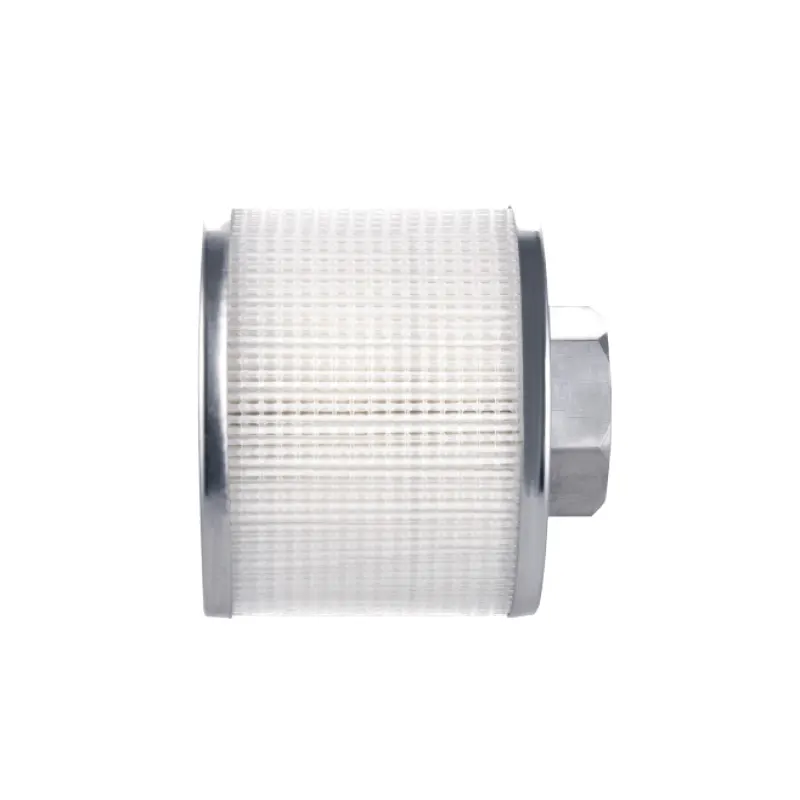
A HEPA filter cartridge is a particulate filter. In a glove box installation it may be used to capture particles in the circulating gas or in a transfer path, depending on the system design. Its purpose is to reduce particulate carryover and protect downstream components or the working environment from particles. It does not remove moisture or oxygen, and it does not replace solvent adsorption or gas purification. A filter that is loaded with particles can also increase pressure drop, so its condition and changeout interval should be part of the maintenance plan.
Compatibility is more than a nominal filter rating. Check the housing, sealing method, airflow direction, allowable pressure drop, particle rating and changeout procedure. If the GP20 loop or the connected box is intended to include a HEPA stage, confirm the interface and filter specification with TENCAN rather than assuming that any cartridge fits any housing. The filter should be installed so that it cannot be bypassed unnoticed, and the system should be checked after replacement for leaks and correct flow.
How to Select and Integrate the GP20
Begin with a short process description: materials, batch size, frequency of access, solvents, powders, expected outgassing and required atmosphere. Match that description to a compatible box and to the GP20 configuration. Agree on the interface drawing, gas supply, vent route, power, floor space, service clearance and alarm signals before installation. Define how the combined system will be leak-tested, purged and commissioned, and who will verify the analyzers.
Set acceptance criteria that reflect the real system. A recovery target after opening the box, a leak-rate limit and a documented purge procedure are more useful than a claim copied from a catalog. Plan for media and filter replacement, calibration gases, sensor checks and operator training. If the process changes - for example, a new solvent or a higher particulate load - review the purification and filtration arrangement again. Finally, confirm compatibility in writing with TENCAN. The GP20 is a capable atmosphere-control cabinet, but it is one part of a system whose performance depends on the box, the loop and the way the work is done.
FAQ
Does the GP20 include a glove box?
No. The GP20 is a gas purification system cabinet. The operator works inside a compatible sealed glove box connected to the purification loop.
Can the GP20 lower oxygen and moisture by itself?
It treats circulating gas, but the achievable atmosphere depends on the complete installation. Leak-tightness, purging, material loads, media condition and sensor placement all affect the result. No universal final value should be assumed without verification.
Does a HEPA filter remove oxygen or moisture?
No. A HEPA filter cartridge captures particles. Water and oxygen control comes from the purification media and the closed-loop atmosphere management.
Can the GP20 be connected to any sealed box?
Not automatically. The box, loop, pressure limits, connections, gas compatibility and controls must be reviewed together. Confirm the interface and operating envelope with TENCAN.
